
Crystal guide
Epidote Meaning, Properties and Care
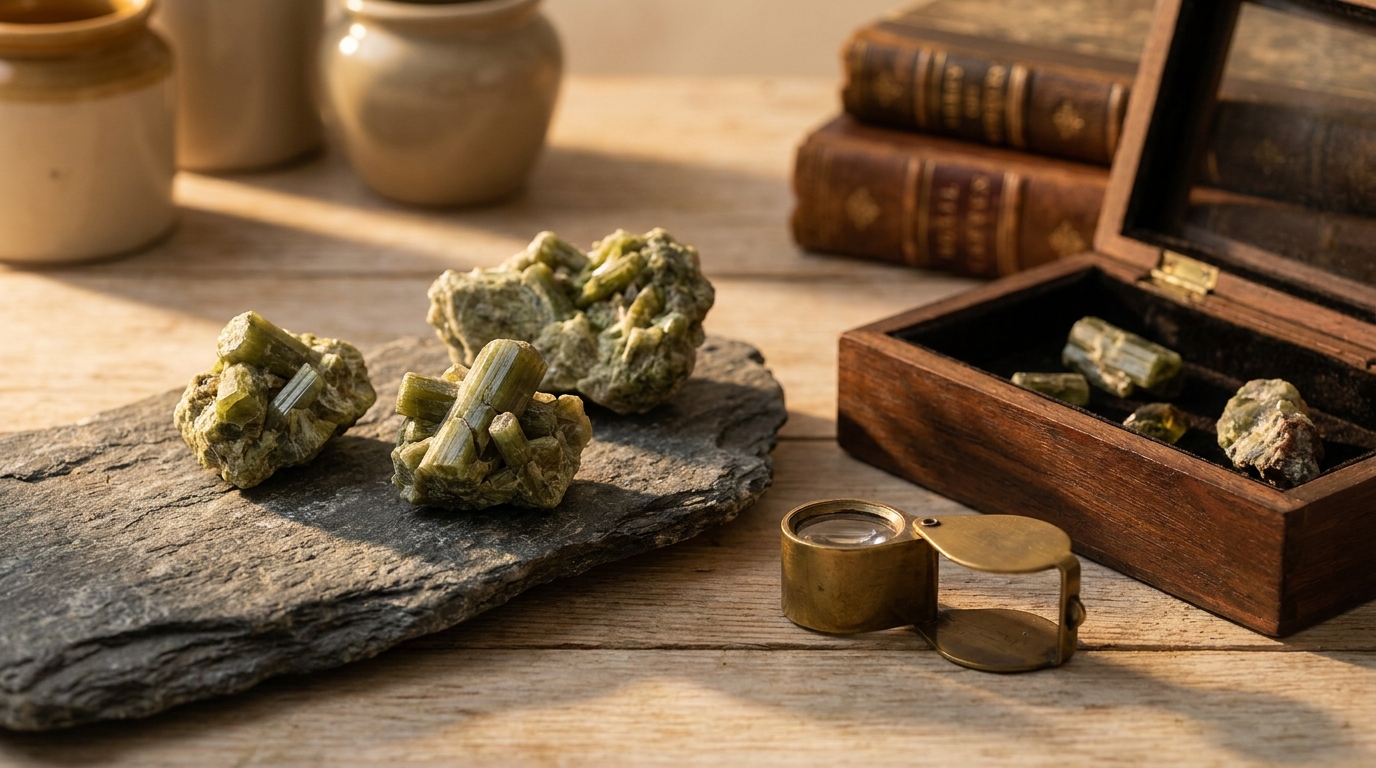
Epidote is a pistachio-green calcium aluminium iron silicate, and the mineral that gives the whole epidote group its name. It sits at about 6 to 7 on the Mohs scale, but it splits cleanly along one flat plane, so a hard knock can crack it. In jewellery it more often appears as cabochons or beads, often of epidote-bearing rock such as unakite, than as faceted stones. In crystal tradition it is a stone of growth and abundance.
At a glance
- A calcium aluminium iron silicate, usually pistachio green to yellow-green, sometimes brownish or nearly black.
- Mohs about 6 to 7, with perfect cleavage in one direction, so it can split if knocked.
- Faceted epidote is a collector's stone. The green in unakite beads and cabochons is epidote.
- Not on the standard birthstone lists. Care: soft cloth, mild soap, no steam or machine cleaners.
Quick facts
| Family | Calcium aluminium iron sorosilicate, the namesake mineral of the epidote group |
|---|---|
| Chemical formula | Ca2Al2(Fe3+,Al)(SiO4)(Si2O7)O(OH) |
| Crystal system | Monoclinic |
| Mohs hardness | 6–7 |
| Luster | Vitreous to resinous, with perfect cleavage in one direction |
| Transparency | Transparent to nearly opaque |
| Natural colors | pistachio green, yellowish green, olive green, brownish green, brown to greenish black |
| Main localities | Austria (Knappenwand); Italy (Piedmont); Norway (Arendal); France (Dauphiné); USA (Connecticut, Alaska); Pakistan; Brazil |
| Common treatments | porous or fractured stones of many kinds can be dyed, so ask whether the colour of a green piece is natural |
Epidote at a glance, in pictures
Hardness range
Natural colors
- pistachio green
- yellowish green
- olive green
- brownish green
- brown to greenish black
Common forms of Epidote
- Rough raw chunk
- Cabochon smooth dome
- Bead drilled bead
How hard is Epidote?
- Talc 1
- Gypsum 2
- Copper coin ~ 3
- Calcite 3
- Fluorite 4
- Apatite 5
- Glass ~ 5.5
- Steel knife ~ 5.5
- Orthoclase 6
- Epidote 6–7
- Quartz 7
- Topaz 8
- Corundum 9
- Diamond 10
What it is and where it comes from
The name comes from the Greek epidosis, meaning increase. It alludes to the way one side at the base of the crystal's prism is longer than the other, so it describes the crystal's shape rather than any property of the stone.
Epidote is an abundant rock-forming mineral that usually forms secondarily. It occurs in metamorphic rocks such as marble and schist, and it forms when feldspars, micas, pyroxenes, amphiboles and garnets in igneous rock are altered by hot fluids.
A rock made of quartz and epidote is called epidosite.
Knappenwand in Austria is described as the classic locality for epidote crystals. Perfectly transparent dark green crystals from Knappenwand and from Brazil have occasionally been cut as gemstones, and faceted epidote is mainly a collector's stone.
Unakite is a coarse-grained rock of pink feldspar, yellow-green epidote and quartz. It was first described in the 1870s and named for the Unaka Range on the North Carolina and Tennessee border. It takes a good polish and is used for beads, cabochons and carvings.
Clinozoisite and piemontite are close relatives in the epidote group. Piemontite is coloured red by manganese. Zoisite, the mineral of tanzanite, was formerly counted in the group but is not any longer.
In crystal tradition
What follows is belief and folklore, passed down in crystal tradition. It is not measured fact.
Traditionally associated with: growth, abundance, motivation, confidence.
Epidote is traditionally read as a stone of growth, abundance and amplification, a meaning that leans on its Greek name for increase. That name describes the crystal's shape, so this is a modern spiritual tradition, not a fact about the stone.
In crystal tradition it is also linked with self-confidence, motivation and making a change, and some retellings say it amplifies whatever intention a person brings to it. These are beliefs within crystal practice and carry no physical evidence.
How to care for Epidote
- Water Unknown
- Sunlight Unknown
- Salt Unknown
- Heat Unknown
- Ultrasonic Avoid
- Chemicals Unknown
Safe = fine as a rule · Caution = only briefly or gently · Avoid = can damage the stone · Unknown = no reliable guidance.
Wipe epidote with a soft cloth, mild soap and lukewarm water, then dry it. Skip ultrasonic and steam cleaners, because vibration and sudden temperature swings can open a crack along the cleavage plane. Store it in a soft pouch apart from harder stones, and take it off before sport and rough work.
Real or fake? Look-alikes and treatments
Often confused with
- Peridot
- Green tourmaline
- Green glass
- Dyed green stones
- Jade
Common look-alikes
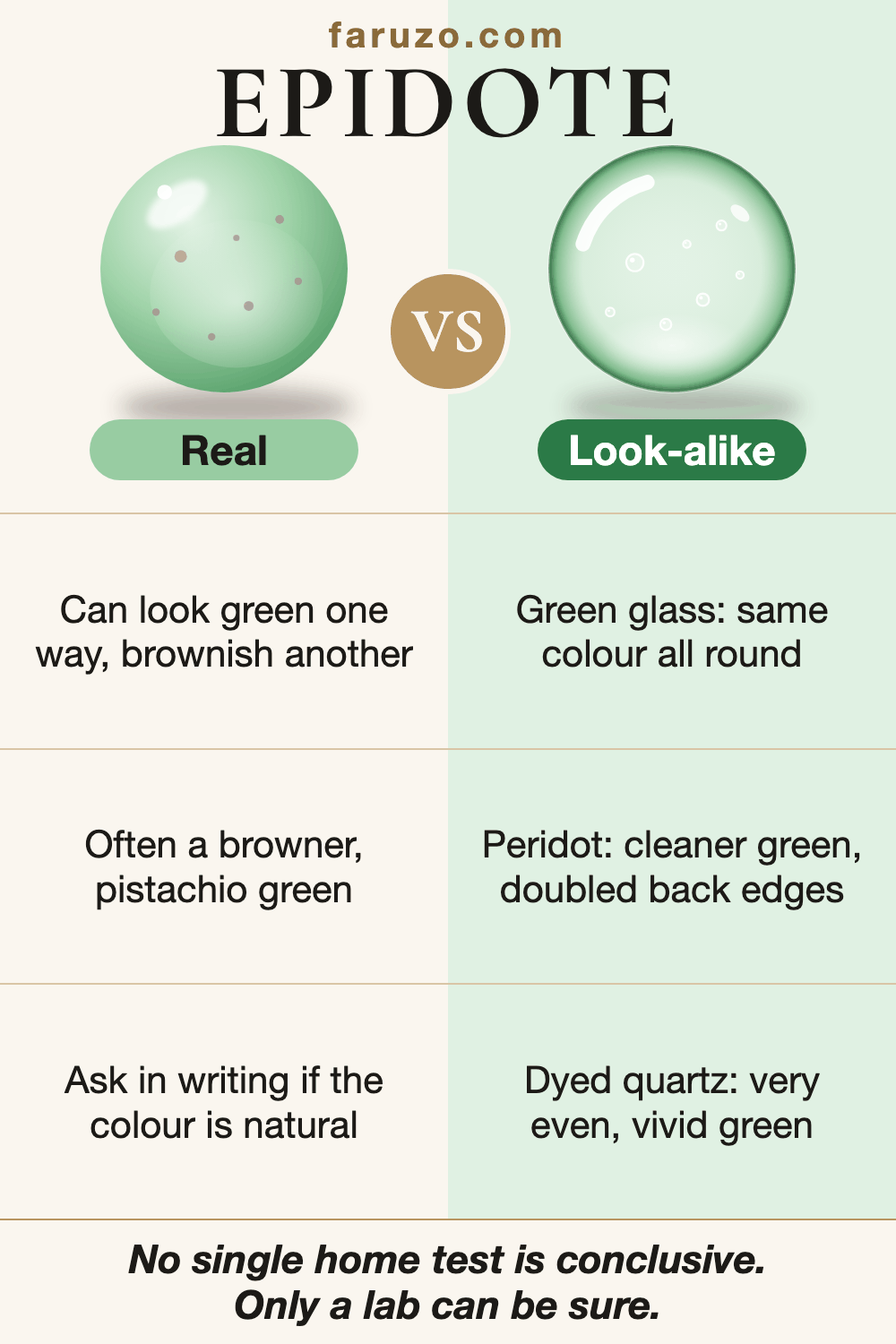
- Peridot. Peridot is a clear, yellowish to grass green gem with a similar Mohs range. Looking through it, the back facet edges appear doubled, and its green is usually cleaner than epidote's browner, pistachio tone. A lab can confirm.
- Green tourmaline. Green tourmaline (verdelite) is harder, at about 7 to 7.5, and has no easy cleavage. Epidote is softer and can look green from one angle and brownish from another. A lab can confirm a stone that matters.
- Green glass. Glass is a long-used imitation of green gems and tends to look less brilliant. It looks the same colour all round, while epidote can shift from green to brownish as it is turned.
- Dyed green stones. Dyed quartz and other dyed stones can pass for green gems. Very even, vivid green with no yellow or brown shift is a warning sign, and the dye can usually be seen under a microscope.
- Jade. Jade (nephrite or jadeite) is similar in hardness but tougher and more resistant to breakage, while epidote can split along its cleavage. Green stones are sometimes sold as jade, so ask what the piece is.
Safe checks you can do
- Ask the seller in writing what the piece is: epidote, epidote-bearing rock such as unakite, or another green stone.
- Turn the stone. Transparent epidote can look green from one angle and brownish from another, while glass looks the same all round.
- Ask whether the colour is natural. A dyed piece of epidote-bearing rock is still real rock, but it is treated, so the seller should say so.
- Do not scratch-test or heat-test a piece you plan to keep, because epidote splits along a flat plane. A lab is the safer route when it matters.
Wearing Epidote
Ring
Careful
Fine with care, but knocks can mark it.
Bracelet
Careful
A knock on a bracelet can split it along a flat plane.
Pendant
Careful
It can split along a flat plane, so keep it protected.
Earrings
Careful
A flat-plane split is possible, so keep earrings for dressy wear.
Guide for everyday wear, based on hardness and care notes. Safe, Careful or Avoid.
Epidote is about 6 to 7 on the Mohs scale, but it splits along one flat plane, so every piece needs some care. A ring is possible for occasional wear in a protective setting, though not the best choice. A bracelet takes the most knocks. A pendant or earrings take fewer, but a hard knock can still split it. Beads and cabochons of tougher epidote-bearing rock such as unakite are the usual jewellery form. Take it off for the gym, cleaning and rough work.
Related stones
Questions about Epidote
What does epidote mean?
In crystal tradition epidote is a stone of growth, abundance and amplification, a reading that leans on its Greek name for increase. That name describes the shape of the crystal, and the meaning is a belief, not a fact about the stone.
What is epidote?
Epidote is a calcium aluminium iron silicate, Ca2Al2(Fe3+,Al)(SiO4)(Si2O7)O(OH), usually pistachio green to yellowish green. It is common in metamorphic rock and gives the epidote group its name.
Is epidote the same as tanzanite?
No. Tanzanite is the blue-purple gem variety of zoisite, a related calcium aluminium silicate. Zoisite was formerly counted in the epidote group but is not any longer, so tanzanite is at best a distant relative.
How hard is epidote?
About 6 to 7 on the Mohs scale, which is similar to peridot. Hardness only measures scratching, though. Perfect cleavage in one direction means a hard knock can still split it.
What colour is epidote?
Usually pistachio green or yellowish green, though it can be olive, brownish or nearly black. Transparent crystals can look green from one direction and brownish from another.
Is epidote a birthstone?
No. Epidote is not on the standard modern or traditional birthstone lists, though lists vary and some alternative lists may include it. Check the list you are following.
Is unakite the same as epidote?
No. Unakite is a rock made of pink feldspar, yellow-green epidote and quartz. The green parts of a unakite bead or cabochon are epidote, and the pink parts are not.
Where does epidote come from?
It is found in many countries. Knappenwand in Austria is a classic locality, and Italy, Norway, France, Pakistan, Brazil and parts of the USA such as Connecticut and Alaska are also named for it. Brazil is a source of gem-quality crystals.
Is epidote rare?
The mineral is common. What is scarce is clean, transparent, facet-grade crystal, which is why faceted epidote is mainly a collector's stone and most jewellery pieces are cabochons, beads or epidote-bearing rock.
Can you wear an epidote ring every day?
It is not the best choice. Because epidote splits along one flat plane, a knock on a ring hand can crack it. A ring suits occasional wear in a protective setting, and a pendant or earrings take fewer knocks.
How do you clean epidote, and can it go in an ultrasonic cleaner?
Wipe it with a soft cloth, mild soap and lukewarm water, then dry it. Skip ultrasonic and steam cleaners, since vibration and sudden temperature changes can open a crack along the cleavage plane.
How can you tell real epidote from a fake?
A home look can only hint. Epidote can look green from one angle and brownish from another, while glass looks the same all round. Peridot, green tourmaline and jade can look similar, so a lab can confirm a stone that matters.
Is the green epidote or unakite I am buying dyed?
Ask the seller to say in writing whether the colour is natural. Porous or fractured stones of many kinds can be dyed. A dyed piece of epidote-bearing rock is still real rock, but it is treated, and the seller should tell you.
What is the difference between epidote and peridot?
They are different minerals with a similar hardness. Peridot is a clear, yellowish to grass green gem with doubled back facet edges, while epidote is often browner and is more often seen as cabochons or beads than as faceted stones.