
Crystal guide
Jade Meaning, Properties and Care
Jade is a shared name for two different minerals: jadeite, a sodium aluminium silicate (about 6.5 to 7 on the Mohs scale), and nephrite, a calcium magnesium silicate (about 6 to 6.5). Both are famously tough, and green is the classic colour, though jade also comes in white, lavender, yellow, black and more. Whether a piece is natural, treated or an imitation matters as much as the mineral. In tradition jade is a stone of calm, luck and virtue.
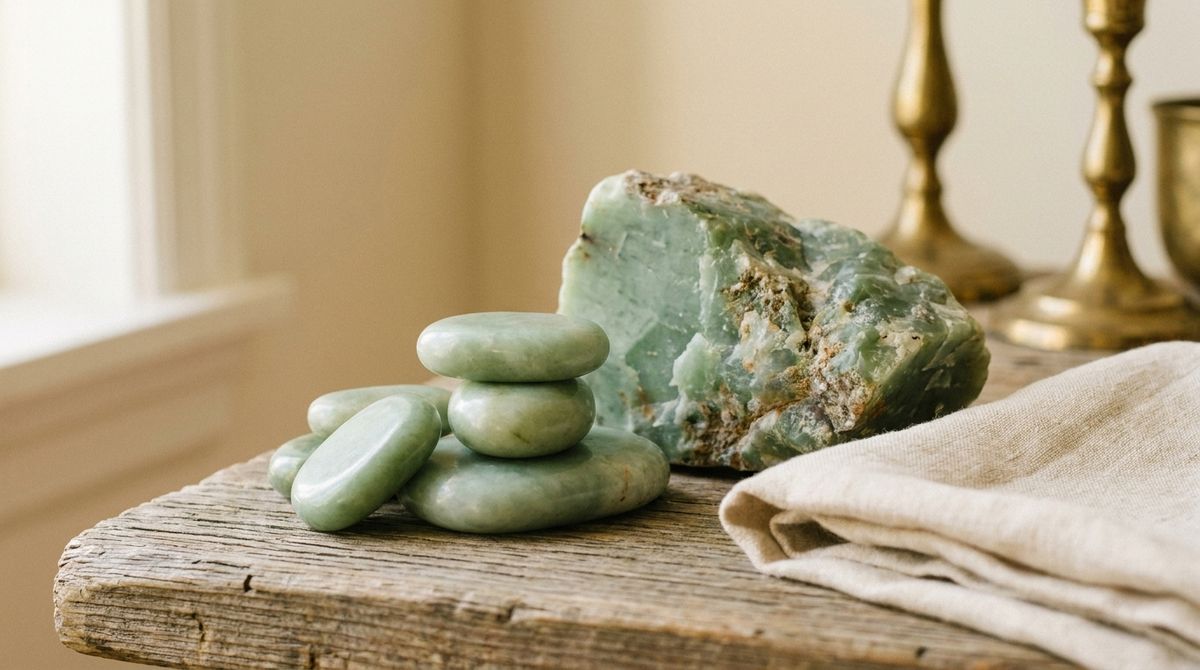
At a glance
- Two minerals: jadeite (NaAlSi2O6, Mohs about 6.5 to 7) and nephrite (Mohs about 6 to 6.5).
- Both are very tough: they resist chipping and breaking better than their hardness numbers suggest.
- Green is classic, but jade also comes in white, lavender, yellow, black and other colours.
- Treatment matters: jade can be dyed, or bleached and filled with polymer (often called B-jade), and look-alikes are common.
Quick facts
| Family | Two unrelated minerals sold as jade: jadeite (a pyroxene) and nephrite (an amphibole) |
|---|---|
| Chemical formula | Jadeite NaAlSi2O6; nephrite Ca2(Mg,Fe)5Si8O22(OH)2 |
| Crystal system | Jadeite monoclinic; nephrite monoclinic. Both form tough masses of interlocking tiny crystals |
| Mohs hardness | 6–7 |
| Luster | Vitreous to greasy or waxy; very tough with a splintery fracture |
| Transparency | Translucent to opaque; rarely almost transparent in fine jadeite |
| Natural colors | green (the classic colour, from pale to deep 'imperial' green in jadeite); white, including creamy 'mutton fat' nephrite; lavender; yellow, orange or brown; grey to black; rarely blue |
| Main localities | Myanmar (Kachin State, the main source of fine jadeite); Guatemala (Motagua River valley); China (Xinjiang and elsewhere); Canada (British Columbia); Russia (Siberia); New Zealand (South Island, where nephrite is called pounamu) |
| Common treatments | jadeite is commonly graded as Type A (natural, usually waxed), Type B (bleached and filled with polymer) or Type C (dyed); some pieces are both B and C; composites that glue a thin jade top onto another backing also exist |
Jade at a glance, in pictures
Chakras (traditional)
Hardness range
Natural colors
- green (the classic colour, from pale to deep 'imperial' green in jadeite)
- white, including creamy 'mutton fat' nephrite
- lavender
- yellow, orange or brown
- grey to black
- rarely blue
Traditionally linked to
- Zodiac
- TaurusLibra
Common forms of Jade
- Rough raw chunk
- Tumbled polished pebble
- Cabochon smooth dome
How hard is Jade?
- Talc 1
- Gypsum 2
- Copper coin ~ 3
- Calcite 3
- Fluorite 4
- Apatite 5
- Glass ~ 5.5
- Steel knife ~ 5.5
- Orthoclase 6
- Jade 6–7
- Quartz 7
- Topaz 8
- Corundum 9
- Diamond 10
What it is and where it comes from
The English word 'jade' traces back to the Spanish piedra de ijada, 'flank stone', from an old belief about the kidney area. 'Nephrite' comes from the same idea, via the Latin lapis nephriticus.
Nephrite was carved in China for thousands of years, and jade in general was treated as a stone of virtue and status there.
Fine jadeite reached Chinese markets much later, from around the 1700s, from Myanmar's Kachin State, which remains the main source of top-quality jadeite.
Jadeite from Guatemala's Motagua River valley was carved by ancient Mesoamerican cultures. In New Zealand, nephrite is called pounamu and is a treasured stone.
Both minerals form tough rock made of tightly interlocking tiny crystals, which is why jade was used for tools and weapons as well as ornaments, and why it resists breaking.
The name 'jadeite' is relatively modern and was only given in the 1800s, when the two minerals were first recognised as different.
In crystal tradition
What follows is belief and folklore, passed down in crystal tradition. It is not measured fact.
Traditionally associated with: calm, luck, prosperity, virtue.
Jade is traditionally associated with the Heart chakra, calm, luck and good fortune. This is a spiritual tradition, not a fact about the stone.
In Chinese culture jade has long stood for purity, virtue and protection, and carved pieces such as discs, bangles and figures are given as meaningful gifts. Crystal lists often pair it with Taurus and Libra.
How to care for Jade
- Water Safe
- Sunlight Caution
- Salt Unknown
- Heat Caution
- Ultrasonic Caution
- Chemicals Caution
Safe = fine as a rule · Caution = only briefly or gently · Avoid = can damage the stone · Unknown = no reliable guidance.
Clean jade with a soft cloth, lukewarm water and mild soap, then dry it. Natural, untreated jade is tough and copes well with ordinary washing. Treated jade (B or C) is the exception: heat, strong light, harsh chemicals, ultrasonic and steam cleaners can degrade a polymer filling or dye, so keep bleach, strong cleaners and those machines away from any piece unless you are sure it is untreated. Keep it away from hard knocks, and store it apart from harder stones. Little is documented about salt, so a rinse after sea swimming is a sensible precaution.
Real or fake? Look-alikes and treatments
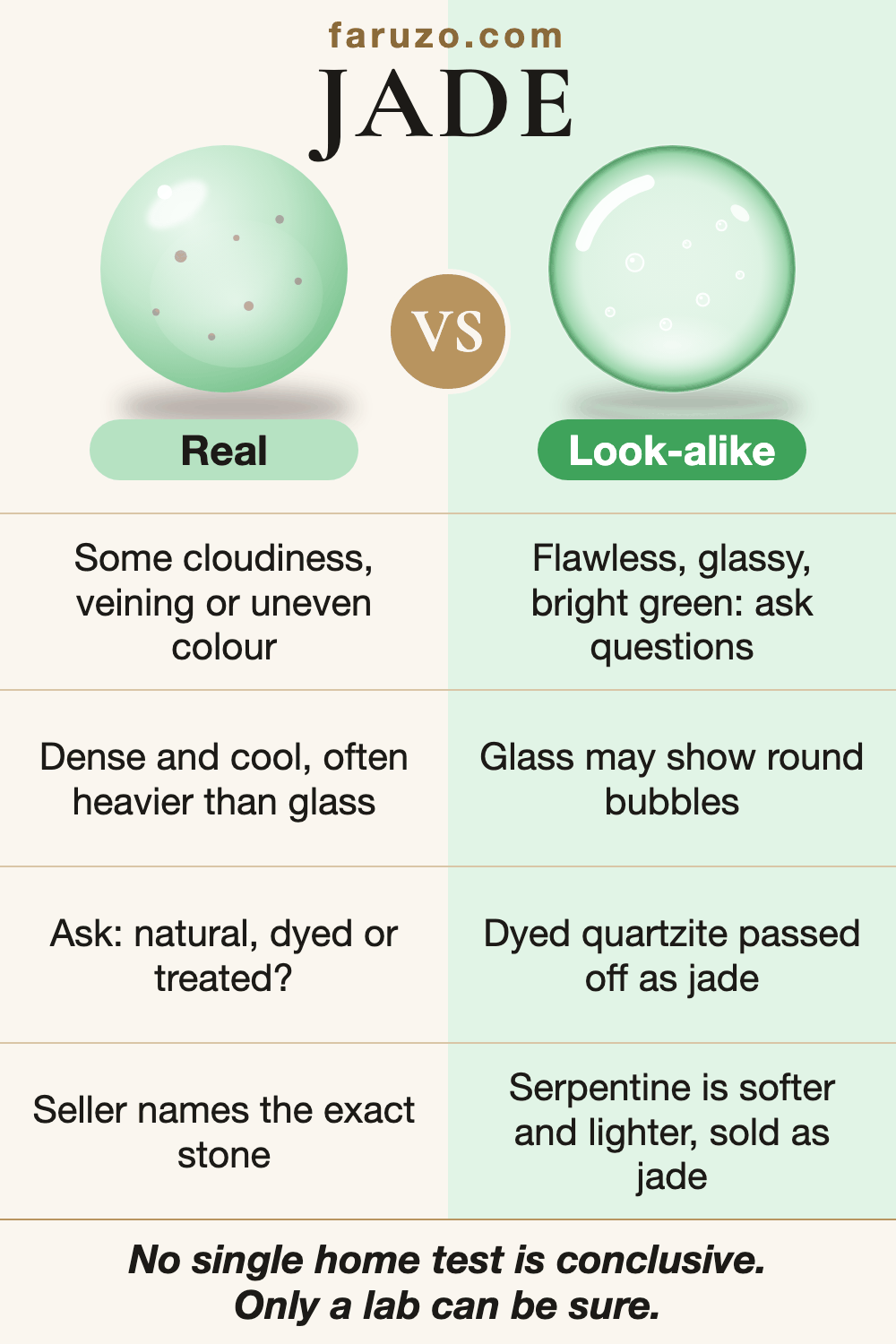
Often confused with
- Serpentine ('new jade')
- Aventurine
- Dyed quartzite or dyed stone
- Glass
- Bleached and polymer-filled jade (B-jade) and dyed jade (C)
Common look-alikes
- Serpentine ('new jade'). Serpentine is a softer green stone often sold as jade. It scratches more easily, can feel lighter and waxier, and is usually less dense. Ask exactly what mineral it is.
- Aventurine. Green aventurine is a quartz that can look like jade. It often shows tiny glittering flecks and a more even, glassy look. Ask whether it is aventurine or jade.
- Dyed quartzite or dyed stone. Dyed stones can imitate rich green. Look for colour pooling in cracks and an unnaturally even, bright shade, and ask whether the stone is dyed.
- Glass. Green glass is a common imitation. It may show small round bubbles and a glassier, too-perfect look.
- Bleached and polymer-filled jade (B-jade) and dyed jade (C). These are real jadeite that has been treated. Very bright, even green at a low price is a warning sign, and dye may pool in cracks. Get it in writing whether it is natural (Type A), polymer-treated or dyed. A lab can confirm.
Safe checks you can do
- Ask the seller in writing whether the piece is natural jadeite, nephrite, treated jade (B or C) or another stone.
- Look for natural variation. Real jade usually shows some cloudiness, veining or uneven colour, while a flawless, glassy, uniformly bright green is a warning sign.
- Check cracks and edges for dye pooling in fine lines, which can suggest a dyed piece.
- Feel its weight. Jade usually feels dense and cool for its size, and often heavier than glass or plastic of the same size, but this is only a hint.
- Be wary of a very cheap, very bright green stone sold as top-grade jade.
- Treated jade cannot be reliably told by eye. For a piece that matters, ask a gemologist or lab, since a lab can detect polymer and dye.
Wearing Jade
Ring
Careful
Fine with care, but knocks can mark it.
Treated jade only: avoid heat and machine cleaning
Bracelet
Safe
Fairly hard, so fine for normal bracelet wear.
Pendant
Safe
Fairly hard, and a pendant sits clear of knocks.
Earrings
Safe
Fairly hard, and earrings rarely take knocks.
Guide for everyday wear, based on hardness and care notes. Safe, Careful or Avoid.
Jade is very tough, so natural pieces handle everyday wear well with ordinary care. Pendants and earrings suit it especially well, and bangles cope with daily life. A ring is fine with some care: jade is a little softer than quartz (nephrite noticeably so), so fine grit can slowly dull the polish. Bleached and polymer-filled or dyed jade is more delicate, so avoid heat, harsh cleaners and strong light. Remove jade for heavy work, since a hard knock can still chip it.
Questions about Jade
What does jade mean?
In tradition jade stands for calm, luck, purity and virtue, and is linked with the Heart chakra. In Chinese culture it has long been a stone of status and protection. These are beliefs and traditions, not facts about the stone.
Is jade one mineral or two?
Two. Jade is a shared name for jadeite, a sodium aluminium silicate, and nephrite, a calcium magnesium silicate. They are different minerals that look and behave alike, so both are sold as jade.
What is the difference between jadeite and nephrite?
Jadeite is slightly harder (about 6.5 to 7 versus about 6 to 6.5), denser, rarer and found in more colours, including vivid green. Nephrite is a bit softer but very tough, and is usually green, white or cream.
How hard is jade?
Roughly 6 to 7 on the Mohs scale, depending on the type. That is not especially hard, but the tightly interlocked crystals make jade tough, so it chips and breaks less readily than the number suggests.
Is jade green?
Green is the classic jade colour, but jade also comes in white, lavender, yellow, orange, brown, grey, black and rarely blue. Colour alone does not tell you whether a stone is jadeite or nephrite.
What is B-jade?
B-jade is jadeite that has been bleached to remove stains and then filled with a clear polymer to improve its look. It is real jadeite but treated, and it is more delicate than natural jade. It should be disclosed by the seller.
How can you tell real jade from fake?
Look for natural variation: real jade usually shows some cloudiness, veining or uneven colour and feels dense, while very even, glassy, bright green can mean glass, dye or imitation. A gemologist or lab can settle it for a stone that matters.
Is dyed jade real jade?
It can be. Dyed jade (Type C) is real jade with added colour, while some stones sold as jade are other minerals dyed green. Ask whether it is natural, dyed or treated, since the answer affects durability and what it is worth.
Can jade get wet?
Yes, natural jade can be washed in lukewarm water with mild soap. Treated (B or C) jade is more delicate, so avoid soaking it and keep it away from machine cleaners unless you are sure it is untreated.
Is jade a birthstone?
No. Jade is not on the standard modern birthstone lists.
Why is it called jade?
The word comes from the Spanish piedra de ijada, meaning flank stone, from an old belief about the body. The name nephrite comes from the same idea. The belief is only the origin of the word, not a fact about the stone.
Is jade rare or expensive?
Fine, evenly coloured jadeite is rare, and top-quality nephrite can also be costly, while ordinary jade is much easier to find. Quality, colour, translucency and treatment all affect value.
Can you wear a jade ring every day?
Natural jade is tough, so a ring is fine with some care. Jade is a little softer than quartz, so daily wear can slowly dull the polish. Pendants and earrings take fewer knocks. Treated jade is more delicate.