
Crystal guide
Unakite Meaning, Properties and Care
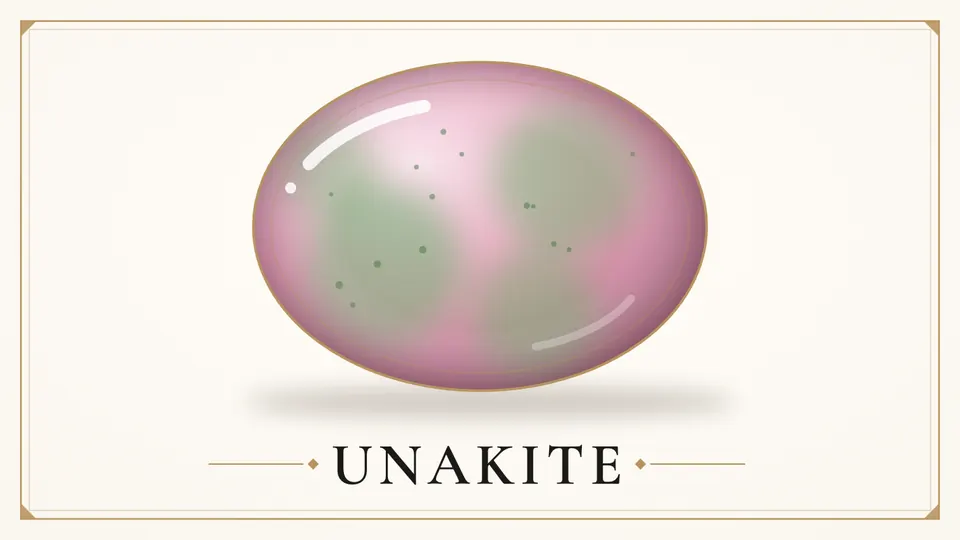
Unakite is a coarse-grained rock made of pink feldspar and yellow-green epidote, usually with some quartz, so it is a rock rather than a single mineral. Its blotchy pink and green pattern is the giveaway. It sits at about 6 to 7 on the Mohs scale, depending on the mix, and takes a good polish for beads, cabochons and carvings. In crystal tradition it is a stone of balance and patience.
At a glance
- A rock, not one mineral: pink feldspar, yellow-green epidote and quartz.
- Mohs about 6 to 7, depending on the mix. As a grainy rock it has no single flat split plane running through a piece.
- Named for the Unaka Range on the North Carolina and Tennessee border, and first described in 1874.
- Not on the standard birthstone lists. A bright piece is worth a question about dye. Care: soft cloth, mild soap, no solvents.
Quick facts
| Family | A rock, not one mineral: a coarse-grained metamorphic rock (altered granitoid) of pink feldspar, yellow-green epidote and quartz |
|---|---|
| Chemical formula | No single formula; it is a mix of orthoclase or microcline feldspar (pink), epidote (green) and quartz (SiO2) |
| Crystal system | Not a single crystal: a granular rock whose grains are feldspar (monoclinic or triclinic), monoclinic epidote and trigonal quartz |
| Mohs hardness | 6–7 |
| Luster | Takes a good polish; individual feldspar and epidote grains can still split along their own planes, but there is no single cleavage plane through a whole piece |
| Transparency | Opaque to nearly opaque as a whole |
| Natural colors | pink to salmon-pink (feldspar); yellow-green to pistachio green (epidote); smoky, grey or colourless quartz, sometimes looking bluish; white or pale grains in places |
| Main localities | USA (Blue Ridge region of North Carolina and Virginia); USA (Tennessee, including Cocke County); USA (at least 30 places, including New Jersey, Massachusetts and Wisconsin); Finland (northeast) |
| Common treatments | porous or fractured stones of many kinds can be dyed, so ask whether the colour of a bright piece is natural; a dyed piece of unakite would still be real rock, but it is treated |
Unakite at a glance, in pictures
Hardness range
Natural colors
- pink to salmon-pink (feldspar)
- yellow-green to pistachio green (epidote)
- smoky, grey or colourless quartz, sometimes looking bluish
- white or pale grains in places
Common forms of Unakite
- Tumbled polished pebble
- Bead drilled bead
- Sphere ball
How hard is Unakite?
- Talc 1
- Gypsum 2
- Copper coin ~ 3
- Calcite 3
- Fluorite 4
- Apatite 5
- Glass ~ 5.5
- Steel knife ~ 5.5
- Orthoclase 6
- Unakite 6–7
- Quartz 7
- Topaz 8
- Corundum 9
- Diamond 10
What it is and where it comes from
Unakite is a coarse-grained metamorphic rock, an altered granitoid. It is made of pink orthoclase or microcline feldspar, yellow-green epidote and quartz that is smoky or colourless. White plagioclase feldspar may also be present.
It is generally understood to have formed when hot fluids altered granite and similar rocks. The epidote is thought to come from altered dark minerals and feldspar in the original rock, and some may have settled straight out of the fluid.
Frederick Bradley first defined and described unakite around 1874. He named it for the Unaka Range, part of the Great Smoky Mountains of western North Carolina and eastern Tennessee, and his samples came mainly from Cocke County, Tennessee.
Unakite turns up in at least 30 places in the United States. Much of the finest material is reportedly found in the Blue Ridge region of North Carolina and Virginia, and it is also reported in northeastern Finland.
In Shenandoah National Park the rock is known for green epidote, pink feldspar and bluish quartz.
Good-quality unakite takes a good polish and is used for beads and cabochons, and for eggs, spheres and animal carvings.
In crystal tradition
What follows is belief and folklore, passed down in crystal tradition. It is not measured fact.
Traditionally associated with: balance, patience, steady growth.
Unakite is traditionally associated with balance, patience and steady growth, a reading that leans on its two colours, pink and green, sitting side by side in one stone. This is a modern spiritual tradition, not a fact about the stone.
In crystal tradition it is also read as a grounding stone for slow, steady progress. These are beliefs within crystal practice and carry no physical evidence.
How to care for Unakite
- Water Unknown
- Sunlight Unknown
- Salt Unknown
- Heat Unknown
- Ultrasonic Unknown
- Chemicals Caution
Safe = fine as a rule · Caution = only briefly or gently · Avoid = can damage the stone · Unknown = no reliable guidance.
Wipe unakite with a soft cloth, lukewarm water and mild soap, then dry it. Keep solvents such as acetone and alcohol away, because a dyed piece can lose colour, and skip steam and ultrasonic cleaners as a precaution, since little is known about how a mixed rock reacts. Store it apart from harder stones, and take it off before sport and rough work.
Real or fake? Look-alikes and treatments
Often confused with
- Dyed jasper
- Pink-and-green glass or resin composites
- Bloodstone and other green stones with red spots
- Plastic beads
Common look-alikes
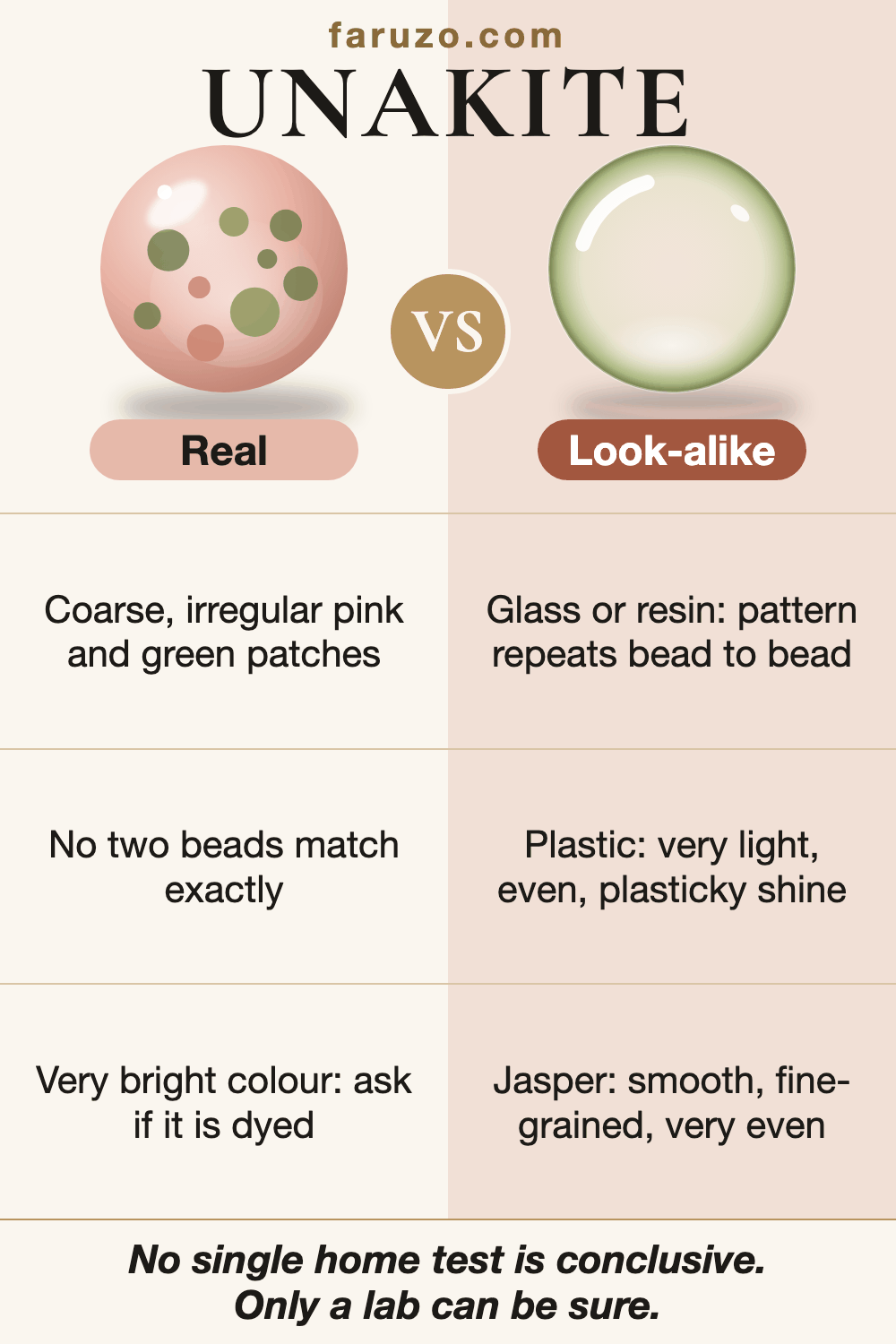
- Dyed jasper. Jasper is a very fine-grained, opaque quartz, so it looks dense and smooth with no separate grains, and fine-grained quartz can be dyed. Unakite shows distinct coarse patches of pink and green. A very even, bright pink-and-green is worth a question.
- Pink-and-green glass or resin composites. Glass and resin are made to copy patterned stone and tend to look less natural. Unakite's patches are irregular and differ from piece to piece, so a blotch pattern that repeats exactly from bead to bead is a warning sign.
- Bloodstone and other green stones with red spots. Bloodstone is a dark green quartz with red or yellow spots, smooth and fine-grained. Unakite is paler, yellow-green and pink in coarse patches, and its pink is feldspar rather than red iron-rich spots.
- Plastic beads. Plastic is often used to imitate gemstones in inexpensive fashion jewellery and is not durable. Very light, very uniform beads with a plasticky shine and no real grain are a reason to ask what they are.
Safe checks you can do
- Ask the seller in writing what the piece is: natural unakite, dyed, or another pink and green stone or imitation.
- Look closely. Real unakite shows coarse, irregular pink and green patches, often with pale or smoky grains, and no two beads match exactly.
- Ask whether the colour is natural. A dyed piece is still real rock, but it is treated, so the seller should say so. Very bright, even pink or green is the cue to ask.
- Do not scratch-test or heat-test a piece you plan to keep. A lab is the safer route when it matters.
Wearing Unakite
Ring
Careful
Fine with care, but knocks can mark it.
Bracelet
Safe
Fairly hard, so fine for normal bracelet wear.
Pendant
Safe
Fairly hard, and a pendant sits clear of knocks.
Earrings
Safe
Fairly hard, and earrings rarely take knocks.
Guide for everyday wear, based on hardness and care notes. Safe, Careful or Avoid.
Unakite is about 6 to 7 on the Mohs scale, depending on the mix. As a grainy rock rather than a single crystal, it is less likely to split along one flat plane, so pendants, earrings and bracelets suit it well. A ring is fine with some care, since everyday grit can dull the polish and a hard knock can still chip it. If a piece might be dyed, keep it away from solvents.
Related stones
Questions about Unakite
What does unakite mean?
In crystal tradition unakite is a stone of balance, patience and steady growth, a reading that leans on its pink and green colours sitting together. That is a belief, not a fact about the stone.
What is unakite?
Unakite is a coarse-grained rock, an altered granite, made of pink feldspar, yellow-green epidote and quartz. It takes a good polish and is used for beads, cabochons, spheres and carvings.
Is unakite a crystal or a mineral?
Neither, strictly. It is a rock, a mix of several minerals, so it has no single formula and no single crystal shape. The pink is feldspar, the green is epidote and the rest is mostly quartz.
Why is unakite pink and green?
The two colours come from two different minerals. The green parts are epidote and the pink parts are feldspar, with smoky or colourless quartz between them. How much of each there is changes from piece to piece.
How hard is unakite?
About 6 to 7 on the Mohs scale, depending on the mix, since feldspar sits at about 6 and quartz at 7. Hardness only measures scratching, and a hard knock can still chip a piece.
Where does the name unakite come from?
It is named for the Unaka Range, part of the Great Smoky Mountains on the North Carolina and Tennessee border. The rock was first defined and described in 1874.
Is unakite a birthstone?
Unakite is not on the standard modern, traditional or UK birthstone lists, though lists vary and some alternative lists may include it. Check the list you are following.
Is unakite the same as epidote?
No. Epidote is one mineral, while unakite is a rock that contains it. The green parts of a unakite bead or cabochon are epidote, and the pink parts are feldspar.
Where does unakite come from?
It occurs in at least 30 places in the United States, and much of the finest material is reportedly found in the Blue Ridge region of North Carolina and Virginia. It is also reported in northeastern Finland.
Can you wear a unakite ring every day?
It is possible with some care. At about 6 to 7 on the Mohs scale, daily grit can slowly dull the polish and a hard knock can chip it. Pendants and earrings take fewer knocks than a ring.
How do you clean unakite?
Wipe it with a soft cloth, lukewarm water and mild soap, then dry it. Keep solvents such as acetone and alcohol away in case the colour is dyed, and skip steam and ultrasonic cleaners as a precaution.
How can you tell real unakite from fake?
A home look can only hint. Real unakite shows coarse, irregular pink and green patches that differ from piece to piece, while glass, resin or plastic can look too regular. Dyed jasper and bloodstone can look similar, so ask the seller and use a lab for a stone that matters.
Is the unakite I am buying dyed?
Ask the seller to say in writing whether the colour is natural. Porous or fractured stones of many kinds can be dyed, and very bright, even colour is the cue to ask. A dyed piece of unakite is still real rock, but it is treated.
Is unakite the same as bloodstone?
No. Bloodstone is a dark green quartz with red or yellow spots. Unakite is a coarse rock of pink feldspar, yellow-green epidote and quartz. They can both be green with a touch of red or pink, but they are different materials.