
Crystal guide
Rhodonite Meaning, Properties and Care
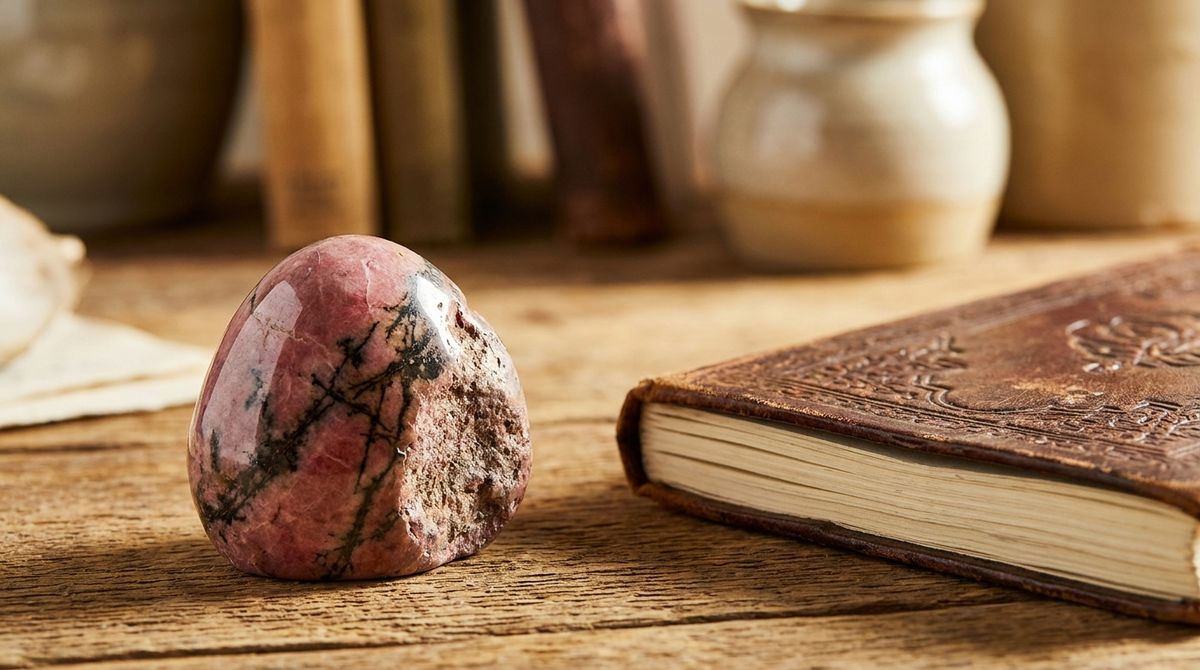
Rhodonite is a rose-pink manganese silicate, (Mn,Fe,Mg,Ca)SiO3, usually crossed by black veins of manganese oxide. Its name comes from the Greek word for rose. At Mohs 5.5 to 6.5 with perfect cleavage, it suits pendants and earrings better than rings. In crystal tradition it is a heart stone linked to compassion and forgiveness.
At a glance
- Formula (Mn,Fe,Mg,Ca)SiO3, triclinic, pink to rose-red with black veining.
- Hardness 5.5 to 6.5 on the Mohs scale, with perfect cleavage that makes sharp knocks risky.
- The black veins are natural and often form where the stone has weathered.
- Care: soft cloth, mild soap, quick rinse; no ultrasonic or steam cleaners. Best as pendants or earrings.
Quick facts
| Family | Manganese silicate (pyroxenoid chain silicate) |
|---|---|
| Chemical formula | (Mn,Fe,Mg,Ca)SiO3 |
| Crystal system | Triclinic, usually massive and compact rather than in clear crystals |
| Mohs hardness | 5.5–6.5 |
| Luster | Vitreous, sometimes pearly on cleavage surfaces; perfect cleavage in two directions |
| Transparency | Mostly opaque to translucent; clear faceting crystals are rare |
| Natural colors | pink to rose-red, brownish or purplish pink, black manganese oxide veining or dendrites |
| Main localities | Russia (the Urals near Yekaterinburg); Australia (Broken Hill, reportedly rare facetable crystals); Sweden; Spain; Switzerland; USA (New Jersey, Nevada and Massachusetts); Madagascar and Brazil |
| Common treatments | usually sold untreated, though pink beads and tumbled stones are sometimes dyed; because of its cleavage, rough handling in cutting and wear is the bigger concern |
Rhodonite at a glance, in pictures
Chakras (traditional)
Hardness range
Natural colors
- pink to rose-red
- brownish or purplish pink
- black manganese oxide veining or dendrites
Common forms of Rhodonite
- Rough raw chunk
- Tumbled polished pebble
- Cabochon smooth dome
How hard is Rhodonite?
- Talc 1
- Gypsum 2
- Copper coin ~ 3
- Calcite 3
- Fluorite 4
- Apatite 5
- Glass ~ 5.5
- Steel knife ~ 5.5
- Orthoclase 6
- Rhodonite 5.5–6.5
- Quartz 7
- Topaz 8
- Corundum 9
- Diamond 10
What it is and where it comes from
The name comes from the Greek rhodon, meaning rose, for the colour.
Imperial-era workshops in the Urals near Yekaterinburg carved rhodonite into vases, slabs and other ornamental pieces.
A large block from the Urals was carved into the sarcophagus of Empress Maria Alexandrovna, completed around 1906 and placed in St. Petersburg.
Rhodonite is the official state gem of Massachusetts, where it occurs as massive pink material in a dark manganese matrix.
The black veins are manganese oxide, often branching like small trees, and they tend to sit along cracks and edges where the stone has weathered.
Most jewelry rhodonite is cut as cabochons or beads from massive material. Clear, facetable crystals, such as those reported from Broken Hill in Australia, are rare and mostly stay in collections.
In crystal tradition
What follows is belief and folklore, passed down in crystal tradition. It is not measured fact.
Traditionally associated with: compassion, forgiveness, self-love.
Rhodonite is traditionally associated with the Heart chakra and with compassion, forgiveness and self-love. This is a modern spiritual tradition, not a fact about the stone.
Crystal tradition nicknames it the rescue stone, a stone people reach for in hard emotional times. This is a belief within crystal practice, not a measurable effect.
How to care for Rhodonite
- Water Caution
- Sunlight Caution
- Salt Unknown
- Heat Avoid
- Ultrasonic Avoid
- Chemicals Caution
Safe = fine as a rule · Caution = only briefly or gently · Avoid = can damage the stone · Unknown = no reliable guidance.
Clean rhodonite by hand with a soft cloth or brush and mild soap, rinse briefly and dry straight away. Do not soak it. Avoid ultrasonic and steam cleaners, because vibration and sudden heat can open a crack along the cleavage. Take it off before lotion, perfume or hairspray, which can dull the surface, and store it apart from harder stones. Long strong sun is best avoided as a precaution, and salt effects are not well documented, so rinse off sea water.
Real or fake? Look-alikes and treatments
Often confused with
- Rhodochrosite
- Rose quartz
- Pink glass
Common look-alikes
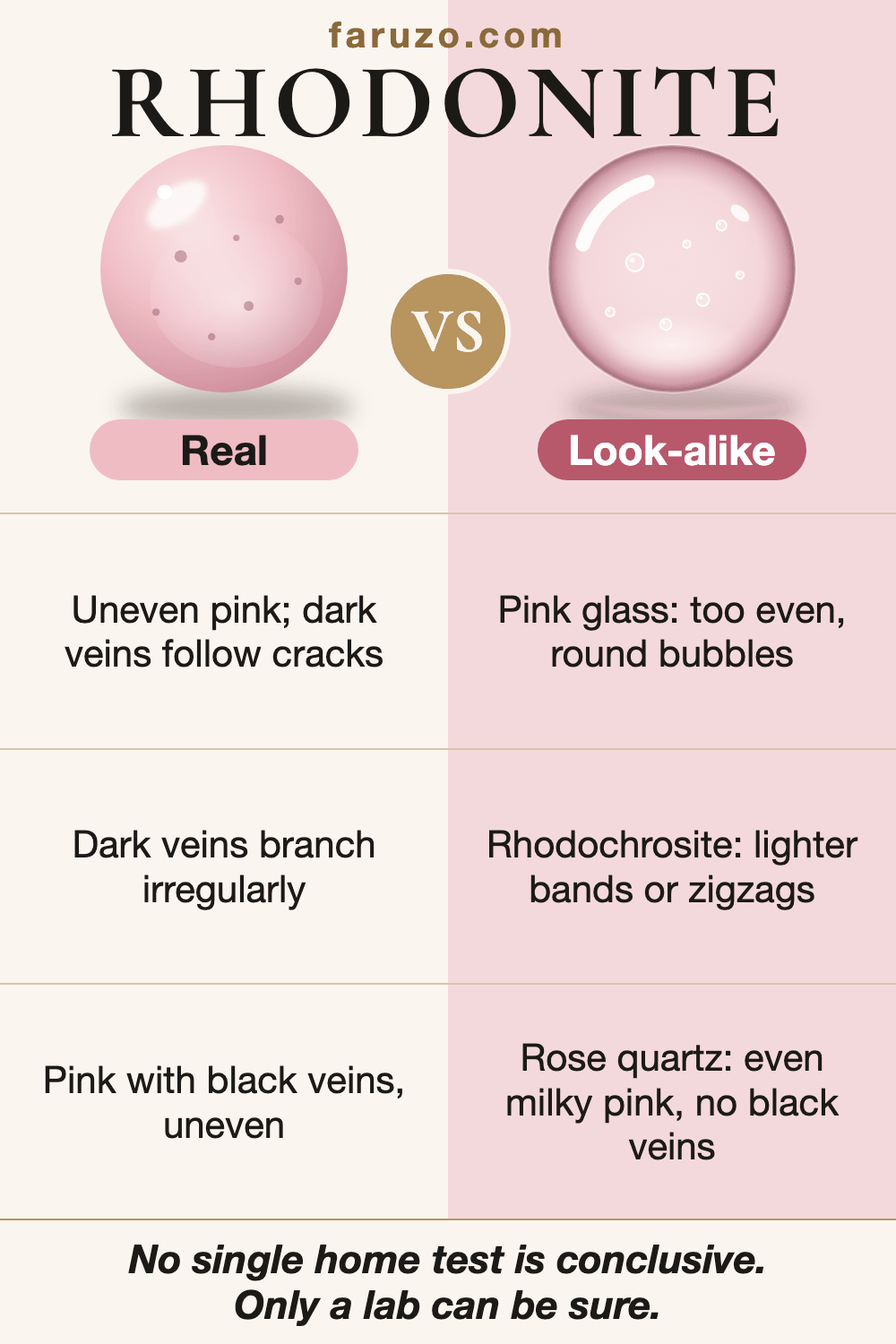
- Rhodochrosite. A separate stone, a manganese carbonate. It is softer (about Mohs 3.5 to 4) and usually shows lighter, banded or zigzag patterns instead of dark veining. Rhodonite will scratch it, though a scratch test can damage a piece you want to keep.
- Rose quartz. Rose quartz is harder (about Mohs 7) and usually an even, milky pink without black veining.
- Pink glass. Glass tends to look too even and may show round bubbles. Rhodonite is usually patchy, with dark veins and a slightly uneven colour. A gemologist can confirm.
Safe checks you can do
- Look for natural unevenness. Rhodonite usually has patchy pink and black veins that follow cracks, whereas glass is typically uniform.
- Check whether the dark veins look too neat or uniform. Natural veining often branches irregularly and sits in cracks.
- Ask the seller in writing whether the stone is natural rhodonite, dyed, glass or another stone such as rhodochrosite.
- Be wary of a very bright, even, candy-pink stone sold as rhodonite, since dye can pool in cracks.
- Avoid scratch-testing a stone you plan to keep. A lab can check it more safely.
Wearing Rhodonite
Ring
Avoid
Splits easily along a flat plane, so a ring is best avoided.
Bracelet
Avoid
One knock on the wrist can split it along a flat plane.
Pendant
Careful
It can split along a flat plane, so keep it protected.
Earrings
Careful
A flat-plane split is possible, so keep earrings for dressy wear.
Guide for everyday wear, based on hardness and care notes. Safe, Careful or Avoid.
Rhodonite is moderately hard, and massive pieces are fairly tough, but it has cleavage, so a sharp knock can still chip or crack it. A ring or bracelet is best avoided. Pendants and earrings suit it better, ideally in a protective setting. Keep it dry between uses and take it off for the gym and rough work.
Related stones
Questions about Rhodonite
What does rhodonite mean?
In crystal tradition rhodonite is a heart stone linked to compassion, forgiveness and self-love, and is nicknamed the rescue stone. That is a belief, not a fact about the stone. The name itself comes from the Greek word for rose.
What is rhodonite?
Rhodonite is a manganese silicate, (Mn,Fe,Mg,Ca)SiO3, that forms pink to rose-red masses with black veining. It is triclinic and usually found massive rather than as clear crystals.
How hard is rhodonite?
Rhodonite is about 5.5 to 6.5 on the Mohs scale. It is softer than quartz, and perfect cleavage makes it more fragile than the number suggests.
Why does rhodonite have black veins?
The black lines are manganese oxide, which often forms along cracks and edges where the stone has weathered. They are natural and are part of why the stone looks distinctive.
Is rhodonite the same as rhodochrosite?
No. Rhodochrosite is a manganese carbonate, softer at about Mohs 3.5 to 4, and usually shows lighter banding. Rhodonite is a silicate, harder, and shows dark veining.
Is rhodonite a birthstone?
No. Rhodonite is not on the standard modern or traditional birthstone lists. It is the official state gem of Massachusetts.
Can rhodonite get wet?
A quick rinse is fine, but do not soak it, and dry it straight away. Take it off before showers, swimming and washing up.
Can you wear a rhodonite ring every day?
A ring is best avoided. It is only moderately hard and has cleavage, so everyday knocks can chip or crack it. Pendants and earrings take far fewer hits.
Does rhodonite fade or darken?
The surface can sometimes darken or turn brownish over time. Long strong sun or heat is best avoided as a precaution, and so are lotion and perfume.
How can you tell real rhodonite from look-alike or dyed stone?
Real rhodonite is usually patchy, with irregular dark veins that follow cracks. Glass and dyed pink stones look more even, and dye can pool in cracks. Only a lab can be sure.
Where does rhodonite come from?
Russia's Urals are a classic source, with others in Australia, Sweden, Spain, Madagascar, Brazil and the USA, including New Jersey and Massachusetts.