
Crystal guide
Rhodochrosite Meaning, Properties and Care
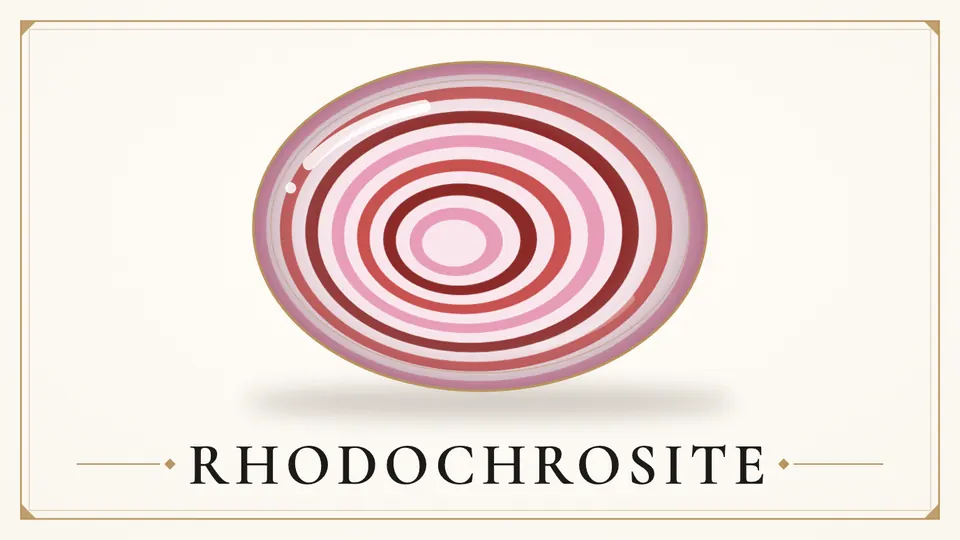
Rhodochrosite is a pink to rose-red manganese carbonate, MnCO3. The banded pink-and-white material often sold as Inca rose, much of it from Argentina, is the form most often seen in jewellery. It is soft, at about 3.5 to 4 on the Mohs scale, it splits along flat planes, and it reacts to acid, so it needs gentle care. In crystal tradition it is a heart stone linked to love and compassion.
At a glance
- Formula MnCO3, a pink to rose-red manganese carbonate. Banded Inca rose is the common jewellery form.
- Mohs about 3.5 to 4 with perfect cleavage, so it scratches easily and can split if knocked.
- It fizzes in acid, so keep it away from acidic cleaners such as vinegar or lemon juice, and do not soak it.
- Not on the standard birthstone lists. Better as a pendant or earrings than as a ring or bracelet.
Quick facts
| Family | Manganese carbonate (calcite group) |
|---|---|
| Chemical formula | MnCO3 |
| Crystal system | Trigonal, found as crystals and also massive, banded and stalactitic |
| Mohs hardness | 3.5–4 |
| Luster | Vitreous to pearly; perfect rhombohedral cleavage; effervesces in warm acids |
| Transparency | Mostly translucent to opaque; Argentine banded material is translucent at best, while rare gem-quality crystals are clear |
| Natural colors | rose-red to pink, pale brown, banded pink and white, grey or yellowish in some pieces |
| Main localities | Argentina (Catamarca, including Capillitas); USA (Colorado, Sweet Home Mine near Alma); China; South Africa; Peru; Japan; Romania (Cavnic, where it was first described) |
| Common treatments | wax or plastic impregnation is a recognised enhancement, so ask whether a piece has been waxed, impregnated or dyed; banded Argentine material is usually sold polished in its natural state; lab-made rhodochrosite has appeared in beads and cabochons |
Rhodochrosite at a glance, in pictures
Chakras (traditional)
Hardness range
Natural colors
- rose-red to pink
- pale brown
- banded pink and white
- grey or yellowish in some pieces
Common forms of Rhodochrosite
- Rough raw chunk
- Bead drilled bead
- Cabochon smooth dome
How hard is Rhodochrosite?
- Talc 1
- Gypsum 2
- Copper coin ~ 3
- Calcite 3
- Rhodochrosite 3.5–4
- Fluorite 4
- Apatite 5
- Glass ~ 5.5
- Steel knife ~ 5.5
- Orthoclase 6
- Quartz 7
- Topaz 8
- Corundum 9
- Diamond 10
What it is and where it comes from
The name joins two Greek words, rodon (rose) and chrosis (colouring), and points to the rose colour of the mineral.
Rhodochrosite is manganese carbonate. Calcium, and to a lesser extent magnesium and zinc, often replace some of the manganese and lighten the colour, which is why much of it is rose-pink rather than deep red.
More on its history
Rhodochrosite is mainly used as an ore of manganese. Attractive banded pieces are set aside for decorative stones and jewellery.
Banded rhodochrosite is mined at Capillitas in Argentina, and Catamarca province is where much of the gem material originates. Argentine deposits also yield stalactite growths up to about four feet long.
The mineral is sometimes sold as Inca rose, Rosa del Inca or Rosinca. These names most often describe the pink-and-white banded Argentine material.
Rhodochrosite is often called Argentina's national gemstone.
Because of its softness and perfect cleavage, rhodochrosite is rarely faceted for jewellery. Banded material is mostly cut as beads and cabochons, and translucent pink faceting rough yields stones of up to about 20 carats.
Rhodochrosite through time
-
1813
Rhodochrosite is first described from a sample from Cavnic in Romania, where it turned up in silver mines.
-
1873
The Sweet Home Mine near Alma, Colorado, opens as a silver mine. It later becomes best known for its rhodochrosite crystals.
-
2002
Colorado officially names rhodochrosite its state mineral.
In crystal tradition
What follows is belief and folklore, passed down in crystal tradition. It is not measured fact.
Traditionally associated with: love, compassion, self-acceptance.
Rhodochrosite is traditionally associated with the Heart chakra and with love, compassion and self-acceptance. This is a modern spiritual tradition, not a fact about the stone.
Zodiac and planet pairings vary from one tradition to another. Treat them as folklore.
How to care for Rhodochrosite
- Water Caution
- Sunlight Unknown
- Salt Unknown
- Heat Caution
- Ultrasonic Avoid
- Chemicals Avoid
Safe = fine as a rule · Caution = only briefly or gently · Avoid = can damage the stone · Unknown = no reliable guidance.
Clean rhodochrosite by hand with a soft brush or cloth, mild soap and warm water only, then dry it straight away. Do not soak it. Because it fizzes in acid, keep it away from acidic cleaners such as vinegar and lemon juice, and from harsh household cleaners. Skip ultrasonic and steam cleaners, since vibration and sudden heat can open a crack along the cleavage planes. Take it off before perfume or hairspray, and store it in its own soft pouch, apart from harder stones that could scratch it.
Real or fake? Look-alikes and treatments
Often confused with
- Dyed calcite or talc-calcite
- Dyed agate
- Rhodonite
- Rose quartz
- Pink glass
- Plastic
Common look-alikes
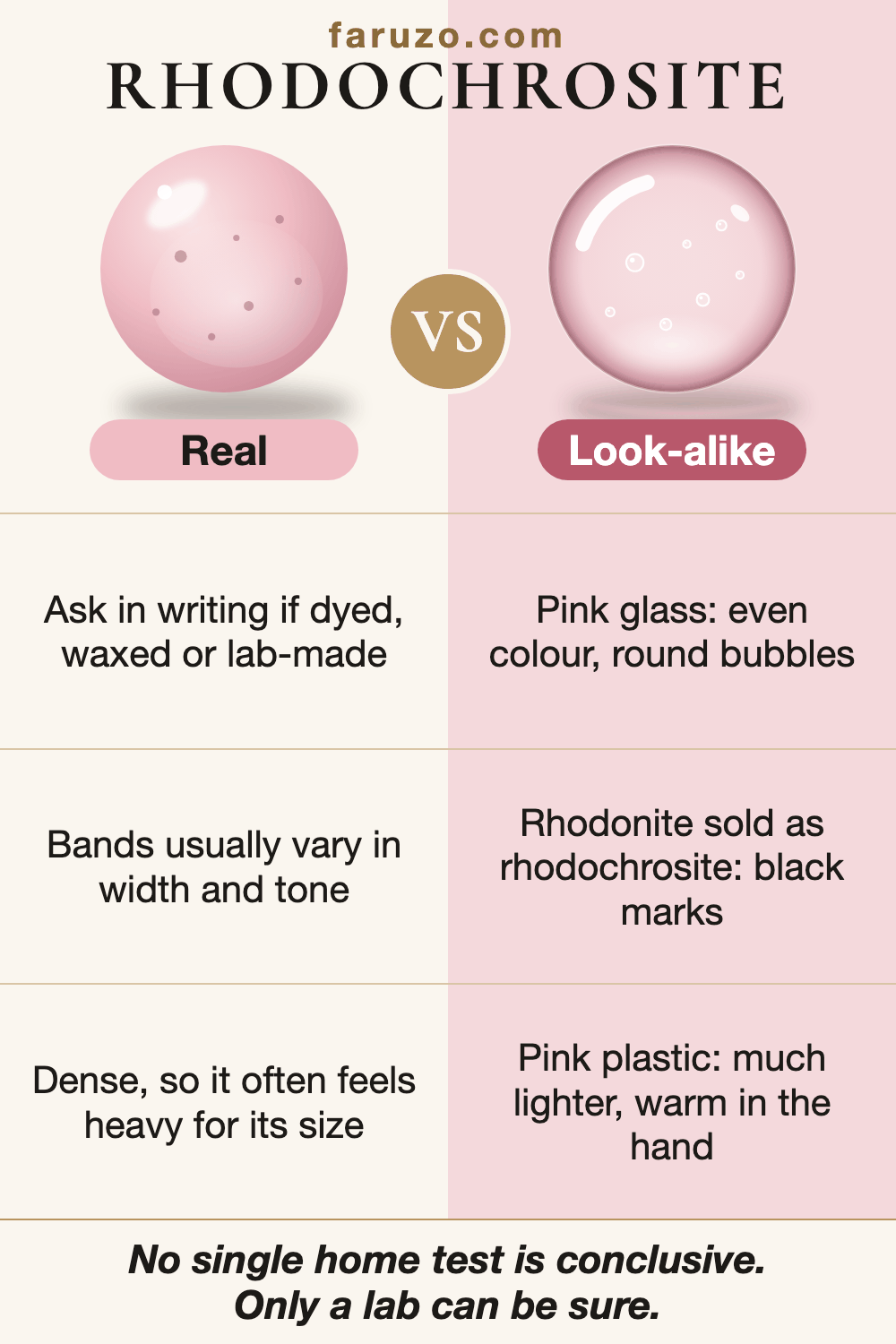
- Dyed calcite or talc-calcite. Dyed calcite beads and talc-calcite aggregates are known imitations of rhodochrosite. The colour can look flatter and more uniform than natural banding. A gem lab can tell them apart without much difficulty.
- Dyed agate. Pale agate is commonly dyed, and dyed agate can show bright pink bands. Agate is a much harder quartz stone (about Mohs 6.5 to 7), usually glassier and more translucent than rhodochrosite's softer bands.
- Rhodonite. A different pink mineral, a silicate rather than a carbonate. It is harder (Mohs 5.5 to 6.5) and often shows black manganese oxide markings, while rhodochrosite tends to show lighter, banded patterns.
- Rose quartz. Rose quartz is much harder (Mohs 7) and usually a soft, cloudy pink without the pink-and-white banding of Inca rose.
- Pink glass. Glass is an age-old gem imitation. It tends to look too even, may show round bubbles, and feels lighter than rhodochrosite, which is a dense stone.
- Plastic. Plastic is used for inexpensive fashion jewellery and is not a durable imitation. It usually feels much lighter and warmer in the hand than stone.
Safe checks you can do
- Ask the seller in writing whether the stone is natural rhodochrosite, and whether it is waxed, impregnated, dyed, lab-made or another material such as calcite, agate or glass.
- Look at the banding. Natural bands usually vary in width and tone, while perfectly uniform stripes or a very bright, even pink call for a closer question.
- Compare the weight. Rhodochrosite is a dense stone, so beads tend to feel heavier than glass or plastic of the same size.
- Do not acid-test or scratch-test a stone you plan to keep. An acid test is destructive, and a gem lab can check it more safely.
Wearing Rhodochrosite
Ring
Avoid
Splits easily along a flat plane, so a ring is best avoided.
Bracelet
Avoid
One knock on the wrist can split it along a flat plane.
Pendant
Careful
It can split along a flat plane, so keep it protected.
Earrings
Careful
A flat-plane split is possible, so keep earrings for dressy wear.
Guide for everyday wear, based on hardness and care notes. Safe, Careful or Avoid.
Rhodochrosite is soft at about 3.5 to 4 and splits along flat planes if knocked, so a ring or bracelet is best avoided. Pendants and earrings take fewer knocks, ideally in a protective setting and for dressy wear. Take it off for washing up, the gym and rough work, and keep it away from acidic cleaners.
Related stones
Questions about Rhodochrosite
What does rhodochrosite mean?
In crystal tradition rhodochrosite is a heart stone linked to love, compassion and self-acceptance. That is a belief, not a fact about the stone. The name itself comes from Greek words meaning rose and colouring.
What is rhodochrosite?
Rhodochrosite is a manganese carbonate, MnCO3. It forms pink to rose-red crystals and masses, and the banded form, often sold as Inca rose, is the one most often cut for jewellery.
How hard is rhodochrosite?
About 3.5 to 4 on the Mohs scale, which is soft. A steel blade can mark it, and perfect cleavage means a knock can also split it.
What is Inca rose?
Inca rose, also written Rosa del Inca or Rosinca, is a name for banded pink-and-white rhodochrosite. Much of it comes from Argentina, where Capillitas in Catamarca province is a well-known source.
Is rhodochrosite a birthstone?
No. Rhodochrosite is not on the standard modern or traditional birthstone lists. Alternative lists vary, so check the list you are following.
Can rhodochrosite get wet, and can you clean it with vinegar?
A quick rinse in warm water with mild soap is fine, but do not soak it. Never clean it with vinegar, lemon juice or other acids, because rhodochrosite fizzes in acid and the surface can be eaten away.
Can you wear a rhodochrosite ring every day?
A ring is best avoided. At about 3.5 to 4 with perfect cleavage, everyday knocks can scratch, chip or split it. Pendants and earrings take far fewer hits.
Is rhodochrosite the same as rhodonite?
No. Rhodochrosite is a softer manganese carbonate with lighter banding, while rhodonite is a harder manganese silicate that often shows black markings. The two names are easy to mix up.
How can you tell real rhodochrosite from look-alike or dyed stone?
A home look can only hint. Natural bands vary in width and tone, while dyed calcite, dyed agate, glass and plastic often look too even. A stone that matters is best checked by a gem lab.
I am buying rhodochrosite jewellery. What should I ask the seller?
Ask in writing whether the stone is natural rhodochrosite, and whether it has been waxed, impregnated, dyed or is lab-made. A treated piece is still real rhodochrosite, but it deserves an honest label and gentler care.
Where does rhodochrosite come from?
Gem material comes mainly from Catamarca in Argentina. Colorado's Sweet Home Mine near Alma is known for its rhodochrosite crystals, and other sources include China, South Africa, Peru and Japan.