
Crystal guide
Calcite Meaning, Properties and Care
Calcite is calcium carbonate (CaCO3), a very common mineral and the reference stone for Mohs 3. It is soft and splits along three flat directions, so care matters more than usual. Clear pieces split a printed letter into two images, and in crystal tradition calcite is linked to clarity and motivation.
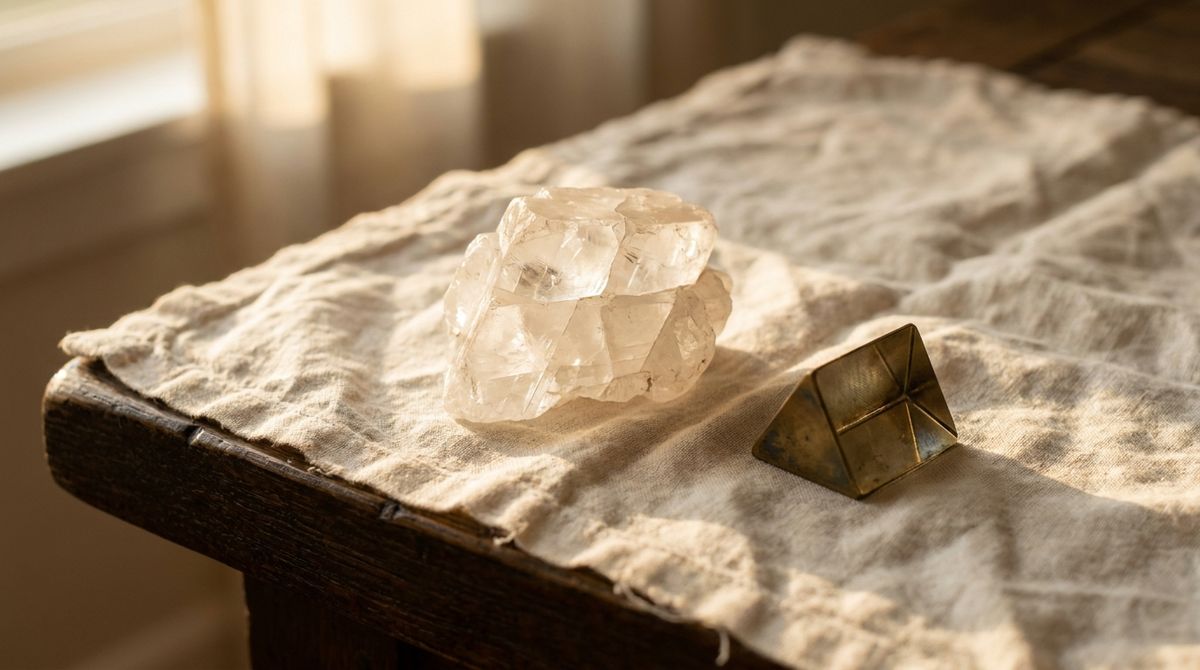
At a glance
- Formula CaCO3, trigonal crystals, hardness Mohs 3.
- Perfect cleavage in three directions: broken pieces settle into slanted blocks called rhombohedrons.
- Colours include clear, white, orange, blue, green and honey-gold.
- Care: soft dry or barely damp cloth, no vinegar or acids, no machine cleaner.
Quick facts
| Family | Carbonate mineral (calcium carbonate); main part of limestone and marble |
|---|---|
| Chemical formula | CaCO3 |
| Crystal system | Trigonal (rhombohedral forms are typical) |
| Mohs hardness | 3 |
| Luster | Vitreous (glassy) to pearly; perfect rhombohedral cleavage in three directions |
| Transparency | Transparent to translucent, sometimes opaque |
| Natural colors | colourless; white; orange; blue; green; honey or golden yellow; grey, red, violet, brown or black (less common) |
| Main localities | Iceland, Mexico, Canada (Ontario), USA (Michigan), England (Cumbria), Germany |
| Common treatments | usually sold untreated, though dyed or heat-treated pieces exist; because it is soft and reacts to acid, rough handling and harsh cleaners are the bigger concern |
Calcite at a glance, in pictures
Hardness range
Natural colors
- colourless
- white
- orange
- blue
- green
- honey or golden yellow
- grey, red, violet, brown or black (less common)
Common forms of Calcite
- Rough raw chunk
- Tumbled polished pebble
- Cabochon smooth dome
How hard is Calcite?
- Talc 1
- Gypsum 2
- Calcite 3
- Fluorite 4
- Apatite 5
- Glass ~ 5.5
- Steel knife ~ 5.5
- Orthoclase 6
- Quartz 7
- Topaz 8
- Corundum 9
- Diamond 10
What it is and where it comes from
Calcite is calcium carbonate. It is the main part of limestone and marble, and stalactites and stalagmites are often made of it.
Calcite defines hardness 3 on the Mohs scale, so it is the stone other minerals are compared against at that level.
In the late 1600s, unusually clear calcite from Iceland, later called Iceland spar, was noticed to show a doubled image of anything viewed through it. The effect is called double refraction, or birefringence.
That doubling is strong enough in clear calcite to see with the naked eye, and the mineral later played a part in early work on the wave nature and polarization of light. Clear calcite was long used in optical instruments.
Trace elements colour calcite. Impurities, mostly iron, tint it orange or honey-gold, with blue and green also seen, so its colour varies widely.
Beyond jewelry, calcite is a huge industrial material: it is the raw material behind chalk, agricultural lime and cement.
As a decorative stone calcite is limited by its softness. It is mostly seen as tumbled stones, raw display clusters and carvings rather than hard-wearing jewelry stones.
In crystal tradition
What follows is belief and folklore, passed down in crystal tradition. It is not measured fact.
Traditionally associated with: mental clarity, emotional release, motivation, communication.
In crystal tradition calcite is associated with mental clarity and emotional release. This is a modern spiritual belief, not a fact about the stone.
By colour, blue calcite is traditionally linked to communication and orange calcite to motivation. These are beliefs within crystal practice, not scientific claims.
How to care for Calcite
- Water Caution
- Sunlight Unknown
- Salt Caution
- Heat Caution
- Ultrasonic Avoid
- Chemicals Avoid
Safe = fine as a rule · Caution = only briefly or gently · Avoid = can damage the stone · Unknown = no reliable guidance.
Wipe calcite with a soft, dry or barely damp cloth. Never use vinegar, lemon or any acidic cleaner, which will etch it. A brief rinse in plain water is usually fine, but do not soak it. Skip ultrasonic cleaners, which can chip or cloud something this soft, and keep it away from heat and steam, since sudden temperature change can crack a cleaved stone. Store it apart from harder stones, keys and metal jewelry that could scratch it. Nothing firm is known about long sun, and salt is best avoided as a precaution.
Real or fake? Look-alikes and treatments
Often confused with
- Quartz, citrine and other harder stones
- Selenite (gypsum)
- Glass or resin imitations
Common look-alikes
- Quartz, citrine and other harder stones. Honey or golden calcite can pass for citrine at a glance. Quartz is Mohs 7 and does not fizz in vinegar, while calcite is much softer, scratches easily and has flat cleavage faces on broken edges. A gemologist can confirm.
- Selenite (gypsum). Selenite is a different mineral, even softer at Mohs 2, and does not fizz in vinegar. Calcite is Mohs 3 and does fizz. Both are pale and often sold side by side.
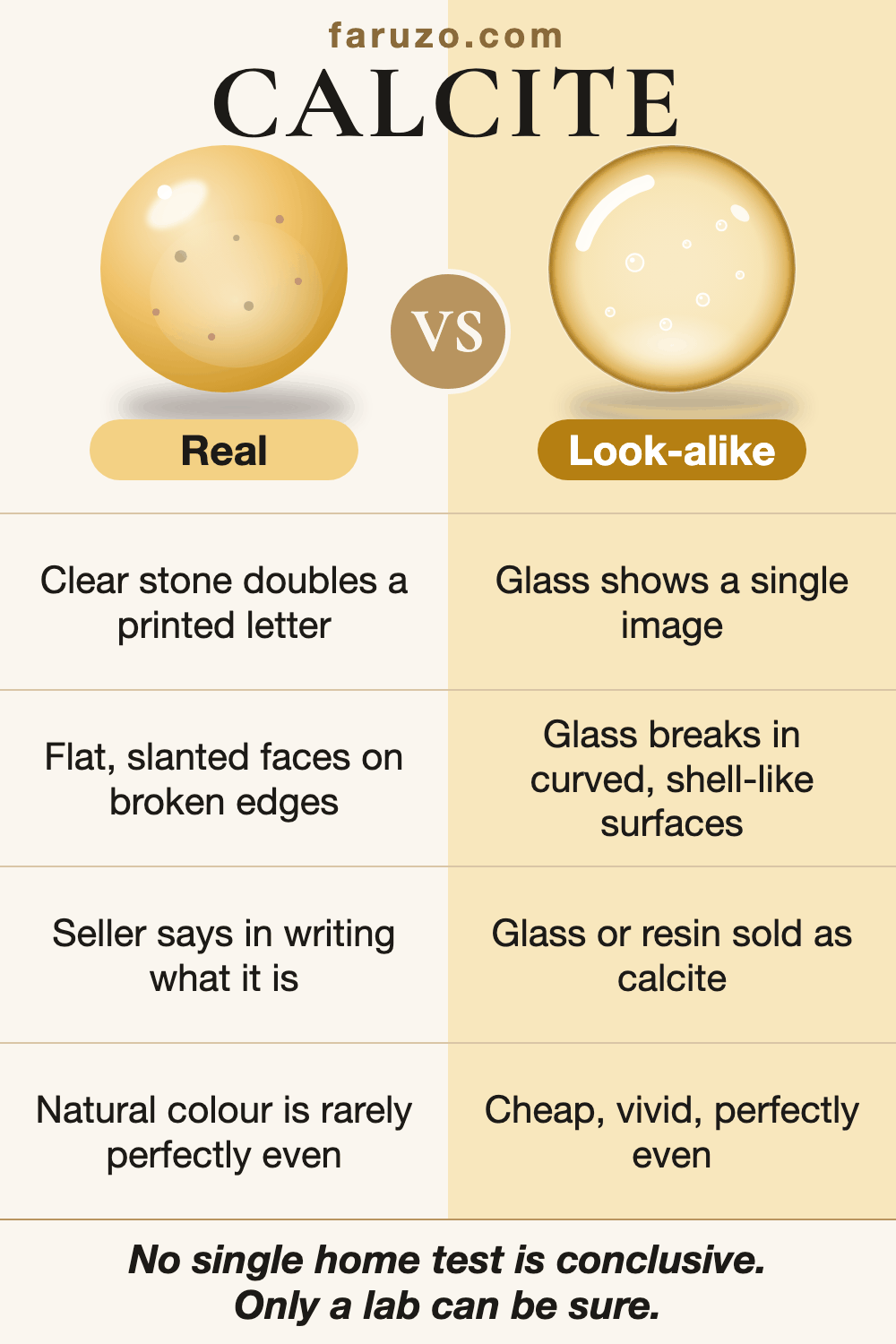
- Glass or resin imitations. Glass can imitate clear or coloured calcite. Glass is often too uniform and may show tiny round bubbles, while real calcite shows flat, stepped cleavage faces on broken edges.
Safe checks you can do
- Ask the seller in writing whether the stone is natural calcite, dyed, glass or something else.
- Clear calcite doubles the image of a printed letter when laid on a page. Glass shows a single image.
- Look closely at any chipped or broken edge. Real calcite tends to show flat, slanted cleavage faces, while glass breaks with curved, shell-like surfaces.
- Do not try acid or a scratch test at home. Both can mark a soft stone, and a lab can identify it more safely.
- Be wary of a very cheap, perfectly even, vivid stone sold as rare calcite. Natural material is rarely perfectly even, so ask questions.
Wearing Calcite
Ring
Avoid
Splits easily along a flat plane, so a ring is best avoided.
Bracelet
Avoid
One knock on the wrist can split it along a flat plane.
Pendant
Avoid
A pendant can still split along a flat plane, so it is best avoided.
Earrings
Avoid
Small and exposed, and it splits easily: earrings are best avoided.
Guide for everyday wear, based on hardness and care notes. Safe, Careful or Avoid.
Calcite is soft (Mohs 3) and splits along perfect cleavage planes, so it is a poor choice for rings, bracelets and other pieces that get knocked. Even a pendant or earring risks scratches and chips, so calcite suits display pieces and tumbled stones far better than daily jewelry. If it is worn at all, keep it for brief occasions in a closed setting, and keep it clear of acids, cleaners and soaking water.
Related stones
Questions about Calcite
What does calcite mean?
In crystal tradition calcite is linked to mental clarity and emotional release, with blue calcite tied to communication and orange calcite to motivation. That is a belief, not a fact about the stone.
What is calcite?
Calcite is calcium carbonate, CaCO3. It forms rocks, cave formations and clear crystals, and is rarely seen as a finished gem.
How hard is calcite?
Calcite is 3 on the Mohs scale and is the stone that defines that level. A steel knife blade scratches it easily, and perfect cleavage adds to the fragility.
What is Iceland spar?
Iceland spar is the clear, transparent kind of calcite. Set on a printed page, it makes each letter appear twice, because it splits a beam of light into two rays. The effect is called double refraction.
What colours does calcite come in?
Pure calcite is clear or white. Trace impurities tint it orange, blue, green or honey-gold, and less often grey, red, violet or brown. Orange is a very common colour in tumbled stones.
Is calcite a birthstone?
No. Calcite does not appear on the usual birthstone lists. Pearl, the June birthstone, is also calcium carbonate, but it is a different material.
Can calcite go in water?
A brief rinse in plain water is usually fine, but do not soak it, and keep it away from acids and steam.
Why does calcite fizz in vinegar?
Calcite reacts with acid and releases carbon dioxide gas, seen as fizzing. That is why even mild vinegar or lemon juice can mark it.
What is the difference between calcite and selenite?
They are unrelated minerals often sold side by side. Calcite is Mohs 3 and fizzes in vinegar. Selenite is a form of gypsum at Mohs 2, even softer, and does not fizz.
What is the difference between calcite and quartz?
Quartz is silicon dioxide at Mohs 7, more than twice as hard. Honey calcite is sometimes mistaken for citrine, a quartz variety, despite the big hardness gap.
How do you clean and care for calcite?
Wipe it with a soft, dry or barely damp cloth. Skip soaking, cleaning machines and acidic products, and wrap it separately from keys and metal jewelry so nothing scratches the surface.
Can you wear calcite jewelry every day?
It is not a good fit for daily wear. At Mohs 3 with perfect cleavage, calcite scratches and chips easily, so it suits display pieces and tumbled stones better than rings or bracelets.
What is Mexican onyx or calcite onyx?
It is a banded form of calcite sold as onyx. It is much softer than true onyx, which is a quartz-family stone, so it needs the same care as calcite.
Is orange calcite natural?
Much orange calcite is natural, tinted by iron, though dyed or heat-treated pieces exist. Ask the seller what treatment a stone has had.
What is blue calcite?
Blue calcite is ordinary calcite (CaCO3) in a blue shade, not a different mineral. At Mohs 3 it scratches easily and fizzes in acids such as vinegar, so it is mostly sold as tumbled stones, spheres and raw display pieces rather than daily jewelry.
Is blue calcite natural or dyed?
Blue is one of calcite's natural colours, tinted by trace impurities. Dyed calcite also turns up in the trade, for example dyed marble, which is calcite, sold as imitation jade, so a very bright, perfectly even blue is worth a question. Ask the seller whether the colour is natural.
What is chrysanthemum stone?
Chrysanthemum stone is a dark rock, often limestone, with white flower-shaped clusters of radiating crystals. The name has no single scientific definition. The white petals may be calcite, aragonite or celestine depending on the deposit, and Hunan in China is a classic source.
Is chrysanthemum stone natural, and is it hard?
Hardness depends on the minerals present, and pieces with calcite or celestine petals are soft and sensitive to acid. Some pieces are enhanced by darkening the dark rock or painting the petals to raise the contrast, so ask the seller whether the pattern is natural.