
Crystal guide
Aragonite Meaning, Properties and Care
Aragonite is calcium carbonate (CaCO3), the same chemistry as calcite but grown in a different crystal pattern. It is soft, at about 3.5 to 4 on the Mohs scale, and brittle, so it is better kept as a display crystal than worn as jewelry. The brown star-shaped clusters sold as sputnik aragonite are radiating groups of its crystals, and in crystal tradition it is a grounding stone.
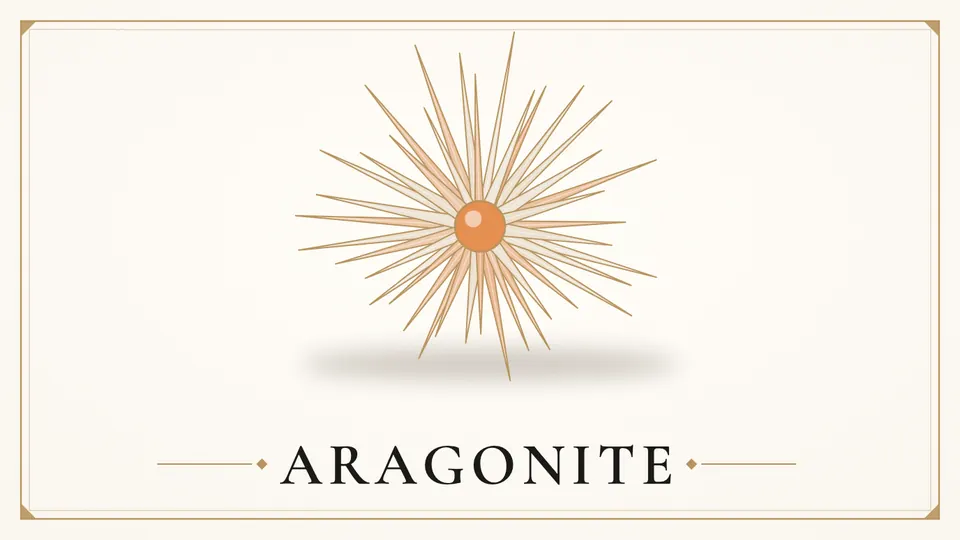
At a glance
- Formula CaCO3, orthorhombic crystals, hardness about Mohs 3.5 to 4.
- Same chemistry as calcite but a different crystal structure, and the main material in shell nacre and pearls.
- Often grows as radiating star or sputnik clusters in white, brown, orange or red.
- Care: dry or barely damp cloth, no vinegar or acids, no machine cleaners. Best as a display piece.
Quick facts
| Family | Carbonate mineral (calcium carbonate), a different crystal form of the same compound as calcite |
|---|---|
| Chemical formula | CaCO3 |
| Crystal system | Orthorhombic, often as twinned groups with a six-sided outline or as needle-like and radiating crystals |
| Mohs hardness | 3.5–4 |
| Luster | Vitreous (glassy), sometimes waxy or resinous; brittle, with one flat cleavage direction that is weak to distinct |
| Transparency | Transparent to opaque |
| Natural colors | white, colourless, brown and reddish brown, orange, red, grey, yellow, blue (less common) |
| Main localities | Spain (Molina de Aragón); Morocco (near Sefrou); Italy (Sicily); Austria; England (Cumbria); China (Guizhou); USA (New Mexico, Arizona) |
| Common treatments | no standard treatment is known, but colour can be added to mineral pieces, so ask whether a very bright, even colour is natural; soft and acid-sensitive, so rough handling and harsh cleaners are the bigger concern |
Aragonite at a glance, in pictures
Chakras (traditional)
Hardness range
Natural colors
- white
- colourless
- brown and reddish brown
- orange
- red
- grey
- yellow
- blue (less common)
Traditionally linked to
- Zodiac
- Capricorn
- Element
- Earth
Common forms of Aragonite
- Rough raw chunk
- Tumbled polished pebble
How hard is Aragonite?
- Talc 1
- Gypsum 2
- Copper coin ~ 3
- Calcite 3
- Aragonite 3.5–4
- Fluorite 4
- Apatite 5
- Glass ~ 5.5
- Steel knife ~ 5.5
- Orthoclase 6
- Quartz 7
- Topaz 8
- Corundum 9
- Diamond 10
What it is and where it comes from
Aragonite is calcium carbonate, the same compound as calcite. It is one of the three most common crystal forms of calcium carbonate, alongside calcite and vaterite, and differs from calcite in how its atoms are stacked.
The mineral was first described in the 1750s from six-sided crystals near Molina de Aragón in Spain, and named aragonite in the 1790s. The name comes from Aragon, though the town is reportedly not in that region.
Repeated twinning, where crystals grow joined together, gives aragonite its typical pseudo-hexagonal shapes. Radiating, needle-like groups also occur, and these are the pieces sold under trade names such as sputnik and star cluster.
In caves it forms stalactite-like growths, and in some iron mines it forms branching, coral-like shapes called flos-ferri, Latin for flowers of iron.
Aragonite also forms in almost all mollusc shells and in the skeletons of corals. The shimmering inner layer of many shells, called nacre or mother-of-pearl, is made of tiny aragonite plates, and pearls are mainly aragonite or a mix of aragonite and calcite.
At the surface of the Earth aragonite is unstable and slowly turns into calcite, over tens of millions of years. That is why aragonite from before the Carboniferous period is essentially unknown.
Outside collecting, crushed aragonite is used in reef aquariums to help keep the water chemistry close to a natural reef.
In crystal tradition
What follows is belief and folklore, passed down in crystal tradition. It is not measured fact.
Traditionally associated with: grounding, patience, steadiness.
In crystal tradition aragonite is a grounding, Earth-linked stone, connected with patience and steadiness and the Root chakra. This is a modern spiritual belief, not a fact about the stone.
Star and sputnik clusters are traditionally linked to the same themes, partly because of their warm earthy colour. Zodiac links vary, and Capricorn is one that is mentioned. Treat them as folklore.
How to care for Aragonite
- Water Caution
- Sunlight Unknown
- Salt Caution
- Heat Caution
- Ultrasonic Avoid
- Chemicals Avoid
Safe = fine as a rule · Caution = only briefly or gently · Avoid = can damage the stone · Unknown = no reliable guidance.
Dust aragonite with a soft dry brush or cloth, and use a barely damp cloth for marks, dried at once. Do not soak it. Never use vinegar, lemon or any acidic cleaner, which dissolves carbonate minerals, and keep it away from salt water. Skip ultrasonic and steam cleaners, because a very brittle stone can chip or split. Very high heat can turn aragonite into calcite, far hotter than any home setting, but a spot away from radiators and bright windows is the safer choice. Nothing firm is known about long sun. Store clusters in a padded box, apart from harder stones that could scratch them, and lift them by the base rather than the spikes.
Real or fake? Look-alikes and treatments
Often confused with
- Calcite
- Selenite (gypsum)
- Quartz clusters
- Glass or resin casts
Common look-alikes
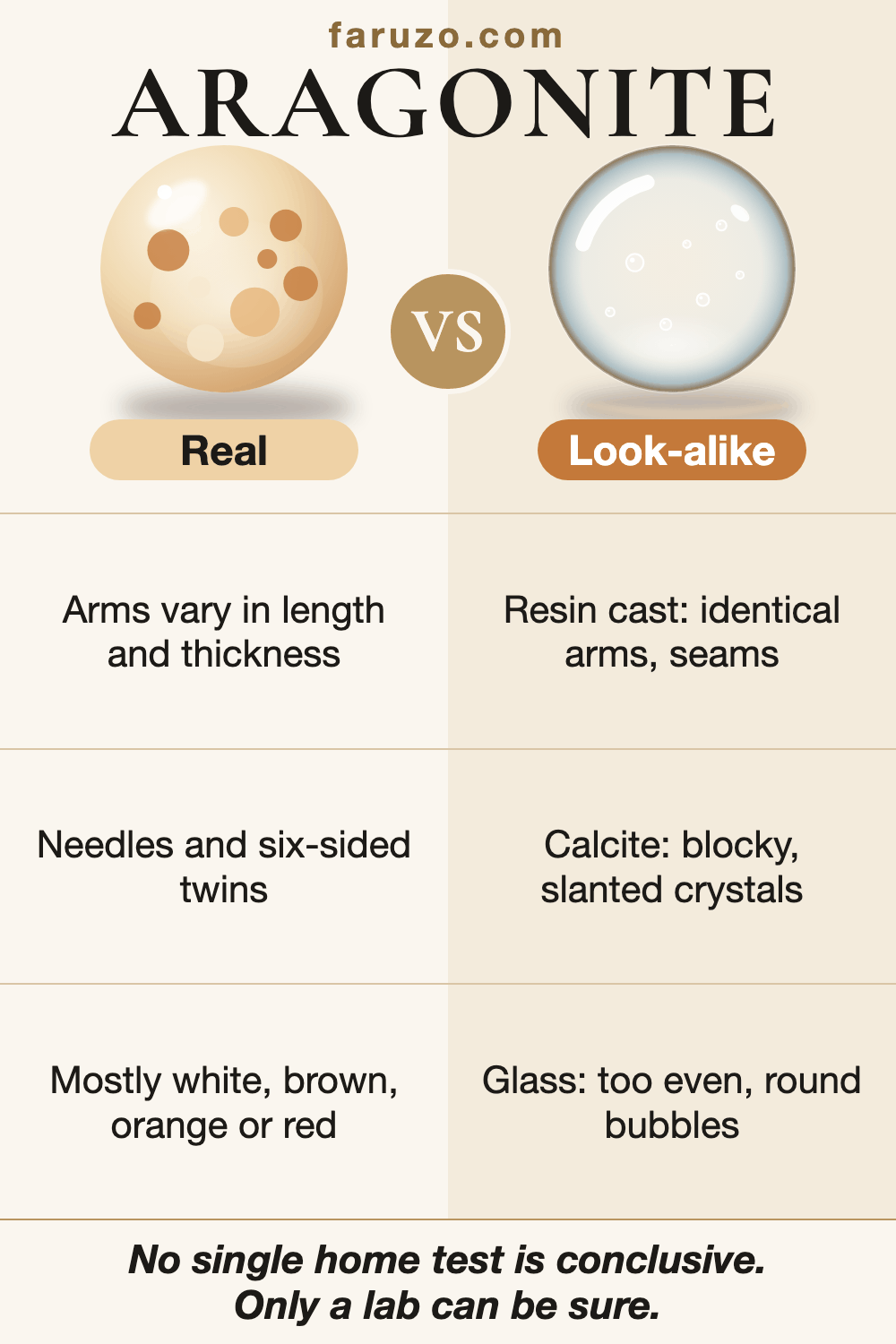
- Calcite. Calcite has the same formula (CaCO3) but is slightly softer, at Mohs 3, and grows as blocky slanted crystals rather than needles and six-sided twins. Both react to acid, so a vinegar test cannot tell them apart, and a gem lab can confirm.
- Selenite (gypsum). Selenite is a different mineral and softer still, at Mohs 2. It forms flat, ribbon-like or blade-like crystals and does not fizz in vinegar, while aragonite is a carbonate and does.
- Quartz clusters. Quartz clusters have six-sided points with a pointed tip and are much harder, at Mohs 7. They are glassier and do not react to vinegar. Aragonite spikes are softer and often brown, orange or white.
- Glass or resin casts. A cast copy tends to look too even, with identical arms, seams or tiny round bubbles. Real aragonite shows natural variation from one arm to the next.
Safe checks you can do
- Ask the seller in writing whether the piece is natural aragonite, dyed, a cast or something else.
- Look at the arms of a cluster. Natural crystals vary in length and thickness, while casts repeat the same shapes and may show moulding seams.
- Be curious about a very bright, perfectly even blue, green or purple. Natural aragonite is mostly white, brown, orange or red, so a vivid colour is worth a question.
- Do not scratch-test or acid-test a piece you plan to keep. A lab is the safer route when it matters.
Wearing Aragonite
Ring
Avoid
Soft and brittle: a ring would scratch and chip quickly.
Bracelet
Avoid
A bracelet meets knocks and water daily, too much for it.
Pendant
Careful
Fine for brief dressy wear; keep it dry and away from knocks.
Earrings
Careful
Small and exposed, so keep earrings for short, careful wear.
Guide for everyday wear, based on hardness and care notes. Safe, Careful or Avoid.
Aragonite is soft, at about 3.5 to 4 on the Mohs scale, and brittle, so it is a much better display crystal than a jewelry stone. A ring or bracelet would scratch and chip quickly. A pendant or earrings are possible for short, careful wear, kept dry and away from knocks, but a cluster, tumbled stone or carving on a shelf shows aragonite at its best.
Related stones
Questions about Aragonite
What does aragonite mean?
In crystal tradition aragonite is a grounding stone linked to patience, steadiness and the Root chakra, and sputnik or star clusters are tied to the same themes. That is a belief, not a fact about the stone.
What is aragonite?
Aragonite is a carbonate mineral with the formula CaCO3, the same compound as calcite but in a different crystal form. It grows as six-sided twins, needles and radiating clusters, and it also builds shells, coral and pearls.
How hard is aragonite?
About 3.5 to 4 on the Mohs scale, a little harder than calcite and roughly the hardness of a copper coin. It is also very brittle, so it chips more easily than its number alone suggests.
What is sputnik aragonite?
Sputnik or star-cluster aragonite is a radiating group of aragonite crystals, usually brown, orange or red, that spreads out like a burst of spikes. The shapes grow naturally, from crystals twinned around a centre.
Is aragonite a birthstone?
No. Aragonite is not on the usual birthstone lists. Pearl, the June birthstone, is mainly aragonite too, but the pearl is a separate gem with its own record.
Is aragonite the same as calcite?
They have the same formula, CaCO3, but a different crystal structure. Aragonite tends to grow as needles and six-sided twins, calcite as blocky slanted crystals, and calcite is slightly softer at Mohs 3.
Are pearls and mother-of-pearl made of aragonite?
Largely, yes. The shimmering nacre layer of many shells is made of tiny aragonite plates, and pearls are mainly aragonite or a mix of aragonite and calcite.
Can aragonite get wet?
A barely damp cloth is fine for marks if you dry it at once, but do not soak it, and keep it away from salt water and vinegar.
Why does aragonite fizz in vinegar?
Aragonite is a carbonate, and acid reacts with it to release carbon dioxide gas, seen as fizzing. That is why even mild vinegar or lemon juice can eat into the surface.
Can you wear aragonite jewelry every day?
It is not a good fit. Aragonite is soft and brittle, so a ring or bracelet would scratch and chip. It suits display pieces, and a pendant or earrings only for short, careful wear.
How do you clean and store aragonite?
Brush it with a soft dry brush or wipe it with a barely damp cloth, dried at once. Skip soaking, cleaning machines and acids. Store clusters in a padded box, and pick them up by the base rather than the spikes.
How can you tell real aragonite from fake?
A home look can only hint. Natural crystals vary in length and thickness, while casts repeat shapes and may show seams. Ask the seller in writing what the piece is, and use a lab if it matters.
Is dyed aragonite still real aragonite?
Yes. A dyed piece is still the real stone with colour added, though a very bright, even blue, green or purple deserves a question. Ask the seller whether the colour is natural.
What colours does aragonite come in?
Most often white, brown, orange or red, and also grey, yellow and, less commonly, blue. A vivid blue is worth asking the seller about. Impurities and sand inside the crystals give the browns and warm tones.
Does aragonite change into calcite?
Yes, over a very long time. At the surface of the Earth aragonite is unstable and slowly turns into calcite across tens of millions of years, so a piece will not change in your lifetime. Very high heat, far above home temperatures, speeds this up.
Where does aragonite come from?
It is found worldwide. Spain is the original locality, and Morocco is another well-known source. It also occurs in caves, in some mines and in shells and coral.