
Crystal guide
Selenite Meaning, Properties and Care
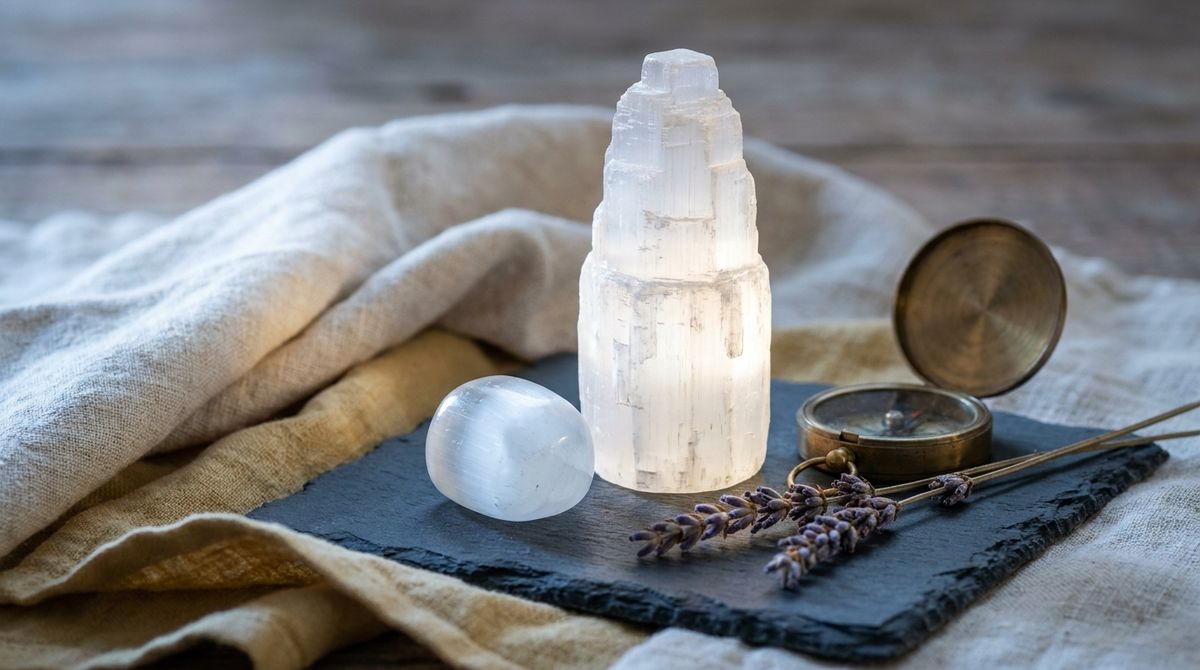
Selenite is the clear, glassy crystal form of gypsum (CaSO4·2H2O, Mohs 2). It is soft enough to scratch with a fingernail and it dissolves slowly in water, so it should not be soaked. The name comes from the Greek word for the Moon, and in crystal tradition it is the moonlight stone of clarity and calm.
At a glance
- Hardness Mohs 2: a fingernail can scratch it, and it splits easily into flat sheets.
- Gypsum (CaSO4·2H2O), a mineral with water built into its structure. It does dissolve slowly in water.
- The name comes from the Greek word for the Moon. It has nothing to do with the element selenium.
- Care: wipe with a dry cloth, never soak.
Quick facts
| Family | Gypsum (sulfate minerals) |
|---|---|
| Chemical formula | CaSO4·2H2O (hydrated calcium sulfate) |
| Crystal system | Monoclinic |
| Mohs hardness | 2 |
| Luster | Vitreous (glassy), sometimes pearly on flat cleavage faces; perfect cleavage in one direction |
| Transparency | Usually transparent to translucent and colourless; the fibrous form (satin spar) is silky rather than clear |
| Natural colors | colourless, white, pale tints from included material |
| Main localities | Naica, Chihuahua, Mexico (giant crystals); Morocco; New Mexico, USA (White Sands); Oklahoma, USA; Brazil |
| Common treatments | usually sold natural and untreated; dyed or coated pieces are sometimes reported |
Selenite at a glance, in pictures
Chakras (traditional)
Hardness range
Natural colors
- colourless
- white
- pale tints from included material
Traditionally linked to
- Planet
- Moon
- Zodiac
- TaurusCancer
- Element
- Air
Common forms of Selenite
- Rough raw chunk
- Tumbled polished pebble
How hard is Selenite?
- Talc 1
- Selenite 2
- Copper coin ~ 3
- Calcite 3
- Fluorite 4
- Apatite 5
- Glass ~ 5.5
- Steel knife ~ 5.5
- Orthoclase 6
- Quartz 7
- Topaz 8
- Corundum 9
- Diamond 10
What it is and where it comes from
The name comes from the Greek word selene, meaning Moon. People once believed the mineral grew and shrank with the phases of the Moon. Despite the similar sound, selenite contains no selenium.
Selenite is the transparent, bladed crystal form of gypsum. Gypsum itself comes from the Greek word for plaster, and heating it drives off its water to make plaster, which is why gypsum is such a familiar building material.
Some of the largest natural crystals ever found are selenite. They turned up in April 2000 in a cave about 300 metres below the Naica mine in Chihuahua, Mexico. The biggest is about 11.4 metres long, with an estimated mass anywhere from roughly 12 to 55 tonnes, depending on the estimate.
The Naica cave was hot, around 58 degrees C in the air, and very humid. The crystals grew from mineral-rich water over at least several hundred thousand years as the cave slowly cooled. The mine reportedly flooded again by about 2015, and the cave is reportedly not accessible.
At White Sands in New Mexico, the gypsum was laid down by shallow seas in the Permian period. The dunefield is about 275 square miles and is among the largest dunefields of its kind on Earth. When the dry Lake Lucero floods and evaporates, small selenite crystals about an inch across form on its surface.
Selenite is a common mineral and raw towers, slabs and desert-rose pieces are widely sold, with Morocco a well-known source for gypsum flowers. Many 'selenite' wands and towers are actually satin spar, a fibrous form of gypsum. Glass, resin and dyed pieces also exist, so ask what you are buying.
In crystal tradition
What follows is belief and folklore, passed down in crystal tradition. It is not measured fact.
Traditionally associated with: clarity, calm, mental focus, cleansing.
Selenite is traditionally associated with the Crown chakra, the Moon, and clarity, calm and mental focus. This is belief, not a fact about the stone.
Selenite is traditionally paired with Taurus, Cancer and the element Air. These pairings differ between lists and have no scientific basis.
A popular belief says selenite cleanses other crystals placed near it. There is no scientific basis for this, and it does not mean the stone is safe to wash.
How to care for Selenite
- Water Avoid
- Sunlight Unknown
- Salt Avoid
- Heat Caution
- Ultrasonic Avoid
- Chemicals Avoid
Safe = fine as a rule · Caution = only briefly or gently · Avoid = can damage the stone · Unknown = no reliable guidance.
Selenite is gypsum, which dissolves slowly in water, so never soak it, rinse it under the tap or leave it in a humid bathroom. A quick splash wiped off at once is unlikely to do visible harm, but repeated wetting can cloud, pit and roughen the surface. Clean with a soft dry cloth or a dry soft brush. Salt water, ultrasonic and steam cleaners and household chemicals are best avoided: they are wet or harsh and the stone is soft. Heat drives water out of gypsum, so keep it away from radiators. Long strong sun is best avoided too, though its effect is not well documented. Store it apart from harder stones and metal, which can scratch it at Mohs 2.
Real or fake? Look-alikes and treatments
Often confused with
- Satin spar and alabaster
- Calcite (fibrous or clear)
- Barite desert rose
- Ulexite (television stone)
- Moonstone
Common look-alikes
- Satin spar and alabaster. Satin spar and alabaster are the same mineral, gypsum, in other forms: satin spar is fibrous with a silky sheen, and alabaster is fine-grained. Most 'selenite' wands and towers on sale are in fact satin spar. Selenite proper is the clear, glassy, flat-faced form. All three are soft and water-soluble.
- Calcite (fibrous or clear). Calcite can look very similar but is harder, about Mohs 3, so a fingernail will not scratch it as easily. It splits in a different pattern, into slanted blocks rather than thin flat sheets, and it fizzes in weak acid, which a gem lab can test safely.
- Barite desert rose. Desert-rose shapes can also be made of barite, which is harder and noticeably heavier. A gypsum desert rose is soft, light and crumbles at the edges, and a fingernail can mark it.
- Ulexite (television stone). Ulexite is sold as a transparent block that seems to carry a picture up from what lies beneath. It is a different mineral and is not Mohs 2 gypsum.
- Moonstone. Moonstone is a different, much harder mineral that shows a floating blue-white glow. The two are often mixed up because both are linked to the Moon, but they are unrelated.
Safe checks you can do
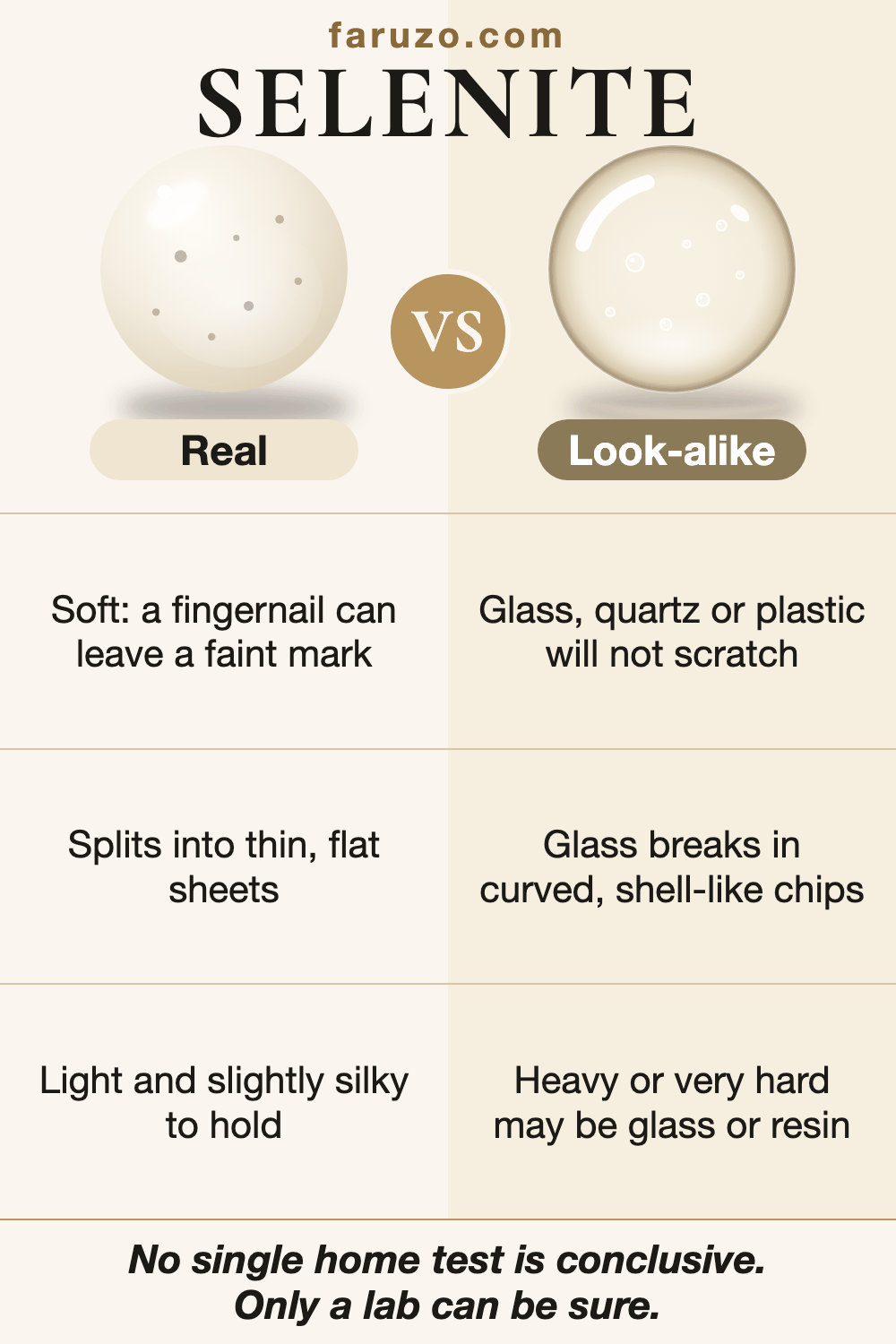
- Try a gentle fingernail test in a hidden spot. Real selenite is Mohs 2, so a fingernail can leave a faint scratch. Glass and clear quartz will not scratch this way, though some plastics can, so use it with the other checks.
- Look at the way it breaks. Selenite splits into thin, flat, slightly flexible sheets and shows clean, straight edges, while glass breaks in curved shell-like chips and quartz does not split flat.
- Check the weight and feel. Gypsum is light and slightly waxy or silky. A tower or wand that feels heavy, very hard or perfectly uniform may be glass, resin or a different mineral such as calcite or barite.
- Be careful with bright colours. Selenite is naturally colourless to white, so strongly coloured pieces are likely dyed or coated. That is not always a problem, but a good seller will say so, and dyed pieces can stain or fade if they get damp.
- Do not test by dropping it in water; use the fingernail and breakage checks instead, and ask what it is.
Wearing Selenite
Ring
Avoid
Splits easily along a flat plane, so a ring is best avoided.
Bracelet
Avoid
One knock on the wrist can split it along a flat plane.
Pendant
Avoid
A pendant has to stay dry, so it is best avoided.
Earrings
Avoid
Rain and showers can ruin it, so earrings are best avoided.
Guide for everyday wear, based on hardness and care notes. Safe, Careful or Avoid.
At Mohs 2 with perfect cleavage and water sensitivity, selenite is poorly suited to rings, bracelets or anything worn daily. It scratches, chips and splits easily, and sweat and water can slowly dull it. It fits best as a display piece, a lamp or a stone kept on a shelf. Even a pendant or earrings are best avoided; if worn at all, wear them rarely, keep them dry and expect them to wear. For jewelry meant for everyday use, a durable metal piece is the safer choice.
Related stones
Questions about Selenite
What does selenite mean?
In crystal tradition selenite is the moonlight stone, traditionally associated with clarity, calm and mental focus. The name comes from the Greek word for the Moon. These are symbolic meanings from tradition, not facts about the stone or claims about your health.
Can selenite go in water?
No. Selenite is gypsum, so soaking or regular rinsing will cloud and roughen it. A quick splash wiped off right away is unlikely to leave visible damage.
How do you clean selenite?
Dry wipe only, with a soft cloth or a dry soft brush, and keep it in its own pouch so harder stones cannot scratch it.
How hard is selenite?
Selenite is Mohs 2, soft enough that a fingernail can scratch it. For comparison, quartz is 7. It also has perfect cleavage, so it splits into flat sheets under light pressure. Handle pieces gently and avoid knocks.
Is selenite a real crystal or just gypsum?
Both. Selenite is the clear, crystalline form of the mineral gypsum, so a real selenite piece is natural gypsum. Satin spar and alabaster are other forms of the same mineral, with a fibrous or fine-grained look instead of clear and glassy.
Is selenite the same as moonstone?
No. They are different minerals: selenite is soft gypsum, while moonstone is a much harder gemstone with a floating blue-white glow. They are often linked because both are tied to the Moon in tradition.
Does selenite really cleanse other crystals?
Many people believe it does, and it is a popular tradition. There is no scientific basis for it. It is folklore about the stone, and the stone itself still needs to be kept dry and handled gently.
Where are some of the biggest selenite crystals?
Some of the largest natural crystals ever found are selenite beams in a cave about 300 metres underground at Naica in Mexico. The biggest reported is about 11.4 metres long. The mine has reportedly flooded again, so the cave is reportedly not accessible.
Where does most selenite come from?
Selenite is a common mineral found in many dry regions. Morocco is a well-known source of gypsum flowers and raw pieces, and it is also found in the United States, Brazil and elsewhere. Exact market shares are not well documented.
How can you tell real selenite from glass?
Real selenite is soft, so a fingernail can leave a faint mark, and it splits into thin flat sheets. Glass is harder and breaks in curved chips. Strongly coloured pieces are likely dyed.
Is selenite safe to wear as jewelry?
It is not ideal. Selenite is soft, scratches easily and reacts to water, so rings, bracelets, pendants and earrings will wear quickly. It suits display, lamps and gentle handling better than daily wear.
Is selenite a birthstone?
No. Selenite is not on the standard modern or traditional birthstone lists. Any month pairing you see is a folk or crystal-shop association that varies between lists.