
Crystal guide
Apophyllite Meaning, Properties and Care
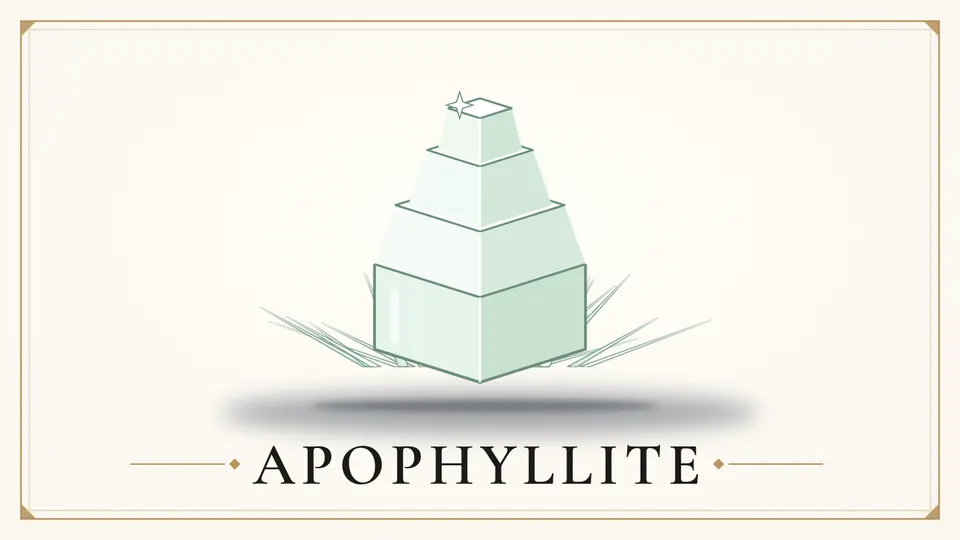
Apophyllite is not one mineral but a small group of closely related ones: glassy, usually colourless or white crystals that grow in gas cavities in volcanic rock. It is soft (Mohs 4.5 to 5), brittle and splits along a flat plane, and its name refers to the way it flakes apart when heated, so it suits display far better than daily wear. In crystal tradition it is linked to clarity and calm.
At a glance
- A group of related minerals, formula (K,Na)Ca4Si8O20(F,OH)·8H2O, tetragonal, usually colourless or white.
- Hardness is only 4.5 to 5 on the Mohs scale, with perfect cleavage and a brittle break.
- Its name means roughly "it flakes off": heat makes it lose water and flake apart.
- Care: no heat, no acids, no soaking. Best kept as a display piece, not worn every day.
Quick facts
| Family | Apophyllite group (phyllosilicates, or sheet silicates); members include fluorapophyllite-(K), fluorapophyllite-(Na) and hydroxyapophyllite-(K) |
|---|---|
| Chemical formula | (K,Na)Ca4Si8O20(F,OH)·8H2O |
| Crystal system | Tetragonal, as tabular to prismatic crystals that can look almost cubic |
| Mohs hardness | 4.5–5 |
| Luster | Vitreous, pearly on cleavage faces; perfect cleavage in one direction, brittle |
| Transparency | Transparent to translucent |
| Natural colors | colourless or white (the usual colours); green, pink, yellow or brown; grey, blue or violet, less often |
| Main localities | India (Deccan Traps basalt, including the Pune and Nashik areas); Germany (Harz Mountains, pink crystals); South Africa (Kalahari manganese fields); USA (New Jersey, Virginia, Arizona); Canada (Mont Saint-Hilaire); Norway (Kongsberg) |
Apophyllite at a glance, in pictures
Chakras (traditional)
Hardness range
Natural colors
- colourless or white (the usual colours)
- green, pink, yellow or brown
- grey, blue or violet, less often
Common forms of Apophyllite
- Rough raw chunk
How hard is Apophyllite?
- Talc 1
- Gypsum 2
- Copper coin ~ 3
- Calcite 3
- Fluorite 4
- Apophyllite 4.5–5
- Apatite 5
- Glass ~ 5.5
- Steel knife ~ 5.5
- Orthoclase 6
- Quartz 7
- Topaz 8
- Corundum 9
- Diamond 10
What it is and where it comes from
The name comes from a Greek word meaning roughly "it flakes off". The mineral tends to flake apart when heated, because it loses water held inside its structure.
Apophyllite once named a single mineral. In the late 1970s it was redefined as a group of chemically similar minerals, including fluorapophyllite-(K), fluorapophyllite-(Na) and hydroxyapophyllite-(K). They differ mainly in whether fluorine or hydroxide, and potassium or sodium, sits in one place in the structure.
René-Just Haüy gave the mineral its name in the early 1800s.
Apophyllite is a secondary mineral. It forms later in gas cavities in basalt and other volcanic rock, and it can be found alongside zeolite minerals such as stilbite.
The Deccan Traps basalt of western India is a notable source of large, clear crystals, including around Pune and Nashik. Large crystals near Bombay (Mumbai) were reportedly found during railway construction.
In crystal tradition
What follows is belief and folklore, passed down in crystal tradition. It is not measured fact.
Traditionally associated with: clarity, intuition, calm.
Apophyllite is traditionally associated with the Crown and Third Eye chakras and with clarity, intuition and calm. Its clear, glassy look is the usual starting point for these ideas.
These associations are a modern spiritual tradition and a matter of belief, not a measured property of the mineral.
How to care for Apophyllite
- Water Caution
- Sunlight Unknown
- Salt Unknown
- Heat Caution
- Ultrasonic Avoid
- Chemicals Avoid
Safe = fine as a rule · Caution = only briefly or gently · Avoid = can damage the stone · Unknown = no reliable guidance.
Dust with a soft brush or an air blower, or use a barely damp cloth dried at once. Do not soak it. Heat makes this mineral lose water and flake apart, and acids can also make it flake, so keep it away from hot water, steam, radiators and acidic cleaners such as vinegar or lemon. Skip ultrasonic cleaners as a precaution, because vibration can split a brittle stone along its cleavage plane. The effect of salt and of long, strong sun is not well documented. Many pieces are sold still attached to host rock or companion minerals, so wash gently or not at all. Store it apart from harder stones so it is not scratched.
Real or fake? Look-alikes and treatments
Often confused with
- Clear quartz points
- Calcite
- Selenite (gypsum)
- Zeolites such as chabazite
- Glass or crystal glass
Common look-alikes
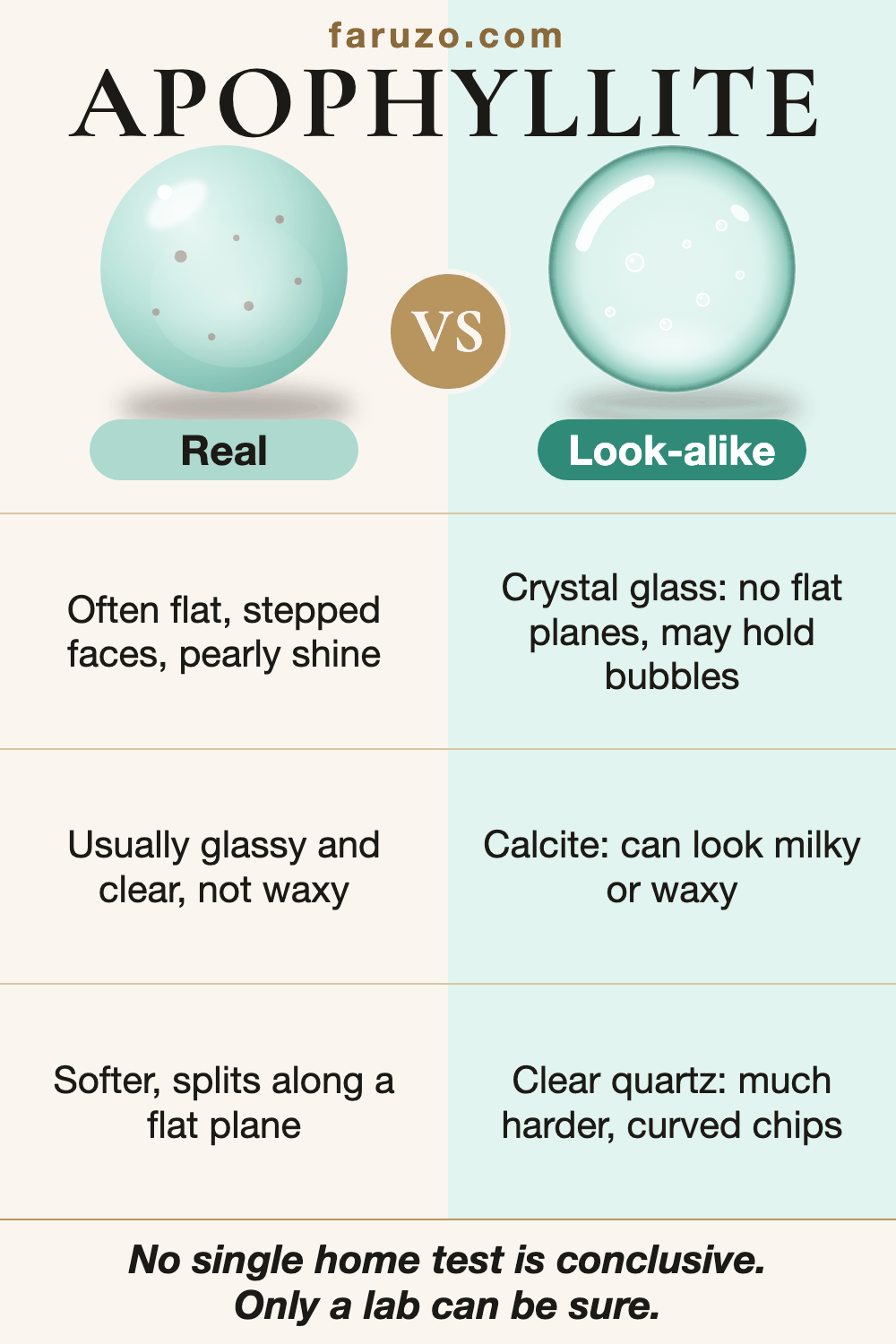
- Clear quartz points. Clear quartz is a different, much harder mineral (Mohs 7) often sold as clear points. Quartz grows as six-sided prisms capped by pyramid-like ends, has no cleavage and breaks in curved, shell-like chips. Apophyllite is tetragonal, softer and splits along a flat plane with a pearly shine.
- Calcite. Calcite is a different mineral with a different crystal form and a lower hardness (Mohs 3). It can look milky or waxy, while apophyllite is usually glassy and clearer.
- Selenite (gypsum). Selenite is a clear variety of gypsum at Mohs 2, soft enough to scratch with a fingernail. Selenite is often seen as long, columnar or fibrous pieces, while apophyllite more often forms tabular to almost cubic crystals.
- Zeolites such as chabazite. Zeolites are a separate group, and apophyllite is often confused with them. Apophyllite is a sheet silicate, zeolites are framework silicates. Chabazite shows rhombohedral crystal angles and its crystals are not striated like apophyllite's.
- Glass or crystal glass. Glass is made, not grown, and can be produced in almost any colour. It has no cleavage planes and may hold round bubbles or swirl marks, while apophyllite shows flat, stepped surfaces with a pearly shine.
Safe checks you can do
- Ask the seller in writing what the piece is and where it comes from: natural apophyllite, a different mineral such as quartz or calcite, or glass.
- Look at any broken or flat face. A natural piece shows flat, stepped surfaces with a pearly shine. Quartz has no cleavage and breaks in curved, shell-like chips.
- Natural clusters grow in cavities in volcanic rock, so a piece may keep some host rock or companion minerals on its base.
- Do not test a piece you want to keep with heat, acid or a scratch. Heat and acid make it flake apart, and it is brittle and marks easily.
Wearing Apophyllite
Ring
Avoid
Splits easily along a flat plane, so a ring is best avoided.
Bracelet
Avoid
One knock on the wrist can split it along a flat plane.
Pendant
Careful
It can split along a flat plane, so keep it protected.
Earrings
Careful
A flat-plane split is possible, so keep earrings for dressy wear.
Guide for everyday wear, based on hardness and care notes. Safe, Careful or Avoid.
Apophyllite is soft (Mohs 4.5 to 5), brittle and splits along a flat plane, so a ring or bracelet is best avoided: one knock can crack a piece. It is a display and collector crystal. If you do wear a small piece as a pendant or in earrings, keep it for occasional, gentle wear, away from hot water, steam and hard knocks.
Related stones
Questions about Apophyllite
What does apophyllite mean?
In crystal tradition apophyllite is linked to clarity, intuition and calm, partly because of its clear, glassy look. That is a belief, not a measured property of the mineral.
What is apophyllite?
Apophyllite is a group of closely related sheet-silicate minerals. They usually form glassy, colourless or white crystals in gas cavities in basalt and other volcanic rock.
Is apophyllite one mineral or several?
Several. The name once belonged to a single mineral, but since the late 1970s it covers a group of chemically similar ones, such as fluorapophyllite-(K), fluorapophyllite-(Na) and hydroxyapophyllite-(K).
How hard is apophyllite?
About 4.5 to 5 on the Mohs scale, a little softer than apatite and well below quartz at 7. It is also brittle, with perfect cleavage, so it chips and splits more easily than its number alone suggests.
Why is it called apophyllite?
The name comes from a Greek word meaning roughly "it flakes off". The mineral tends to flake apart when heated, because it loses water held in its structure.
Is apophyllite a birthstone?
No. Apophyllite is not on the usual modern or traditional birthstone lists.
Is apophyllite a zeolite?
No. Apophyllite is a sheet silicate, while zeolites are framework silicates. The two are often confused and can grow in the same gas cavities in volcanic rock.
Can apophyllite be worn in jewelry?
It is not well suited to it. Apophyllite is soft and splits along a flat plane, so a ring or bracelet is best avoided. A pendant or earrings are possible for occasional, gentle wear, but display suits it better.
Can apophyllite get wet?
A barely damp cloth is fine for marks if you dry the piece at once. Do not soak it, and keep it away from hot water, steam and acidic cleaners, which can make it flake.
Does heat damage apophyllite?
Heat is the mineral's known weak point. It loses water and flakes apart when heated, so keep it away from radiators, steam and hot water.
Is apophyllite the same as selenite?
No. Selenite is a clear variety of gypsum at Mohs 2, soft enough to scratch with a fingernail. Apophyllite is harder, at Mohs 4.5 to 5, and is a different mineral group.
How can I tell apophyllite from clear quartz?
Quartz is much harder (Mohs 7), has no cleavage and breaks in curved, shell-like chips. Apophyllite is softer and splits along a flat plane with a pearly shine. A lab can confirm a piece when it matters.
Does apophyllite come in colours?
It is usually colourless or white. Green, pink, yellow and brown pieces also occur, and blue or violet are reported less often.
Where does apophyllite come from?
The Deccan Traps basalt of western India, around Pune and Nashik, is a notable source. It also occurs in Germany, South Africa, the USA, Canada and Norway.
What should I ask before buying an apophyllite piece?
Ask what the piece is and where it comes from, and whether it is natural apophyllite or another mineral or glass. Ask for a clear photo of its base and any broken faces. Handle it gently, because it is brittle and splits along a flat plane.