
Crystal guide
Pearl Meaning, Properties and Care
Pearl is an organic gem made by a living mollusc, built up in layers of nacre (calcium carbonate). It is soft, at about 2.5 to 4 on the Mohs scale (some lists go slightly higher), and perfume, acid, sweat and heat can all harm it. Natural pearls form by chance, while cultured pearls are real pearls grown with human help. In crystal tradition pearl is a gentle stone of purity, calm and wisdom.
At a glance
- Made by a mollusc in layers of nacre (calcium carbonate): an organic gem, not a mineral.
- Mohs only about 2.5 to 4, so it is very soft. Perfume, acid, sweat and heat can all harm it.
- Cultured pearls are real pearls grown with human help, and dyed or bleached pearls are real pearls too. Look-alikes are glass, plastic or coated beads.
- The June birthstone, and the gem given for the 3rd and 30th wedding anniversaries.
Quick facts
| Family | Organic gem: layers of nacre made by a mollusc (mainly calcium carbonate as aragonite, bound by conchiolin) |
|---|---|
| Chemical formula | CaCO3 (calcium carbonate), usually as aragonite with an organic binder |
| Crystal system | None as a whole: built up in concentric layers of nacre, so an organic gem rather than a mineral |
| Mohs hardness | 2.5–4 |
| Luster | Pearly, with a soft glow from the layered nacre |
| Natural colors | white and cream, black and gray, yellow, orange, pink, lavender, green, blue |
| Main localities | China (the leading source of freshwater pearls); Japan and China (Akoya); Australia, Indonesia and the Philippines (South Sea); French Polynesia (Tahitian); the Persian Gulf (historic fishery) |
| Common treatments | bleaching with hydrogen peroxide to lighten and even out colour is routine; dyeing, mostly of lower-quality pearls; irradiation, which can darken some pearls to dark gray; a colourless hard coating is reportedly sometimes applied; ask the seller in writing which treatments, if any, were used |
| Birth month | June (the standard birthstone for the month) |
Looking for the month? June birthstone guide
Pearl at a glance, in pictures
Chakras (traditional)
Hardness range
Natural colors
- white and cream
- black and gray
- yellow
- orange
- pink
- lavender
- green
- blue
Traditionally linked to
- Planet
- Moon
- Zodiac
- CancerGemini
- Element
- Water
Common forms of Pearl
- Bead drilled bead
- Sphere ball
How hard is Pearl?
- Talc 1
- Gypsum 2
- Copper coin ~ 3
- Calcite 3
- Pearl 2.5–4
- Fluorite 4
- Apatite 5
- Glass ~ 5.5
- Steel knife ~ 5.5
- Orthoclase 6
- Quartz 7
- Topaz 8
- Corundum 9
- Diamond 10
What it is and where it comes from
A natural pearl forms by chance inside a mollusc, without human help. A microscopic irritant gets in and the mollusc coats it with layer after layer of nacre.
The grain-of-sand story is rarely true. The irritant is more often organic material, a parasite or displaced tissue.
More on its history
Natural pearls are very rare: hundreds of oysters or mussels may have to be opened to find a single wild pearl.
A cultured pearl starts when a technician places a bead and a piece of tissue in a host mollusc, which then coats it with nacre. The result is made of the same nacre as a natural pearl.
The Persian Gulf pearl fishery was praised by Pliny the Elder (23 to 79 AD) as the most productive in the world.
Today the large majority of pearls on the market are cultured, and freshwater pearls, led by China, are the most commonly produced type.
Pearl through time
-
c. 2206 BC
A Chinese historian writes about pearls, the earliest known reference.
-
1560
La Peregrina is reportedly found in Panama and later kept by Philip II of Spain.
-
1916
The pearl-culturing technique is patented in Japan and applied to Akoya oysters that year.
-
1917
Pierre Cartier trades a double strand of natural pearls for a mansion on Fifth Avenue in New York.
-
1928
The first small commercial crop of South Sea cultured pearls is produced.
In crystal tradition
What follows is belief and folklore, passed down in crystal tradition. It is not measured fact.
Traditionally associated with: purity, calm, wisdom.
In crystal tradition pearl is linked with purity, calm and wisdom, and with the Moon and water. These are beliefs, not measured effects of the material.
Cancer and Gemini are the zodiac signs most often paired with pearl, though zodiac links vary. This is folklore and spiritual belief.
In Western tradition pearl is a classic bridal gem, and it is the traditional gift for the 3rd and 30th wedding anniversaries.
How to care for Pearl
- Water Caution
- Sunlight Caution
- Salt Unknown
- Heat Avoid
- Ultrasonic Avoid
- Chemicals Avoid
Safe = fine as a rule · Caution = only briefly or gently · Avoid = can damage the stone · Unknown = no reliable guidance.
Wipe pearls with a very soft, clean cloth after each wearing. For a deeper clean, use lukewarm soapy water, then let a strand dry fully before you wear it. Put pearls on last, once perfume, hairspray and cosmetics have dried, because many chemicals and all acids harm nacre, and vinegar dissolves it. Keep them away from heat, steam and ultrasonic cleaners, and out of long, intense light, which can dry the nacre and crack it.
Real or fake? Look-alikes and treatments
Often confused with
- Glass-bead pearls
- Plastic pearls
- Shell-core beads with pearlescent paint
- Mother-of-pearl composites
Common look-alikes
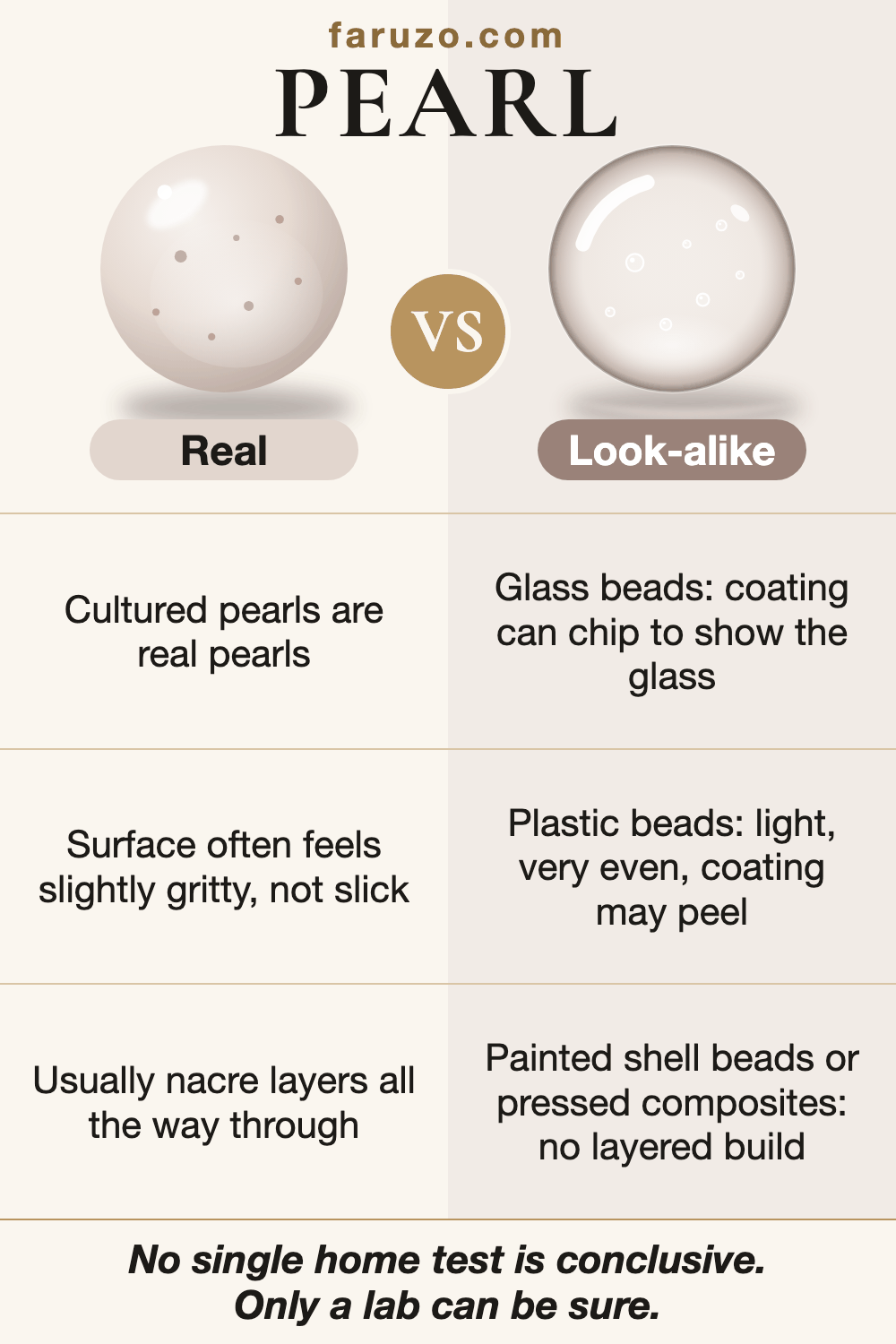
- Glass-bead pearls. A glass bead dipped or sprayed with a pearlescent coating. It can look convincing, but the coating can chip or wear to show the glass, and the surface tends to feel smooth rather than slightly gritty.
- Plastic pearls. Plastic beads with a pearlescent coating. They can feel light and look very even from one bead to the next, and the coating can peel or flake with wear.
- Shell-core beads with pearlescent paint. A bead cut from shell and coated with pearlescent paint is a different material, not a pearl. Look closely at the surface and at the drill hole, where a worn coating can show the bead underneath.
- Mother-of-pearl composites. Crushed shell powder pressed into a bead shape. It has a pearly sheen but none of the layered build of a pearl, so a closer look or a lab check can tell them apart.
Safe checks you can do
- Ask the seller in writing whether the pearls are natural, cultured, freshwater or saltwater, and whether they are dyed, bleached or coated. Cultured and treated pearls are real pearls, while glass, plastic and coated beads are a different material.
- Some sellers suggest touching a pearl lightly to the edge of a tooth: nacre tends to feel slightly gritty, while a perfectly smooth feel can point to an imitation. This is not conclusive, since some coated imitations feel gritty too, and rubbing can mark a pearl you plan to keep.
- Look closely at the surface and the drill hole. A coating on an imitation can chip or peel, while a real pearl is nacre all the way through its layers.
- Only a lab can tell a natural pearl from a cultured one, usually with X-rays that show a cultured pearl's bead centre and a natural pearl's growth rings.
- Do not try acid, vinegar or heat on a pearl. Acid dissolves nacre and heat can burn it, so a lab check is the safe route for a pearl that matters.
Wearing Pearl
Ring
Avoid
Soft and easily scratched: keep for dressy, occasional wear.
Bracelet
Avoid
Knocks, soap and sweat mark it: dressy, occasional wear only.
Pendant
Avoid
Perfume and sweat harm it: dressy, occasional wear only.
Earrings
Avoid
Hairspray and perfume harm it: occasional wear only.
Guide for everyday wear, based on hardness and care notes. Safe, Careful or Avoid.
Pearl is very soft and easily harmed by perfume, acid, sweat and heat, so rings, bracelets, pendants and earrings are all best avoided for everyday wear. If you do wear pearls, keep them for dressy, occasional wear. A ring or bracelet meets knocks, soap and hot water most often. A pendant or earrings sit clear of more knocks, but they still meet perfume, hairspray and sweat. Put pearls on last, wipe them after wearing, and keep them out of heat and steam.
Related stones
Questions about Pearl
What does pearl mean?
In crystal tradition pearl is a gentle stone of purity, calm and wisdom, linked with the Moon, water and the Crown chakra. That is a belief, not a fact about the material. Its real story is a gem made by a living mollusc, layer by layer.
What is a pearl?
A pearl is an organic gem made inside a mollusc. A microscopic irritant gets in, and the mollusc coats it with layers of nacre, which is mostly calcium carbonate. The result is a soft gem with a pearly glow.
Is pearl the June birthstone?
Yes. Pearl is a June birthstone, shared with moonstone and alexandrite. It is also the gem given for the 3rd and 30th wedding anniversaries.
Are cultured pearls real pearls?
Yes. A cultured pearl is a real pearl, made of the same nacre as a natural one. The difference is that a technician places the bead and tissue in the mollusc, which then grows the pearl. Most pearls on the market today are cultured.
What is the difference between natural and cultured pearls?
A natural pearl forms by chance, without human help, and is very rare. A cultured pearl is grown with human help and care. Both are real pearls, and a lab usually needs X-rays to tell them apart.
What are Akoya, South Sea, Tahitian and freshwater pearls?
They are among the main kinds of cultured pearl. Akoya are the familiar white or cream saltwater pearls, South Sea pearls are large and range from white to golden, Tahitian pearls are often dark, and freshwater pearls are the most commonly produced. Japan, Australia, French Polynesia and China are leading sources.
How hard is pearl?
About 2.5 to 4 on the Mohs scale (some lists go slightly higher), so it is very soft and scratches easily. It is also sensitive to acid, heat and many chemicals, which matters as much as hardness.
Are pearls dyed or bleached, and are they still real?
Often, yes. Bleaching to even out colour is routine, and dye is used on some lower-quality pearls. These are treatments of real pearls, so the pearls are still real, but a seller should say so.
How can you tell a real pearl from an imitation?
A home look can only hint. A real pearl has a soft glow from layered nacre and tends to feel slightly gritty, while many imitations are perfectly smooth and uniform. Glass, plastic and coated beads can fool the eye, so ask the seller and use a lab for a pearl that matters.
Does the tooth test work?
It is not conclusive. Some sellers suggest touching a pearl to a tooth edge, where nacre tends to feel slightly gritty and a smooth feel may point to an imitation. Some coated imitations feel gritty too, and rubbing can mark a pearl, so use it only as a hint.
What are glass, plastic and shell-bead pearls?
They are look-alikes: beads of glass, plastic or cut shell coated with a pearlescent layer. They are different materials from a pearl. The coating can chip or wear, which is one way they give themselves away.
How do you clean and care for pearls?
Wipe them with a very soft, clean cloth after each wearing, and use lukewarm soapy water only for an occasional deeper clean. Put them on after perfume and hairspray have dried, and never use vinegar, steam or an ultrasonic cleaner.
Can you wear a pearl ring every day?
A ring is best avoided for daily wear. Pearl is very soft, so everyday knocks scratch it, and a ring meets soap, hot water, perfume and sweat too often.
What should I ask a seller before buying pearl jewelry?
Ask whether the pearls are natural or cultured, freshwater or saltwater, and whether they are dyed, bleached or coated. Ask whether they are real pearls at all, or glass, plastic or shell beads with a pearlescent coating. Get the answers in writing.
Where do pearls come from?
Freshwater pearls come mostly from China. Akoya pearls come from Japan and China, South Sea pearls from Australia, Indonesia and the Philippines, and Tahitian pearls from French Polynesia. The Persian Gulf was the best-known historic fishery.