
Crystal guide
Alexandrite Meaning, Properties and Care
Alexandrite is the colour-change variety of chrysoberyl, a beryllium aluminium oxide (BeAl2O4). It looks green in daylight and red to purplish red in lamplight, and at Mohs 8.5 it is hard enough for daily wear. Natural alexandrite is very rare, so most alexandrite in jewellery is lab-created, and a gem lab report is how to tell which one you have. In tradition it is a stone of balance and change.
At a glance
- Colour change: green to bluish green in daylight, red to purplish red in lamplight.
- Formula BeAl2O4, a form of chrysoberyl. Mohs 8.5, with excellent toughness.
- Natural stone is very rare. Most alexandrite in jewellery is lab-created, and a gem lab report tells which.
- A June birthstone, with pearl and moonstone, and the traditional gem for the 55th anniversary.
Quick facts
| Family | Chrysoberyl (beryllium aluminium oxide), the colour-change variety; not a beryl, despite the similar name |
|---|---|
| Chemical formula | BeAl2O4, with traces of chromium behind the colour change |
| Crystal system | Orthorhombic |
| Mohs hardness | 8.5 |
| Luster | Vitreous; rated excellent for toughness, with no cleavage trouble in normal wear |
| Transparency | Cut as transparent faceted stones, usually mixed cuts; some stones show a cat's-eye effect |
| Natural colors | green to bluish green in daylight or fluorescent light; red to purplish red in incandescent light; three pleochroic colours: green, orange and purple-red |
| Main localities | Russia (Ural Mountains, the original source); Brazil; Sri Lanka; East Africa (including Tanzania); India (Andhra Pradesh); Madagascar |
| Common treatments | the main question when buying is origin: natural, lab-created or another colour-change material; ask the seller in writing, and ask for a gem lab report for any stone priced as natural |
| Birth month | June (with pearl and moonstone) |
Looking for the month? June birthstone guide
Alexandrite at a glance, in pictures
Hardness range
Natural colors
- green to bluish green in daylight or fluorescent light
- red to purplish red in incandescent light
- three pleochroic colours: green, orange and purple-red
Common forms of Alexandrite
- Rough raw chunk
- Faceted cut gem
- Cabochon smooth dome
How hard is Alexandrite?
- Talc 1
- Gypsum 2
- Copper coin ~ 3
- Calcite 3
- Fluorite 4
- Apatite 5
- Glass ~ 5.5
- Steel knife ~ 5.5
- Orthoclase 6
- Quartz 7
- Topaz 8
- Alexandrite 8.5
- Corundum 9
- Diamond 10
What it is and where it comes from
Alexandrite is the colour-change variety of chrysoberyl. Traces of chromium replace some aluminium in the crystal and absorb light in a narrow yellow band, so daylight leaves the stone looking green and lamplight leaves it looking red. It is often put as emerald by day, ruby by night.
The colour change is a separate effect from pleochroism. Pleochroism gives three colours, green, orange and purple-red, depending on the direction light passes through the crystal.
The stone is often said to have been found in Russia's Ural Mountains around 1830 and named for Alexander II, then the young heir to the throne. Who first found it is debated, so the story is best read as lore.
Its red and green are often said to have matched the military colours of imperial Russia, which helped the stone catch the country's attention.
The Ural deposits did not last. Most alexandrite now comes from Brazil, Sri Lanka and East Africa, with more in India and Madagascar. Newer stones can include fine ones, but many show a less precise colour change and muddier hues than the old Russian stones.
Fine natural alexandrite is scarce, above all in larger sizes. Many cut stones are under about one carat, and larger stones of good quality can rise sharply in price.
Some stones show a cat's-eye effect, caused by parallel needle-like inclusions, instead of or alongside the colour change.
Lab-created alexandrite is chrysoberyl too. It is grown by flux, pulled (Czochralski) or hydrothermal methods, and hydrothermal stones have the same physical and chemical properties as natural ones. It is real alexandrite material made by people rather than mined, and it should be sold as lab-created.
In crystal tradition
What follows is belief and folklore, passed down in crystal tradition. It is not measured fact.
Traditionally associated with: balance, change, seeing both sides.
In crystal tradition alexandrite is a stone of balance and change, because the gem itself looks like two different stones in two lights. This is a belief drawn from how it looks, not a fact about the stone.
It is often described as a stone for seeing a situation from more than one side. Treat that as folklore.
How to care for Alexandrite
- Water Safe
- Sunlight Unknown
- Salt Unknown
- Heat Caution
- Ultrasonic Caution
- Chemicals Unknown
Safe = fine as a rule · Caution = only briefly or gently · Avoid = can damage the stone · Unknown = no reliable guidance.
Warm soapy water and a soft brush are a good way to clean alexandrite. Ultrasonic and steam cleaners are usually safe too, but if you do not know how a stone was made or treated, wipe it with a damp cloth instead. Store it apart from other gems so a harder one cannot scratch it.
Real or fake? Look-alikes and treatments
Often confused with
- Colour-change corundum sold as alexandrite
- Colour-change sapphire
- Colour-change spinel
- Colour-change garnet
- Colour-change glass
Common look-alikes
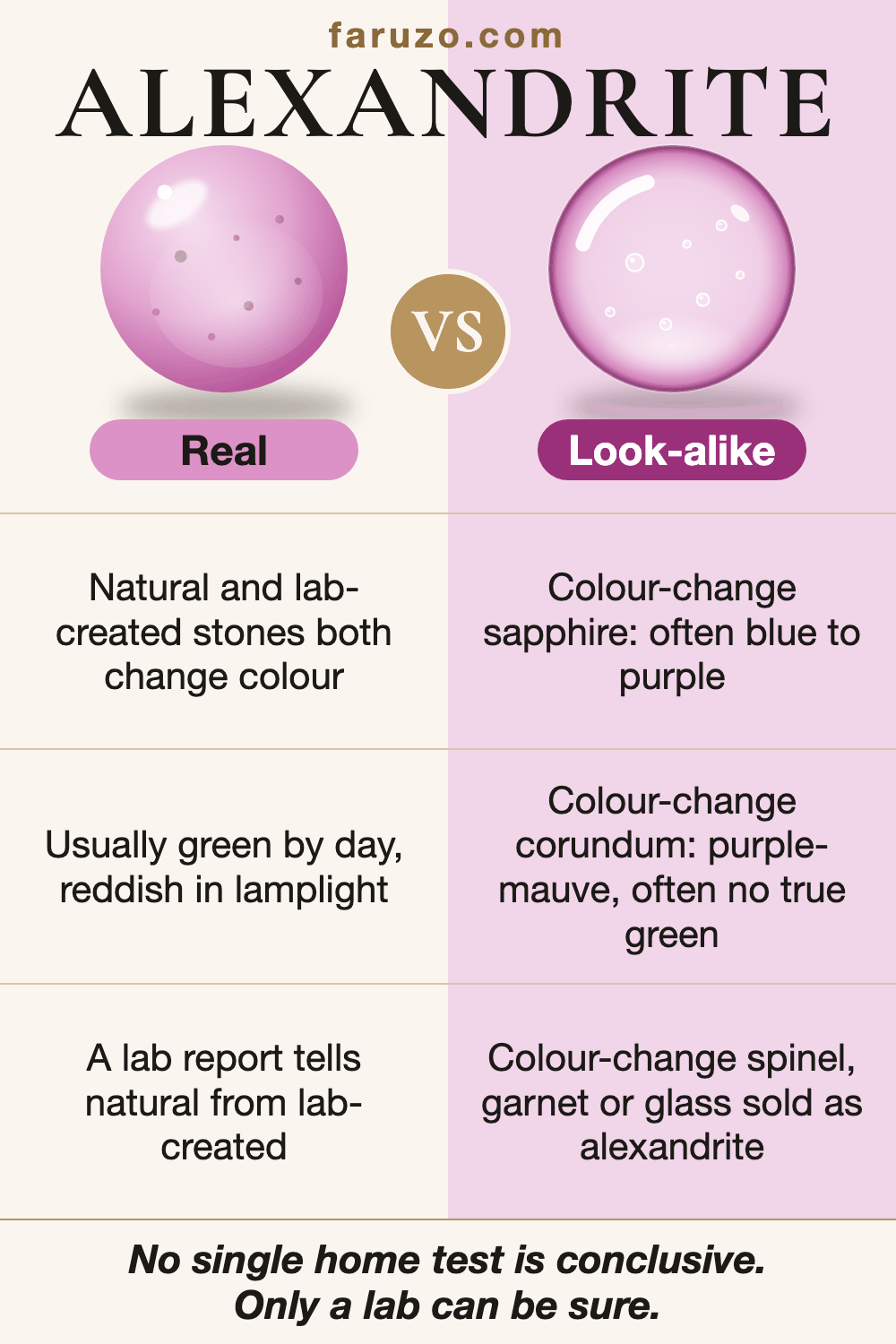
- Colour-change corundum sold as alexandrite. This is corundum with trace elements such as vanadium, not chrysoberyl, and it is sometimes labelled synthetic alexandrite by mistake. Its change tends to run to a purple-mauve with no true green, which is not how alexandrite looks. A gem lab can tell the two apart.
- Colour-change sapphire. Colour-change sapphire is a different mineral, most often going from blue in daylight to purple under incandescent light. The colour pair is usually different from alexandrite's green and red.
- Colour-change spinel. Colour-change spinel is a different mineral that is sometimes sold as synthetic alexandrite. The colour change alone cannot settle it, so a gem lab can confirm.
- Colour-change garnet. A rare garnet from Madagascar goes from blue-green in daylight to purple in incandescent light. It is a different mineral and a different colour pair from alexandrite.
- Colour-change glass. Glass can be made to shift colour and is a common budget imitation. Under magnification it can show round gas bubbles or swirl lines, and a gem lab can confirm what it is.
Safe checks you can do
- Ask the seller in writing whether the stone is natural alexandrite, lab-created alexandrite or another colour-change material.
- For any stone priced as natural, ask for a gem lab report. It is the way to tell natural from lab-created, and a lab-created stone should be sold as such.
- Compare the stone in daylight and under a warm lamp. Alexandrite shifts from green to bluish green towards red to purplish red. A change with no real green points to another material.
- Treat a large, clean stone at a low price with care. Natural alexandrite is very rare, and larger stones of good quality are scarcer still.
- Under magnification a very clean stone with curved striations can point to a pulled lab-created stone, while flux-grown stones can show inclusions that look natural. These are hints, not proof.
- Do not rely on a scratch test or a hardness test. Lab-created alexandrite has the same hardness as natural stone, so the test cannot tell them apart.
Wearing Alexandrite
Ring
Safe
Hard enough for daily wear.
Bracelet
Safe
Tough enough for everyday bracelets.
Pendant
Safe
A pendant sits clear of most knocks.
Earrings
Safe
Earrings rarely take hard knocks.
Guide for everyday wear, based on hardness and care notes. Safe, Careful or Avoid.
At Mohs 8.5 with excellent toughness, alexandrite suits rings, bracelets, pendants and earrings for daily wear. Hard is not unbreakable, so take a ring off for heavy work and hard knocks. A lab-created stone has the same hardness as a natural one, so origin and price, not durability, are the real difference.
Related stones
Questions about Alexandrite
What does alexandrite mean?
In crystal tradition alexandrite stands for balance and change, because the stone looks like two different gems in two lights. That is a belief, not a fact about the stone. Its practical claim to fame is a green-to-red colour change and a hardness of Mohs 8.5.
What is alexandrite?
Alexandrite is the colour-change variety of chrysoberyl, a beryllium aluminium oxide with the formula BeAl2O4. It is not a beryl, despite the similar name. Traces of chromium give it the colour change.
Is alexandrite a June birthstone?
Yes. June has three birthstones: pearl, moonstone and alexandrite. Alexandrite is also the traditional gem for the 55th wedding anniversary.
Why does alexandrite change colour?
Chromium in the crystal absorbs light in a narrow yellow band. Daylight leaves the stone looking green to bluish green, and incandescent light, such as a lamp or candle flame, leaves it looking red to purplish red. The stone itself does not change; only the light does.
How hard is alexandrite?
Mohs 8.5, below sapphire and ruby (9) and diamond (10) but harder than most gems. Its toughness is also rated excellent, so it resists both scratches and knocks well.
Can you wear an alexandrite ring every day?
Usually yes, since Mohs 8.5 and excellent toughness suit rings. Hard is not unbreakable, so take it off for heavy work. The same applies to lab-created stones, which are equally hard.
Is lab-created alexandrite real?
Lab-created alexandrite is real alexandrite material, chrysoberyl made by people instead of mined. Hydrothermal stones have the same physical and chemical properties as natural ones. It should be sold as lab-created, and it is priced differently from a natural stone.
Is the alexandrite in a shop natural or lab-created?
Natural alexandrite is very rare, so most alexandrite in jewellery is lab-created. Ask the seller in writing which it is, and ask for a gem lab report for any stone priced as natural. A report is how to tell natural from lab-created.
I found an alexandrite ring at a low price. Is it natural?
Most likely not. At a low price it is probably lab-created alexandrite or a different colour-change material, since natural alexandrite is among the more expensive coloured gems. Ask in writing what the stone is. Lab-created alexandrite is a fair product when sold as such.
What is sold as alexandrite but is a different material?
Colour-change corundum, sapphire, spinel, garnet and glass are all sold under the name. They are different materials, not chrysoberyl. Corundum with trace elements such as vanadium is the classic one, and it tends to shift to a purple-mauve with no true green.
How can you tell natural, lab-created and look-alike alexandrite apart?
A home look can only hint. Alexandrite shifts from green to red, while many look-alikes shift between other colours. Natural and lab-created chrysoberyl can look almost the same, so a gem lab report is the way to tell a stone that matters.
Why is natural alexandrite so expensive?
Fine natural stones are scarce, above all in larger sizes. Most cut stones are under one carat, and the original Russian deposits did not last. The strongest colour change commands the most.
Where does alexandrite come from?
The Ural Mountains of Russia are the original source, but those deposits did not last. Most alexandrite now comes from Brazil, Sri Lanka and East Africa, with more in India and Madagascar.
Who is alexandrite named after?
It is often said to be named for Alexander II, then the young heir to the Russian throne. The story is told as lore, and who first found the stone is debated.
Can alexandrite get wet, and can you use an ultrasonic cleaner?
Yes to water. Warm soapy water and a soft brush are best. Ultrasonic and steam cleaners are usually safe too, but if you do not know how a stone was made or treated, wipe it with a damp cloth.