
Crystal guide
Moonstone Meaning, Properties and Care
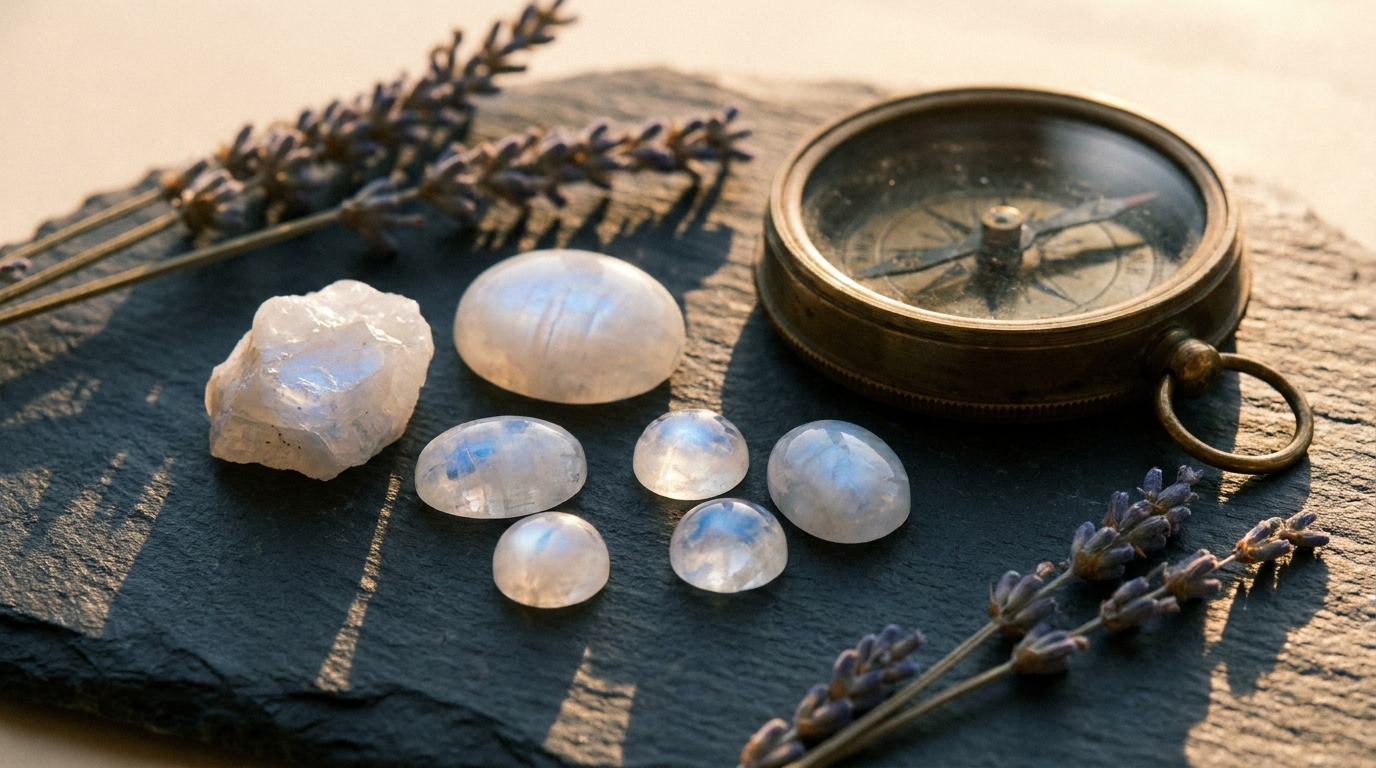
Moonstone is a feldspar (about KAlSi3O8, Mohs 6 to 6.5) known for adularescence, a soft blue-white glow that seems to float under the surface. The effect is real optics, not a coating. It is a June birthstone alongside pearl and alexandrite, and in crystal tradition it is a stone of intuition and new beginnings.
At a glance
- Hardness Mohs 6 to 6.5: softer than quartz (7) or sapphire (9), with perfect cleavage, so hard knocks can chip it.
- The glow is adularescence: light scattering between thin alternating layers of orthoclase and albite feldspar.
- A June birthstone with pearl and alexandrite.
- Rainbow moonstone is a pale labradorite, a different feldspar, sold under the moonstone name.
Quick facts
| Family | Feldspar group (orthoclase with albite layers) |
|---|---|
| Chemical formula | KAlSi3O8 (orthoclase); sometimes given as (K,Na)AlSi3O8 for the layered mix |
| Crystal system | Monoclinic (orthoclase) |
| Mohs hardness | 6–6.5 |
| Luster | Vitreous to pearly; perfect cleavage in one direction |
| Transparency | Transparent to translucent. The best stones are nearly transparent with few inclusions; milky material is common. |
| Natural colors | colorless, white, gray, green, peach, brown, blue sheen over a colorless body (most prized) |
| Main localities | Sri Lanka, Myanmar, India, Madagascar, Armenia, Australia, Mexico, Norway, Poland, United States |
| Common treatments | no common treatment is reported for fine moonstone; check what has been done to a stone |
| Birth month | June (with pearl and alexandrite) |
Looking for the month? June birthstone guide
Moonstone at a glance, in pictures
Chakras (traditional)
Hardness range
Natural colors
- colorless
- white
- gray
- green
- peach
- brown
- blue sheen over a colorless body (most prized)
Traditionally linked to
- Planet
- Moon
- Zodiac
- Cancer
- Element
- Water
Common forms of Moonstone
- Rough raw chunk
- Tumbled polished pebble
- Cabochon smooth dome
How hard is Moonstone?
- Talc 1
- Gypsum 2
- Copper coin ~ 3
- Calcite 3
- Fluorite 4
- Apatite 5
- Glass ~ 5.5
- Steel knife ~ 5.5
- Orthoclase 6
- Moonstone 6–6.5
- Quartz 7
- Topaz 8
- Corundum 9
- Diamond 10
What it is and where it comes from
Moonstone is a feldspar. It forms as orthoclase and albite that start mixed together and separate into thin, stacked, alternating layers as the rock cools slowly.
Light scattering between those layers gives adularescence, a milky blue-white sheen that appears to float and move as the stone turns. It is best shown by a smooth domed cabochon cut.
The Romans are said to have believed moonstone was solidified moonbeams and linked it to lunar deities, and Hindu tradition also describes it as made of moonlight.
In India moonstone is traditionally treated as sacred and is reported as a customary wedding gift. Tradition says carrying it protected travellers, especially at night or over water.
Adularescent moonstone was once called adularia, a name tied to the Adula mountains of Switzerland, an early source of fine material.
Moonstone became fashionable again in the Art Nouveau and Arts and Crafts periods, when designers such as René Lalique and Louis Comfort Tiffany set it in jewelry.
Myanmar historically produced the most valued stones, and Sri Lanka and India are major suppliers today. Fine gem material with a strong blue flash is comparatively rare, especially in large sizes.
The modern US June list was standardised around 1912, and alexandrite was added later, around 1952.
In crystal tradition
What follows is belief and folklore, passed down in crystal tradition. It is not measured fact.
Traditionally associated with: intuition, new beginnings, protection on journeys, emotional balance.
Moonstone is traditionally associated with the Third Eye and Crown chakras. This is a modern spiritual tradition, not a fact about the stone.
Moonstone is traditionally paired with Cancer, because Cancer is treated as a Moon-ruled sign in Western astrology and moonstone is treated as the Moon's gemstone, with the element Water. This is a belief-system pairing, not an astronomical one, and lists differ.
Moonstone is traditionally read as a stone of intuition, new beginnings and emotional balance, an idea rooted in old beliefs that it is made of moonlight and tied to the lunar cycle. Legends also credit it with good luck, and some believed holding one in the mouth at a full moon revealed the future. These are symbolic meanings, not effects on the body or mind.
How to care for Moonstone
- Water Caution
- Sunlight Caution
- Salt Unknown
- Heat Caution
- Ultrasonic Avoid
- Chemicals Unknown
Safe = fine as a rule · Caution = only briefly or gently · Avoid = can damage the stone · Unknown = no reliable guidance.
Clean by hand with warm water, a drop of mild soap and a soft cloth, then dry. Skip ultrasonic and steam cleaners: moonstone has perfect cleavage and a layered structure, so vibration and heat can crack it. Keep it away from strong heat, sharp temperature swings and long direct sun. Store it apart from harder stones and metals that can scratch it, and avoid salt water and harsh household chemicals.
Real or fake? Look-alikes and treatments
Often confused with
- Rainbow moonstone (labradorite)
- Opal
- Glass or synthetic look-alikes
- Opalite and sea opal
Common look-alikes
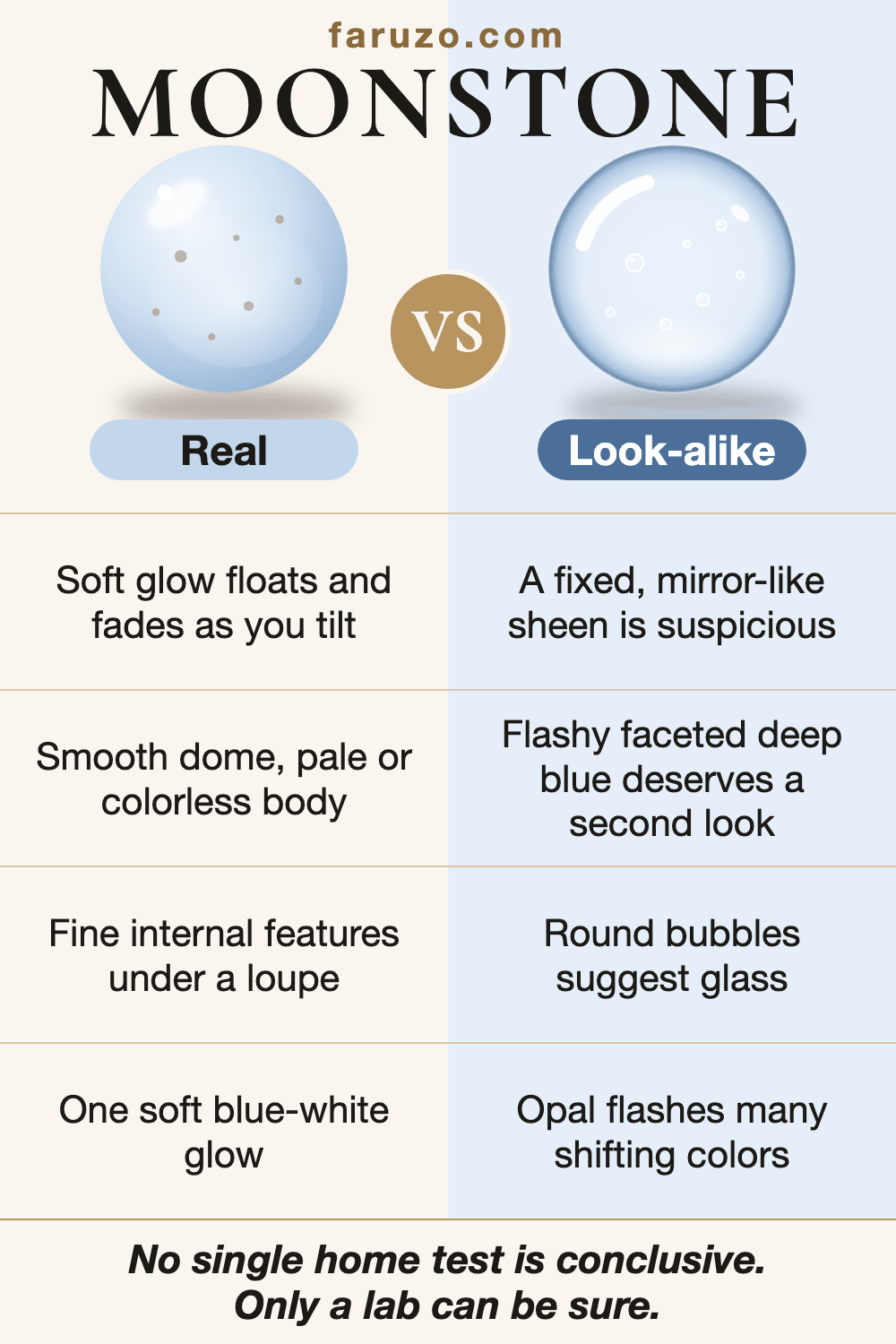
- Rainbow moonstone (labradorite). Rainbow moonstone is a pale, transparent labradorite, a plagioclase feldspar, not orthoclase moonstone. True moonstone typically shows a soft single blue-white glow over a light or colorless body, while labradorite shows bolder multicolor flashes (labradorescence), often over a darker base.
- Opal. Opal is a different material with play-of-color in many hues that shift as the stone moves. Moonstone's glow is a floating blue-white or milky sheen that sits over a mostly one-colour body. Opal is also softer than quartz, but a gemologist can separate the two by refractive index.
- Glass or synthetic look-alikes. Glass is usually uniform, with no layered, moving sheen, and may show round bubbles under a loupe. Moonstone's glow appears to float inside the stone and changes with the angle, and it can show fine internal features and feather-like fractures. A gemologist can confirm with standard tests.
- Opalite and sea opal. Opalite is man-made glass sold as moonstone-like or sea opal, and it is one of the most common cheap look-alikes. It glows evenly milky-blue, lacks the floating layered sheen and may show round bubbles under a loupe. Ask what the stone is.
Safe checks you can do
- Turn the stone under one light. Real moonstone shows a soft glow that seems to float below the surface and moves or fades as you tilt it. A sheen that stays fixed like a painted or mirror-like layer is suspicious.
- Check the cut and body. Moonstone is mostly cut as a smooth domed cabochon, with a colorless to pale body. A bright, flashy faceted stone sold as a deep blue moonstone deserves a second opinion.
- Look closely with a loupe. Round bubbles suggest glass, while real moonstone often has fine internal features.
- For a stone that matters, ask a gemologist or lab to measure it, and ask the seller in writing which of the two it is.
Wearing Moonstone
Ring
Careful
Fine with care, but knocks can mark it.
Bracelet
Careful
A knock on a bracelet can split it along a flat plane.
Pendant
Careful
It can split along a flat plane, so keep it protected.
Earrings
Careful
A flat-plane split is possible, so keep earrings for dressy wear.
Guide for everyday wear, based on hardness and care notes. Safe, Careful or Avoid.
At Mohs 6 to 6.5 with perfect cleavage, moonstone can scratch, chip or cleave from hard knocks. It suits pendants, earrings and brooches best. A ring can work with a protective bezel or a recessed setting, but take it off for sports, the gym or manual work. Keep it in its own pouch, since quartz or sapphire can mark a softer gem.
Questions about Moonstone
What does moonstone mean?
In crystal tradition moonstone is a stone of intuition, new beginnings and emotional balance, rooted in old beliefs that it formed from moonlight and tied to the lunar cycle. These are symbolic meanings from tradition, not facts about the stone or claims about your health.
Is moonstone a birthstone?
Yes, moonstone is a June birthstone, shared with pearl and alexandrite.
What is moonstone made of?
Moonstone is a feldspar, mostly orthoclase (about KAlSi3O8) with thin layers of albite. It is a natural mineral, not glass or a coating.
Why does moonstone glow?
Adularescence comes from light scattering between microscopically thin layers of two feldspar minerals. It looks like a soft blue-white light floating below the surface and is best shown by a domed cabochon cut.
Is rainbow moonstone the same as moonstone?
No. Rainbow moonstone is a pale, transparent variety of labradorite, a different feldspar, with bolder multicolor flashes. A good seller names it clearly.
How hard is moonstone, and can you wear it every day?
Moonstone is Mohs 6 to 6.5, softer than quartz or sapphire, and it has perfect cleavage. With care it can last for years, but pendants and earrings take fewer knocks than rings. Take rings off for sports, the gym and manual work.
How do you clean moonstone?
Use warm water, a drop of mild soap and a soft cloth, then dry it. Its layered structure and cleavage make it prone to cracking under vibration and sudden heat, so gentle hand cleaning is best.
How can you tell real moonstone from glass?
Real moonstone shows a soft glow that seems to float inside the stone and shifts as you tilt it. Glass is usually uniform and may show round bubbles under a loupe. A home look can only hint, so use a gemologist or lab if it matters.
Where does the best moonstone come from?
Myanmar historically produced the most valued stones, and Sri Lanka and India are major sources today. The mineral also occurs in Madagascar, Armenia, Australia, Mexico and other countries, but stones with a strong blue glow are comparatively rare.
Which zodiac sign goes with moonstone?
Moonstone is most often paired with Cancer on modern zodiac gemstone lists, because Cancer is treated as a Moon-ruled sign. It is a belief-system pairing, not an astronomical one, and lists vary.
Can moonstone get wet?
A quick rinse or hand-wash in warm water is fine. Dry it afterwards, and avoid long soaking, strong heat and sharp temperature swings.
How is moonstone graded, and what about peach or grey moonstone?
The most prized stones are nearly transparent with a strong, even blue flash. Peach, grey and white moonstone are natural colour varieties, usually cheaper, and some are sold as sunstone, which is a different feldspar with glittery flecks.
Is opalite the same as moonstone?
No. Opalite is man-made glass, usually milky blue, sold as a moonstone-like stone. Moonstone is a natural feldspar.
What is black moonstone?
Black moonstone is a trade name, not a separate kind of moonstone. The dark feldspar sold under it may be labradorite or another dark feldspar. Rainbow moonstone is also a trade name for labradorite, while moonstone proper shows a soft blue-white glow over a pale body. Ask the seller what the stone actually is.
How can you tell black moonstone from labradorite?
Tilt the stone under one light. A soft, even sheen points to moonstone, while bold colour flashes that appear and vanish as you turn it point to labradorite, which is usually dark grey to black. A home look can only hint, so ask the seller to name the stone or have it checked.