
Crystal guide
Emerald Meaning, Properties and Care
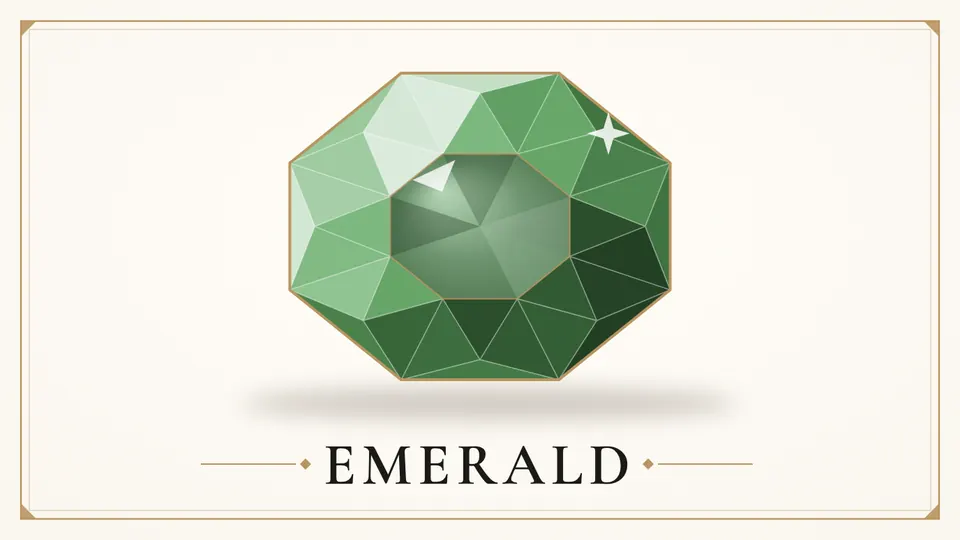
Emerald is the green variety of beryl, a beryllium aluminium silicate (Be3Al2Si6O18) coloured by traces of chromium and sometimes vanadium. At Mohs 7.5 to 8 it resists scratches, but it is brittle and most stones are full of tiny cracks, so a hard knock can chip or crack it. Filling those cracks with oil, wax or resin is routine, and the stone is still real emerald. In tradition it is a stone of renewal and growth.
At a glance
- Formula Be3Al2Si6O18: emerald is the green variety of beryl, the same mineral as blue aquamarine and pink morganite.
- Mohs 7.5 to 8, yet brittle and full of fine cracks: hardness is not durability, so a hard knock can chip it.
- Oil, wax or resin filling is routine and is a treatment of real emerald, not a fake. Keep it away from ultrasonic and steam cleaners.
- The May birthstone, and the gem for the 20th and 35th wedding anniversaries.
Quick facts
| Family | Beryl (beryllium aluminium silicate), the green variety; blue aquamarine and pink morganite are the same mineral |
|---|---|
| Chemical formula | Be3Al2Si6O18, with traces of chromium and sometimes vanadium giving the green |
| Crystal system | Hexagonal, in flat-topped hexagonal columns |
| Mohs hardness | 7.5–8 |
| Luster | Vitreous to resinous, with imperfect cleavage in one direction; poor toughness, since most emeralds are heavily included |
| Transparency | Transparent to translucent |
| Natural colors | green; bluish green to pure green; vivid, saturated green is usually the most prized |
| Main localities | Colombia (Muzo, Chivor, Coscuez); Zambia; Brazil (Minas Gerais); Pakistan; Afghanistan; Zimbabwe; Madagascar |
| Common treatments | filling of surface-reaching cracks with oil, wax or resin is routine, and the stone is still real emerald; paler, heavily cracked stones are sometimes dyed green; ask the seller to say in writing what filler or dye was used |
| Birth month | May (the birthstone for the month) |
Looking for the month? May birthstone guide
Emerald at a glance, in pictures
Chakras (traditional)
Hardness range
Natural colors
- green
- bluish green to pure green
- vivid, saturated green is usually the most prized
Traditionally linked to
- Zodiac
- Taurus
Common forms of Emerald
- Rough raw chunk
- Faceted cut gem
How hard is Emerald?
- Talc 1
- Gypsum 2
- Copper coin ~ 3
- Calcite 3
- Fluorite 4
- Apatite 5
- Glass ~ 5.5
- Steel knife ~ 5.5
- Orthoclase 6
- Quartz 7
- Emerald 7.5–8
- Topaz 8
- Corundum 9
- Diamond 10
What it is and where it comes from
Emerald is the green variety of beryl, the mineral that also gives blue aquamarine and pink morganite. Trace chromium, and sometimes vanadium, colours the green.
Where emerald ends and paler green beryl begins is a judgement about how strong the green is. A stone that is too light in colour is called green beryl instead.
More on its history
The name comes from the ancient Greek smaragdos, meaning green gem, by way of Latin and Old French.
The earliest known emerald mines were in Egypt, and Cleopatra is remembered for her passion for the stone. Colombia has been the leading producer of fine emerald for many centuries.
Within Colombia, Muzo is known for darker pure greens, Chivor for lighter bluish greens and Coscuez for slightly yellowish greens.
Most emeralds are heavily included, and the web of cracks and tiny crystals inside is often called the jardin, French for garden. Colombian stones often hold three-phase inclusions: a tiny salt crystal, a liquid and a gas bubble.
The crystal grows as a flat-topped green hexagonal column, which is why emerald is so often cut as a rectangle with stepped facets, the emerald cut. Because emerald is less dense than diamond, a one-carat emerald can look larger than a one-carat diamond.
Emerald through time
-
1st century AD
Pliny the Elder judges in his Natural History that "nothing greens greener" than emerald.
-
1500s
Spanish explorers invade the New World and loot emeralds from present-day Colombia, where the Incas had prized them for about 500 years.
-
1960s
Lab-grown emerald reaches the market, with flux-grown stones sold from 1964 and hydrothermal ones made from 1965.
-
2011
Elizabeth Taylor's emerald pendant sells for $6,578,500, about $280,000 per carat.
In crystal tradition
What follows is belief and folklore, passed down in crystal tradition. It is not measured fact.
Traditionally associated with: renewal, growth, eloquence.
In crystal tradition emerald is traditionally linked with renewal, growth and the Heart chakra, often explained by its fresh green. These are beliefs, not measured effects of the stone.
Folk belief once held that emerald sharpened wit, made speakers eloquent and revealed the future when placed under the tongue. Treat this as folklore.
Taurus is the sign most often linked with emerald, though zodiac links vary from one tradition to another. Treat them as folklore.
How to care for Emerald
- Water Caution
- Sunlight Unknown
- Salt Unknown
- Heat Avoid
- Ultrasonic Avoid
- Chemicals Avoid
Safe = fine as a rule · Caution = only briefly or gently · Avoid = can damage the stone · Unknown = no reliable guidance.
Clean emerald gently with a soft brush and warm, soapy water, then pat it dry. Never use an ultrasonic cleaner, and skip steam: vibration and heat can push the oil or resin out of the cracks. Keep it away from heat, harsh chemicals and hot dishwashing water, which can damage a filled stone, and from sudden knocks and sharp changes in temperature. Take it off before sport, swimming and cleaning, and store it in a soft pouch so it is not knocked.
Real or fake? Look-alikes and treatments
Often confused with
- Green beryl
- Tsavorite
- Green tourmaline
- Peridot
- Green glass and dyed crackled quartz
- Doublets and triplets
Common look-alikes
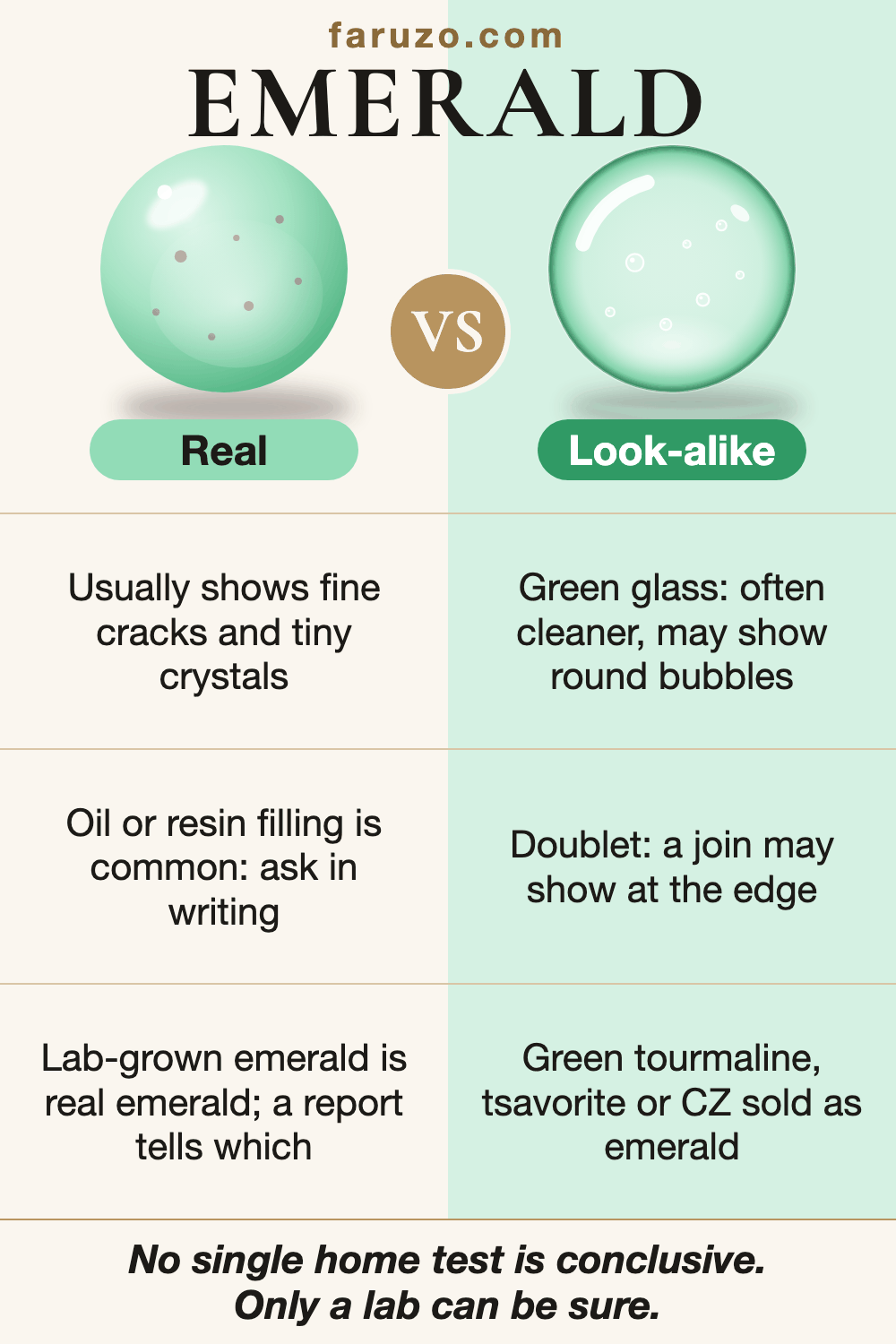
- Green beryl. Paler green beryl is the same mineral as emerald, so the difference is how strong the green is, not what the stone is made of. A pale stone sold as emerald may be named green beryl by a gem lab, so check the name on the paperwork.
- Tsavorite. Tsavorite is a green garnet, a different mineral at Mohs 7 to 7.5, and a vivid one can pass for emerald at a glance. Colour alone is not a safe guide, so a lab can confirm.
- Green tourmaline. Green tourmaline is a different mineral, and the first green tourmaline crystal on record, found in 1554, was called Brazilian emerald. A rich green one can look much like emerald, so a lab can confirm.
- Peridot. Peridot is a different mineral, usually yellowish green rather than bluish green, and softer at Mohs 6.5 to 7. A deeper green stone can still be mistaken for emerald by eye.
- Green glass and dyed crackled quartz. Glass is an old imitation that can be made in virtually any colour, and quartz that has been cracked and dyed green is a convincing look-alike. Its fractured, dyed look can be seen under a microscope.
- Doublets and triplets. A doublet joins two pieces with colourless glue, and a triplet joins three or two pieces with coloured cement, so the green can come from the join rather than the stone. A join can show at the edge under magnification.
- Green cubic zirconia. Cubic zirconia is man-made and can be made in green. At Mohs 8 to 8.5 it is harder than emerald, so a scratch test cannot separate the two.
Safe checks you can do
- Ask the seller in writing whether the stone is natural emerald, oil, wax or resin filled, lab-grown, dyed or another green stone, and what filler was used.
- For any emerald that matters, ask for an identification report from a gem lab. In most cases a lab can tell a natural stone from a lab-grown one by features under magnification, and can recognise filling.
- Do not read cracks or tiny crystals inside as a sign of a fake. Most emeralds are heavily included, so a spotless, evenly bright green stone at a low price deserves a closer look.
- Do not read oil or resin in a stone as a sign it is fake. Filling is a routine treatment of real emerald, and it should be disclosed.
- Do not rely on a scratch test. Emerald is brittle and can chip, and green cubic zirconia is harder than emerald, so hardness cannot decide it.
Wearing Emerald
Ring
Avoid
Heat can ruin it, so a ring is best avoided.
Brittle: a hard knock can still chip or crack it
Bracelet
Careful
A knock on a bracelet can split it along a flat plane.
Brittle with fine cracks, so keep it from hard knocks
Pendant
Careful
It can split along a flat plane, so keep it protected.
Brittle, so keep it from hard knocks
Earrings
Careful
A flat-plane split is possible, so keep earrings for dressy wear.
Brittle, so take them off for sport
Guide for everyday wear, based on hardness and care notes. Safe, Careful or Avoid.
Wear emerald with care. At Mohs 7.5 to 8 it resists scratches, but it is brittle, has imperfect cleavage and most stones are full of tiny cracks, so hardness is not durability and a hard knock can chip or split it. Heat is the bigger risk for a ring, which meets hot water and steam most often, so a ring is best kept for occasional wear, such as dressy days, in a protective setting, taken off near hot water. Bracelets, pendants and earrings need care too: keep them from hard knocks and steam, and take them off for sport and rough work.
Related stones
Questions about Emerald
What does emerald mean?
In crystal tradition emerald stands for renewal and growth, and is linked with the Heart chakra and the sign Taurus. Those are beliefs, not facts about the stone. Its practical claim to fame is a vivid green colour and a long history as one of the most prized coloured gems.
What is emerald?
Emerald is the green variety of beryl, a beryllium aluminium silicate with the formula Be3Al2Si6O18. Its green comes from traces of chromium and sometimes vanadium. Beryl also gives blue aquamarine and pink morganite.
Is emerald a birthstone?
Yes. Emerald is the May birthstone. It is also the gem given for the 20th and 35th wedding anniversaries.
How hard is emerald, and is it durable?
Emerald is 7.5 to 8 on the Mohs scale, so it resists scratches better than most gems. Hardness is not durability, though. Most emeralds are heavily included and brittle, so a hard knock can chip or crack one.
Is oil-filled emerald fake?
No. Oil, wax or resin is used to fill cracks that reach the surface, so the stone looks clearer. It is a treatment of real emerald, it is routine for the stone, and it should be disclosed. The filler can be driven out by heat, steam, ultrasonic cleaners or some chemicals, so clean the stone gently.
Is lab-grown emerald real?
Lab-grown emerald is real emerald: beryl with essentially the same chemical, physical and optical properties as a mined stone, grown by people in a lab. It is made by the flux or hydrothermal method, and flux-grown stones have been sold since the 1960s. It should be sold as lab-grown, and in most cases a gem lab can tell it from a mined stone by features under magnification.
How can you tell real emerald from fake?
A home look can only hint. Most real emeralds show cracks and tiny crystals inside, but a spotless, evenly bright green stone at a low price deserves a closer look. Glass, doublets, green cubic zirconia and other green stones can look similar, and no single home test is conclusive, so a lab can confirm a stone that matters.
What can be mistaken for emerald?
Paler green beryl, tsavorite, green tourmaline and peridot are real green stones that can be sold as emerald or mistaken for it. Green glass, dyed crackled quartz, doublets and triplets, and green cubic zirconia are the common imitations.
Is green beryl the same as emerald?
Both are green beryl. Where emerald ends and paler green beryl begins is a judgement about how strong and saturated the green is. A pale stone sold as emerald may be named green beryl by a gem lab.
What should I ask a seller before buying an emerald?
Ask four things in writing: is it natural or lab-grown, has it been oil, wax or resin filled and how much, has it been dyed, and can you see an identification report from a gem lab. In the US, sellers are generally expected to disclose treatments. An untreated emerald is usually worth more than a filled one of similar quality, so the answer affects the price.
How do you clean emerald, and can it go in an ultrasonic cleaner?
Use a soft brush and warm, soapy water, then pat it dry. Never use an ultrasonic cleaner, and skip steam, because vibration and heat can push the filler out of the cracks. Hot dishwashing water and harsh chemicals can also damage a filled stone.
Can you wear an emerald ring every day?
A ring is best kept for occasional wear rather than every day. Emerald resists scratches, yet it is brittle, and a ring meets knocks and hot water most often. A bracelet, pendant or earrings are the gentler choices, and a protective setting helps. Take a ring off for sport, rough work and washing up.
What is the jardin in emerald?
Jardin is French for garden: the web of cracks and tiny crystals inside most emeralds. It is normal for natural emerald. Colombian stones often hold three-phase inclusions, made of a tiny salt crystal, a liquid and a gas bubble.
Why is it called the emerald cut?
The emerald cut is a rectangular step cut, and it is the cut most often used on emerald because the crystal grows as a flat-topped hexagonal column. It is named for the stone it suits.
Where does emerald come from?
Colombia has been the leading producer of fine emerald for more than 500 years, with Muzo, Chivor and Coscuez its best-known areas. Zambia is a major producer too, and emerald also comes from Brazil, Pakistan, Afghanistan, Zimbabwe and Madagascar.