
Crystal guide
Ruby Meaning, Properties and Care
Ruby is the red variety of corundum, an aluminium oxide (Al2O3) coloured by traces of chromium. At Mohs 9 it ranks just below diamond among the usual jewellery gems, so it suits everyday wear. Many rubies are heated, and some have cracks filled with glass, so treatment is worth asking about when you buy one. In tradition it is a stone of passion, courage and vitality.
At a glance
- Formula Al2O3: ruby is red corundum, and corundum in other colours is called sapphire.
- Mohs 9, second only to diamond among the common gems, though a hard knock can still chip an edge.
- Heat treatment is common and glass filling is sometimes used: ask which, because treatment decides how to clean it.
- The July birthstone, and the traditional gem for the 15th and 40th anniversaries.
Quick facts
| Family | Corundum (aluminium oxide), the red variety; other colours of gem corundum are called sapphire |
|---|---|
| Chemical formula | Al2O3, with traces of chromium giving the red |
| Crystal system | Trigonal |
| Mohs hardness | 9 |
| Luster | Vitreous to subadamantine |
| Transparency | Transparent to translucent; stones with a star effect are cut as domed cabochons |
| Natural colors | red, vivid red to slightly purplish red, orangy red to purplish red |
| Main localities | Myanmar (Mogok), Mozambique (Montepuez), Vietnam, Thailand and Cambodia, Sri Lanka, Madagascar, Tanzania |
| Common treatments | heat treatment is the most common, used to improve colour and reduce fine needle inclusions; glass filling of fractures is sometimes used to look clearer, and the stone is then more vulnerable; lattice diffusion and dye are also used; ask the seller which treatments were used |
| Birth month | July (the standard birthstone for the month) |
Looking for the month? July birthstone guide
Ruby at a glance, in pictures
Chakras (traditional)
Hardness range
Natural colors
- red
- vivid red to slightly purplish red
- orangy red to purplish red
Traditionally linked to
- Planet
- Sun
- Zodiac
- Leo
- Element
- Fire
Common forms of Ruby
- Rough raw chunk
- Faceted cut gem
- Cabochon smooth dome
How hard is Ruby?
- Talc 1
- Gypsum 2
- Copper coin ~ 3
- Calcite 3
- Fluorite 4
- Apatite 5
- Glass ~ 5.5
- Steel knife ~ 5.5
- Orthoclase 6
- Quartz 7
- Topaz 8
- Ruby 9
- Diamond 10
What it is and where it comes from
Pure corundum is colourless. Chromium in its crystal structure turns it red, and more chromium gives a stronger red. Corundum in any other colour is called sapphire, and the line between ruby and pink sapphire is debated.
The name comes from the Latin ruber, meaning red. In Sanskrit ruby is called ratnaraj, the king of gems. The Mogok valley in Myanmar is the legendary source, and the Montepuez mine in Mozambique is among the most significant modern deposits.
More on its history
For centuries red spinel passed as ruby in Europe's crown jewels. The Black Prince's Ruby in the British Imperial State Crown is a spinel, and red spinels were once called balas rubies.
Rubies that form in marble, such as those from Myanmar and northern Vietnam, tend to be intensely red and to glow red under ultraviolet light and sunlight. Rubies from basalt hold more iron, which makes them darker and mutes that glow.
Some rubies show a three- or six-rayed star, called asterism, caused by fine needle inclusions of rutile. Stones cut to show it are domed cabochons.
Ruby through time
-
1783
Red spinel is recognised as a mineral distinct from ruby, after centuries as a stand-in in crown jewels.
-
1903
Lab-created ruby, made by the flame-fusion method, goes into commercial production.
-
1960
The first working laser is built around a ruby crystal and its red glow at 694 nm.
-
2015
A 25.59-carat ruby ring sells at auction for about $1.27 million per carat, a record for a coloured gem.
In crystal tradition
What follows is belief and folklore, passed down in crystal tradition. It is not measured fact.
Traditionally associated with: passion, courage, vitality.
In Sanskrit tradition ruby is ratnaraj, the king of gems, and it is traditionally linked with passion, courage, vitality and status. These are beliefs, not measured effects of the stone.
In Hindu astrology ruby is associated with the Sun and the deity Surya, and wearing it is believed to bring favour. Modern crystal tradition links it with the Root and Heart chakras and with the element Fire.
Burmese warriors are said to have carried rubies into battle in the belief that the stone made them invincible. Zodiac links vary from one tradition to another, with Leo the one most often named. Treat all of this as folklore.
How to care for Ruby
- Water Safe
- Sunlight Unknown
- Salt Unknown
- Heat Caution
- Ultrasonic Caution
- Chemicals Unknown
Safe = fine as a rule · Caution = only briefly or gently · Avoid = can damage the stone · Unknown = no reliable guidance.
Warm soapy water and a soft brush suit most ruby. Ultrasonic and steam cleaners are generally safe for untreated, heat-treated and diffusion-treated stones, but a glass-filled or dyed ruby should only be wiped with a damp cloth. If you do not know how a stone was treated, use the gentle method.
Real or fake? Look-alikes and treatments
Often confused with
- Red spinel
- Red garnet
- Red tourmaline (rubellite)
- Red glass and doublets
Common look-alikes
- Red spinel. Spinel can match ruby's red closely and once passed as it in crown jewels. It is a different mineral, Mohs 8 rather than 9, and bends light once instead of twice. A lab can tell the two apart.
- Red garnet. Red garnet is a different mineral that has been falsely sold as ruby. Its colour often leans darker or browner, and it is softer than ruby. Colour alone is not a safe guide, so a lab can confirm.
- Red tourmaline (rubellite). Rubellite is the trade name for red to pink tourmaline, and the name can mislead buyers into thinking it is ruby. It is a different mineral with a different look under magnification.
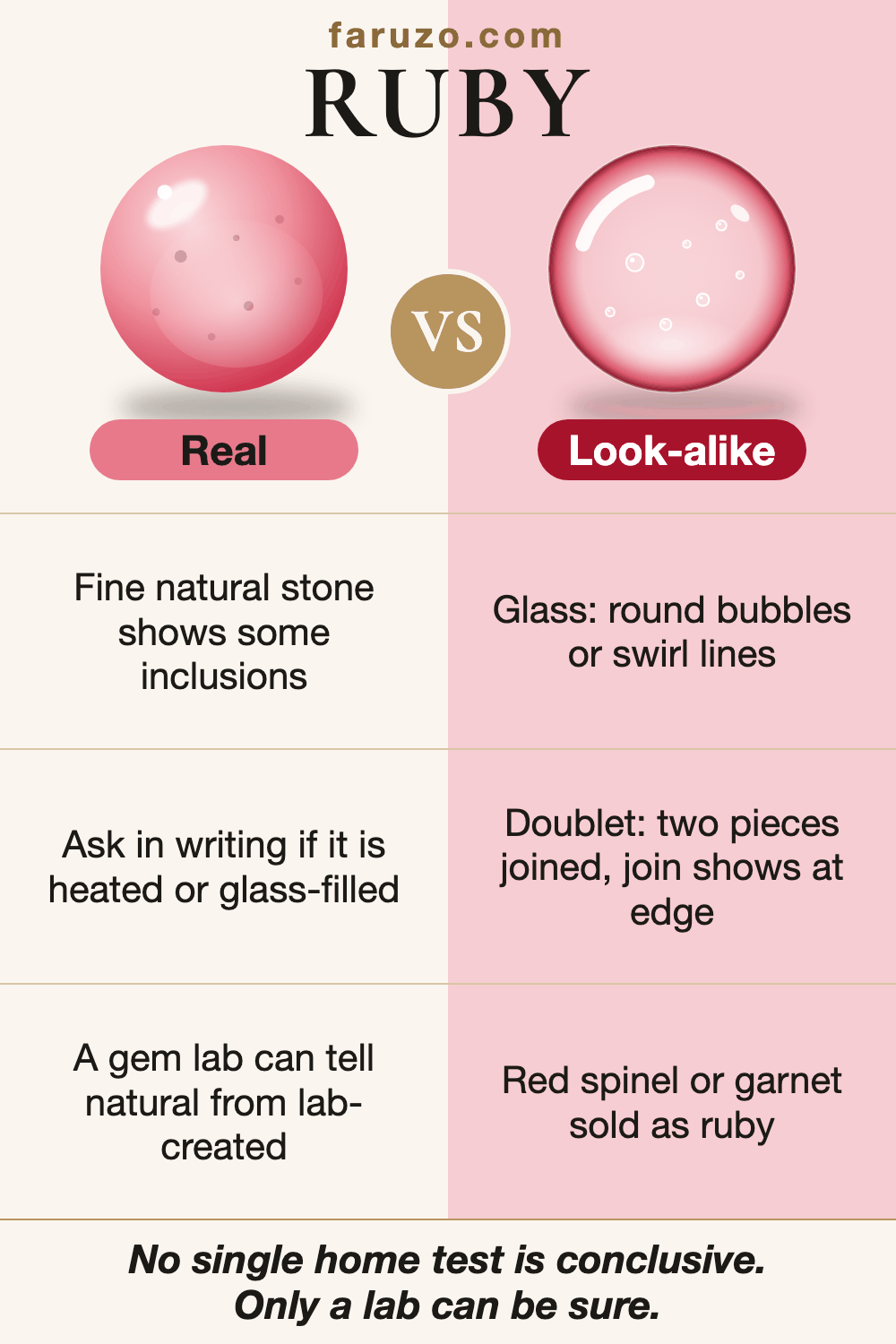
- Red glass and doublets. Coloured glass is a common imitation, and it can show round gas bubbles or swirl lines. A doublet is two pieces joined, often with a thin real or lab-created top over a plain base, and the join can show at the edge under magnification.
Safe checks you can do
- Ask the seller in writing whether the stone is natural ruby, heat-treated, glass-filled, lab-created or another red stone.
- For any ruby that matters, ask for an identification report from a gem lab. Only a lab can say whether a stone is natural or lab-created and whether it is treated.
- Be wary of a flawless, vivid stone at a low price. Fine natural ruby usually shows some inclusions, and a spotless one can point to a lab-created stone.
- Under a 10x loupe, gas bubbles in cracks can point to glass filling, and curved lines can point to a lab-created stone. These are hints, not proof.
- Do not rely on a scratch test. Lab-created ruby has the same hardness as natural ruby, so a hardness test cannot separate them.
Wearing Ruby
Ring
Safe
Hard enough for daily wear.
Glass-filled ruby needs more care
Bracelet
Safe
Tough enough for everyday bracelets.
Glass-filled ruby needs more care
Pendant
Safe
A pendant sits clear of most knocks.
Earrings
Safe
Earrings rarely take hard knocks.
Guide for everyday wear, based on hardness and care notes. Safe, Careful or Avoid.
At Mohs 9, ruby is among the hardest gems and suits rings, bracelets, pendants and earrings for daily wear. Hard is not unbreakable, though: a sharp knock can still chip an edge. A glass-filled or dyed stone is more fragile and needs gentler care, so ask how yours was treated before you wear it every day.
Related stones
Questions about Ruby
What does ruby mean?
In crystal tradition ruby stands for passion, courage and vitality, and in Sanskrit it is called ratnaraj, the king of gems. Those are beliefs, not facts about the stone. Its practical claim to fame is a deep red colour and a hardness of Mohs 9.
What is ruby?
Ruby is the red variety of corundum, an aluminium oxide with the formula Al2O3. Its red comes from traces of chromium. Pure corundum is colourless.
Is ruby the July birthstone?
Yes. Ruby is the July birthstone on the standard lists, and it is also the traditional gem for the 15th and 40th wedding anniversaries.
Is ruby the same mineral as sapphire?
Yes. Ruby and sapphire are both corundum. Red corundum is called ruby, and gem corundum in every other colour, including blue, pink and yellow, is called sapphire. Where deep pink ends and ruby begins is debated.
How hard is ruby?
Mohs 9, just below diamond among the common gems. That makes it very resistant to scratching. A hard knock can still chip an edge, and a glass-filled stone is more fragile.
What is pigeon's blood ruby?
Pigeon's blood is a trade term for the most prized red, a vivid red with a slight purplish hint, often linked with stones from Mogok in Myanmar. It describes a colour grade, not a different mineral, and it is not a promise of origin or of no treatment.
Is heat-treated ruby still real ruby?
Yes. Heat is the most common treatment and the stone is still natural ruby. It is used to improve colour and reduce fine needle inclusions. Ask the seller to say in writing whether a stone was heated.
What is lead-glass filled ruby, and should I be careful with one?
It is a real ruby, usually of lower quality, with cracks filled with glass so it looks clearer. It is a treated stone, not a fake, and it should be sold as such. It is more fragile than other ruby, so keep it away from hard knocks, heat, steam and ultrasonic cleaners. Clean it with a damp cloth only.
What should I ask a seller before buying a ruby?
Ask four things in writing: is it natural or lab-created, has it been heated, has it been glass-filled or dyed, and can you see an identification report from a gem lab. In the US, sellers are generally expected to disclose treatments; ask for it in writing.
Is lab-created ruby real?
Lab-created ruby is real corundum, made by people instead of mined. It has the same chemistry, the same chromium colour and the same hardness as mined ruby. It should be sold as lab-created, and it is priced differently from a mined stone.
How can you tell ruby from red spinel or garnet?
A home look can only hint. Red spinel can look almost identical and is Mohs 8, and garnet is a different, softer mineral. Because colour alone is not a safe guide, a lab can confirm a stone that matters.
How do you clean ruby?
Use warm soapy water and a soft brush. Ultrasonic and steam cleaners are generally safe for untreated, heat-treated and diffusion-treated stones, but a glass-filled or dyed ruby should only be wiped with a damp cloth.
Can you wear a ruby ring every day?
Usually yes, since Mohs 9 resists scratching better than almost any other gem. Take it off for heavy work, because a sharp knock can still chip an edge. A glass-filled stone needs far more care.
What is a star ruby?
A ruby with a three- or six-rayed star that moves across its surface, caused by fine needle inclusions of rutile. Stones cut to show it are domed cabochons rather than faceted.
Where does ruby come from?
The Mogok valley in Myanmar is the legendary source. Montepuez in Mozambique is among the most significant modern deposits, and rubies also come from Vietnam, Thailand and Cambodia, Sri Lanka, Madagascar and Tanzania.