
Crystal guide
Spinel Meaning, Properties and Care
Spinel is a magnesium aluminium oxide (MgAl2O4), a hard gem at 8 on the Mohs scale that comes in red, pink, orange, blue and more. For centuries it was mistaken for ruby, and some famous crown-jewel "rubies" are spinel. It has no true cleavage, so it wears well, and a lot of spinel in everyday jewellery is lab-created. In crystal tradition it is a stone of energy and renewal.
At a glance
- Formula MgAl2O4, a cubic gem at Mohs 8 with no true cleavage.
- Long mistaken for ruby: the Black Prince's Ruby, about 170 carats in the Imperial State Crown, is a spinel.
- A lot of spinel in budget jewellery is lab-created: real spinel made by people. A gem lab report is how to tell natural from lab-created in most cases.
- Often listed as an August birthstone with peridot and sardonyx. Care: soft cloth, mild soap, no steam or ultrasonic.
Quick facts
| Family | Magnesium aluminium oxide (spinel group) |
|---|---|
| Chemical formula | MgAl2O4 |
| Crystal system | Cubic (isometric), often as octahedral crystals that are frequently twinned |
| Mohs hardness | 8 |
| Luster | Vitreous, with no true cleavage but octahedral parting and a conchoidal fracture |
| Transparency | Transparent to opaque, with gem stones usually transparent when cut |
| Natural colors | red, pink, orange, purple to violet, blue, bluish green, black |
| Main localities | Myanmar, Sri Lanka, Tajikistan, Afghanistan, Vietnam, Tanzania, Pakistan, Madagascar |
| Common treatments | most spinel that reaches a gem lab is untreated, though treated stones turn up from time to time; oiling is the most common treatment, and heating is rare; lab-created spinel is real spinel made by people, so ask whether a stone is natural or lab-created |
| Birth month | August (an additional modern birthstone alongside peridot and sardonyx) |
Looking for the month? August birthstone guide
Spinel at a glance, in pictures
Chakras (traditional)
Hardness range
Natural colors
- red
- pink
- orange
- purple to violet
- blue
- bluish green
- black
Common forms of Spinel
- Rough raw chunk
- Faceted cut gem
How hard is Spinel?
- Talc 1
- Gypsum 2
- Copper coin ~ 3
- Calcite 3
- Fluorite 4
- Apatite 5
- Glass ~ 5.5
- Steel knife ~ 5.5
- Orthoclase 6
- Quartz 7
- Spinel 8
- Corundum 9
- Diamond 10
What it is and where it comes from
Spinel is magnesium aluminium oxide, MgAl2O4, in the cubic system. Crystals often form as octahedra, which look like two pyramids joined base to base, and many are twinned.
The name is traced to the Latin for a little thorn, a nod to the pointed shape of its crystals.
More on its history
Red and pink spinel get their colour from chromium, the same trace element that colours ruby. Vivid blue comes from cobalt, violet to blue from iron, and orange and purple from a mix of iron and chromium.
Before ruby had a firm definition, transparent red spinels were called "balas rubies" or spinel-rubies. The word balas comes from Balascia, the old name for Badakhshan, a region now split between Afghanistan and Tajikistan.
Ancient mines in central and southeast Asia produced very large spinel crystals. Kings and emperors prized them, and they often changed hands as spoils of war.
The Black Prince's Ruby, a crimson stone of about 170 carats at the front of Britain's Imperial State Crown, is a spinel. It is believed to have been mined in Badakhshan. The Timur Ruby, another large spinel in the Crown Jewels, weighs about 350 carats and carries several Persian inscriptions.
Gem spinel is mined today in Myanmar (the Mogok area), Sri Lanka, Tajikistan, Vietnam, Tanzania and Pakistan, among other places.
Lab-created spinel is real spinel made by people, using methods similar to those for lab-created corundum, such as the Verneuil flame-fusion method. It has long been used as an inexpensive cut gem in August birthstone jewellery, and pale blue and green lab-created stones can resemble aquamarine, emerald or tourmaline.
Spinel through time
-
1367
A large red stone, later called the Black Prince's Ruby, is said to pass to Edward, the Black Prince. It is now known to be a spinel.
-
1783
Spinel is clearly separated from ruby, based on their different chemistry.
-
2016
Spinel is added as an extra August birthstone beside peridot and sardonyx. The year is often given as 2016.
In crystal tradition
What follows is belief and folklore, passed down in crystal tradition. It is not measured fact.
Traditionally associated with: energy, renewal, perseverance.
Spinel is traditionally associated with energy, renewal and perseverance, and red spinel with the Root chakra. This is a modern spiritual tradition, not a fact about the stone.
Old lore in Burma called spinel crystals nat thwe, meaning "polished by the spirits".
Links to zodiac signs vary from one tradition to another. Treat any of them as folklore.
How to care for Spinel
- Water Safe
- Sunlight Unknown
- Salt Unknown
- Heat Caution
- Ultrasonic Caution
- Chemicals Caution
Safe = fine as a rule · Caution = only briefly or gently · Avoid = can damage the stone · Unknown = no reliable guidance.
Clean spinel with a soft cloth or brush, mild soap and lukewarm water, then dry it. Oiling is the most common treatment, so a stone of unknown history is best kept away from steam, ultrasonic cleaners and harsh chemicals, which can draw oil out of fine cracks. Store it apart from softer gems so it cannot scratch them, and take it off before sport and rough work.
Real or fake? Look-alikes and treatments
Often confused with
- Ruby and pink sapphire
- Red garnet
- Tourmaline
- Glass
- Cubic zirconia
Common look-alikes
- Ruby and pink sapphire. Ruby and pink sapphire are corundum, a different mineral at Mohs 9, and red spinel is often mistaken for them. Corundum bends light twice and spinel once, but that needs a lab to check, so colour alone is not a safe guide.
- Red garnet. Garnet is a different mineral and softer, at Mohs 6.5 to 7.5 against spinel's 8. Both bend light once, so a basic look can mislead and a gem lab can confirm.
- Tourmaline. Pink, red, blue and green tourmaline can resemble spinel. Tourmaline is a different mineral at Mohs 7 to 7.5 and bends light twice, while spinel bends it once. A lab can confirm.
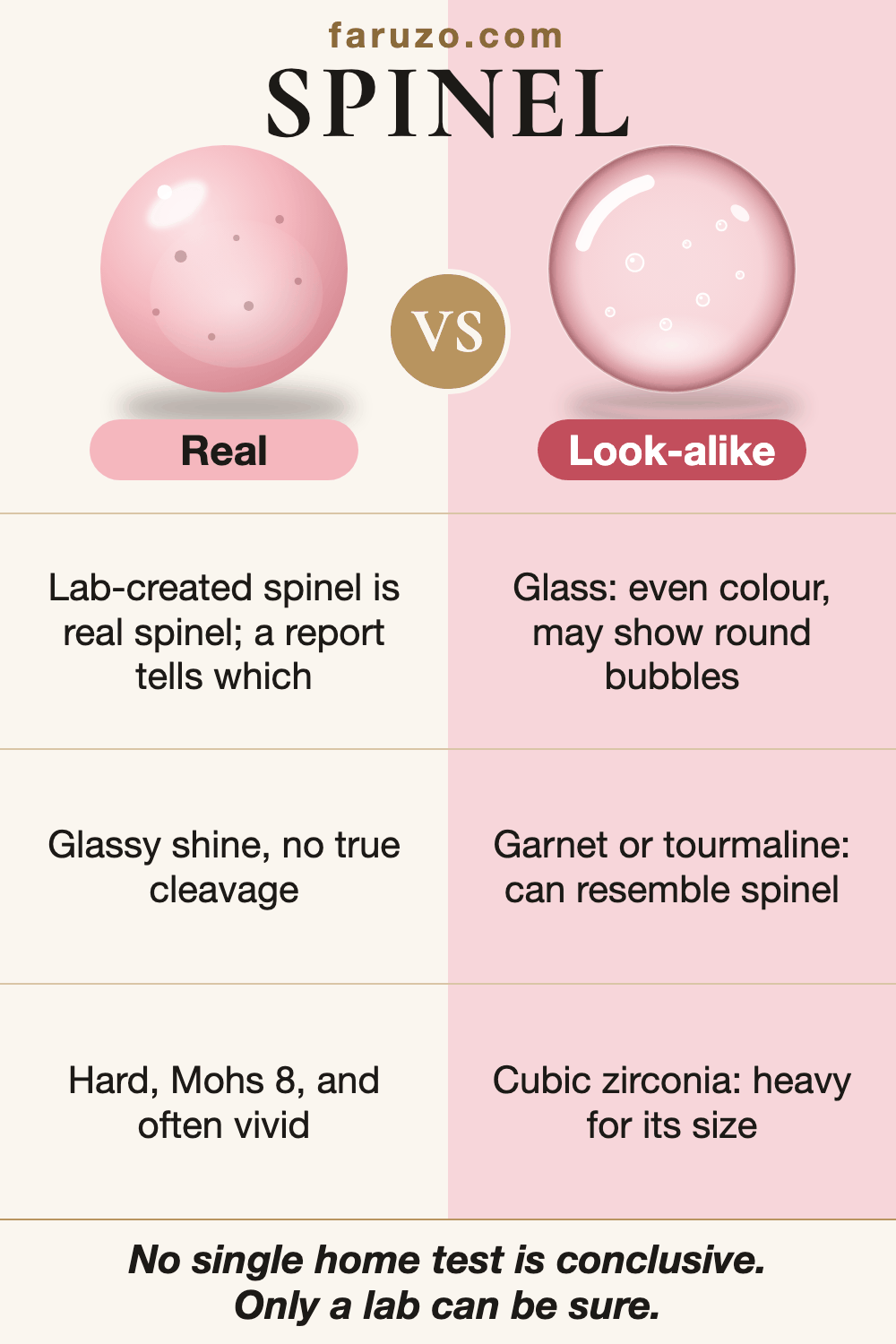
- Glass. Glass can be made in virtually any colour, so it is a common stand-in for coloured gems. It can look too even and may show round gas bubbles or swirl lines under magnification.
- Cubic zirconia. Cubic zirconia is a different, man-made material with a similar hardness, Mohs 8 to 8.5, so scratching will not separate them. It is much denser, so a cubic zirconia stone feels heavy for its size next to spinel.
Safe checks you can do
- Ask the seller in writing whether the stone is natural spinel, lab-created spinel or another gem, and whether it is oiled or heated.
- Remember that lab-created spinel is real spinel. What matters is that it is described as lab-created, because that changes the price.
- To tell natural from lab-created spinel, or spinel from a look-alike, a gem lab report for the stone is the reliable route in most cases.
- Check that the name on the paperwork says spinel. A red stone sold as ruby, or a bargain "spinel" with no lab report, is worth questioning.
- Do not scratch-test or heat-test a stone you plan to keep. A gem lab is the safer route when it matters.
Wearing Spinel
Ring
Safe
Hard enough for daily wear.
Bracelet
Safe
Tough enough for everyday bracelets.
Pendant
Safe
A pendant sits clear of most knocks.
Earrings
Safe
Earrings rarely take hard knocks.
Guide for everyday wear, based on hardness and care notes. Safe, Careful or Avoid.
At Mohs 8, spinel resists everyday scratching, and with no true cleavage it is sturdier than many coloured gems, so a ring is reasonable for daily wear, as are bracelets, pendants and earrings. It is not unbreakable: octahedral parting means a hard, sharp knock at the wrong angle can still chip or part a stone. A ring or bracelet takes the most knocks, so a setting that protects the edge is worth having. Keep oiled stones away from steam and ultrasonic cleaners, and store spinel apart from softer gems.
Related stones
Questions about Spinel
What does spinel mean?
In crystal tradition spinel is linked to energy, renewal and perseverance, and red spinel to the Root chakra. That is a belief, not a fact about the stone. Its practical claim to fame is a long history as the gem mistaken for ruby.
What is spinel?
Spinel is a magnesium aluminium oxide with the formula MgAl2O4. It forms cubic crystals, often as octahedra, and comes in red, pink, orange, purple, blue and black. Red and pink come from chromium, and vivid blue from cobalt.
Is spinel a birthstone?
Yes, spinel is often listed as an August birthstone alongside peridot and sardonyx. It is often said to have been added to the lists in 2016. Peridot is on every list, so check which list you are following.
Is spinel the same as ruby?
No. Ruby is corundum, at Mohs 9, while spinel is a different mineral at Mohs 8. Red spinel can look very like ruby, and several famous gems called rubies, including the Black Prince's Ruby, are spinel. The two were only clearly separated in the 18th century.
How hard is spinel, and does it break easily?
Spinel is 8 on the Mohs scale and has no true cleavage, so it does not split along flat planes. Some crystals show octahedral parting, so a hard, sharp knock can still chip or part a stone. In everyday wear it is a tough gem.
Is lab-created spinel real?
Lab-created spinel is real spinel, made by people instead of mined. It has the same chemistry and hardness as natural spinel. It should be sold as lab-created, and it is priced differently from a natural stone. It is common in inexpensive birthstone jewellery.
Is spinel natural or treated?
Most spinel that reaches a gem lab is untreated, but treated stones turn up from time to time. Oiling is the most common treatment, and heating is rare. A treated spinel is still real spinel, so ask the seller to say in writing what has been done.
How can you tell real spinel from fake?
A home look can only hint. Glass can look too even and may show round bubbles, and cubic zirconia feels heavy for its size. Ruby, garnet and tourmaline can resemble spinel, so a gem lab report is the sure way to confirm a stone that matters.
What can be mistaken for spinel?
Ruby and pink sapphire, red garnet, tourmaline, glass and cubic zirconia can all pass for spinel at a glance. These are different materials. Lab-created spinel is not on that list, because it is real spinel.
What should I ask a seller before buying spinel?
Ask whether the stone is natural or lab-created, whether it has been oiled or heated, and whether there is a gem lab report for the stone. A reputable seller will put the answers in writing.
Can you wear a spinel ring every day?
Spinel is one of the better coloured gems for a ring, since it is Mohs 8 with no true cleavage. A hard knock can still chip any stone, so choose a setting that protects the edge, and take the ring off for sport and rough work.
How do you clean spinel, and can it go in an ultrasonic cleaner?
Use a soft cloth or brush with mild soap and lukewarm water, then dry it. Because oiling is the most common treatment, skip ultrasonic and steam cleaners unless you know the stone is untreated. Vibration and heat can draw oil out of fine cracks.
What colours does spinel come in?
Spinel comes in red, pink, orange, purple, violet, blue, bluish green and black. Bright red, cobalt blue and vivid pink and orange are among the most valued, while pale lavender costs less.
Where does spinel come from, and why is it called spinel?
Gem spinel is mined in Myanmar, Sri Lanka, Tajikistan, Vietnam, Tanzania and Pakistan, among other places. The name is traced to the Latin for a little thorn, a nod to the pointed shape of its crystals.