
Crystal guide
Garnet Meaning, Properties and Care
Garnet is not one mineral but a group of related silicate minerals, and it comes in nearly every colour, with red the most common. Most gem garnet measures about 6.5 to 7.5 on the Mohs scale and has no cleavage, so it is fairly sturdy for jewelry, though not as hard as ruby or sapphire. In crystal tradition garnet is a stone of vitality, courage and commitment.
At a glance
- A group of silicate minerals with the general formula X3Y2(SiO4)3. Five species matter as gems: pyrope, almandine, spessartine, grossular and andradite.
- Mohs about 6.5 to 7.5 depending on type, with no cleavage, so it is fairly sturdy but not as hard as sapphire.
- Found in nearly every colour. Red is the most common, and green tsavorite and demantoid are among the most prized.
- Listed for January and the 2nd wedding anniversary. Care: soft brush and warm soapy water, no steam.
Quick facts
| Family | Garnet group of silicate minerals. The main gem species are pyrope, almandine, spessartine, grossular and andradite; rhodolite is a violet-red pyrope-almandine blend and uvarovite is a rare, usually tiny-crystalled green species |
|---|---|
| Chemical formula | General formula X3Y2(SiO4)3. Pyrope Mg3Al2(SiO4)3, almandine Fe3Al2(SiO4)3, spessartine Mn3Al2(SiO4)3, grossular Ca3Al2(SiO4)3, andradite Ca3Fe2(SiO4)3 |
| Crystal system | Isometric (cubic) |
| Mohs hardness | 6.5–7.5 |
| Luster | Vitreous to resinous. No cleavage, so it breaks unevenly rather than splitting along flat planes |
| Transparency | Gem material is usually transparent. Red garnets such as almandine, pyrope and rhodolite usually show no inclusions to the eye, while spessartine and hessonite more often do |
| Natural colors | red (the most common), purplish red, orange to yellow, green (tsavorite and demantoid), brown, colourless (rare), rare blue-green to purple colour-change |
| Main localities | Madagascar; Kenya; Tanzania; Namibia; Sri Lanka; Myanmar; Russia (Ural Mountains); Czech Republic (Bohemia), historic; India; Brazil; Iran; Afghanistan; Pakistan; USA |
| Common treatments | most garnets are untreated; a garnet is occasionally fracture-filled, which needs gentler care; some demantoid is reportedly heated at low temperature to improve colour, and this is thought to be hard to detect |
| Birth month | January, and the gem for a 2nd wedding anniversary |
Looking for the month? January birthstone guide
Garnet at a glance, in pictures
Chakras (traditional)
Hardness range
Natural colors
- red (the most common)
- purplish red
- orange to yellow
- green (tsavorite and demantoid)
- brown
- colourless (rare)
- rare blue-green to purple colour-change
Traditionally linked to
- Zodiac
- CapricornAquarius
- Element
- Fire
Common forms of Garnet
- Rough raw chunk
- Faceted cut gem
- Cabochon smooth dome
- Bead drilled bead
How hard is Garnet?
- Talc 1
- Gypsum 2
- Copper coin ~ 3
- Calcite 3
- Fluorite 4
- Apatite 5
- Glass ~ 5.5
- Steel knife ~ 5.5
- Orthoclase 6
- Quartz 7
- Garnet 6.5–7.5
- Topaz 8
- Corundum 9
- Diamond 10
What it is and where it comes from
Garnet is a group of related silicate minerals that share the formula X3Y2(SiO4)3 and differ in which metals they hold, such as calcium, magnesium, iron, manganese, aluminium or chromium. Five species matter as gems: pyrope, almandine, spessartine, grossular and andradite.
The name comes from the medieval Latin granatus, meaning pomegranate, probably because dark red garnet crystals resemble the fruit's seeds. Garnet has been used as a gem and as an abrasive since the Bronze Age.
More on its history
Pyrope is the garnet species that is reliably red in nature, and its name comes from Greek words meaning fire and eye. Rhodolite is a violet-red blend of mostly pyrope with almandine, named from the Greek for rose. Pyrope from Bohemia was a favourite in the Victorian era.
Almandine is deep red, often leaning towards purple, and is the most common gem garnet. Its name goes back to Alabanda, a town in ancient Caria in Asia Minor. When cut as a smooth dome rather than facets it has long been called carbuncle.
Spessartine runs from yellow through orange to red and is named after the Spessart region of Bavaria. Orange-yellow stones from Madagascar are sold as Mandarin garnet, and Namibia and Tanzania are key sources of orange to yellow spessartine.
Grossular has the widest colour range, from colourless through green, yellow, brown, orange and red. Its name comes from the Latin for gooseberry, after a green stone found in Siberia. Hessonite, a cinnamon-brown to orange grossular, is a common variety.
Tsavorite is the vivid green variety of grossular, coloured by traces of vanadium or chromium. The geologist Campbell Bridges reportedly found green grossular in Tanzania in the late 1960s and in Kenya in the early 1970s, and Tiffany and Co. named it after Tsavo National Park and promoted it from the mid-1970s.
Andradite is the calcium-iron garnet. Its green gem variety, demantoid, owes its colour to chromium and was found in the Ural Mountains of Russia in the mid-1800s. The name comes from an old German word for diamond, because of its strong fire, and Peter Carl Fabergé used it in jewellery.
Fine demantoid often holds horsetail inclusions, golden fibres radiating from a tiny crystal. They are a typical sign of natural demantoid and can add to a stone's value. Uvarovite, a bright green chromium garnet, is usually found only as small crystals.
A rare pyrope-spessartine garnet from near Bekily in Madagascar shifts from blue-green in daylight to purple under incandescent light, a change like alexandrite's. These were among the first blue garnets to reach the market, and the colour is linked to relatively high vanadium.
Red garnet beads from an Egyptian grave are said to be about 5,000 years old or more. In Roman times red garnet was widely traded, and carved garnet signet rings were used to stamp the wax that sealed documents. Clergy and nobility favoured it in the Middle Ages.
Garnet cloisonne, gold cells inlaid with red garnet, appears from Anglo-Saxon England to the Black Sea, and the Staffordshire Hoard found in the late 2000s is one example. Bohemian deposits around 1500 later grew into a jewelry industry that peaked in the late 1800s.
Garnet is also a working mineral. Crushed garnet is used as an abrasive in sandblasting and waterjet cutting, and a synthetic yttrium aluminium garnet (YAG) was used as a diamond simulant in the 1970s.
Africa supplies much of the world's garnet today. Namibia produces demantoid, and Kenya, Tanzania and Madagascar supply most tsavorite. Other sources include Myanmar, Brazil, Iran, Afghanistan, Pakistan, India and Sri Lanka.
Garnet through time
-
More than 5,000 years ago
A red garnet bead necklace from an Egyptian grave dates to around this time.
-
Roman era
Red garnet is widely traded, and carved garnet signet rings stamp the wax seals on documents.
-
Around 1500
Bohemian deposits add supply and start a regional jewelry industry that peaks in the late 1800s.
-
Mid-1800s
Green demantoid is found in the Ural Mountains of Russia.
-
1967 to 1974
Green grossular is found in Tanzania and Kenya, and Tiffany and Co. markets it as tsavorite in 1974.
-
Late 1990s
Blue-green to purple colour-change garnets are found near Bekily in Madagascar.
In crystal tradition
What follows is belief and folklore, passed down in crystal tradition. It is not measured fact.
Traditionally associated with: vitality, courage, commitment, protection.
Garnet is traditionally associated with the Root chakra. This is a modern spiritual tradition, not a fact about the stone, and lists differ.
Garnet is traditionally linked with Capricorn and Aquarius, the signs usually paired with January, and with the element Fire. These mappings differ between lists and have no scientific basis.
Old lore used the name carbuncle for red stones, garnet among them, and a carbuncle is said to have been one of four precious stones given to King Solomon. This is legend, not documented history.
Some people believe garnet brings wealth and happiness, and Indian astrology links it with self-confidence and clear thinking. These are beliefs people have held, not effects on the body or mind.
In crystal tradition garnet is associated with vitality, willpower, courage and commitment. This is symbolic meaning from tradition, not a claim about your health.
How to care for Garnet
- Water Safe
- Sunlight Unknown
- Salt Unknown
- Heat Caution
- Ultrasonic Caution
- Chemicals Unknown
Safe = fine as a rule · Caution = only briefly or gently · Avoid = can damage the stone · Unknown = no reliable guidance.
Clean garnet with a soft brush and warm soapy water, which is usually safe. Ultrasonic cleaners are usually fine for sound stones but not for stones with fractures or fracture filling, and steam cleaning is best avoided. Demantoid is softer than tsavorite, so handle it gently. Keep garnet apart from harder gems such as sapphire and diamond, which can scratch it, and from softer gems such as opal and pearl, which it can scratch.
Real or fake? Look-alikes and treatments
Often confused with
- Glass
- Garnet-topped doublet
- Red spinel
- Red or pink tourmaline
Common look-alikes
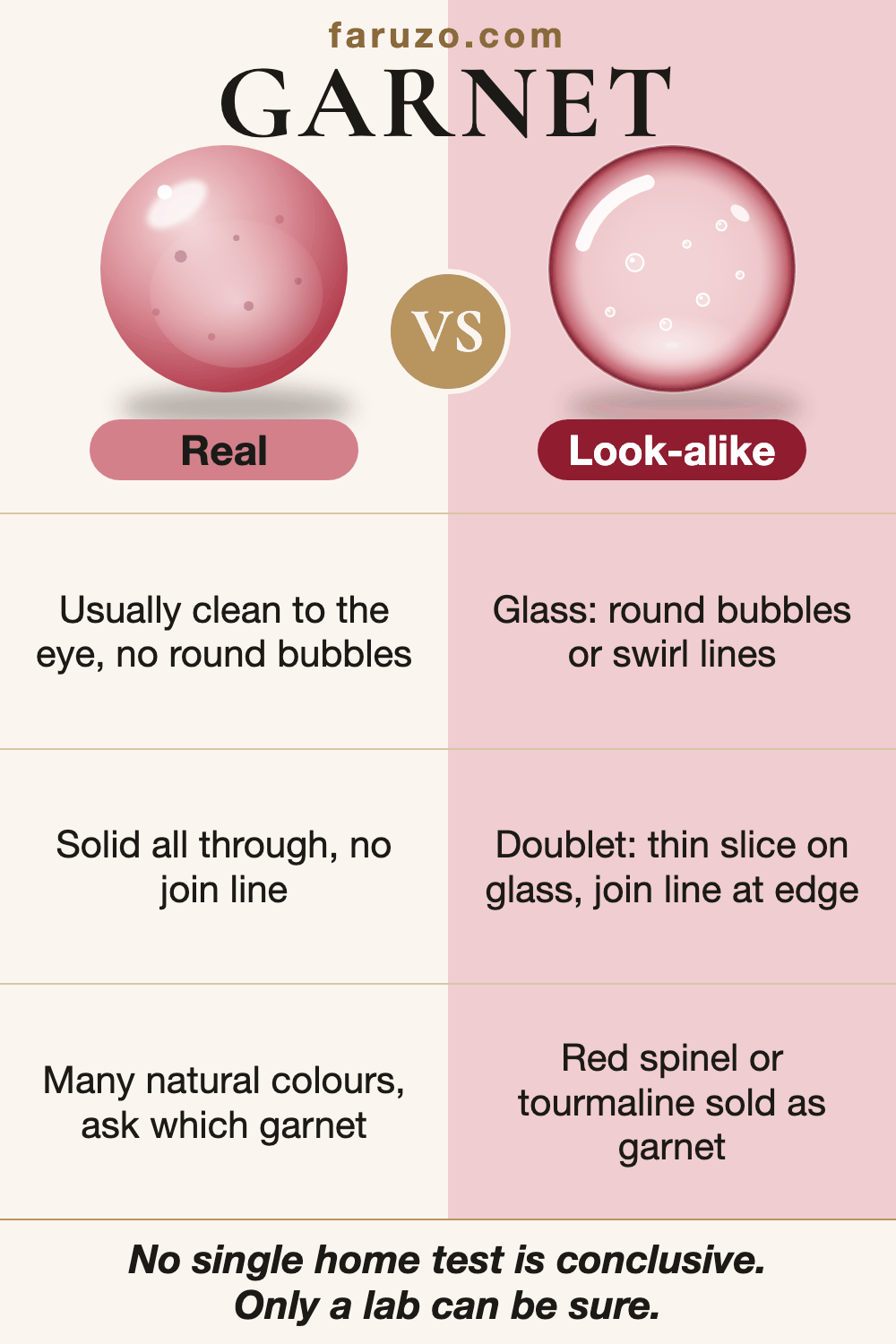
- Glass. Glass can be made in almost any colour and is a long-standing imitation. Under a loupe it may show round gas bubbles or swirl lines, which natural garnet typically does not show.
- Garnet-topped doublet. A doublet joins two pieces, here a thin slice of real garnet on top of a glass base. The garnet top can carry convincing inclusions that hide the glass below, and some apparent crystals can turn out to be round gas bubbles. A join line may show along the edge under magnification, and a lab can confirm it.
- Red spinel. Red spinel can look like red garnet. It is harder, at Mohs 8, and like garnet it is singly refractive, so a simple refractive-index check may not separate them. A lab can confirm which one it is.
- Red or pink tourmaline. Some red to pink tourmaline can resemble a garnet. Tourmaline is doubly refractive (birefringence 0.018 to 0.040) while garnet is not, so the back facets of a tourmaline may look doubled. Treat that as a hint, not proof.
Safe checks you can do
- Ask the seller in writing which garnet it is (for example pyrope, almandine, spessartine, tsavorite or demantoid) and whether it is natural, treated, a doublet or glass.
- Look through a loupe for round gas bubbles or swirl lines, which point to glass, and for a join line around the edge, which can mean a doublet. Natural red garnet is usually clean to the eye.
- Do not judge by colour alone. Garnet comes in nearly every colour, so orange, green or yellow stones can be genuine. A stone sold as blue or colour-change garnet is rare, so ask for lab testing.
- Do not scratch-test or heat-test a stone you plan to keep. A lab is the safer route when it matters, especially for tell-apart cases such as red spinel.
Wearing Garnet
Ring
Careful
Fine with care, but knocks can mark it.
Bracelet
Safe
Fairly hard, so fine for normal bracelet wear.
Pendant
Safe
Fairly hard, and a pendant sits clear of knocks.
Earrings
Safe
Fairly hard, and earrings rarely take knocks.
Guide for everyday wear, based on hardness and care notes. Safe, Careful or Avoid.
Garnet measures about 6.5 to 7.5 on the Mohs scale and has no cleavage, so it is fairly sturdy, though not as hard as ruby or sapphire. Earrings and pendants suit it best, and a bracelet is fine for normal wear. A ring is possible with care, since a hard knock can still mark or chip a stone, so take it off for gym and heavy work. Demantoid is the softer of the green garnets and deserves a protective setting. Store garnet apart from harder gems.
Related stones
Questions about Garnet
What does garnet mean?
In crystal tradition garnet is linked with vitality, courage and commitment, and with the Root chakra. That is a belief, not a fact about the stone. Its practical story is a family of minerals found in nearly every colour.
What is garnet?
Garnet is a group of related silicate minerals with the general formula X3Y2(SiO4)3. Five species matter as gems: pyrope, almandine, spessartine, grossular and andradite. Most gem garnet is a mix of two or more of them.
Is garnet a birthstone?
Yes. Garnet is the January birthstone on the major lists, and it is also the gem for a 2nd wedding anniversary. The assignment runs by month, so any birthday from 1 to 31 January counts.
How hard is garnet?
About 6.5 to 7.5 on the Mohs scale, depending on the type. Pyrope and almandine sit near 7 to 7.5, while grossular and demantoid are around 6.5 to 7. Garnet has no cleavage, so it does not split along flat planes, though a hard knock can still chip it.
Is garnet only red?
No. Red is the most common colour, but garnet also comes in orange, yellow, green, brown and purplish red, and rarely in blue-green to purple colour-change stones. Each species tends towards its own colours.
What are the types of garnet?
The main gem types are pyrope (red), almandine (deep red to purplish), spessartine (orange to yellow), grossular (colourless to green, including tsavorite and hessonite) and andradite (yellow to green, including demantoid). Rhodolite is a violet-red pyrope-almandine blend.
Which garnets tend to be the most valuable?
Colour matters most, and no standard grading scale exists for garnet. Green tsavorite and demantoid gain a great deal of value as they get larger, while red almandine does not. Rare colour-change and blue garnets are also sought after.
What is the difference between garnet and ruby?
Ruby is a different mineral, corundum, and is harder than garnet. Deep red pyrope and almandine can look like ruby at a glance, but a lab can tell them apart. Garnet is more sensitive to knocks, so a garnet ring needs more care.
Is there a blue garnet?
Yes, but it is rare. Some pyrope-spessartine garnets from Madagascar look blue-green in daylight and shift to purple under incandescent light. They were among the first blue garnets to reach the market.
Is garnet good for an everyday ring?
It can work with care. At about 6.5 to 7.5 with no cleavage, garnet is fairly sturdy, but a hard knock can still mark or chip it, so a protective setting and sensible wear are wise. Earrings and pendants take fewer knocks than a ring.
How do you clean garnet, and can it get wet?
Water is fine. Use a soft brush with warm soapy water, then dry it. Ultrasonic cleaners are usually safe for sound stones but not for fractured or fracture-filled ones, and steam cleaning is best avoided.
How can you tell real garnet from fake?
A home look can only hint. Round bubbles or swirl lines point to glass, and a join line can mean a garnet-topped doublet. Red spinel and some tourmaline can look similar, so ask the seller in writing and use a lab for a stone that matters.
Is garnet treated or dyed?
Most garnets are untreated. A garnet is occasionally fracture-filled, and some demantoid is reportedly heated at low temperature. Ask the seller to state any treatment in writing.
Where does garnet come from?
Africa supplies much of the world's garnet today, including Namibia, Kenya, Tanzania and Madagascar. Other sources include Myanmar, Brazil, Iran, Afghanistan, Pakistan, India and Sri Lanka. Bohemia was the main historic source of red pyrope.
Where does the name garnet come from?
It comes from the medieval Latin granatus, meaning pomegranate, probably because red garnet crystals resemble the fruit's seeds.