Quick answer: The January birthstone is garnet. GIA lists garnet for January [1], and so do Jewelers of America [2] and the American Gem Society [3]. No second January stone appears on any of the three lists. Garnet is most often deep red, but it also comes in orange, yellow, purple and green [1].
At a glance
- Stone: garnet, listed for January by GIA, Jewelers of America and the American Gem Society [1][2][3]
- Color: most often red; also orange, yellow, purple and vivid green [1]
- Hardness: 6.5 to 7.5 on the Mohs scale, depending on the type [1]
- Name: from Latin for "pomegranate", after the red seeds [1][3]
- Meaning (tradition): old beliefs link garnet with wealth and happiness; these are beliefs, not facts [1]
- Best worn as: earrings, brooches and pendants [1]
Which stone is the January birthstone?
Garnet. For January the three lists agree, so there is no second stone to choose between. The assignment runs by month, not by day: if your birthday falls anywhere from 1 to 31 January, garnet is your stone.
The lists do differ in other months. Our guide to birthstones by month shows where.
Garnet is a family, not one mineral
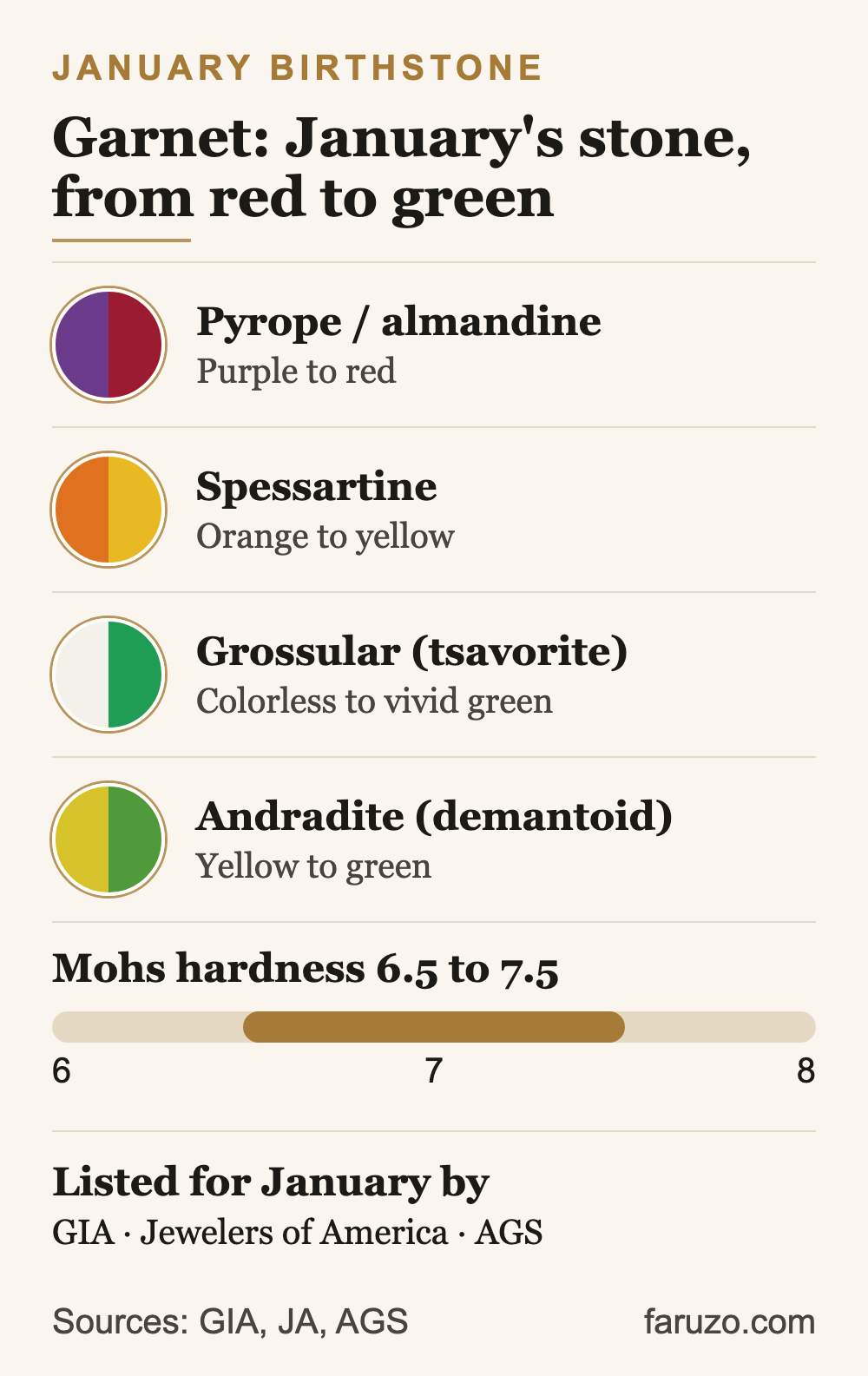
Garnet is a group of related minerals. GIA names five that matter as gems: pyrope, almandine, spessartine, grossular and andradite [1].
- Pyrope and almandine run from purple to red.
- Spessartine appears in orange and yellow.
- Andradite is mostly yellow to green. Its gem form is called demantoid.
- Grossular has the widest range, from colorless through yellow and orange-red to a vivid green called tsavorite.
GIA also notes garnets that shift from blue to purple in different light [1]. So red is common, but it is not a rule. For the full mineral breakdown, see garnet meaning.
Where the name comes from
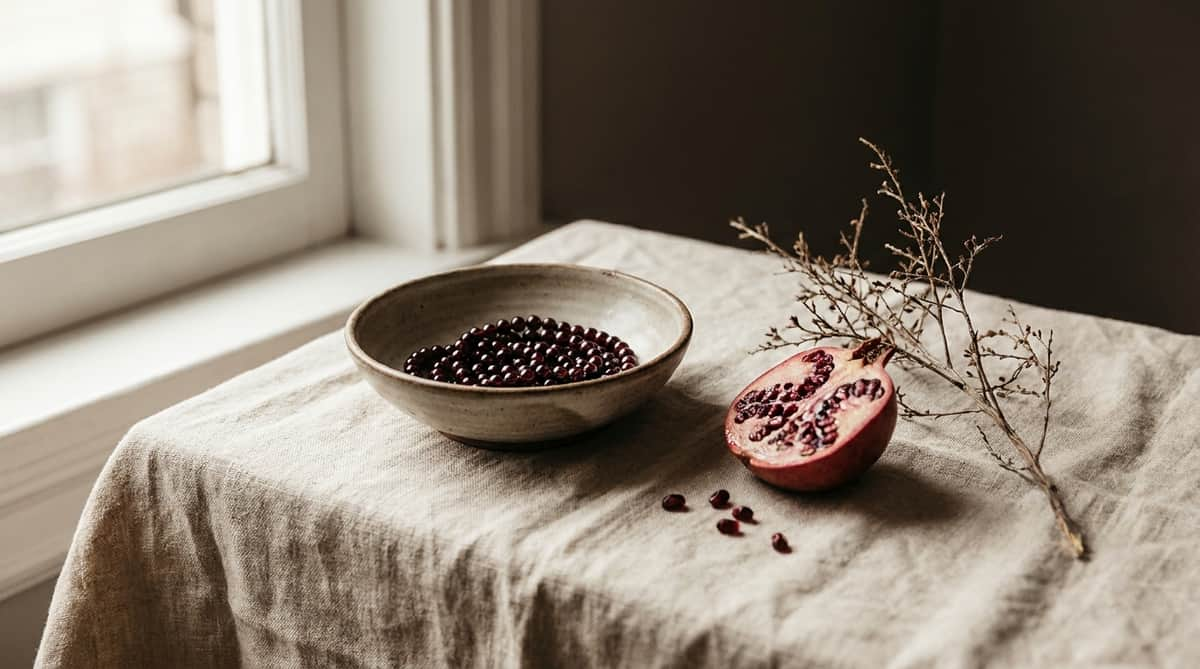
The word "garnet" traces to medieval Latin granatus, meaning "pomegranate" [1]. GIA ties the name to the similar red color. The American Gem Society adds that the English word comes from Middle English gernet, "dark red", in the 13th century, itself derived from the Latin word for pomegranate and its seeds [3].
A short history
GIA says garnets have served as gemstones, and as abrasives, since the Bronze Age [1].
- Ancient Egypt: necklaces set with red garnets adorned the pharaohs [1]. The American Gem Society dates Egyptian garnet inlays in jewelry and carvings to around 3100 BC and says Egyptians called it a symbol of life [3].
- Ancient Rome: signet rings carried garnet intaglios, used to stamp the wax that sealed important documents [1].
- The Middle Ages: clergy and nobility preferred red garnets [1].
- The Victorian era (1837 to 1901): red pyrope garnets from Bohemia, now part of the Czech Republic, were very popular [1]. The American Gem Society adds Russian demantoid garnets, and jewelry that copied the pomegranate with clusters of tiny red stones [3].
The Smithsonian holds an antique pyrope garnet hair comb from that era in the National Gem Collection [1]. Pyrope comes from the Greek pyrōpos, "fiery-eyed" [1].
What garnet is said to mean
Meaning is tradition, not science. GIA reports that some people believe garnet brings wealth and happiness, and that Indian astrology links it with self-confidence and clear thinking [1]. We repeat these only as beliefs people have held. They are not facts about the stone.
Where garnet comes from
Garnets come from many countries. Bohemia was the main source of the Victorian red pyropes. Today, much of the world's garnet comes from Africa [1].
- Namibia produces demantoid.
- Kenya, Tanzania and Madagascar supply most bright green tsavorite.
- Namibia and Tanzania are key sources of orange-to-yellow spessartine.
- Other sources include Myanmar, Brazil, Iran, Afghanistan, Pakistan, India and Sri Lanka [1]. The American Gem Society also names the United States, Greece and Russia [3].
How hard is garnet?
Garnets measure 6.5 to 7.5 on the Mohs scale [1][3]. GIA says that makes them more vulnerable to damage than rubies, sapphires and diamonds. Not every garnet suits daily wear, but GIA calls garnet ideal for earrings, brooches and pendants [1].
If you are comparing red stones, ruby vs garnet covers the hardness gap and how to tell them apart.
How gemologists judge garnet
The American Gem Society says garnet can be judged along some of the same parameters as diamonds, with cut and clarity affecting its beauty and value [3]. It points to saturated color, seen in both natural and artificial light, and a cut that spreads light evenly. Some inclusions are part of a garnet's look: "horsetails" in demantoid, for example [3]. Rarer colors, such as green or blue, usually cost more [3].
Caring for garnet
- Clean with a soft brush and warm soapy water. GIA calls this always safe [1].
- Ultrasonic cleaners are usually fine, except for fractured or fracture-filled stones [1].
- Avoid steam cleaning [1].
- Store garnet apart from harder gems. Diamonds, rubies and sapphires can scratch it, and garnet can scratch softer stones such as opal or pearl [1].
GIA says most garnets are untreated, though rarely some are fracture-filled [1].
Does the birthstone month matter?
We measured whether stones really get more attention in their own month. The results are in birth-month stone popularity data.
Keep going: the next month
February's stone is amethyst. Read the February birthstone guide.
FAQ
Is there a blue garnet?
The American Gem Society says some rare garnets are blue [3], and GIA notes garnets that change from blue to purple in different light [1].
What does a garnet crystal look like?
Britannica says garnets usually grow as well-formed crystals with 12 or 24 sides, called dodecahedrons and trapezohedrons. It also notes garnets have been favored by lapidaries since ancient times and are widely used as an abrasive [4].
Why is tsavorite called tsavorite?
The American Gem Society says tsavorite is named for Tsavo National Park in Kenya, and that it needs special conditions and unusual rock chemistry to form [3].
How tough is garnet?
The American Gem Society rates garnet's toughness as fair to good [3]. For the Mohs numbers and care advice, see the hardness and care sections above.
Is garnet also an anniversary stone?
GIA's January page mentions garnet as a gem to celebrate a 2nd wedding anniversary [1].
Sources
- GIA, "January Birthstones", https://www.gia.edu/birthstones/january-birthstones (read 2026-11-09)
- Jewelers of America, "Birthstones", https://www.jewelers.org/find-a-jeweler/buying-guides/birthstones/ (read in a browser 2026-11-09; January: Garnet)
- American Gem Society, "January Birthstones: Garnet", https://www.americangemsociety.org/january-birthstone/ (read in a browser 2026-11-09)
- Encyclopaedia Britannica, "garnet", https://www.britannica.com/science/garnet (read in a browser 2026-11-09; updated Oct. 1, 2026)