
Crystal guide
Carnelian Meaning, Properties and Care
Carnelian is the orange-to-red-brown variety of chalcedony, a microcrystalline form of quartz (SiO2, Mohs 6.5 to 7) coloured by iron oxide. Heating is a very old and very common way to deepen its red, and some commercial material is dyed. It is not on the standard birthstone list, and in crystal tradition it is linked with courage and drive.
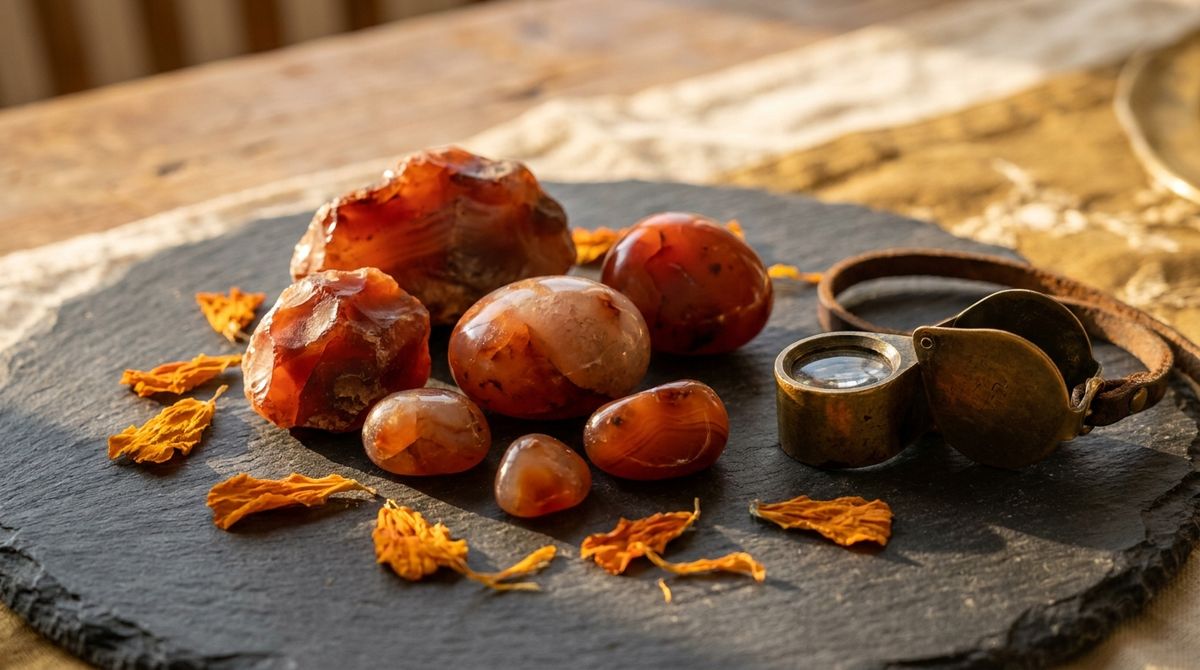
At a glance
- Hardness Mohs 6.5 to 7: quartz-family hardness, with no cleavage.
- Chalcedony (SiO2) coloured by iron oxide, from pale orange to nearly black-brown.
- Colour is often enhanced by heating or dyeing, and heating for red has been used for centuries.
- Care: keep it away from solvents and long strong sun, especially if it may be dyed.
Quick facts
| Family | Chalcedony (microcrystalline quartz, silica group) |
|---|---|
| Chemical formula | SiO2 (chalcedony is mostly quartz with minor intergrown moganite, both SiO2) |
| Crystal system | Cryptocrystalline: crystals too small to see without magnification. The quartz part is trigonal and the moganite part is monoclinic. |
| Mohs hardness | 6.5–7 |
| Luster | Waxy to resinous when rough; takes a glassy polish. Streak white. No cleavage; fracture uneven, splintery or conchoidal. |
| Transparency | Translucent; thin edges let light through, thick or heavily included pieces look opaque. |
| Natural colors | pale orange, orange to orange-red, reddish brown, deep red-brown to nearly black (darkest material is often called sard) |
| Main localities | India (the main source of commercial carnelian), Brazil, Peru, Sri Lanka, Egypt, Uruguay, Indonesia, Iran, Russia (Siberia), Germany |
| Common treatments | heating to deepen or develop red colour, in use for centuries and very common; dyeing of pale chalcedony or agate; assume it may be enhanced unless the seller says otherwise |
Carnelian at a glance, in pictures
Chakras (traditional)
Hardness range
Natural colors
- pale orange
- orange to orange-red
- reddish brown
- deep red-brown to nearly black (darkest material is often called sard)
Traditionally linked to
- Zodiac
- VirgoLeoTaurus
- Element
- Fire
Common forms of Carnelian
- Rough raw chunk
- Tumbled polished pebble
- Cabochon smooth dome
- Bead drilled bead
How hard is Carnelian?
- Talc 1
- Gypsum 2
- Copper coin ~ 3
- Calcite 3
- Fluorite 4
- Apatite 5
- Glass ~ 5.5
- Steel knife ~ 5.5
- Orthoclase 6
- Carnelian 6.5–7
- Quartz 7
- Topaz 8
- Corundum 9
- Diamond 10
What it is and where it comes from
Carnelian is one of the oldest jewelry stones. Faceted carnelian beads come from the Varna necropolis in Bulgaria (mid-5th millennium BC), and carnelian beads were traded from the Indus Valley to the Royal Cemetery at Ur in the 3rd millennium BC.
Etched carnelian beads, with white patterns made by painting an alkaline paste onto the stone and firing it, were probably first made in the Indus Valley.
Carnelian was widely used in Rome for engraved gems on signet and seal rings, because hot wax does not stick to it. Dark sard was used for Assyrian cylinder seals and for Egyptian and Phoenician scarabs.
In ancient Egypt, tyet (Isis-knot) amulets were often made of red jasper or similar red materials such as carnelian or red glass.
The English name was first 'cornelian' (14th century), from Latin cornum, the cornel cherry, whose red fruit resembles the stone. 'Carnelian' is a later variant, probably influenced by Latin caro, 'flesh'.
Heating has been used for centuries to produce carnelian's rich red. In the early 19th century Idar-Oberstein in Germany developed classical staining methods for agate, later using imported Brazilian agate to make coloured beads sold worldwide.
In crystal tradition
What follows is belief and folklore, passed down in crystal tradition. It is not measured fact.
Traditionally associated with: courage, motivation, creativity, vitality.
Carnelian is traditionally associated with the Sacral chakra, and it is sometimes linked to the Root chakra too. This is a modern spiritual tradition, not a fact about the stone.
Carnelian is traditionally associated with the element Fire. Gemstone-astrology lists name Virgo, Leo or Taurus for it, and they disagree with each other. These mappings have no scientific basis.
Carnelian is traditionally associated with courage, motivation and creative drive, themes that follow its fiery orange-red colour. This is a modern spiritual tradition, not a fact about the stone, and not an effect on the body or mind.
How to care for Carnelian
- Water Caution
- Sunlight Caution
- Salt Unknown
- Heat Caution
- Ultrasonic Caution
- Chemicals Avoid
Safe = fine as a rule · Caution = only briefly or gently · Avoid = can damage the stone · Unknown = no reliable guidance.
Chalcedony such as carnelian is relatively porous and absorbs dyes well, so a short rinse is fine but do not soak a piece that may be dyed. Dyed gems need protection from solvents and prolonged sunlight: acetone and alcohol can dissolve dyes, and a sunny window ledge can cause fading. Avoid torch or open-flame work near the stone. Skip salt and ultrasonic cleaners as a precaution. A soft cloth and mild soapy water are a reasonable default.
Real or fake? Look-alikes and treatments
Often confused with
- Sard
- Red jasper
- Banded agate
- Dyed pale chalcedony or agate
- Red glass
Common look-alikes
- Sard. Sard is the same material in a darker, browner range. The difference is not rigidly defined and the boundary with carnelian is blurry. If a seller calls a brown-red stone either name, both are fair; there is no lab test that separates them cleanly.
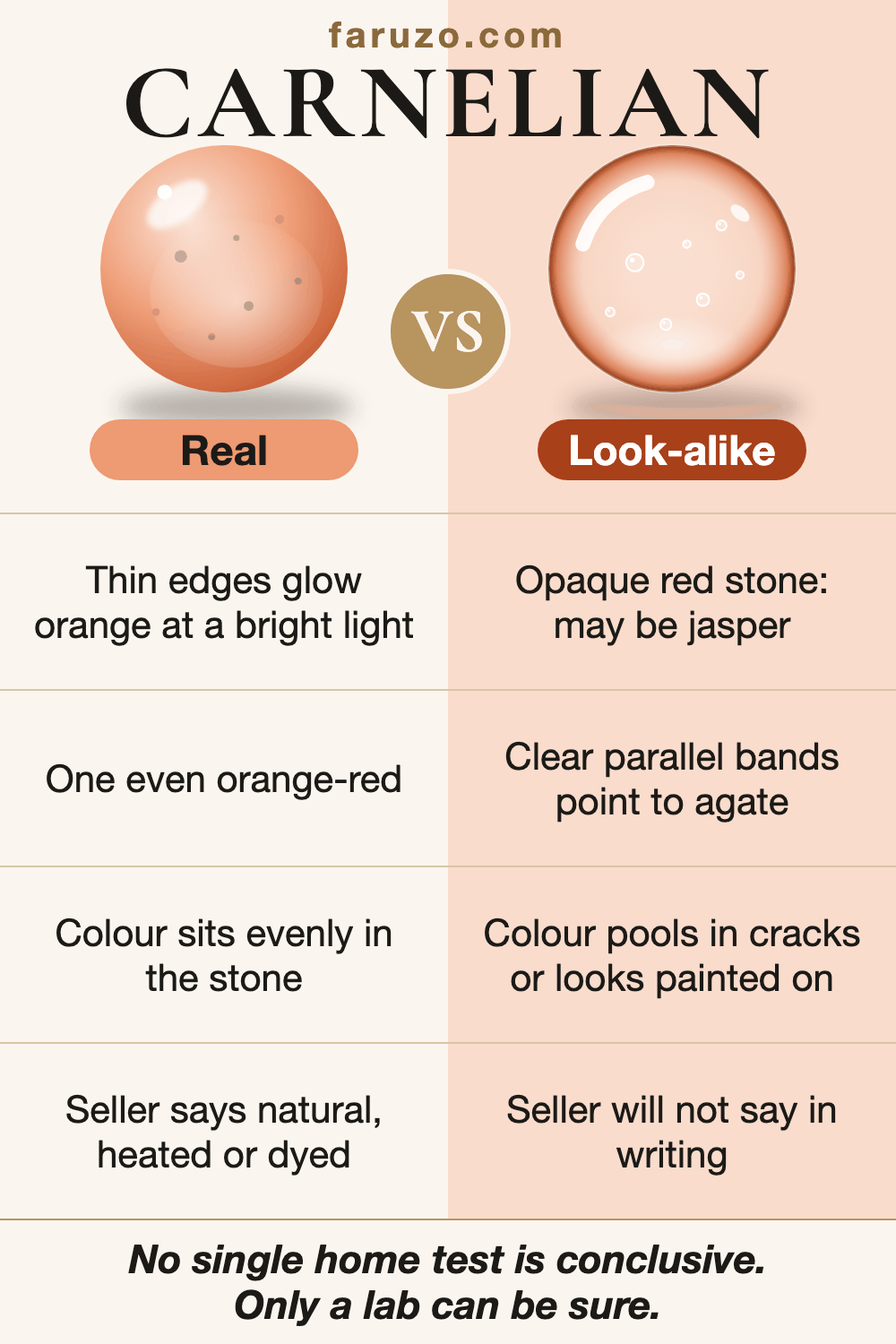
- Red jasper. Jasper is opaque, while carnelian is translucent. Hold the stone to a bright light: carnelian lets orange light through at thin edges, jasper does not. Both are coloured by iron and both are 6.5 to 7 on the Mohs scale, so hardness cannot separate them.
- Banded agate. Agate is also chalcedony but is known for visible bands of different colours, while carnelian is sold for a single even orange-red. Much commercial carnelian starts as pale agate that has been heated or dyed.
- Dyed pale chalcedony or agate. This is the same mineral, so refractive index and density do not give it away. A qualified gemologist can usually detect dyeing, dye can leak from larger fractures, and solvents such as acetone or alcohol can dissolve dyes. Organic dyes penetrate only a short distance from exposed surfaces.
- Red glass. Red glass was used as a substitute for carnelian in ancient Egyptian amulets. Glass is not chalcedony, so a gemologist can compare its refractive index and density with carnelian's (1.535 to 1.539 and 2.58 to 2.64).
Safe checks you can do
- Ask the seller in writing whether the stone is natural colour, heated or dyed. Assume it may have been enhanced unless you are told otherwise.
- Heated is not the same as fake. The question to ask is whether the heating or dyeing was disclosed, not whether the stone is untreated.
- Look closely, ideally with a loupe, at cracks and drill holes. Dye can leak from larger fractures, and organic dyes penetrate only a short distance from exposed surfaces. Colour that pools in cracks or looks painted on is a warning sign, but it is a sign, not proof.
- Check light and banding. Real carnelian is translucent, so thin edges glow when held to a bright light; an opaque red stone may be jasper. Distinct parallel bands point to agate. Neither check shows whether the colour was heated or dyed.
- For a stone that matters, ask a gemologist or lab. A qualified gemologist can usually detect dyeing. Carnelian reads refractive index 1.535 to 1.539 and specific gravity 2.58 to 2.64, which separates it from glass and many other red stones, but cannot show that the colour is natural.
- Do not rely on a single home test. A simple test (acetone rub, scratch or float) is not conclusive proof of dye or of natural colour, and solvents can damage dyed stones.
Wearing Carnelian
Ring
Careful
Fine with care, but knocks can mark it.
Bracelet
Safe
Fairly hard, so fine for normal bracelet wear.
Pendant
Safe
Fairly hard, and a pendant sits clear of knocks.
Earrings
Safe
Fairly hard, and earrings rarely take knocks.
Guide for everyday wear, based on hardness and care notes. Safe, Careful or Avoid.
Carnelian is Mohs 6.5 to 7 with no cleavage, so it is commonly cut as beads, cabochons and engraved gems and suits pendants, bead bracelets and earrings well. At 6.5 to 7 it can be scratched by harder materials such as topaz, corundum and diamond, and by grit that contains quartz, so a ring is workable but will show wear sooner than a sapphire or diamond ring, and a protective setting helps. Because the colour may be heated or dyed, take it off before using cleaning products or solvents and keep it out of long strong sun.
Related stones
Questions about Carnelian
What does carnelian mean?
In crystal tradition, carnelian is associated with courage, motivation and creative drive, themes that follow its orange-red colour. That is a modern spiritual tradition, not a fact about the stone and not an effect on the body or mind. As a material, carnelian is orange-red chalcedony that people have made into beads and seals for thousands of years.
Is carnelian a real gemstone or just dyed agate?
Carnelian is a real natural variety of chalcedony, coloured by iron oxide. Much of what is sold, though, starts as paler chalcedony or agate that has been heated, and some is dyed.
How can you tell if carnelian is dyed or heat-treated?
There is no reliable quick test. Look with a loupe for colour pooling in cracks or around drill holes, which can indicate dye. A gemologist can usually detect dyeing, but heated carnelian is hard to tell from naturally coloured carnelian, so assume it may have been enhanced.
What is the difference between carnelian and sard?
They are the same material, iron-coloured chalcedony. Sard is the darker, browner end, and carnelian is lighter orange to reddish brown. The boundary is blurry, so a seller using either name is not necessarily wrong.
What is the difference between carnelian and red jasper?
Both are coloured by iron and both are Mohs 6.5 to 7. The visible difference is light: carnelian is translucent chalcedony and glows orange when held to a bright light, while jasper is opaque. They are often confused.
How hard is carnelian? Can I wear it every day?
Carnelian is Mohs 6.5 to 7, the same range as quartz-family stones. It is harder than ordinary glass (about 5.5) and can be scratched by topaz, corundum and diamond. It has no cleavage, so it is not prone to splitting. Pendants and earrings take the least wear; a ring is workable but will show scratches sooner than harder stones.
Can carnelian go in water or sunlight?
A short rinse is fine, but it is best not to soak it or leave it on a sunny window ledge. Chalcedony is relatively porous and absorbs dye well, and dyed gems need protection from solvents and prolonged sunlight because some dyes dissolve in acetone or alcohol or fade in ultraviolet light. Since you often cannot know whether a piece is dyed, treat it as if it might be.
Is carnelian a birthstone?
Carnelian is not a standard birthstone, though sard and sardonyx appear as August alternates on some lists. Some gemstone-astrology lists include it for a zodiac sign (Virgo, Leo and Taurus all appear), but they disagree, and these are traditions rather than a standard list.