
Crystal guide
Sardonyx Meaning, Properties and Care
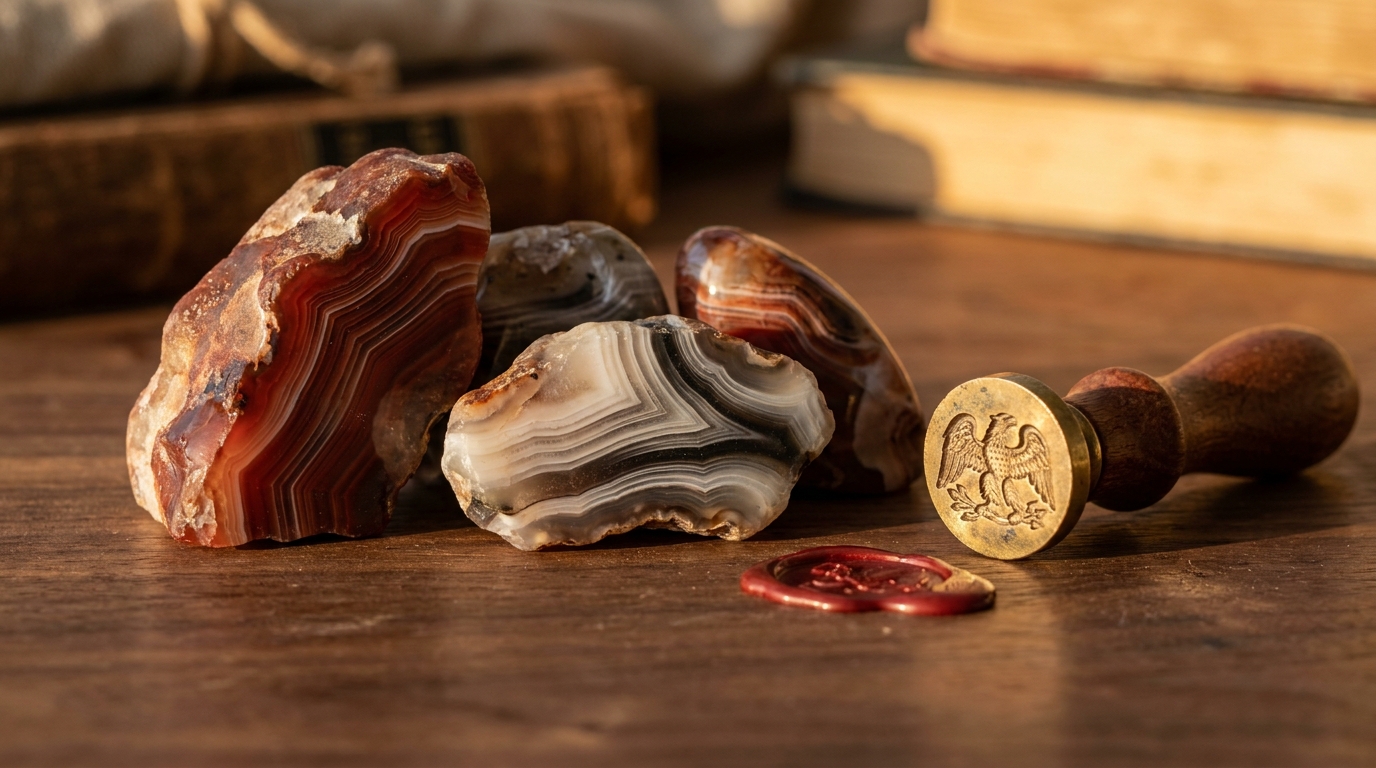
Sardonyx is banded chalcedony, a fine-grained form of quartz (SiO2), with reddish-brown sard layers alternating with white or black onyx layers. It is about Mohs 6.5 to 7 with no cleavage, and dyed stones are common. In crystal tradition it is a stone of courage, strength and protection.
At a glance
- Banded chalcedony, formula SiO2, hardness about Mohs 6.5 to 7, no cleavage.
- Bands of reddish-brown sard alternate with white or black onyx; the name joins the two.
- Chalcedony is commonly dyed. A dyed piece is still real sardonyx, a treated stone, not a fake.
- Care: warm soapy water and a soft brush. Avoid ultrasonic and steam cleaners, and high heat.
Quick facts
| Family | Chalcedony, a microcrystalline quartz (silicate); a banded form made of sard and onyx layers |
|---|---|
| Chemical formula | SiO2 |
| Crystal system | Microcrystalline (cryptocrystalline) quartz, too fine-grained to show crystals |
| Mohs hardness | 6.5–7 |
| Luster | Vitreous to waxy; no cleavage, and it breaks with uneven, splintery or curved surfaces |
| Transparency | Opaque to translucent |
| Natural colors | reddish brown to dark orange (sard bands), white (onyx bands), black (onyx bands) |
| Main localities | India, Brazil, Germany, Madagascar, Uruguay, United States |
| Common treatments | commonly dyed, like other chalcedony; heating is also used, and high heat can change the colour of dyed stones |
| Birth month | August (traditionally, in some lists; lists vary) |
Looking for the month? August birthstone guide
Sardonyx at a glance, in pictures
Chakras (traditional)
Hardness range
Natural colors
- reddish brown to dark orange (sard bands)
- white (onyx bands)
- black (onyx bands)
Traditionally linked to
- Planet
- Mars
- Zodiac
- Leo
- Element
- Fire
Common forms of Sardonyx
- Rough raw chunk
- Tumbled polished pebble
- Cabochon smooth dome
How hard is Sardonyx?
- Talc 1
- Gypsum 2
- Copper coin ~ 3
- Calcite 3
- Fluorite 4
- Apatite 5
- Glass ~ 5.5
- Steel knife ~ 5.5
- Orthoclase 6
- Sardonyx 6.5–7
- Quartz 7
- Topaz 8
- Corundum 9
- Diamond 10
What it is and where it comes from
The name joins sard, a reddish-brown chalcedony, with onyx, from the Greek word for 'claw' or 'fingernail'.
Sard is often said to be named for Sardis, an ancient city in Lydia. Other suggestions link the word to a Persian term for yellowish-red or a Greek term for flesh.
Sardonyx turns up in Minoan art from Knossos on Crete, so it was already being worked in the Bronze Age.
Sard, the red-brown half of the stone, was cut into Assyrian cylinder seals, Egyptian and Phoenician scarabs, and early Greek and Etruscan gems.
The Romans favoured it for seals and signet rings because hot wax does not stick to it. A design cut into the stone left a clean impression.
Its contrasting layers also suited cameos and intaglios, where a carver cuts a pale figure out of a darker band.
Colouring chalcedony artificially is an old practice known in Roman times, and it is still routine in the trade today.
It is often described as the oldest August stone, with a history of more than 4,000 years. Peridot and spinel joined the August lists later, and sardonyx now appears on some lists and not others.
In crystal tradition
What follows is belief and folklore, passed down in crystal tradition. It is not measured fact.
Traditionally associated with: courage, strength, protection, clear speech.
Sardonyx is traditionally associated with courage, strength and protection. In Roman tradition, soldiers carried sardonyx carved with Mars, the god of war, for courage in battle. This is a tradition, not a fact about the stone.
In the Renaissance it was linked with eloquence, and it is traditionally tied to clear speech and steadiness in partnerships. It is also traditionally believed to be one of the stones of the High Priest's breastplate in the Old Testament. Chakra and zodiac links vary between lists, with Root and Leo named often. These are beliefs within crystal practice, not scientific claims.
How to care for Sardonyx
- Water Safe
- Sunlight Unknown
- Salt Unknown
- Heat Caution
- Ultrasonic Caution
- Chemicals Unknown
Safe = fine as a rule · Caution = only briefly or gently · Avoid = can damage the stone · Unknown = no reliable guidance.
Clean sardonyx with warm soapy water and a soft brush, then dry it. Ultrasonic and steam cleaners are best avoided, and high heat, including heat during jewelry repair, can change the colour of dyed stones. Effects of long direct sun, salt and strong cleaners are not well documented, so keep them away as a precaution.
Real or fake? Look-alikes and treatments
Often confused with
- Banded glass
- Banded calcite (sold as 'onyx' or 'Mexican onyx')
- Plastic or resin
Common look-alikes
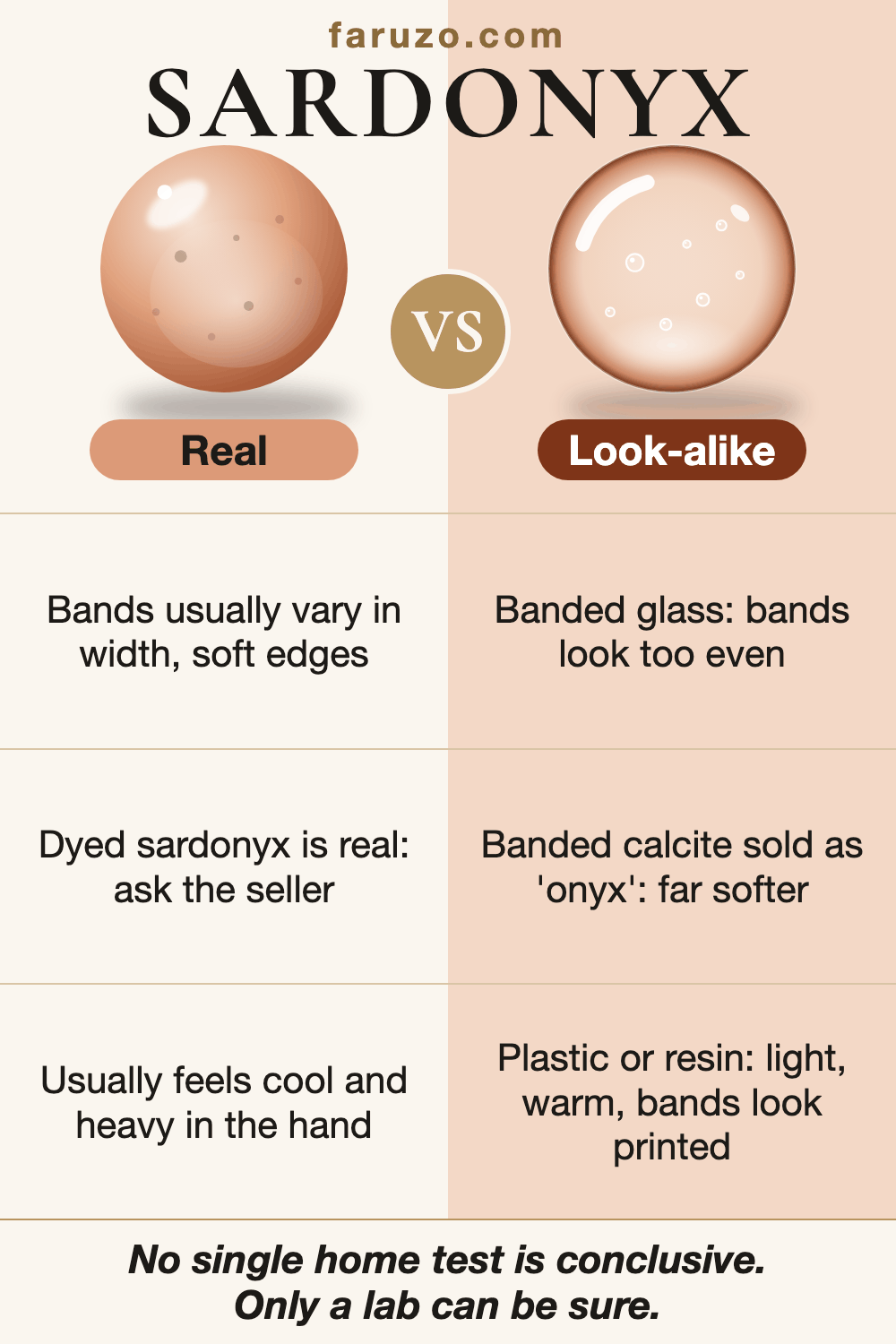
- Banded glass. Glass can be made in red-brown and white or black layers. It tends to look too regular and too perfect, may hold tiny round bubbles, feels warmer in the hand and breaks with curved, shell-like surfaces. Real sardonyx bands usually vary in width and have slightly uneven edges.
- Banded calcite (sold as 'onyx' or 'Mexican onyx'). Banded calcite is carved and sold as onyx, including as 'Mexican onyx', but it is much softer (about Mohs 3) and a steel blade scratches it. It is a different mineral from chalcedony. If the seller says marble or onyx for a banded stone, ask what the material is.
- Plastic or resin. Plastic and resin feel light and warm, scratch easily and may show moulded seams or bands that look printed or uniform. Real stone feels cool and noticeably heavier for its size.
Safe checks you can do
- Ask the seller in writing whether the stone is natural, dyed or treated, and whether it is sardonyx or something else. Dyed sardonyx is still real chalcedony, so ask for plain disclosure.
- Look at the bands in strong light. In real sardonyx the layers usually vary in width and have soft, slightly uneven edges. Bands that look too even or printed point to glass or plastic.
- Look for tiny round bubbles or a surface that seems too perfect. Glass often has both, while real stone does not.
- Check the feel. Real stone tends to feel cool and heavy in the hand, while glass warms up faster and plastic feels light.
- Be wary of a large, perfectly banded piece sold cheaply as rare sardonyx. A soft banded 'onyx' carving may be calcite, so ask what the stone is.
- Avoid scratch-testing a stone you plan to keep. For a stone that matters, a gem lab can confirm what it is and give written identification.
Wearing Sardonyx
Ring
Careful
Fine with care, but knocks can mark it.
Dyed pieces: keep away from high heat
Bracelet
Safe
Fairly hard, so fine for normal bracelet wear.
Pendant
Safe
Fairly hard, and a pendant sits clear of knocks.
Earrings
Safe
Fairly hard, and earrings rarely take knocks.
Guide for everyday wear, based on hardness and care notes. Safe, Careful or Avoid.
Sardonyx is fairly hard (Mohs 6.5 to 7) with no cleavage, so bracelets, pendants and earrings suit it well. A ring is fine with care, since knocks and hard surfaces can scratch the polish over time. Dyed pieces are best kept away from high heat.
Related stones
Questions about Sardonyx
What does sardonyx mean?
In crystal tradition sardonyx is a stone of courage, strength and protection, with older links to clear speech. That is a belief, not a fact about the stone. As a material it is simply banded chalcedony with reddish-brown and white or black layers.
What is sardonyx?
Sardonyx is a banded form of chalcedony, a fine-grained quartz (SiO2). Its layers combine sard, a reddish-brown chalcedony, with onyx, which is usually white or black. The name joins the two.
Is sardonyx a birthstone?
Sardonyx is traditionally an August birthstone in some lists, but lists vary. Some include it beside peridot and spinel, and others leave it out. Peridot is the August stone on all the main lists, so check which list you are following.
Is dyed sardonyx real?
Yes. Dyeing is common for chalcedony, and a dyed sardonyx is still real stone that has been treated. It is not a fake. What matters is plain disclosure, so ask the seller whether the stone is natural or dyed, and expect the price to reflect it.
How hard is sardonyx?
Sardonyx is about 6.5 to 7 on the Mohs scale, harder than a steel blade and in the same range as quartz and peridot. It has no cleavage, so it resists chipping better than softer stones, though it can still scratch over time.
What is the difference between sardonyx and onyx?
Onyx is banded chalcedony in black and white, or other colours, with straight parallel bands. Sardonyx is onyx that also carries layers of reddish-brown sard. If there is no red-brown layer, the stone is plain onyx.
What is the difference between sardonyx and carnelian?
Carnelian is a single orange to reddish-brown chalcedony with no banding. Sard is the darker, browner end of the same range, and the line between the two is not sharp. Sardonyx is the banded stone, with sard layers alongside white or black onyx.
Is Mexican onyx the same as sardonyx?
No. 'Mexican onyx' is banded calcite, a much softer mineral at about Mohs 3. Sardonyx is chalcedony, a form of quartz at about 6.5 to 7. The two can look alike in carved pieces, so ask what the stone is.
Can sardonyx get wet?
Yes. Warm soapy water is fine for cleaning the stone itself. Keep soaks short, and keep dyed pieces away from high heat.
How can you tell real sardonyx from fake?
Home checks are only hints. Real sardonyx usually has bands of uneven width and feels cool, while glass may show bubbles and plastic feels light. Banded calcite sold as onyx is much softer. For a stone that matters, a gem lab can confirm it. Dye is not a sign of a fake.
How do you clean and care for sardonyx?
Use warm soapy water and a soft brush, then dry it. Ultrasonic and steam cleaners are best avoided, and so is high heat, because it can change the colour of dyed stones. Store it apart from harder stones that could scratch the polish.
Why did the Romans use sardonyx for signet rings?
Hot wax does not stick to the stone, so a design cut into it left a clean impression in the seal. Its hardness and fine grain also held crisp detail, and its layers suited cameos and intaglios.
Is sardonyx good for an everyday ring?
It can work with care. At about Mohs 6.5 to 7 it is fairly hard, but knocks and hard surfaces can scratch the polish over time. Bracelets, pendants and earrings take fewer knocks and suit it well.