
Crystal guide
Peridot Meaning, Properties and Care
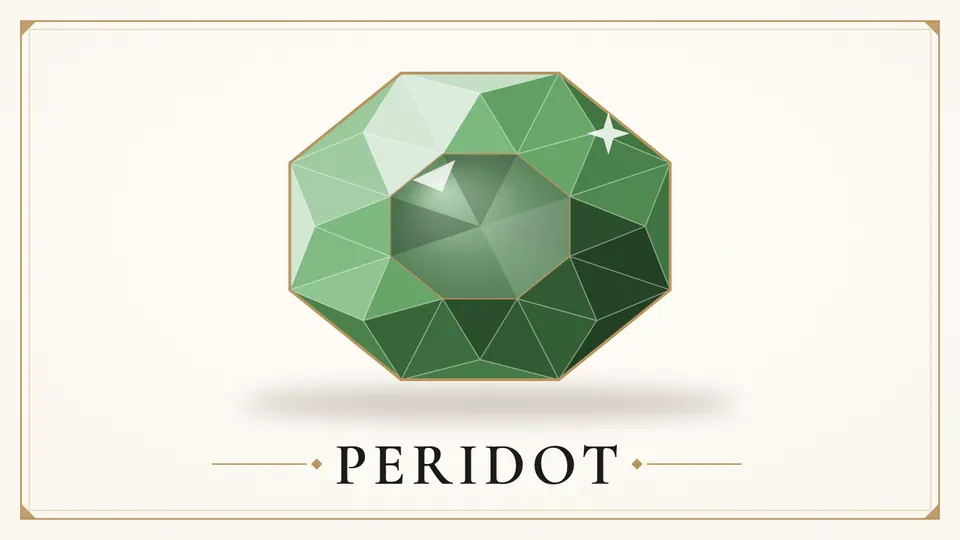
Peridot is the gem variety of the mineral olivine, ((Mg,Fe)2SiO4), in yellowish green to olive green. Its green is part of the mineral itself rather than caused by a trace impurity, so it stays in essentially one colour family. It is one of the modern August birthstones, and in crystal tradition it is linked to light, renewal and warmth.
At a glance
- Hardness Mohs 6.5 to 7: durable enough for jewelry, but best worn with some care, since it can scratch and chip.
- Olivine, (Mg,Fe)2SiO4, in yellowish green to olive green; the best colour is a clean, rich green.
- A modern August birthstone, and a gem for a wedding anniversary (lists give the 15th or 16th).
- Care: a soft brush and gentle hand-washing. Avoid steam and machine cleaners.
Quick facts
| Family | Olivine (silicate group); the gem variety of the magnesium-rich olivine, forsterite |
|---|---|
| Chemical formula | (Mg,Fe)2SiO4 |
| Crystal system | Orthorhombic |
| Mohs hardness | 6.5–7 |
| Luster | Vitreous (glassy) |
| Transparency | Transparent for gem material. Most fine peridot is eye-clean, though tiny dark crystals or disk-shaped "lily pad" inclusions are common. |
| Natural colors | yellowish green; olive green; rich, clean green (most prized); brownish green (lower value) |
| Main localities | Arizona, USA (San Carlos Apache Reservation); Myanmar (near Mogok); Pakistan; China; Vietnam; Tanzania; Zabargad (St. John's Island) in the Red Sea, historic |
| Common treatments | fractures may be filled in some stones |
| Birth month | August (a modern birthstone; spinel and sardonyx are also listed) |
Looking for the month? August birthstone guide
Peridot at a glance, in pictures
Chakras (traditional)
Hardness range
Natural colors
- yellowish green
- olive green
- rich, clean green (most prized)
- brownish green (lower value)
Traditionally linked to
- Planet
- Sun
- Zodiac
- LeoVirgo
- Element
- Fire
Common forms of Peridot
- Rough raw chunk
- Tumbled polished pebble
- Cabochon smooth dome
- Faceted cut gem
How hard is Peridot?
- Talc 1
- Gypsum 2
- Copper coin ~ 3
- Calcite 3
- Fluorite 4
- Apatite 5
- Glass ~ 5.5
- Steel knife ~ 5.5
- Orthoclase 6
- Peridot 6.5–7
- Quartz 7
- Topaz 8
- Corundum 9
- Diamond 10
What it is and where it comes from
The name peridot is thought to come from the Arabic faridat, meaning gem, though the origin is not certain.
Ancient Egyptians mined peridot on a Red Sea island now called Zabargad or St. John's Island. They are reported to have called it the gem of the sun.
Peridot was long confused with other gems. It was often labelled topaz or emerald, and the large green stones on the Shrine of the Three Holy Kings in Cologne Cathedral, believed for centuries to be emeralds, are reportedly peridot.
It has been suggested that the emeralds linked with Cleopatra may in fact have been peridot. This is a suggestion, not an established fact.
Peridot is one of the few gems that also arrives from space. It occurs in pallasite meteorites, and olivine has been found in comet dust returned by a spacecraft, as well as in rock from the Earth's upper mantle.
Today most peridot in jewelry comes from China, Myanmar, Pakistan, Tanzania, Vietnam and the United States, with Arizona the main American source, where it formed in volcanic lava fields.
Peridot is a modern August birthstone, alongside spinel and sardonyx. Anniversary lists vary: it is given for the 15th wedding anniversary in some lists and the 16th in others.
In crystal tradition
What follows is belief and folklore, passed down in crystal tradition. It is not measured fact.
Traditionally associated with: renewal, warmth, protection, positivity.
Peridot is traditionally associated with the Heart and Solar Plexus chakras. This is a modern spiritual tradition, not a fact about the stone, and lists differ.
Peridot is traditionally associated with the zodiac signs Leo and Virgo, the Sun and the element Fire. This is a modern spiritual tradition, not a fact about the stone. These mappings differ between lists and have no scientific basis.
Peridot has long been linked with light. The ancient Egyptians are reported to have called it the gem of the sun, and old belief held that it guarded the wearer against the dangers of the night, especially when set in gold. These are symbolic and historical beliefs, not effects on the body or mind.
In crystal tradition peridot is associated with renewal, a fresh start and a warm, positive outlook. This is symbolic meaning from tradition, not a claim about your health.
How to care for Peridot
- Water Safe
- Sunlight Unknown
- Salt Unknown
- Heat Caution
- Ultrasonic Avoid
- Chemicals Caution
Safe = fine as a rule · Caution = only briefly or gently · Avoid = can damage the stone · Unknown = no reliable guidance.
Hand-wash peridot with a soft brush in mildly soapy warm water. Skip ultrasonic and steam cleaners, since peridot has only fair to good toughness and can have fractures, and stones with filled fractures should only ever be cleaned in warm soapy water. Keep it away from torches and sudden temperature swings. Peridot can be attacked by strong acids, so keep it from household chemicals and rinse and dry the stone after any contact.
Real or fake? Look-alikes and treatments
Often confused with
- Emerald
- Green tourmaline
- Green garnet (demantoid)
- Glass
- Green sapphire
Common look-alikes
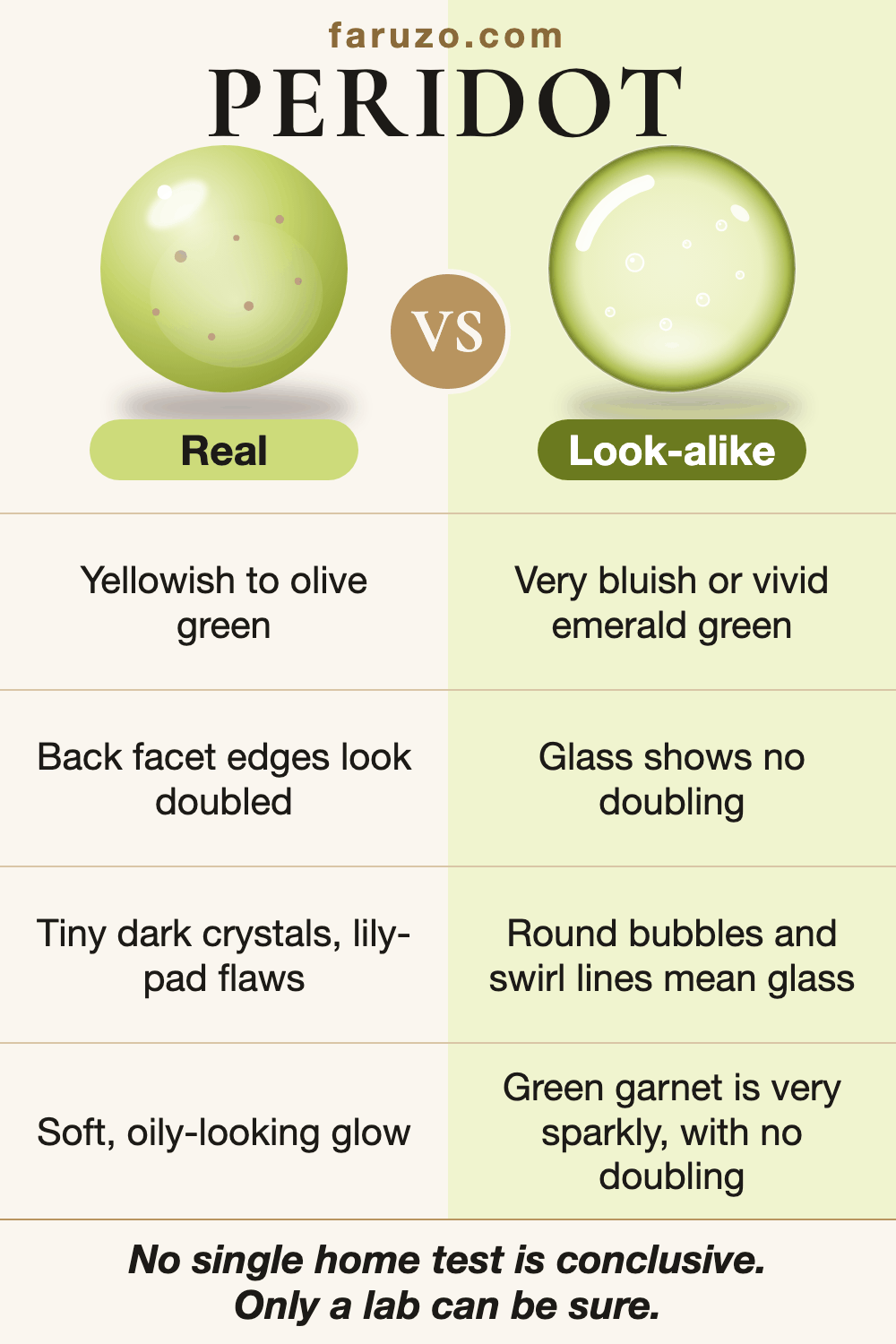
- Emerald. Emerald is a beryl, Mohs 7.5 to 8, and its green is usually a cooler, bluer green with a softer look, while peridot is yellowish to olive green. Peridot shows strong double refraction, so back facets often look doubled. The two were confused for centuries, so colour alone is not a safe guide.
- Green tourmaline. Green tourmaline can look very similar and comes in a wider range of greens, including bluish and deeper shades. Tourmaline is also doubly refractive, but peridot's doubling is much stronger, so its back facets look more clearly doubled. A gemologist can separate them with a refractometer.
- Green garnet (demantoid). Demantoid garnet is a rarer green with very strong sparkle. Peridot has a softer, oily-looking glow and visible doubling of facets, which garnet does not show, because garnet is single-refracting. Lab measurement settles it.
- Glass. Green glass is a common imitation. Glass shows no doubling of the back facets, may show round gas bubbles and swirl marks, and often feels warmer in the hand than cold gem stone. These are signs, not proof.
- Green sapphire. Green sapphire is corundum, Mohs 9, and usually a cooler, greyer or bluer green than peridot. It is much harder and shows far weaker doubling of the back facets. A gemologist can confirm it.
Safe checks you can do
- Look through the top of a faceted stone at the back facets. Peridot's strong double refraction usually makes each facet edge appear doubled. Glass and most other look-alikes do not show this, though a few other gems do, so treat it as a strong hint rather than proof.
- Check the colour. Peridot is yellowish to olive green, and a very bluish or very vivid emerald-green stone sold as peridot deserves a second look. Real stones vary from piece to piece, so colour alone is not conclusive.
- Inclusions can help. Small dark crystals and disk-shaped lily-pad inclusions are typical in natural peridot, while round bubbles and swirl lines point to glass. A perfectly clean stone is not fake, since fine peridot is often eye-clean.
- Be wary of marketing language. An "unheated" label on peridot is a sales phrase rather than a mark of quality, and a grade such as "AAA" is set by each seller. For an important stone, ask a gemologist or lab to measure it.
Wearing Peridot
Ring
Careful
Fine with care, but knocks can mark it.
Bracelet
Safe
Fairly hard, so fine for normal bracelet wear.
Pendant
Safe
Fairly hard, and a pendant sits clear of knocks.
Earrings
Safe
Fairly hard, and earrings rarely take knocks.
Guide for everyday wear, based on hardness and care notes. Safe, Careful or Avoid.
Peridot has fair to good toughness and a cleavage direction, so pendants and earrings suit it best, and a bracelet is fine for normal wear, with an occasional knock risk. Rings take the most knocks and can scratch or chip a stone that is softer than quartz, so a protective setting and occasional wear are wise for an everyday ring. Store peridot apart from harder stones such as sapphire or diamond to avoid scratches, and take it off before heavy work or very hot water.
Related stones
Questions about Peridot
What does peridot mean?
In crystal tradition peridot is a stone of light, renewal and a warm, positive outlook. It has long been linked with the sun, and old belief held that it protected the wearer at night. These are symbolic meanings from tradition, not facts about the stone or claims about your health.
Is peridot a real gemstone?
Yes. Peridot is the gem variety of the mineral olivine, not glass or a synthetic. Some stones have filled fractures, and green glass is a common imitation, so ask the seller what yours is.
What month is peridot the birthstone for?
August. Peridot is a modern August birthstone (spinel and sardonyx are also listed). It is also a wedding anniversary gem, the 15th in some lists and the 16th in others.
What colour is peridot?
Yellowish green to olive green, with brownish undertones lowering value. Its green is part of the mineral itself rather than caused by a trace impurity, so it stays essentially in one colour family.
How hard is peridot?
Mohs 6.5 to 7: hard enough for jewelry, but softer than sapphire or topaz, so it can scratch or chip. For a ring, choose a protective setting and avoid hard knocks.
How do you clean peridot?
Rinse it with a soft brush in lukewarm water and a drop of mild soap, then dry it with a soft cloth. Peridot can have fractures and only fair to good toughness, so leave machine cleaners alone.
What is the difference between peridot and emerald?
They are different minerals. Peridot is olivine, Mohs 6.5 to 7, typically yellowish to olive green, with strong double refraction that makes back facets look doubled. Emerald is a beryl, Mohs 7.5 to 8, usually a cooler, bluer green. The two were confused for centuries, so a gemologist is the reliable way to tell.
Can peridot come from space?
Yes, in a sense. Peridot is olivine, and olivine occurs in pallasite meteorites as well as in rock from the Earth's upper mantle. Most peridot used in jewelry, however, is mined on Earth, with Arizona the main American source.
How can you tell real peridot from glass?
Look through the top of the stone at the back facets: peridot's strong double refraction usually makes them appear doubled, which glass does not do. Glass may also show round bubbles or swirl marks. These are signs, not proof, so use lab testing if it matters.
Is peridot good for an everyday ring?
It can work with care. At 6.5 to 7 with only fair to good toughness, peridot can scratch or chip from knocks, so a protective setting and occasional wear are wise. Pendants, earrings and bracelets are the lower-risk choices.
Does peridot suit gold or steel?
Its yellow-green tone looks warm against gold-toned metal, and it also pairs well with cool silver-toned metal. It is a matter of taste, not a rule.