
Crystal guide
Prehnite Meaning, Properties and Care
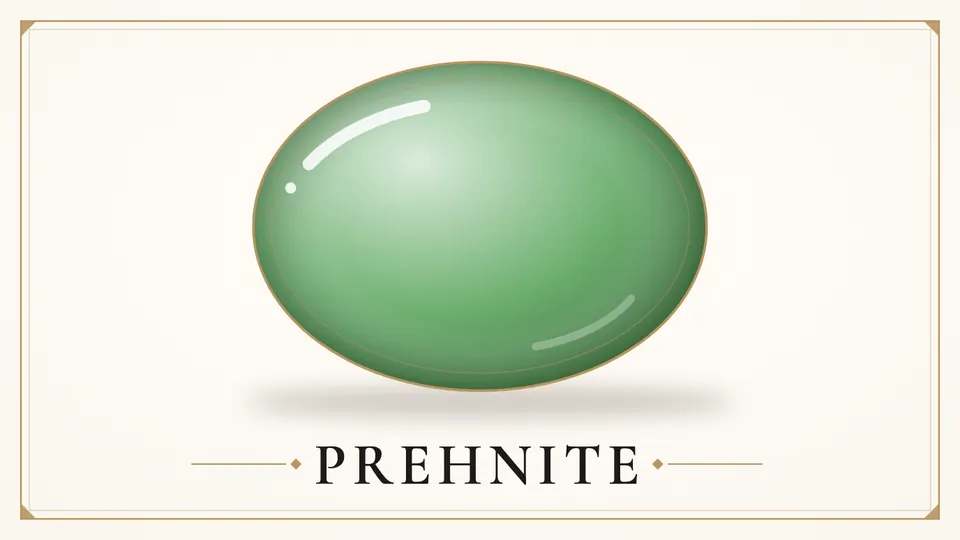
Prehnite is a pale-green calcium aluminium silicate, usually translucent and most often seen as glossy cabochons and beads. It sits at about 6 to 6.5 on the Mohs scale, but it has a distinct cleavage plane, so a hard knock can chip or split it. Some pieces carry dark epidote crystals inside the green. In crystal tradition it is a stone of calm and inner peace.
At a glance
- A calcium aluminium silicate, usually light green with a whitish or yellowish tinge, mostly translucent.
- Mohs about 6 to 6.5, with distinct cleavage in one direction, so it can chip or split if knocked.
- Often cut as cabochons and beads. Some pieces carry dark epidote crystals inside the green.
- Not on the standard birthstone lists. Care: soft cloth, mild soap, no heat, steam or machine cleaners.
Quick facts
| Family | Basic calcium aluminium silicate, sometimes with a little iron |
|---|---|
| Chemical formula | Ca2Al(AlSi3O10)(OH)2 |
| Crystal system | Orthorhombic |
| Mohs hardness | 6–6.5 |
| Luster | Vitreous to pearly, with distinct cleavage in one direction |
| Transparency | Mostly translucent, rarely transparent |
| Natural colors | light green; yellowish green; mint green; greenish white; rarely yellow, orange, pink, grey or colourless |
| Main localities | South Africa (Cradock, Kalahari Manganese Fields); Australia (Wave Hill Station); Mali; India; China; France (Bourg d'Oisans); USA (New Jersey, Connecticut) |
| Common treatments | usually sold as natural; rough specimens are sometimes oiled for shine, and dyed or coated green stones of many kinds exist, so ask whether the colour is natural |
Prehnite at a glance, in pictures
Hardness range
Natural colors
- light green
- yellowish green
- mint green
- greenish white
- rarely yellow, orange, pink, grey or colourless
Common forms of Prehnite
- Rough raw chunk
- Cabochon smooth dome
- Bead drilled bead
How hard is Prehnite?
- Talc 1
- Gypsum 2
- Copper coin ~ 3
- Calcite 3
- Fluorite 4
- Apatite 5
- Glass ~ 5.5
- Steel knife ~ 5.5
- Orthoclase 6
- Prehnite 6–6.5
- Quartz 7
- Topaz 8
- Corundum 9
- Diamond 10
What it is and where it comes from
Prehnite is named for Colonel Hendrik von Prehn (1733 to 1785), who commanded the military forces of the Dutch colony at the Cape of Good Hope from 1768 to 1780 and is said to have brought specimens to Europe.
It was first described in the late 1700s, from material in the Karoo dolerites near Cradock in South Africa.
Prehnite forms in veins and cavities in basalt and similar rock, and it most often grows as rounded, bubbly masses that are stalactitic, botryoidal or globular. Distinct crystals are very rare.
It is often found beside other cavity minerals such as calcite, apophyllite and epidote. Epidote crystals are sometimes caught inside the prehnite, which gives some cabochons their dark green flecks.
Gem-quality deposits occur around Wave Hill Station in Australia's Northern Territory, and rare orange prehnite was found in the Kalahari Manganese Fields of South Africa in April 2000.
Because it is rarely fully transparent, prehnite is mostly cut as cabochons and beads. It is a minor gemstone that collectors also prize.
In crystal tradition
What follows is belief and folklore, passed down in crystal tradition. It is not measured fact.
Traditionally associated with: calm, inner peace, intuition.
In crystal tradition prehnite is linked with calm, inner peace and a gentle, open outlook, a meaning that follows its soft green colour. These are beliefs within crystal practice and carry no physical evidence.
Some retellings also tie it to intuition and a quiet, reflective mood, and call it a stone for slowing down. This is symbolic meaning from tradition, not a claim about health or the mind.
How to care for Prehnite
- Water Unknown
- Sunlight Unknown
- Salt Unknown
- Heat Caution
- Ultrasonic Avoid
- Chemicals Caution
Safe = fine as a rule · Caution = only briefly or gently · Avoid = can damage the stone · Unknown = no reliable guidance.
Wipe prehnite with a soft cloth, mild soap and lukewarm water, then dry it. Keep it away from hot water, steam and ultrasonic cleaners, because prehnite is sensitive to heat and vibration can stress a stone with a cleavage plane. Skip solvents and strong chemicals, since a dye, oil or coating on some pieces can be stripped. Store it in a soft pouch apart from harder stones, and take it off before sport and rough work.
Real or fake? Look-alikes and treatments
Often confused with
- Peridot
- Jade
- Chrysoprase
- Serpentine
- Green glass
- Plastic
Common look-alikes
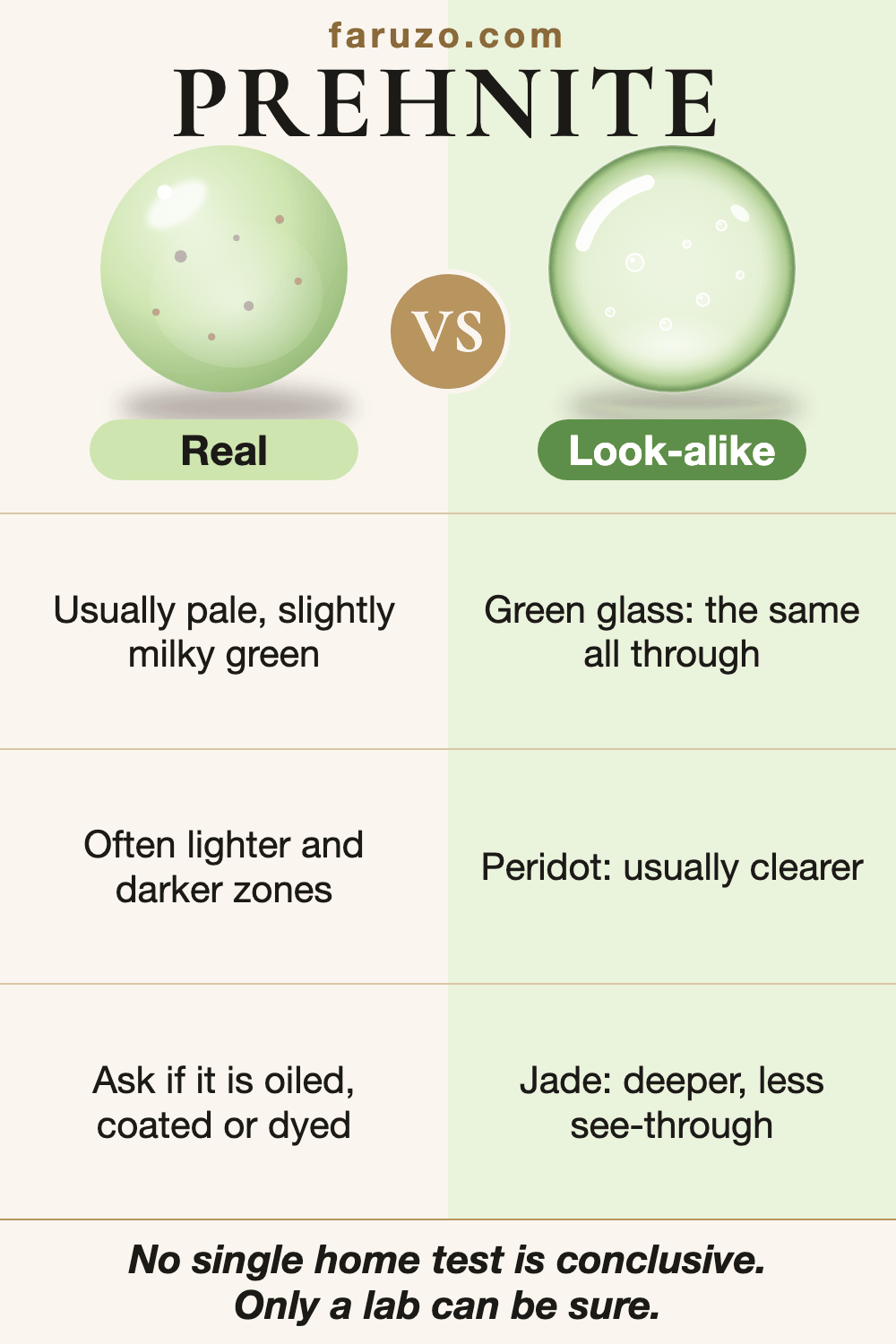
- Peridot. Peridot is a slightly harder gem, at about 6.5 to 7, and is usually more transparent, with an olive to yellow-green tone. Under magnification its back facet edges appear doubled. Prehnite is usually paler and translucent. A lab can confirm.
- Jade. Jade (nephrite or jadeite) is usually deeper in colour and less transparent than prehnite, and nephrite is tougher and more resistant to breakage. Green stones are sometimes sold as jade, so ask what the piece is.
- Chrysoprase. Chrysoprase is a chalcedony, normally an even apple green, coloured by traces of nickel. Prehnite is usually paler, with a whitish or yellowish tinge, and may show lighter and darker zones or dark epidote flecks. A lab can confirm.
- Serpentine. Most serpentines are much softer, at about 2.5 to 4, and the harder bowenite reaches about 5.5. Green serpentine is sometimes sold as false jade, so a green piece sold under a vague name deserves a question.
- Green glass. Glass can be made in nearly any colour and is less brilliant than most gems. It tends to look the same all through, while natural prehnite often shows lighter and darker green zones. A lab can confirm a piece that matters.
- Plastic. Plastic is used in inexpensive fashion jewellery and is not a durable imitation, so a green piece that wears, dulls or scratches quickly may not be stone at all.
Safe checks you can do
- Ask the seller in writing what the piece is: prehnite, prehnite with epidote, or another green stone sold under a similar name.
- Look at the colour. Natural prehnite is usually a pale, slightly milky green and may show lighter and darker zones or dark epidote flecks, while glass tends to look the same all through.
- Ask whether the colour is natural and whether the piece is oiled, coated or dyed. A treated piece of real prehnite is still prehnite, but it should be sold as treated.
- Do not scratch-test or heat-test a piece you plan to keep, because prehnite has a cleavage plane and is sensitive to heat. A lab is the safer route when it matters.
Wearing Prehnite
Ring
Careful
Fine with care, but knocks can mark it.
Bracelet
Careful
A knock on a bracelet can split it along a flat plane.
Pendant
Careful
It can split along a flat plane, so keep it protected.
Earrings
Careful
A flat-plane split is possible, so keep earrings for dressy wear.
Guide for everyday wear, based on hardness and care notes. Safe, Careful or Avoid.
Prehnite is about 6 to 6.5 on the Mohs scale and has a distinct cleavage plane, so every piece needs some care. A ring is possible for occasional wear in a protective setting. A bracelet takes the most knocks. A pendant or earrings take fewer, but a hard knock can still chip or split it. Beads and cabochons are the usual jewellery form. Keep it away from heat and steam, and take it off for the gym, cleaning and rough work.
Related stones
Questions about Prehnite
What does prehnite mean?
In crystal tradition prehnite is a stone of calm, inner peace and a gentle, open outlook. That meaning follows its pale green colour and is a belief within crystal practice, not a fact about the stone.
What is prehnite?
Prehnite is a calcium aluminium silicate, Ca2Al(AlSi3O10)(OH)2, usually light green and mostly translucent. It forms in cavities and veins in basalt and similar rock, often as rounded, bubbly masses.
Is prehnite a birthstone?
No. Prehnite is not on the standard modern, traditional or UK birthstone lists, though lists vary and some alternative lists may include it. Check the list you are following.
How hard is prehnite?
About 6 to 6.5 on the Mohs scale, a little softer than peridot. Hardness only measures scratching, though. A distinct cleavage plane means a hard knock can still chip or split it.
What colour is prehnite?
Usually a light green with a whitish or yellowish tinge, from mint to yellowish green. Deeper green is less common, and colourless, white, yellow, orange or pink pieces are rare.
What are the dark flecks in some prehnite?
They are usually epidote, a darker green mineral that grows alongside prehnite and is sometimes caught inside it. A cabochon with epidote crystals inside looks flecked or feathery against the pale green.
Is prehnite the same as epidote?
No. They are different minerals. Epidote is a darker pistachio green and often browner, and it can be found inside prehnite, but prehnite is the pale green host.
Where does prehnite come from?
It is found in many countries. It was first described from near Cradock in South Africa, and Australia, Mali, India, China, France and parts of the USA such as New Jersey and Connecticut are also named for it.
Where does the name prehnite come from?
It is named for Colonel Hendrik von Prehn, a Dutch commander at the Cape of Good Hope in the 1700s who is said to have brought specimens to Europe.
Can you wear a prehnite ring every day?
It is not the best choice. Because prehnite has a cleavage plane, a knock on a ring hand can chip or split it. A ring suits occasional wear in a protective setting, and a pendant or earrings take fewer knocks.
How do you clean prehnite, and can it go in an ultrasonic cleaner?
Wipe it with a soft cloth, mild soap and lukewarm water, then dry it. Skip ultrasonic and steam cleaners, since prehnite is sensitive to heat and vibration can stress a stone with a cleavage plane.
How can you tell real prehnite from a fake?
A home look can only hint. Natural prehnite is usually a pale, slightly milky green and may show lighter and darker zones, while glass tends to look the same all through. Peridot, jade and chrysoprase can look similar, so a lab can confirm a stone that matters.
Is the green prehnite I am buying dyed or coated?
Ask the seller to say in writing whether the colour is natural and whether the piece is oiled, coated or dyed. Porous or fractured stones of many kinds can be dyed. A treated piece of real prehnite is still prehnite, but the seller should tell you.
What is the difference between prehnite and peridot?
They are different minerals. Peridot is slightly harder and usually more transparent, with an olive to yellow-green tone and doubled back facet edges, while prehnite is usually paler, translucent and more often cut as a cabochon.
What is the difference between prehnite and jade?
They are different materials. Jade is usually deeper in colour and less transparent, and nephrite is tougher, while prehnite is a paler, translucent green with a cleavage plane.