
Crystal guide
Chrysoprase Meaning, Properties and Care
Chrysoprase is the apple-green variety of chalcedony, a waxy, microcrystalline form of quartz (SiO2), and its colour comes from traces of nickel. It sits at about 6.5 to 7 on the Mohs scale, but some stones can fade in strong sun or heat, and ordinary chalcedony dyed green is sometimes sold under the same name. In crystal tradition it is a stone of hope and a gentle heart.
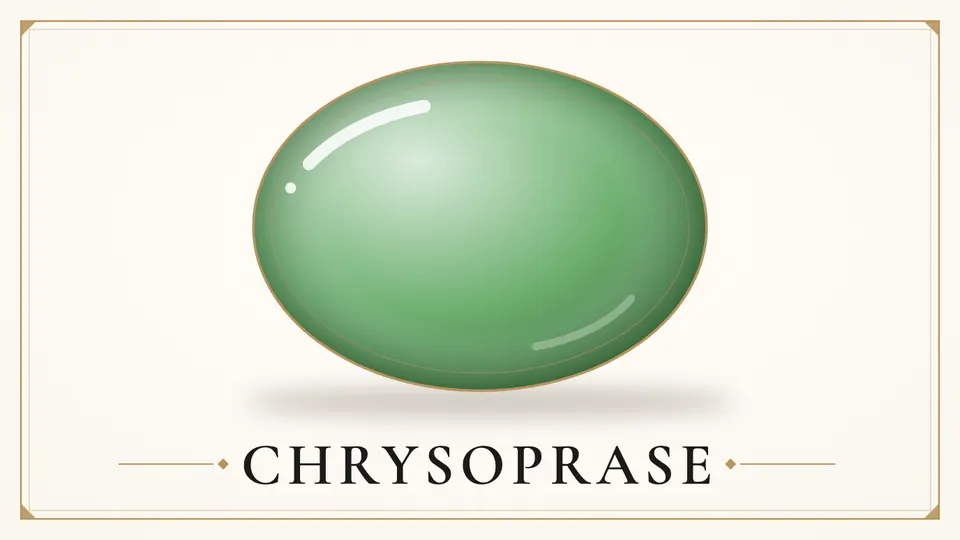
At a glance
- Formula SiO2, the apple-green, nickel-coloured variety of chalcedony.
- Mohs about 6.5 to 7: fine for a pendant or earrings, and a ring does best in a protective setting.
- Colour can fade in strong sun or heat, and green-dyed chalcedony is sold under the name, so ask.
- Not a jade, though sometimes sold as "Australian jade". Care: mild soap, soft cloth, no ultrasonic.
Quick facts
| Family | Microcrystalline quartz (chalcedony); the apple-green variety coloured by nickel |
|---|---|
| Chemical formula | SiO2 |
| Crystal system | Trigonal quartz with some monoclinic moganite, as microscopic fibres |
| Mohs hardness | 6.5–7 |
| Luster | Waxy to glassy; breaks with curved, flint-like surfaces |
| Transparency | Translucent |
| Natural colors | apple green, yellowish green, bluish green to deep green, darker green (sometimes called prase) |
| Main localities | Australia (Queensland and Western Australia), Tanzania, Poland, Brazil, Russia, USA (Arizona and California) |
| Common treatments | ordinary chalcedony dyed green is sold under the name, and dyed stones are not chrysoprase; dyed stones may fade in sun or heat, and some natural stones can pale or dry out in strong sun |
| Birth month | Not on the standard modern or traditional lists; at least one UK list names it for May alongside emerald |
Chrysoprase at a glance, in pictures
Chakras (traditional)
Hardness range
Natural colors
- apple green
- yellowish green
- bluish green to deep green
- darker green (sometimes called prase)
Common forms of Chrysoprase
- Rough raw chunk
- Cabochon smooth dome
- Tumbled polished pebble
- Bead drilled bead
How hard is Chrysoprase?
- Talc 1
- Gypsum 2
- Copper coin ~ 3
- Calcite 3
- Fluorite 4
- Apatite 5
- Glass ~ 5.5
- Steel knife ~ 5.5
- Orthoclase 6
- Chrysoprase 6.5–7
- Quartz 7
- Topaz 8
- Corundum 9
- Diamond 10
What it is and where it comes from
The name comes from the Greek chrysos ("gold") and prasinon ("green"). Darker green stones are sometimes called prase, though that word is also used loosely for other green quartz.
Chrysoprase is coloured by tiny amounts of nickel, usually as nickel-bearing silicates. That makes it different from emerald and from "chrome" chalcedony, whose green comes from chromium.
It forms where nickel-rich rock such as serpentinite weathers deeply. In Australian deposits it occurs as veins and nodules alongside brown iron oxides.
Australia, mainly Queensland (around Marlborough and Greenvale) and Western Australia, is a well-known gem source. Tanzania has produced steadily since the 1980s, and Poland is a long-known European source.
A newer Western Australian find, close to the known Yerilla deposit, reportedly reached the Bangkok gem markets from mid-2024.
In crystal tradition
What follows is belief and folklore, passed down in crystal tradition. It is not measured fact.
Traditionally associated with: hope, forgiveness, optimism.
Chrysoprase is traditionally associated with the Heart chakra and with hope, forgiveness and an open, generous outlook, themes that follow its fresh green colour. This is a modern spiritual tradition, not a fact about the stone.
It is also said to suit people starting something new. Treat that as folklore, not as an effect on the body or mind.
How to care for Chrysoprase
- Water Safe
- Sunlight Caution
- Salt Unknown
- Heat Caution
- Ultrasonic Caution
- Chemicals Caution
Safe = fine as a rule · Caution = only briefly or gently · Avoid = can damage the stone · Unknown = no reliable guidance.
Clean chrysoprase with mild soap, warm water and a soft brush or cloth, then dry it. Keep it out of strong sun and away from hot water and steam, since dyed stones can fade and some natural stones can pale or dry out. Skip ultrasonic cleaners and harsh chemicals. Store it in a closed box or pouch, apart from harder stones so it is not scratched.
Real or fake? Look-alikes and treatments
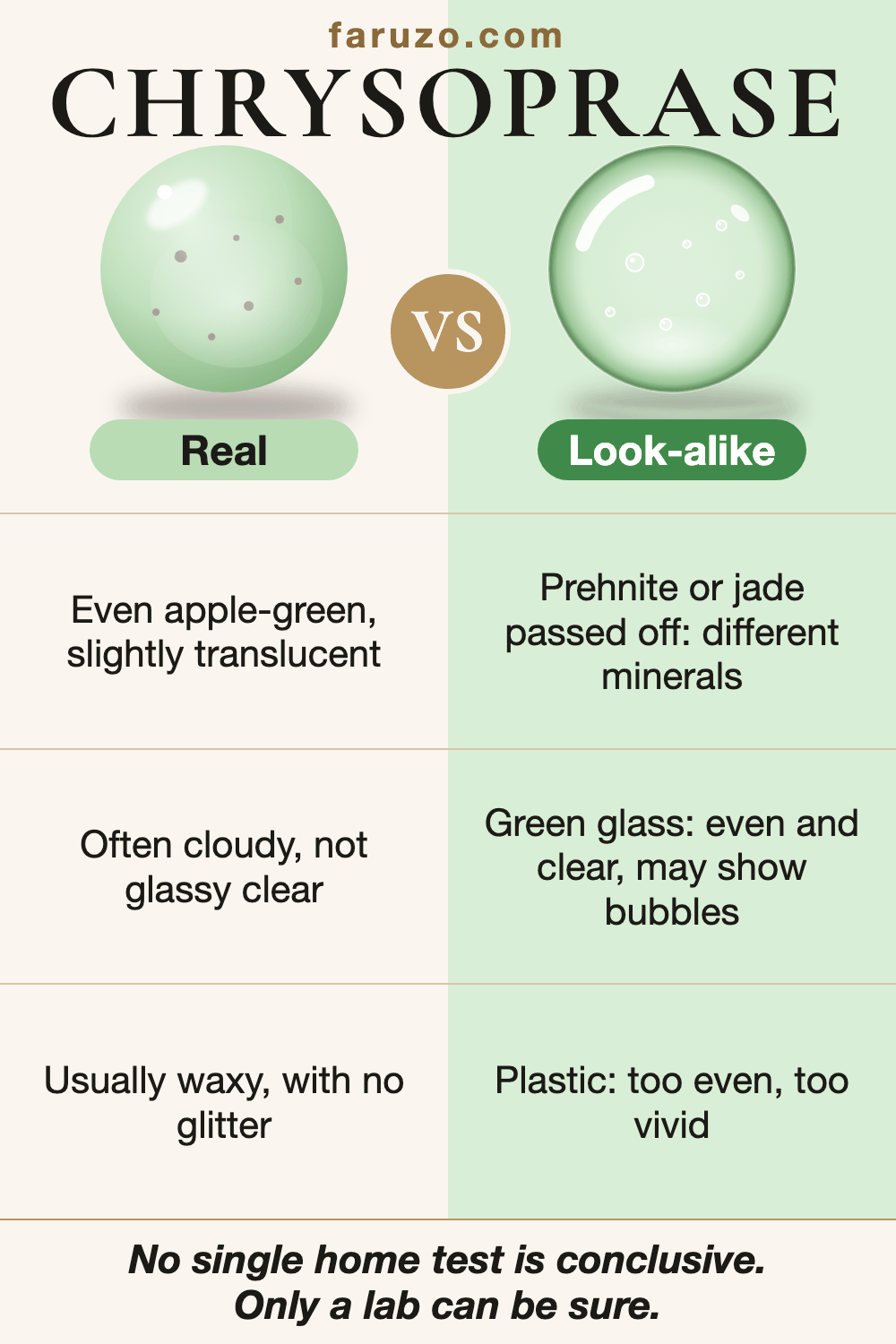
Often confused with
- Prehnite
- Jade (jadeite or nephrite)
- Green glass
- Dyed green quartz or quartzite
- Green aventurine
- Plastic
Common look-alikes
- Prehnite. Prehnite is a pale to yellowish green stone that can look close to light chrysoprase, but it is usually a little softer (about 6 to 6.5) and often has a more glassy or pearly shine and a grape-like surface in the rough. Colour alone is not a safe guide, so ask for the stone's name in writing.
- Jade (jadeite or nephrite). True jade is a different mineral from chrysoprase. Chrysoprase is sometimes sold as "Australian jade" or "Queensland jade", and very fine stones have been marketed as "imperial jade". Ask what the stone really is and avoid price comparisons based on the word jade.
- Green glass. Glass is a common imitation of green stones. It tends to look too even and clear, may show round gas bubbles, and lacks chrysoprase's soft, cloudy depth.
- Dyed green quartz or quartzite. Quartz or quartzite dyed bright green can imitate chrysoprase. Look for colour that is very uniform and vivid, or that pools in cracks and pits, and ask the seller what the material is.
- Green aventurine. Green aventurine is quartz with tiny mica flakes that glitter when the stone is turned, and it is also sold under jade names. Chrysoprase has no glitter, just an even waxy green.
- Plastic. Plastic feels light and warm and is much softer than chrysoprase, so it scratches and dents easily. Cheap beads sold as green stone are sometimes plastic.
Safe checks you can do
- Ask the seller in writing whether the stone is natural chrysoprase or chalcedony dyed green. Dyed green chalcedony is not chrysoprase, even though it is real chalcedony.
- Look at the colour in good light. Natural chrysoprase usually shows soft cloudy patches or faint veining, while a perfectly even, vivid green can point to dye. Colour that pools in cracks and pits is another warning sign. This is a hint, not proof.
- Be wary of "jade", "imperial jade" or "Australian jade" on a green stone. Ask what mineral it is, and do not compare its price with true jade.
- Hold a plain-looking stone to a light. A glittering sparkle points to aventurine, and tiny round bubbles point to glass.
- For a stone that matters, a gem lab can test whether nickel is the colouring agent, which separates natural chrysoprase from dyed chalcedony. Do not scratch-test a stone you plan to keep.
Wearing Chrysoprase
Ring
Careful
Fine with care, but knocks can mark it.
Bracelet
Safe
Fairly hard, so fine for normal bracelet wear.
Pendant
Safe
Fairly hard, and a pendant sits clear of knocks.
Earrings
Safe
Fairly hard, and earrings rarely take knocks.
Guide for everyday wear, based on hardness and care notes. Safe, Careful or Avoid.
At about 6.5 to 7 and with a curved, flint-like break rather than flat planes that split, chrysoprase is tough enough for a pendant, earrings or a bracelet. A ring is fine with care, but a protective setting helps because some stones fall below 7 and everyday grit can scratch it. Take it off for sport and rough work, and keep it out of strong sun and hot water, since the colour of dyed stones can fade.
Related stones
Questions about Chrysoprase
What does chrysoprase mean?
In crystal tradition chrysoprase is a stone of hope, forgiveness and an open heart, linked to the Heart chakra and to fresh starts. These are symbolic meanings from tradition, not facts about the stone or claims about your health.
What is chrysoprase?
Chrysoprase is the apple-green variety of chalcedony, a microcrystalline form of quartz with the formula SiO2. Its colour comes from traces of nickel, and it forms where nickel-rich rock weathers deeply.
What gives chrysoprase its green colour?
Tiny amounts of nickel, usually as nickel-bearing silicates inside the stone. That is why it is not coloured like emerald, which gets its green from chromium.
Is chrysoprase a type of jade?
No. Chrysoprase is chalcedony (quartz), while true jade is jadeite or nephrite, a different mineral. It is sometimes sold as "Australian jade" or "Queensland jade", which is a trade nickname, not a mineral relationship.
How hard is chrysoprase?
About 6.5 to 7 on the Mohs scale, close to quartz. That is tough enough for most jewellery, though a ring does best in a protective setting.
Is chrysoprase a birthstone?
It is not on the standard modern or traditional birthstone lists. At least one UK list names it for May alongside emerald, and lists vary, so check the list you are following.
Does chrysoprase fade?
It can. Dyed stones may fade in sun or heat, and some natural stones can pale or dry out in strong sun. Keep it out of sunny windows and hot water, and store it in a closed box between wearings.
Is dyed green chalcedony the same as chrysoprase?
No. Chalcedony dyed green is still chalcedony, but it is not chrysoprase, whose green comes naturally from nickel. Ask the seller to state in writing whether the colour is natural.
How can you tell real chrysoprase from fake?
A home look can only hint. Natural stones usually show soft cloudy patches rather than an even, vivid green, and colour that pools in cracks can point to dye. Prehnite, jade, glass and dyed quartz can look similar, so a gem lab can confirm a stone that matters.
I was offered a cheap bright green stone called chrysoprase. Is it real?
Be careful. Very even, vivid green at a low price is a common sign of chalcedony dyed to imitate chrysoprase, or of glass. Ask the seller in writing what the stone is and whether the colour is natural.
Can you wear a chrysoprase ring every day?
It can be worn, but take care. A protective setting helps, and rings meet more knocks and grit than pendants or earrings. Take it off for sport, gardening and cleaning.
Can chrysoprase get wet, and can you use an ultrasonic cleaner?
Water is fine, so mild soap and warm water with a soft brush are the usual way to clean it. Skip ultrasonic cleaners, hot water and harsh chemicals, since they can fade a dyed stone.
Where does chrysoprase come from?
Australia, mainly Queensland and Western Australia, is a well-known gem source. Tanzania, Poland, Brazil, Russia and parts of the USA also produce it.