
Crystal guide
Aventurine Meaning, Properties and Care
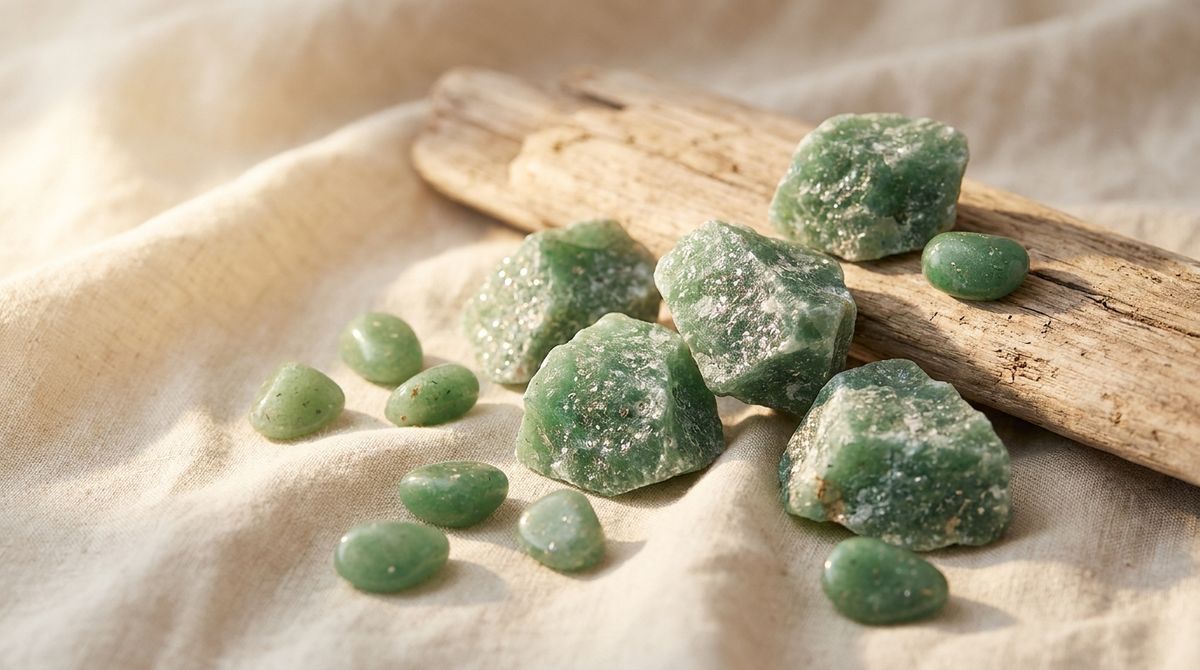
Aventurine is quartz (or quartzite) full of tiny flat mineral flakes that glitter as the stone moves, an effect called aventurescence. Green aventurine, coloured by chromium-bearing fuchsite mica, is the best-known kind and the one many people mean by the word. It is not on the standard birthstone list, and in crystal tradition it is the stone of luck and opportunity.
At a glance
- Hardness Mohs 6.5 to 7: ranges differ slightly, because aventurine is a rock made of quartz grains and mica flakes, not a single crystal.
- Quartz (SiO2) with fuchsite mica flakes (green), or hematite and goethite flakes (orange, red, brown).
- India is a main commercial source; smaller deposits include Austria, Chile, Spain, Russia and South Africa.
- Care: hand-clean gently; be cautious with machine cleaners, heat and solvents. A glittering green stone sold as jade is often aventurine.
Quick facts
| Family | Quartz (silica group); a quartz-rich rock (quartzite) with mica inclusions |
|---|---|
| Chemical formula | SiO2 (the quartz grains); the green flakes are fuchsite, K(Al,Cr)3Si3O10(OH)2 |
| Crystal system | Trigonal for the quartz itself. Aventurine is a massive, aggregate material and does not form single crystals. |
| Mohs hardness | 6.5–7 |
| Luster | Vitreous for quartz, waxy to dull when massive, with a glittery sheen from the mica flakes |
| Transparency | Translucent to opaque; heavy fuchsite content can make it opaque |
| Natural colors | green (chromium-bearing fuchsite mica); orange, brown, red-brown and gold-brown (hematite or goethite flakes); blue to blue-grey (the cause is debated); grey, yellow, and creamy white; brownish pink (manganese-bearing mica) |
| Main localities | India (Mysore, Chennai and Karnataka areas; the main commercial source); Austria (Styria, near Mariazell); Chile; Spain; Russia; South Africa; USA; Germany (Black Forest) |
| Common treatments | usually sold untreated; dye can enter porous or fractured stones, so ask whether a piece is natural or dyed |
Aventurine at a glance, in pictures
Chakras (traditional)
Hardness range
Natural colors
- green (chromium-bearing fuchsite mica)
- orange, brown, red-brown and gold-brown (hematite or goethite flakes)
- blue to blue-grey (the cause is debated)
- grey, yellow, and creamy white
- brownish pink (manganese-bearing mica)
Traditionally linked to
- Planet
- Mercury
- Zodiac
- VirgoLibra
Common forms of Aventurine
- Rough raw chunk
- Tumbled polished pebble
- Cabochon smooth dome
How hard is Aventurine?
- Talc 1
- Gypsum 2
- Copper coin ~ 3
- Calcite 3
- Fluorite 4
- Apatite 5
- Glass ~ 5.5
- Steel knife ~ 5.5
- Orthoclase 6
- Aventurine 6.5–7
- Quartz 7
- Topaz 8
- Corundum 9
- Diamond 10
What it is and where it comes from
The name comes from the Italian "a ventura", meaning "by chance". It was first used for aventurine glass (goldstone), a man-made glass with tiny copper crystals, and the mineral was named after the glass because it shimmers in the same way, not the other way round.
The early history of the glass is murky. One account says it was discovered by chance in the 18th century, while another credits a 17th-century Venetian process, with the Miotti family and a date of 1626 often mentioned. The story of a Murano workman dropping copper filings into molten glass is a tale, not a record.
The sparkle comes from platy mineral inclusions. The classic one is fuchsite, a chromium-rich variety of muscovite mica: trivalent chromium replaces some aluminium in the mica and produces its apple-green colour. Hematite or goethite flakes give the orange and brown tones.
India is a major commercial source of green and blue-green aventurine. Most of it is carved into beads and figurines; the finer pieces are cut as cabochons.
"Indian jade" is a trade name sometimes given to green aventurine. It is a misleading label, not a mineral name: aventurine is quartz, and jade is jadeite or nephrite.
In crystal tradition
What follows is belief and folklore, passed down in crystal tradition. It is not measured fact.
Traditionally associated with: luck, opportunity, prosperity, calm.
Green aventurine is traditionally associated with the Heart chakra (Anahata), and blue aventurine with the Throat chakra. This is a modern spiritual tradition, not a fact about the stone.
Green aventurine is traditionally paired with the zodiac sign Virgo (Libra is sometimes given too) and the planet Mercury. These mappings differ between lists and have no scientific basis.
Aventurine is traditionally called a stone of luck and opportunity, linked to prosperity and fresh chances, and in feng shui practice it is placed in a wealth corner, near an entryway or by a cash register. It is also linked, in modern lore, to a calm, level-headed outlook. These are symbolic meanings, not effects on the body or mind, and they are not why the stone was named: the name comes from the glass.
How to care for Aventurine
- Water Safe
- Sunlight Caution
- Salt Unknown
- Heat Caution
- Ultrasonic Avoid
- Chemicals Caution
Safe = fine as a rule · Caution = only briefly or gently · Avoid = can damage the stone · Unknown = no reliable guidance.
Clean aventurine by hand with warm water, a few drops of mild dish soap and a soft brush. Machine cleaners are a risk because it is a rock of quartz grains and mica flakes, so skip them. Keep it away from torches and sudden heat. Sunlight and solvents matter mainly for dyed pieces: dyes can be lifted by alcohol or acetone and some fade in sun, so avoid both on any dyed or treated piece. Salt is best avoided as a precaution. Quartz has no cleavage, but aventurine can be brittle, so a hard knock can still chip it.
Real or fake? Look-alikes and treatments
Often confused with
- Jade (jadeite or nephrite)
- Goldstone (aventurine glass)
- Sunstone (aventurine feldspar)
- Malachite
- Dyed quartz or quartzite
- Strawberry quartz
Common look-alikes
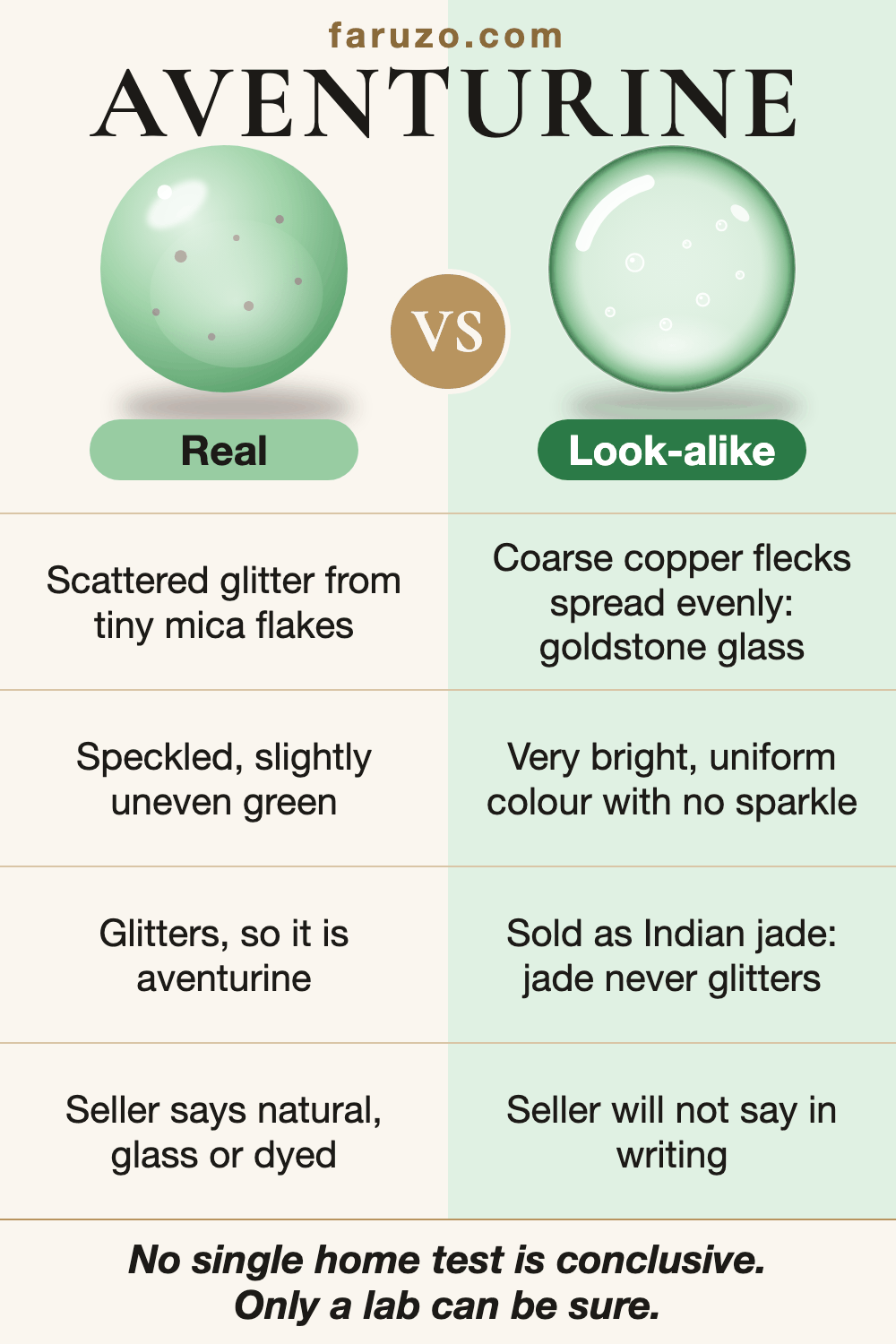
- Jade (jadeite or nephrite). Jade is jadeite or nephrite, not quartz. Aventurine glitters from mica flakes, while jade has a waxy to glassy sheen and no aventurescence. Specific gravity is about 2.64 to 2.69 for aventurine against roughly 2.9 to 3.4 for jade, so jade is denser; a gemologist can measure that. Hardness overlaps, so it does not separate them.
- Goldstone (aventurine glass). Goldstone is man-made glass with copper crystals. Its coarse copper flecks are spread in an unnaturally uniform way and it is usually golden brown, though it can be blue or green. Glass of this kind is softer than natural aventurine, and flaky-inclusion glass also exists in blue and, rarely, green. Red aventurine can be confused with it.
- Sunstone (aventurine feldspar). Sunstone is aventurescent feldspar, not quartz. It can be confused with orange and red aventurine, but is generally more transparent. A refractometer reading separates the minerals, so ask a gemologist for a stone that matters.
- Malachite. Very fuchsite-rich aventurine can look dark and opaque. Malachite is a copper carbonate with banded patterns; aventurine looks speckled and glittery.
- Dyed quartz or quartzite. Dye can enter porous or fractured stones, and many dyes can be removed by solvents such as alcohol or acetone. Dyed quartz is usually easy to spot under a microscope. No quick check settles whether aventurine is dyed; very bright or uniform colour with no mica sparkle is a reason to ask questions.
- Strawberry quartz. A bangle sold as strawberry quartz can turn out to be brownish pink aventurine, with manganese-bearing mica flakes. A trade name alone does not tell you what is inside, so ask what the stone is.
Safe checks you can do
- Ask the seller in writing whether the stone is natural aventurine, glass or dyed material.
- Tilt the stone under a light. Natural aventurine shows scattered glitter from mica flakes inside a speckled, slightly uneven body. Goldstone shows coarse copper flecks spread in an unnaturally uniform way. This is a sign, not proof.
- For a stone sold as jade, check the sparkle first. Jade is waxy to glassy and does not glitter, and a green stone that glitters is aventurine. Be wary of loose "jade" labels on green stones, because several different materials are sold that way.
- For a stone that matters, ask a gemologist or lab to measure it. Values for aventurine are refractive index about 1.544 to 1.553 and specific gravity about 2.64 to 2.69, which separate it from jade and many glass imitations; they cannot show whether a quartz stone is dyed.
- Do not rely on one home test. A gemologist can often detect dyed stones under magnification.
Wearing Aventurine
Ring
Careful
Fine with care, but knocks can mark it.
Bracelet
Safe
Fairly hard, so fine for normal bracelet wear.
Pendant
Safe
Fairly hard, and a pendant sits clear of knocks.
Earrings
Safe
Fairly hard, and earrings rarely take knocks.
Guide for everyday wear, based on hardness and care notes. Safe, Careful or Avoid.
At Mohs 6.5 to 7, aventurine suits beads, bracelets, pendants and cabochons well. Aventurine is a rock with mica flakes rather than a single crystal, and its hardness is somewhat lower than single-crystal quartz, so it can scratch or chip if it is knocked or stored loose against harder stones. A ring takes more knocks than a pendant, so a protective setting is sensible. Clean it by hand, and remove it before solvents or strong cleaners.
Questions about Aventurine
What does aventurine mean?
In crystal tradition aventurine is the stone of luck and opportunity, linked to prosperity and fresh chances. The word itself comes from the Italian "a ventura", "by chance". These are symbolic meanings from tradition, not facts about the stone or claims about your health.
What does green aventurine mean?
Green aventurine is the best-known variety, and it carries much of the luck, prosperity and opportunity symbolism. Crystal tradition also pairs it with the Heart chakra (and blue aventurine with the Throat chakra) and the sign Virgo. They are modern traditions with no scientific basis.
Is aventurine the same as green aventurine?
Aventurine is the umbrella name for quartz or quartzite with sparkling flake inclusions in any colour. Green aventurine is the common variety coloured by chromium-bearing fuchsite mica, so most people who say "aventurine" mean the green kind. Other colours include orange, red-brown, brown, blue, grey, yellow and creamy white.
Why does aventurine sparkle?
The glitter is called aventurescence. It comes from tiny, flat, platy mineral inclusions inside the translucent quartz that reflect light as the stone moves. In green aventurine the inclusions are fuchsite, a chromium-rich mica; in orange and brown material they are hematite or goethite.
Is aventurine a real gemstone?
Yes. Natural aventurine is a real quartz-based material. It is a rock, quartz with mica flakes, rather than a single crystal. The name comes from aventurine glass, which is a different, man-made material, so ask whether a piece is natural stone or glass.
Is aventurine the same as jade?
No. Jade is jadeite or nephrite, while aventurine is quartz with mica flakes. The simplest check is the sparkle: aventurine glitters from mica flakes, and jade has a waxy to glassy sheen without glitter. Jade is also denser, which a gemologist can measure.
How hard is aventurine? Can I wear it every day?
Aventurine is Mohs 6.5 to 7, with ranges differing slightly because it is a rock made of quartz grains and mica. A pendant, bracelet or bead necklace is usually the lower-risk choice for daily wear. A ring takes more knocks, so a protective setting is sensible. The Mohs scale is not linear, so each step is not the same size.
How do you clean aventurine?
Clean it by hand with warm water, mild soap and a soft brush, and skip cleaning machines. Avoid solvents and long sun on dyed or treated pieces. In crystal practice, cleansing is a symbolic ritual; it does not change the stone.
Is aventurine a birthstone?
Not on the standard birthstone list, which names no month for aventurine. Crystal tradition pairs green aventurine with Virgo and the planet Mercury, but that is a separate tradition from birthstones, and Libra is sometimes given instead.
What zodiac sign is aventurine for?
Crystal tradition most often pairs green aventurine with Virgo, and Libra is sometimes given too. It is also paired with the planet Mercury. These pairings differ between lists and have no scientific basis.
Is aventurine dyed or treated?
Aventurine is usually sold untreated. Dye can enter porous or fractured stones, so check that the listing says whether a piece is natural or dyed.
Where does aventurine come from?
India is a major commercial source, often the Mysore, Chennai and Karnataka areas. Other deposits include Austria (near Mariazell), Chile, Spain, Russia, South Africa, the USA and Germany's Black Forest.
Does aventurine fade in the sun?
The natural glitter and green come from mineral flakes and are not known for fading. Dyed or treated pieces can fade in long strong sun, so keep those out of a sunny window.