
Crystal guide
Chalcedony Meaning, Properties and Care
Chalcedony is a waxy, translucent form of quartz (SiO2) made of crystals too fine to see, and it is the family name behind agate, onyx, carnelian, jasper and chrysoprase. On its own the word usually means the plain, evenly coloured stone in soft blue, grey or white. In crystal tradition it is a gentle stone of goodwill and calm talk.
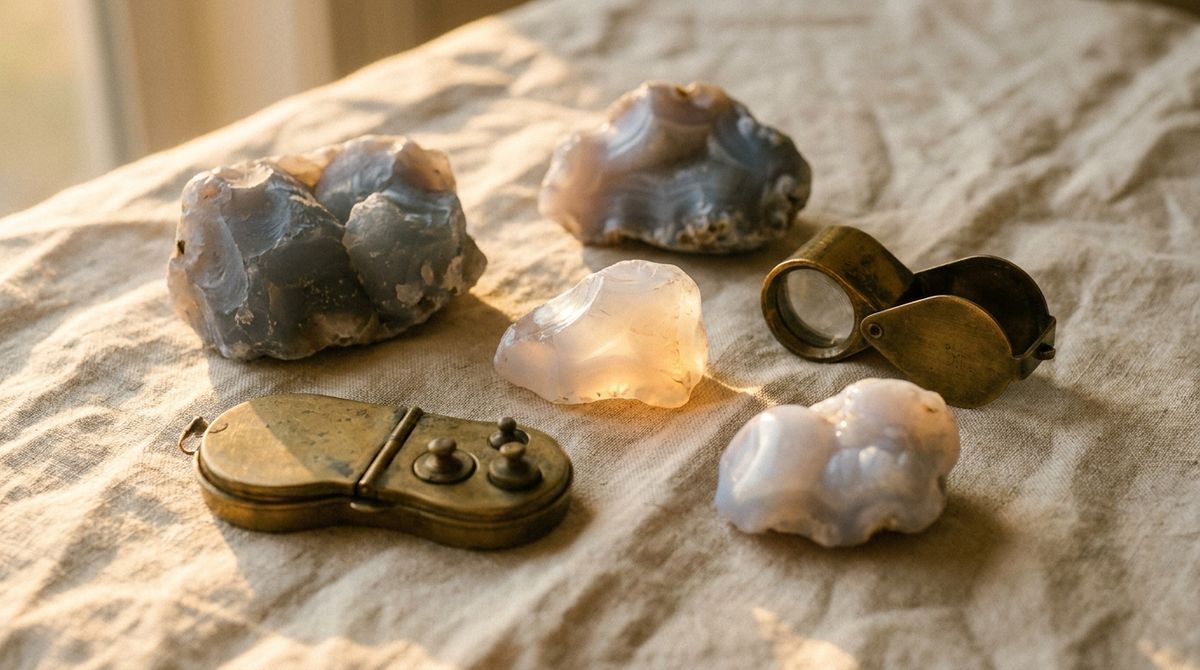
At a glance
- Formula SiO2, built from microscopic quartz crystals, with a waxy shine and a see-through-but-cloudy look.
- Hardness about 6.5 to 7 on the Mohs scale, tough enough to cut and carve finely.
- Plain chalcedony is blue, grey, white or milky; banded, red, black or green types usually go by their own names.
- Deep, even blue is often dyed, so ask. Care: mild soap, soft cloth, no harsh cleaners.
Quick facts
| Family | Microcrystalline quartz (silica); the umbrella family for agate, onyx, carnelian, jasper and chrysoprase |
|---|---|
| Chemical formula | SiO2 |
| Crystal system | Trigonal quartz with some monoclinic moganite, as microscopic fibres |
| Mohs hardness | 6.5–7 |
| Luster | Waxy, sometimes silky or glassy |
| Transparency | Translucent |
| Natural colors | white and milky; grey; grey-blue and soft blue; brown, less often |
| Common treatments | dyeing and heating are common ways to deepen or change colour on commercial stones; deep, even blue chalcedony is often dyed |
Chalcedony at a glance, in pictures
Chakras (traditional)
Hardness range
Natural colors
- white and milky
- grey
- grey-blue and soft blue
- brown, less often
Common forms of Chalcedony
- Rough raw chunk
- Tumbled polished pebble
- Cabochon smooth dome
- Bead drilled bead
How hard is Chalcedony?
- Talc 1
- Gypsum 2
- Copper coin ~ 3
- Calcite 3
- Fluorite 4
- Apatite 5
- Glass ~ 5.5
- Steel knife ~ 5.5
- Orthoclase 6
- Chalcedony 6.5–7
- Quartz 7
- Topaz 8
- Corundum 9
- Diamond 10
What it is and where it comes from
The name goes back to the Latin chalcedonius and is traditionally linked to Chalcedon, an old town on the Asian side of the Bosphorus, though that link is doubtful.
Chalcedony has been used since early times for stone tools, beads, seals, cameos and carved vessels, because its fine grain cuts cleanly.
It is made of fibres of quartz mixed with a little moganite, a related silica mineral, packed so finely that single crystals cannot be seen.
Many well-known stones are simply chalcedony with a different look: banded agate, orange-red carnelian, black-and-white onyx, apple-green chrysoprase and opaque jasper.
Jewellery chalcedony is usually cut as a smooth cabochon or bead rather than faceted, which shows off its even colour and soft glow.
In crystal tradition
What follows is belief and folklore, passed down in crystal tradition. It is not measured fact.
Traditionally associated with: goodwill, calm communication, balance.
Chalcedony is traditionally seen as a gentle stone of goodwill and calm, measured speech, and is linked to the Throat chakra. These are modern spiritual associations, not facts about the stone.
A chalcedony is named among the twelve foundation stones in the Book of Revelation, which is part of why it has long carried a quiet, old-world reputation.
How to care for Chalcedony
- Water Safe
- Sunlight Caution
- Salt Unknown
- Heat Caution
- Ultrasonic Caution
- Chemicals Caution
Safe = fine as a rule · Caution = only briefly or gently · Avoid = can damage the stone · Unknown = no reliable guidance.
Undyed chalcedony is hard and not fussy, but dyed stones can lose colour. Wipe with a soft cloth and a little mild soap, rinse and dry. Keep dyed pieces away from strong light, hot water and harsh cleaners, and skip ultrasonic cleaning for them. Store it apart from harder stones such as sapphire so it is not scratched.
Real or fake? Look-alikes and treatments
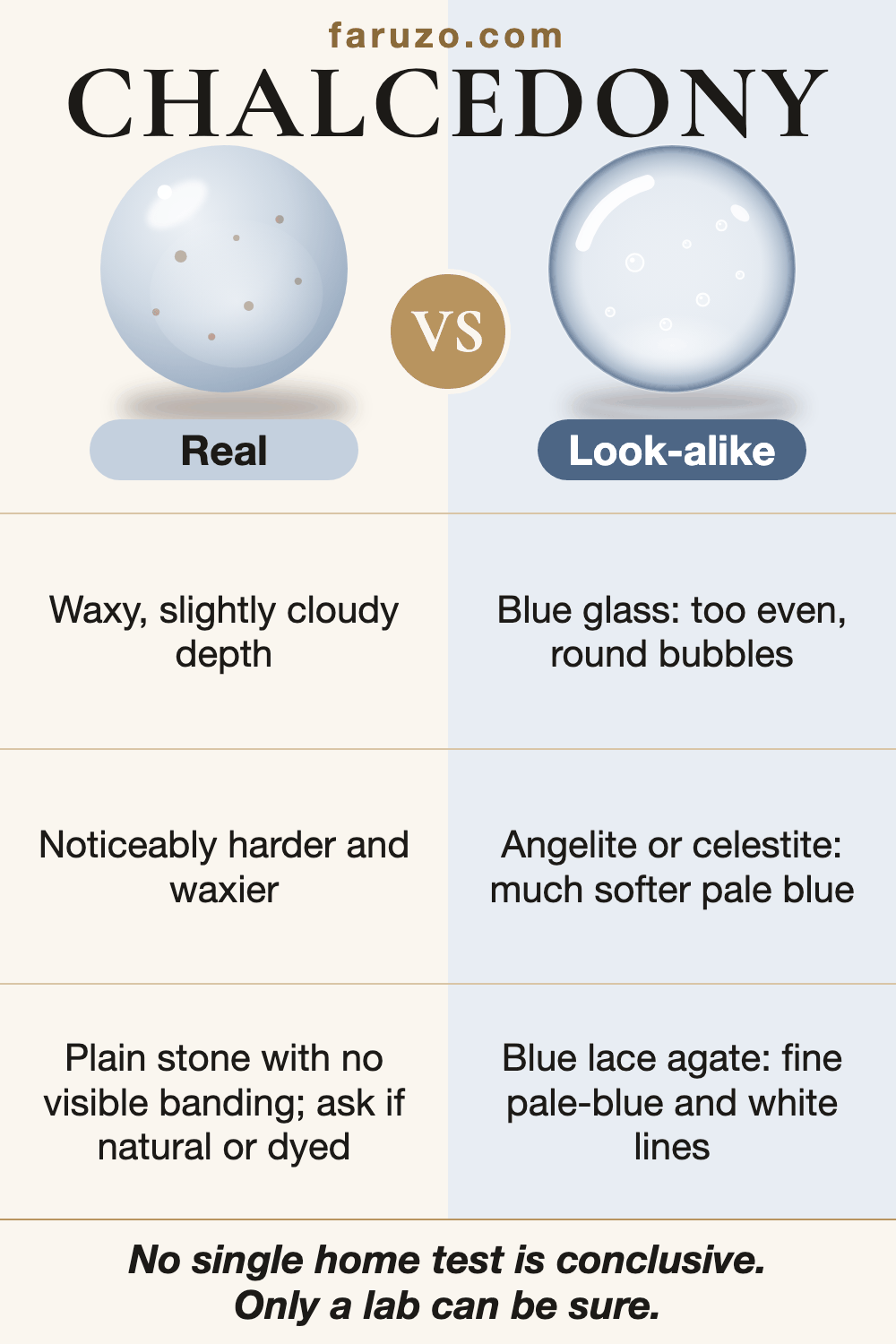
Often confused with
- Blue glass
- Angelite and celestite
- Blue lace agate
Common look-alikes
- Blue glass. Glass is a common imitation of soft blue stone. It can look too even and may show round bubbles, while chalcedony has a waxy, slightly cloudy depth. A lab can confirm.
- Angelite and celestite. These are different, much softer pale blue stones. Chalcedony is noticeably harder and waxier.
- Blue lace agate. This is a banded chalcedony with fine pale-blue and white lines. Plain chalcedony has no visible banding.
Safe checks you can do
- Ask in writing whether the stone is natural, dyed or glass, especially if the blue is deep and perfectly even.
- Look for a waxy, slightly cloudy translucence. A glassy, bubble-flecked look points to glass.
- Check for dye pooling in tiny cracks or at drill holes, a common sign of colour added to pale stone.
- Do not scratch-test a stone you plan to keep. A lab can test it safely.
Wearing Chalcedony
Ring
Careful
Fine with care, but knocks can mark it.
Bracelet
Safe
Fairly hard, so fine for normal bracelet wear.
Pendant
Safe
Fairly hard, and a pendant sits clear of knocks.
Earrings
Safe
Fairly hard, and earrings rarely take knocks.
Guide for everyday wear, based on hardness and care notes. Safe, Careful or Avoid.
Chalcedony is fairly hard with no flat splitting planes, so bracelets, pendants and earrings all suit it well. A ring is fine with care, since hard knocks can still mark it. If a piece is dyed, take it off for swimming, hot baths and cleaning.
Related stones
Questions about Chalcedony
What does chalcedony mean?
In crystal tradition chalcedony is a gentle stone of goodwill and calm, clear speech, linked to the Throat chakra. That is a belief, not a property of the stone.
What is chalcedony?
Chalcedony is silica (SiO2) in the form of microscopic quartz fibres, with a waxy, translucent look. It is the umbrella family that includes agate, onyx, carnelian, jasper and chrysoprase.
Is chalcedony the same as agate?
Agate is a banded type of chalcedony. Plain chalcedony usually means the even, unbanded stone in blue, grey or white. The mineral is the same.
What colour is chalcedony?
Plain chalcedony is usually soft blue, grey, white or milky. Orange-red, black-and-white and apple-green family members are sold under their own names.
How hard is chalcedony?
About 6.5 to 7 on the Mohs scale. It resists everyday dust and wear but can still be scratched by harder gems.
Is chalcedony a birthstone?
Plain chalcedony is not on the standard modern birthstone lists. Some family members appear on traditional lists, such as bloodstone for March and sardonyx for August.
Is blue chalcedony dyed?
Often, when the blue is deep and perfectly even. Natural colour is usually paler grey-blue. Dyed stone is still real chalcedony, but the colour is not natural.
Will chalcedony fade or be harmed by water?
Natural colour is stable and water is fine. Dyed stones can fade in strong light or after long soaking, so keep them out of hot baths and bright sun.
Can you wear a chalcedony ring?
Yes, with some care. It is fairly hard but not diamond-tough, so knocks can mark it. Pendants and earrings take fewer knocks.
Where does the name chalcedony come from?
It comes from the Latin chalcedonius and is traditionally tied to the old town of Chalcedon near Istanbul, though that link is doubtful.
Is dyed chalcedony worth less than natural?
Usually, yes. Natural, untreated colour is generally preferred, and a fair seller will say if the stone has been dyed.