
Crystal guide
Onyx Meaning, Properties and Care
Onyx is banded chalcedony, a fine-grained form of quartz (SiO2) with straight, parallel bands, at Mohs 6.5 to 7. The deep, even black most people picture is usually produced by dyeing, because natural solid black is uncommon. In crystal tradition onyx is a protection and grounding stone.
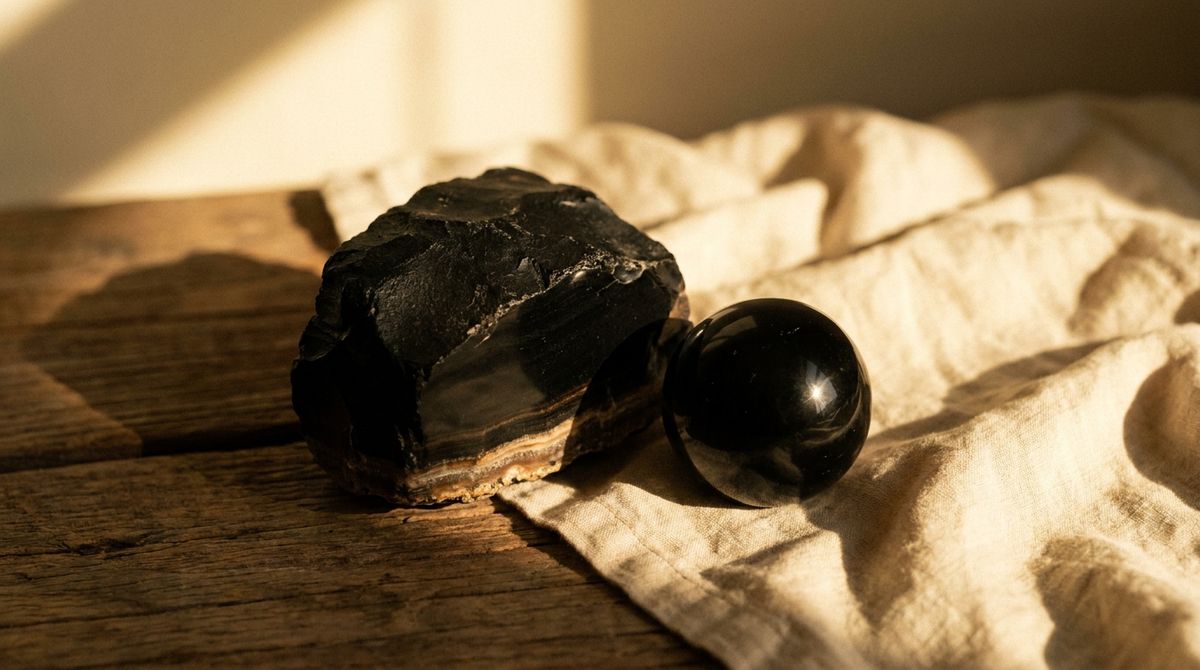
At a glance
- Banded chalcedony, formula SiO2, hardness Mohs 6.5 to 7, no cleavage.
- Its bands are straight and parallel, which is how it differs from curved-band agate.
- A deep, even black onyx is usually dyed, often starting from lighter agate or chalcedony.
- Care: soft cloth, lukewarm water, mild soap. A ring can scratch over time; bracelets and pendants are easier on it.
Quick facts
| Family | Chalcedony, a microcrystalline quartz (silicate); a straight-banded form related to agate |
|---|---|
| Chemical formula | SiO2 |
| Crystal system | Microcrystalline (cryptocrystalline) quartz, too fine-grained to show crystals |
| Mohs hardness | 6.5–7 |
| Luster | Vitreous to waxy; no cleavage and breaks with curved surfaces |
| Transparency | Opaque to translucent |
| Natural colors | black, white, black and white bands, brown, red (red-and-white banded stone is called sardonyx) |
| Main localities | Brazil, Uruguay, India, Madagascar, Mexico, China, United States |
| Common treatments | most black onyx is dyed or colour-treated, often starting from lighter chalcedony or agate; heat is also used to deepen the colour |
Onyx at a glance, in pictures
Chakras (traditional)
Hardness range
Natural colors
- black
- white
- black and white bands
- brown
- red (red-and-white banded stone is called sardonyx)
Traditionally linked to
- Planet
- Saturn
- Zodiac
- CapricornLeo
- Element
- Earth
Common forms of Onyx
- Rough raw chunk
- Tumbled polished pebble
- Cabochon smooth dome
How hard is Onyx?
- Talc 1
- Gypsum 2
- Copper coin ~ 3
- Calcite 3
- Fluorite 4
- Apatite 5
- Glass ~ 5.5
- Steel knife ~ 5.5
- Orthoclase 6
- Onyx 6.5–7
- Quartz 7
- Topaz 8
- Corundum 9
- Diamond 10
What it is and where it comes from
The name comes from the Greek onyx, meaning 'claw' or 'fingernail'.
Many ancient vessels called onyx, including some from Egypt, are calcite alabaster, a softer banded stone that is a different material from the chalcedony onyx sold today.
In ancient Rome, layered onyx was carved into cameos and engraved signet rings. The light and dark bands let a carver cut a pale figure out of a dark background.
Its fine grain and hardness held crisp detail, so it was also used for intaglio seals pressed into wax.
Colouring chalcedony black is an old practice, and it is still standard in the trade.
In the 19th century black onyx became a common material in Victorian mourning jewelry, which is part of why a black stone still reads as somber or protective in Western jewelry.
In crystal tradition
What follows is belief and folklore, passed down in crystal tradition. It is not measured fact.
Traditionally associated with: protection, grounding, self-discipline, endurance.
Onyx is traditionally associated with protection, absorbing or deflecting negative energy rather than amplifying anything. It is also linked with grounding and emotional endurance. This is a spiritual tradition, not a fact about the stone.
It is traditionally tied to focus and self-discipline, a stone people reach for when they want to hold a boundary or follow something through. It is usually linked to the Root chakra, and zodiac links vary, with Capricorn named often. These are beliefs within crystal practice, not scientific claims.
How to care for Onyx
- Water Caution
- Sunlight Caution
- Salt Unknown
- Heat Caution
- Ultrasonic Caution
- Chemicals Caution
Safe = fine as a rule · Caution = only briefly or gently · Avoid = can damage the stone · Unknown = no reliable guidance.
Clean onyx with a soft cloth, lukewarm water and mild soap, then dry it. A quick rinse is fine, but long soaking, ultrasonic and steam cleaners, strong heat and long direct sun are best avoided, since the colour of a dyed piece can shift over time. Keep it away from harsh cleaners and acids as a precaution, and store it apart from harder stones that could scratch the polish. Effects of salt are not well documented, so avoid it as a precaution.
Real or fake? Look-alikes and treatments
Often confused with
- Glass
- Banded calcite (sold as 'onyx')
- Black obsidian
- Black tourmaline
Common look-alikes
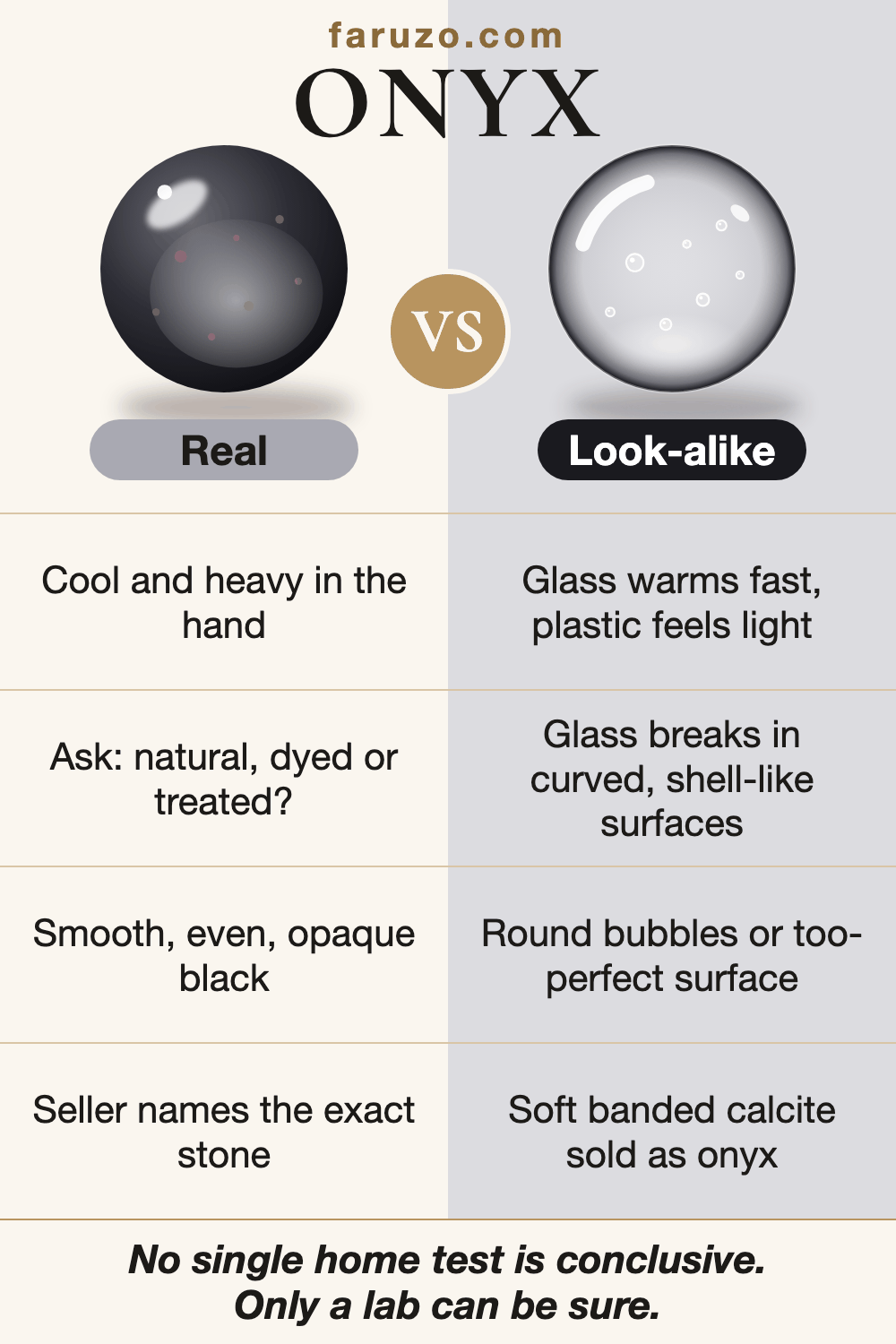
- Glass. Black glass can imitate polished onyx. Glass is often too perfect, may hold tiny round bubbles, feels warmer in the hand and breaks with curved, shell-like surfaces. Onyx tends to feel cool and may show faint banding in strong light.
- Banded calcite (sold as 'onyx'). Banded calcite is often carved and sold under the name onyx, but it is much softer (about Mohs 3) and a steel blade scratches it. Real onyx is chalcedony at Mohs 6.5 to 7. Ask what the stone is.
- Black obsidian. Obsidian is volcanic glass, softer at Mohs 5 to 5.5, with a glassy shine and curved breaks. It is usually a smoky black that shows no bands, while onyx is a flatter, more even opaque black.
- Black tourmaline. Black tourmaline is a different mineral, often sold raw or semi-polished with a duller surface and visible vertical lines (striations). Polished onyx has a smooth, even glassy surface.
Safe checks you can do
- Ask the seller in writing whether the stone is natural, dyed or treated, and whether it is onyx, agate or something else. Dyed onyx is still real chalcedony, so ask for plain disclosure.
- Hold it to strong light. Dyed stone can show a brownish or lighter edge, or faint banding, where the colour did not reach fully.
- Look for tiny round bubbles or a surface that seems too perfect. Glass often has both, while real stone does not.
- Check the feel. Real stone tends to feel cool and heavy in the hand, while glass warms up faster and plastic feels light.
- Be wary of a very cheap, large and perfectly even black piece sold as a rare natural stone. Natural solid black is uncommon, so ask questions.
- Avoid scratch-testing a stone you plan to keep; a gemologist can test it with no damage.
Wearing Onyx
Ring
Careful
Fine with care, but knocks can mark it.
Dyed pieces: do not soak
Bracelet
Safe
Fairly hard, so fine for normal bracelet wear.
Pendant
Safe
Fairly hard, and a pendant sits clear of knocks.
Earrings
Safe
Fairly hard, and earrings rarely take knocks.
Guide for everyday wear, based on hardness and care notes. Safe, Careful or Avoid.
Onyx is fairly hard (Mohs 6.5 to 7) with no cleavage, so it is suited to bracelets, pendants and earrings. It can work in a ring with some care, but everyday knocks and hard surfaces may scratch the polish over time. The colour of black pieces holds up well in normal wear; a long soak or strong heat is the thing to avoid.
Related stones
Questions about Onyx
What does onyx mean?
In crystal tradition onyx is a protection and grounding stone, linked to endurance, self-discipline and holding a boundary. That is a belief, not a fact about the stone. Geologically it is simply chalcedony with straight, parallel bands.
What is onyx?
Onyx is a banded form of chalcedony, a fine-grained quartz (SiO2). Its bands run straight and parallel, unlike the curved bands of agate. The name comes from the Greek word for 'claw' or 'fingernail'.
Is black onyx dyed?
Usually yes. Natural solid-black onyx exists but is uncommon, so lighter chalcedony or agate is routinely colour-treated to a deep, even black. This is standard trade practice, and the stone is still real chalcedony.
How hard is onyx?
Onyx is 6.5 to 7 on the Mohs scale, harder than a steel blade and close to quartz. It has no cleavage, so it resists chipping better than softer stones, though it can still scratch over time.
Is onyx a birthstone?
Plain onyx is not usually listed among the standard modern birthstones, but sardonyx, which is onyx banded with sard (a brownish-red chalcedony), is generally listed for August. Some older or regional lists include onyx itself for certain months, and lists vary.
What is the difference between onyx and agate?
They are close relatives, both banded chalcedony. Onyx has straight, parallel bands, while agate has curved, wavy bands that follow the shape of the stone. Black agate and black onyx are often the same material sold under two names.
What is the difference between onyx and black tourmaline?
They are different minerals. Onyx is banded quartz, usually polished glossy, while black tourmaline is often sold raw or semi-polished with a duller, lined surface.
Can onyx get wet?
A quick rinse will not harm the stone itself. Long soaking is best avoided, because the colour of dyed pieces can shift.
How can you tell real onyx from fake?
Home checks are only hints. Real onyx often shows faint, straight banding in strong light and feels cool, while glass may show bubbles. Banded calcite sold as onyx is much softer. For a stone that matters, have a gemologist test it. A deep, even black is usually dye, which does not make it a fake.
How do you clean and care for onyx?
Use a soft cloth, lukewarm water and mild soap, then dry it. Keep soaks short and keep it away from heat and solvents. Wrap it separately from harder stones that could scratch the polish.
Why was onyx used for cameos and seals?
Its layers of light and dark let carvers cut a pale design from a dark background, and its hardness and fine grain held crisp detail. Layered onyx was carved into cameos and signet rings in ancient Rome.
Will black onyx lose its colour?
Dyed black is generally stable in normal wear. Long soaks, strong heat and long direct sun are best avoided, and solvents should stay away from it.