
Crystal guide
Agate Meaning, Properties and Care
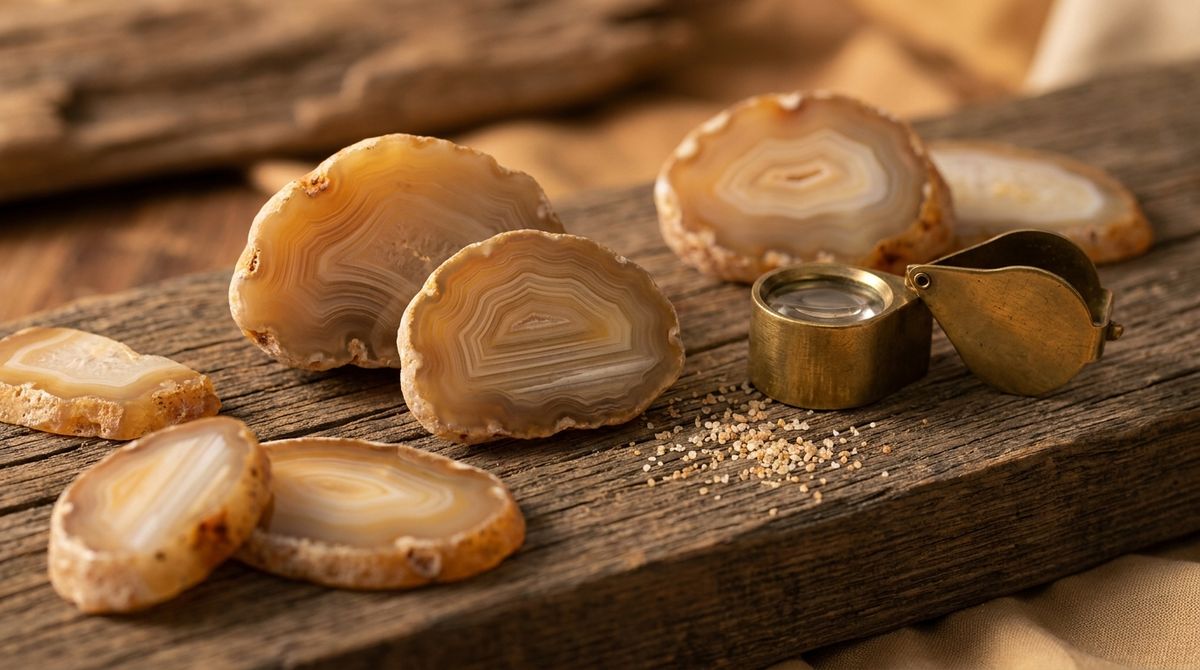
Agate is a banded form of chalcedony, a fine-grained type of quartz (SiO2), with a hardness of about 6.5 to 7 on the Mohs scale. Its curved or concentric stripes form layer by layer inside cavities in rock. Because it takes dye easily, the bright blue, purple and neon agate seen in shops is very often colour-treated. In crystal tradition it is a grounding, protective stone.
At a glance
- Banded chalcedony, formula SiO2, with a hardness of about 6.5 to 7 and no flat cleavage planes.
- Sold under many names, such as blue lace, Botswana and crazy lace agate, and also as cut slices that show the banding. Moss agate is a related green-included chalcedony with its own page.
- Natural colours are mostly greys, creams, browns, reds and soft blues. Very bright, uniform neon colours are usually dyed.
- Care: warm water, mild soap, soft cloth. Skip machine cleaners on colour-treated stones, and take rings off before rough work.
Quick facts
| Family | Quartz (silicate), a banded variety of chalcedony |
|---|---|
| Chemical formula | SiO2 |
| Crystal system | Microcrystalline (the crystals are too small to see without magnification), trigonal quartz structure |
| Mohs hardness | 6.5–7 |
| Luster | Vitreous to waxy; breaks with curved, shell-like surfaces |
| Transparency | Translucent to opaque |
| Natural colors | grey, white and cream; brown, amber and rust red; soft blue (blue lace agate); pale green, pink or purple tones from trace minerals; any vivid colour when dyed |
| Main localities | Brazil, Uruguay, India, Mexico, USA, Germany (Idar-Oberstein), Namibia, Madagascar |
| Common treatments | dyeing is common and is how most bright blue, purple, green and neon agate is made; heating is also used to deepen reds and browns; solid black agate is often coloured with dye |
Agate at a glance, in pictures
Chakras (traditional)
Hardness range
Natural colors
- grey, white and cream
- brown, amber and rust red
- soft blue (blue lace agate)
- pale green, pink or purple tones from trace minerals
- any vivid colour when dyed
Common forms of Agate
- Rough raw chunk
- Tumbled polished pebble
- Cabochon smooth dome
How hard is Agate?
- Talc 1
- Gypsum 2
- Copper coin ~ 3
- Calcite 3
- Fluorite 4
- Apatite 5
- Glass ~ 5.5
- Steel knife ~ 5.5
- Orthoclase 6
- Agate 6.5–7
- Quartz 7
- Topaz 8
- Corundum 9
- Diamond 10
What it is and where it comes from
Agate is a banded variety of chalcedony, a microcrystalline quartz. The bands form as silica-rich water seeps into cavities in volcanic rock and deposits thin layers over a very long time, each reflecting slightly different trace minerals.
The name is usually traced to the Achates River in Sicily, and the Greek naturalist Theophrastus is thought to have written about the stone around 300 BCE.
Agate has been carved for thousands of years. Its hardness and fine grain made it a long-used material for seals, signet rings, beads and small ornamental objects in the ancient Near East and Mediterranean.
It was also carried as a protective amulet in the ancient world, a reputation that has lasted into modern crystal tradition.
Agate is often porous at the microscopic scale, so it can take dye readily. Dyeing has a long history in the trade, and much of the bright agate sold today has been colour-treated.
From the early 1800s, Brazilian agate was cut in Idar-Oberstein in Germany, a cutting centre where dyeing became a standard trade step.
In crystal tradition
What follows is belief and folklore, passed down in crystal tradition. It is not measured fact.
Traditionally associated with: grounding, balance, protection.
Agate is traditionally associated with grounding, emotional balance and protection, and is often linked to the Root chakra. This is a long-standing spiritual tradition, not a fact about the stone.
Within crystal tradition, colours get their own meanings, for example green moss agate for growth, blue lace agate for calm speech and fire agate for courage. These are beliefs within crystal practice and have no physical basis.
How to care for Agate
- Water Safe
- Sunlight Caution
- Salt Unknown
- Heat Caution
- Ultrasonic Caution
- Chemicals Caution
Safe = fine as a rule · Caution = only briefly or gently · Avoid = can damage the stone · Unknown = no reliable guidance.
Clean agate with warm water, a drop of mild soap and a soft brush, then dry it fully. Water is fine for natural stone. Skip ultrasonic and steam cleaners on colour-treated or cracked agate, because vibration and heat may speed up colour loss. Natural colour is generally steady, but bright colour-treated pieces should stay out of long direct sun and strong heat. Keep it away from harsh cleaners and acids as a precaution, and store it apart from harder stones so it is not scratched.
Real or fake? Look-alikes and treatments
Often confused with
- Colour-treated agate sold as natural
- Onyx
- Glass or resin imitations
- Moss agate and other chalcedony
Common look-alikes
- Colour-treated agate sold as natural. This is the most common issue. Very bright, even blues, purples, pinks and neons across every band are usually dye, and dye often pools in cracks and edges. Ask whether the colour is natural or dyed.
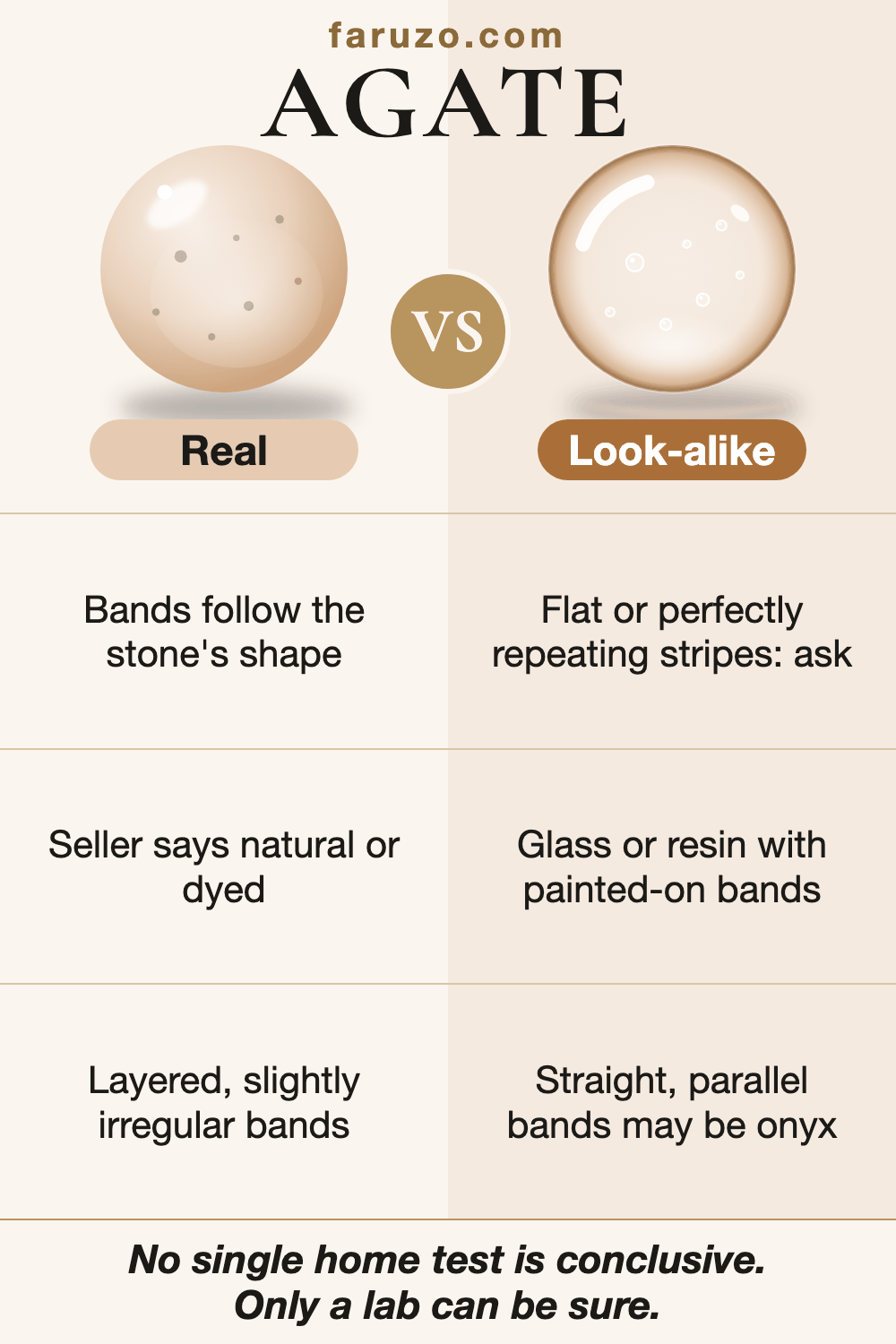
- Onyx. Onyx is a close relative with straight, parallel bands, often black and white. Agate bands are usually curved or concentric. Ask rather than assume from the name.
- Glass or resin imitations. Glass tends to look too even, with no natural banding, and may show tiny round bubbles. Real agate has layered, slightly irregular bands, and its pattern follows the shape of the slice.
- Moss agate and other chalcedony. Moss agate is a milky to clear chalcedony with green, moss-like threads and usually has no banding. It has its own page and is often sold under the agate name, but it is a different look, not a fake.
Safe checks you can do
- Ask the seller in writing whether the stone is natural colour, treated with dye or heat-treated. Dye is common and is not a problem when it is disclosed.
- Look at the colour. Natural agate is usually soft greys, creams, browns, reds and pale blues. Neon blue, purple or pink that is equally saturated in every band is usually dye.
- Check cracks and edges. Dye often collects in fractures and between bands, leaving darker lines than the rest of the stone.
- Look at the bands. Natural bands follow the shape of the stone and vary slightly in width. Painted, flat or perfectly repeating stripes deserve questions.
- Be wary of a solid, deep black stone sold as natural onyx or agate. Much of it has been coloured black, so ask.
- Do not rely on one home test. Added colour does not make agate fake, and a gemologist or lab can tell you whether colour has been added.
Wearing Agate
Ring
Careful
Fine with care, but knocks can mark it.
Bracelet
Safe
Fairly hard, so fine for normal bracelet wear.
Pendant
Safe
Fairly hard, and a pendant sits clear of knocks.
Earrings
Safe
Fairly hard, and earrings rarely take knocks.
Guide for everyday wear, based on hardness and care notes. Safe, Careful or Avoid.
Agate is hard enough for most jewelry and has no flat cleavage planes, so pendants, earrings and bracelets are easy, low-risk choices. A ring is fine with care: a hard knock can still chip or scratch it, so take it off before heavy work. Colour-treated pieces are best kept away from long sun and strong heat, which can fade the colour. Keep it in its own pouch so harder stones do not scratch it.
Related stones
Questions about Agate
What does agate mean?
In crystal tradition agate is a grounding, steadying stone linked to emotional balance and protection, and it was carried as an amulet in the ancient world. That is a belief, not a fact about the stone. Its measurable traits are its banding and its hardness of about 6.5 to 7.
What is agate?
Agate is a banded variety of chalcedony, which is a fine-grained form of quartz (SiO2). It is best known for its stripes and is found as polished slices, beads and cabochons.
How hard is agate?
About 6.5 to 7 on the Mohs scale, similar to quartz. It is hard enough for jewelry but is not scratch-proof the way sapphire or diamond is, and a sharp knock can chip it.
Is agate a real gemstone?
Yes. It is a well-defined mineral variety that has been used for jewelry, seals and carvings for thousands of years. It is a common, affordable gem rather than a rare one.
Why is some agate so brightly coloured?
Natural agate comes in a wide but mostly soft range of colours from trace minerals. Very bright, uniform blues, purples, pinks and neons are almost always the result of dye, because agate is porous and takes dye easily.
How can you tell if agate is dyed?
Very vivid, even colour in every band is often a warning sign, along with colour that pools in cracks and edges. A listing that says natural or dyed in plain words is more useful than any quick test.
What is the difference between agate and onyx?
Both are banded chalcedony. Agate bands are usually curved or concentric, while onyx has straight, parallel bands. A lot of solid black stone sold as onyx has been coloured, so check how it was coloured.
What is the difference between agate and a geode?
A geode is the hollow rock itself, often lined with crystals. Agate is a banded mineral that can form the lining of a geode. Not every geode contains agate, and not every agate came from a geode.
Is agate durable enough for an everyday ring?
Yes, with care. Its hardness is about 6.5 to 7, but it is not scratch-proof and can chip on a hard knock, so take a ring off for rough work. Pendants, earrings and bracelets are lower-risk choices.
How do you clean agate?
Use warm water, a drop of mild soap and a soft brush, then dry it fully. Colour-treated agate also dislikes cleaning machines, because vibration and heat can speed up colour loss.
Is agate a birthstone?
No. Agate is not on the standard modern birthstone lists.
Is moss agate the same as agate?
Not quite. Moss agate is a green-included chalcedony that usually has no banding, so it is a related stone rather than banded agate, though it is commonly sold under the agate name.
Does agate fade in the sun?
Natural agate colour is generally steady. Colour-treated agate can lose colour in long strong sun or near heat, so keep bright pieces off sunny windowsills and away from hot water.
What are blue lace, Botswana and crazy lace agate?
They are named types of banded agate. Blue lace agate is pale blue with fine lace-like bands, Botswana agate is a fine-banded grey, pink and brown stone from Botswana, and crazy lace agate has swirling, multi-coloured patterns.
Is a polished agate slice or a sparkly edge natural?
A slice is cut and polished from natural stone, and a sparkly crystal edge can be natural too. Either can still have added colour, so ask whether the colour is natural.