
Crystal guide
Petrified Wood Meaning, Properties and Care
Petrified wood is fossil wood in which minerals have replaced the original material, most often silica in the form of quartz, chalcedony or opal. It can keep the grain, growth rings and even cell detail of the tree. Most pieces sit at about 6.5 to 7 on the Mohs scale, though opal-type pieces are softer. In crystal tradition it is a stone of patience and endurance.
At a glance
- Fossil wood where minerals, mostly silica (quartz, chalcedony or opal), have replaced the original wood.
- Mohs about 6.5 to 7 for most pieces. Pieces where opal took over are softer, nearer 5.5 to 6.
- Often keeps growth rings and cell detail, in earthy browns, creams and reds, and sometimes greys, yellows or greens.
- Care: soft cloth, mild soap, no steam or machine cleaners. Neon, perfectly even colour usually means dye or resin. Not a standard birthstone.
Quick facts
| Family | Fossil wood in which silica, mostly quartz, chalcedony or opal, has replaced or filled the original wood; a rock rather than a single mineral |
|---|---|
| Chemical formula | Mostly SiO2 (silica); no single formula, because the replacing minerals vary |
| Crystal system | Mostly very fine-grained quartz (chalcedony); some pieces hold opal or moganite instead, so the structure varies from piece to piece |
| Mohs hardness | 6.5–7 |
| Luster | Takes a polish; no cleavage, and breaks unevenly or in splinters |
| Transparency | Opaque to translucent; pieces from some places are nearly opaque, others more translucent |
| Natural colors | brown, grey, cream and white, red and pink, yellow, green (less common), blue to violet (less common), black |
| Main localities | USA (Arizona), Indonesia, Madagascar, Thailand, Myanmar |
| Common treatments | colour can be enhanced by dyeing, as with other chalcedony, so ask whether the colour is natural; bright, perfectly even colour can point to dye or resin |
Petrified Wood at a glance, in pictures
Chakras (traditional)
Hardness range
Natural colors
- brown
- grey
- cream and white
- red and pink
- yellow
- green (less common)
- blue to violet (less common)
- black
Common forms of Petrified Wood
- Rough raw chunk
- Cabochon smooth dome
- Bead drilled bead
How hard is Petrified Wood?
- Talc 1
- Gypsum 2
- Copper coin ~ 3
- Calcite 3
- Fluorite 4
- Apatite 5
- Glass ~ 5.5
- Steel knife ~ 5.5
- Orthoclase 6
- Petrified Wood 6.5–7
- Quartz 7
- Topaz 8
- Corundum 9
- Diamond 10
What it is and where it comes from
Petrifaction happens underground. Wood buried by water-borne sediment or volcanic ash loses oxygen, so it decays very slowly, while mineral-rich water fills its cells and empty spaces.
In some pieces the cell walls act as a template, so the stone copies the wood in fine detail. The result is a three-dimensional stone version of the tree.
Silica is the usual replacement, as quartz, chalcedony or opal. About 40 minerals have been found in petrified wood, with calcite and pyrite much less common than silica.
Under magnification, cut pieces can show the oval pores, fine rays and growth rings of the original tree, where slow winter and fast summer growth left their bands.
Colour comes mostly from trace metals. Iron is the most important and gives a range of hues depending on its oxidation state, while chromium can give bright green. Carbon and manganese also colour some pieces.
Petrified wood ranges from about 390 million years old (Devonian) to nearly recent. The famous logs of Arizona are said to be over 200 million years old.
The word petrify comes from the Greek petra, meaning rock. The Chemnitz petrified forest in Germany was reportedly found in 1737.
Ancestral Puebloan builders used petrified wood in their walls, including Agate House near Petrified Forest National Park in Arizona.
Today it goes mostly into polished slices, bookends, table tops and clock faces. Cabochons and beads are made too, though jewelry is a smaller use.
Well-known places include Arizona, Madagascar, Egypt, Indonesia and Thailand and Myanmar. Pieces from different places differ in colour and in how clear the wood structure is.
In crystal tradition
What follows is belief and folklore, passed down in crystal tradition. It is not measured fact.
Traditionally associated with: patience, endurance, stability.
Petrified wood is traditionally linked with patience, endurance and a sense of deep time, because it is a tree that has lasted millions of years. This is a modern spiritual tradition, not a fact about the stone.
Chakra and zodiac links vary from one tradition to another, with the Root chakra often mentioned. Treat them as folklore.
How to care for Petrified Wood
- Water Safe
- Sunlight Unknown
- Salt Unknown
- Heat Caution
- Ultrasonic Caution
- Chemicals Unknown
Safe = fine as a rule · Caution = only briefly or gently · Avoid = can damage the stone · Unknown = no reliable guidance.
Wipe petrified wood with a soft cloth, lukewarm water and a little mild soap, then dry it. Skip steam and ultrasonic cleaners, since natural cracks can widen and opal-type pieces dislike heat and drying out. Keep it apart from harder stones in storage, and take it off before sport and rough work, because a hard knock can chip it or open a crack.
Real or fake? Look-alikes and treatments
Often confused with
- Moulded resin or plastic
- Resin-filled real wood
- Wood-patterned jasper or agate
- Glass or a polished stone in fossil colours
Common look-alikes
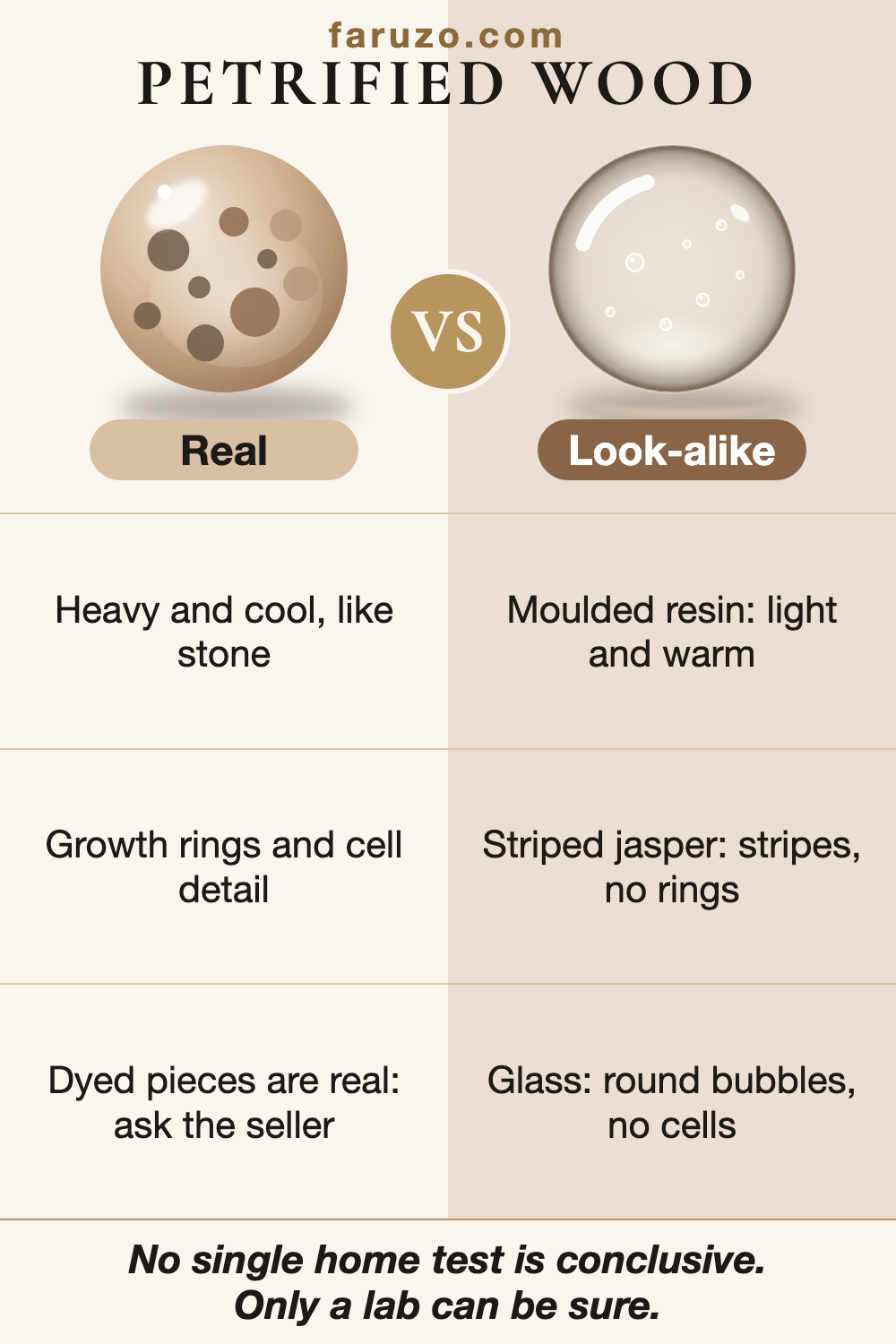
- Moulded resin or plastic. Some pieces are moulded resin, painted to look like stone. They feel light and warm in the hand, the grain can look blurry or repeated, and the polished surface may look waxy, sometimes with tiny bubbles. Real stone feels heavy and cool.
- Resin-filled real wood. This is real wood stabilised with resin to look like stone. It is fine when it is labelled, but it is wood, not stone, so it is light for its size and scratches easily.
- Wood-patterned jasper or agate. Some jasper and agate show stripes that look a little like wood grain but were never a tree. Real petrified wood, cut across, shows the oval cells, rays and growth rings of wood. Stripes alone are not enough, and a piece can be partly jasper or agate and still be real petrified wood.
- Glass or a polished stone in fossil colours. Glass and plain polished stones can be dyed or coloured to resemble wood-coloured fossil stone. They show no real wood structure of cells, rays or rings, and glass may show round bubbles.
Safe checks you can do
- Ask the seller in writing whether the piece is natural petrified wood, dyed, resin-filled or moulded. A dyed piece is still real petrified wood, but the colour is not natural, so the seller should say so.
- Look closely at the grain. Real petrified wood keeps believable growth rings, knots and cell detail, while grain that looks blurry, broken or repeated is a warning sign.
- Weigh it in your hand. Real petrified wood feels heavy and cool like stone, while resin and treated wood feel light and warmer.
- Check the colour. Natural colours are usually earthy and uneven, while neon, perfectly uniform colour points to dye or resin.
- Do not scratch-test or hot-pin a piece you plan to keep. A lab is the safe route for a piece that matters.
Wearing Petrified Wood
Ring
Careful
Knocks can chip it or open a crack; opal-type pieces are softer.
Bracelet
Careful
Fine for everyday wear; opal-type pieces are softer, so go gently.
Pendant
Safe
Sits away from knocks; opal-type pieces are softer, so go gently.
Earrings
Safe
Light and mostly out of the way; opal-type pieces are softer.
Guide for everyday wear, based on hardness and care notes. Safe, Careful or Avoid.
At about 6.5 to 7 petrified wood is fairly hard, so a pendant or earrings suit normal wear and a bracelet is fine for everyday wear. A ring is possible with care, because a knock can chip it or open a natural crack, so take it off for sport and rough work. Pieces where opal took over are softer, so wear them even more gently.
Related stones
Questions about Petrified Wood
What does petrified wood mean?
In crystal tradition petrified wood is a stone of patience and endurance, often linked with the Root chakra. That is a belief, not a fact about the stone. Its real story is a tree that was turned to stone over a very long time.
What is petrified wood?
It is fossil wood in which minerals have replaced the original material. The mineral is most often silica, as quartz, chalcedony or opal, and it can copy the wood's grain and cell detail.
Is petrified wood a crystal?
It is a rock rather than a single crystal. It is usually made of very fine-grained quartz or chalcedony, sometimes with opal, so the structure varies from piece to piece.
How hard is petrified wood?
Most pieces are about 6.5 to 7 on the Mohs scale, close to quartz. Pieces where opal took over are softer, nearer 5.5 to 6, so ask what the piece is made of.
Is petrified wood a birthstone?
Petrified wood is not on the standard modern or traditional birthstone lists, though lists vary. Check the list you are following.
How can you tell real petrified wood from fake?
A home look can only hint. Real petrified wood feels heavy and cool, with believable growth rings and cell detail, while resin and treated wood feel light and warm. Neon, perfectly even colour is a warning sign.
Is dyed petrified wood real?
Yes, in the sense that the stone is real, but the colour has been added. A seller should say so rather than call the colour natural. If you want natural colour, ask in writing.
What colours does petrified wood come in?
Mostly browns, greys, creams and reds, because iron colours much of it. Yellow and pink occur, and green and blue to violet pieces are less common.
Can you wear a petrified wood ring?
It is possible with care. The stone is fairly hard, but a hard knock can chip it or open a natural crack, so a ring suits occasional wear rather than daily work with your hands.
Can petrified wood get wet or go in an ultrasonic cleaner?
A rinse in lukewarm water is fine if you dry it. Skip ultrasonic and steam cleaners, since natural cracks can widen and opal-type pieces dislike heat and drying out.
Is it legal to collect petrified wood?
Not everywhere. Taking it from Petrified Forest National Park in Arizona is against the law, and rules differ on other public land, so check with the land manager before you collect. Pieces sold in shops there come from private land outside the park.
How old is petrified wood?
It ranges from about 390 million years old to nearly recent. The famous Arizona logs are over 200 million years old.
Where does petrified wood come from?
It is found in many places, including Arizona, Madagascar, Egypt, Indonesia, Thailand and Myanmar. Colour and wood detail differ from one place to another.
What should I ask a seller before buying petrified wood?
Ask whether the piece is natural petrified wood, whether the colour is natural or dyed, and whether any resin was used to fill it. For a slice or bookend, ask where it came from, since not every place allows collecting.