
Crystal guide
Opal Meaning, Properties and Care
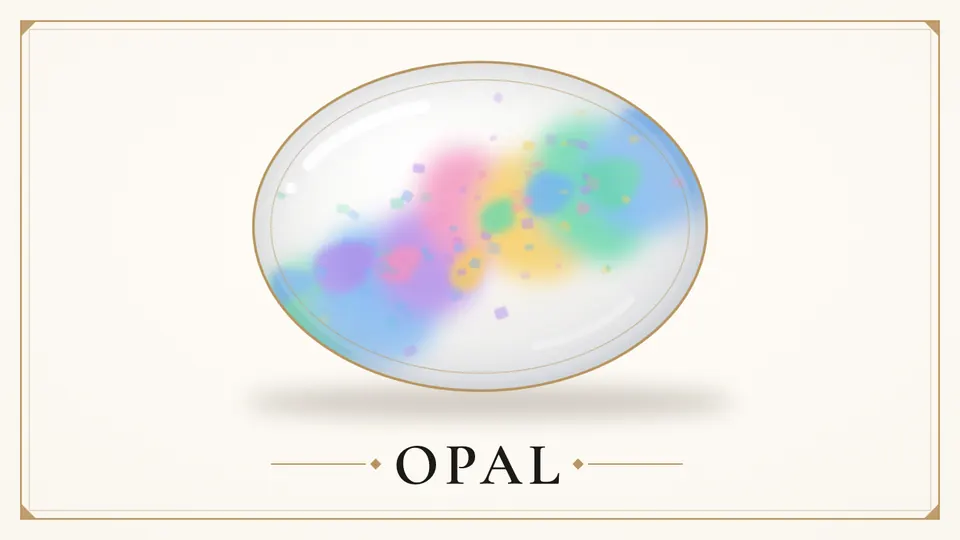
Opal is hydrated silica (SiO2 with water), with no crystal structure of its own, and Mohs 5.5 to 6.5 makes it softer than most popular gems. Its best known trait is play-of-color, a flash of rainbow hues that moves as the stone turns. It is an October birthstone, and in crystal tradition it is linked to creativity and emotional expression.
At a glance
- Hardness Mohs 5.5 to 6.5: opal scratches and chips more easily than quartz or sapphire.
- Hydrated silica: it holds up to about 20% water, so it can crack if it dries out too fast or gets hot.
- The October birthstone, with the famous rainbow flash called play-of-color.
- Care: wipe with a soft damp cloth and dry it at once. No soaking, no ultrasonic or steam cleaners, and avoid heat.
Quick facts
| Family | Opal (hydrated silica; amorphous, so strictly a mineraloid) |
|---|---|
| Chemical formula | SiO2·nH2O |
| Crystal system | Amorphous (no crystal structure) |
| Mohs hardness | 5.5–6.5 |
| Luster | Subvitreous to waxy; no cleavage |
| Transparency | Ranges from transparent through translucent to opaque, depending on the type |
| Natural colors | white, colorless, black, orange to red (fire opal), blue, green, play-of-color shows many rainbow hues |
| Main localities | Australia (the main source of precious opal); Ethiopia; Mexico; Brazil; Nevada, USA; Slovakia |
| Common treatments | impregnation with oil, wax or plastic; smoke or sugar treatment of some porous opal to darken it; surface modification |
| Birth month | October |
Looking for the month? October birthstone guide
Opal at a glance, in pictures
Chakras (traditional)
Hardness range
Natural colors
- white
- colorless
- black
- orange to red (fire opal)
- blue
- green
- play-of-color shows many rainbow hues
Traditionally linked to
- Zodiac
- LibraScorpio
- Element
- Water
Common forms of Opal
- Rough raw chunk
- Cabochon smooth dome
- Bead drilled bead
How hard is Opal?
- Talc 1
- Gypsum 2
- Copper coin ~ 3
- Calcite 3
- Fluorite 4
- Apatite 5
- Glass ~ 5.5
- Steel knife ~ 5.5
- Orthoclase 6
- Opal 5.5–6.5
- Quartz 7
- Topaz 8
- Corundum 9
- Diamond 10
What it is and where it comes from
The name most likely traces back to the Sanskrit word upala, meaning jewel, passing through Greek and Latin into English.
Opal was rare and highly prized in antiquity. The Romans are said to have counted it among their most precious stones, and Pliny the Elder described it.
Before large deposits were developed in Australia in the 19th century, the best known source was in what is now Slovakia. Mining in Australia expanded in the late 19th century, and Australia became the world's main source of precious opal.
Play-of-color comes from light bending between tiny, orderly silica spheres, roughly 0.2 microns across, packed in the stone. Opal without this effect is called common opal.
Opal's reputation for bad luck is often traced to a popular 1829 novel rather than to older tradition, and it did not reflect how the stone was seen earlier.
Ethiopian opal has become a major part of today's market. Much of it is hydrophane, meaning it soaks up water and can turn more transparent or stain when wet, then slowly dries back.
Fire opal and pink opal are varieties of opal, not separate minerals. Fire opal is transparent to translucent with a warm yellow to red body colour and is best known from Mexico. Pink opal is an opaque pastel common opal from Peru and, like other common opal, does not show play-of-color.
In crystal tradition
What follows is belief and folklore, passed down in crystal tradition. It is not measured fact.
Traditionally associated with: creativity, emotional expression, inspiration.
Opal is traditionally associated with the Crown chakra. This is a modern spiritual tradition, not a fact about the stone.
Opal is traditionally associated with the zodiac signs Libra and Scorpio and the element Water. These mappings differ between lists and have no scientific basis.
In crystal tradition opal stands for creativity, inspiration and emotional expression, partly because its colors seem to shift with the light. These are symbolic meanings, not effects on the body or mind.
How to care for Opal
- Water Caution
- Sunlight Caution
- Salt Unknown
- Heat Avoid
- Ultrasonic Avoid
- Chemicals Caution
Safe = fine as a rule · Caution = only briefly or gently · Avoid = can damage the stone · Unknown = no reliable guidance.
A soft damp cloth and a drop of mild soap are the usual clean for opal, then dry it gently. Machine cleaners are not recommended. Strong heat or drying out too fast may crack it, so keep it away from radiators, hot cars and long strong sun, which can also dull it. It can also scratch or chip, so a protective setting and separate storage help. Treated, composite or porous (hydrophane) opal may react badly to soaking or solvents, so keep those dry and wipe them clean. Salt and household chemicals are best avoided as a precaution.
Real or fake? Look-alikes and treatments
Often confused with
- Doublets and triplets
- Lab-made (synthetic) opal
- Resin or plastic imitations
- Opalite (trade name)
Common look-alikes
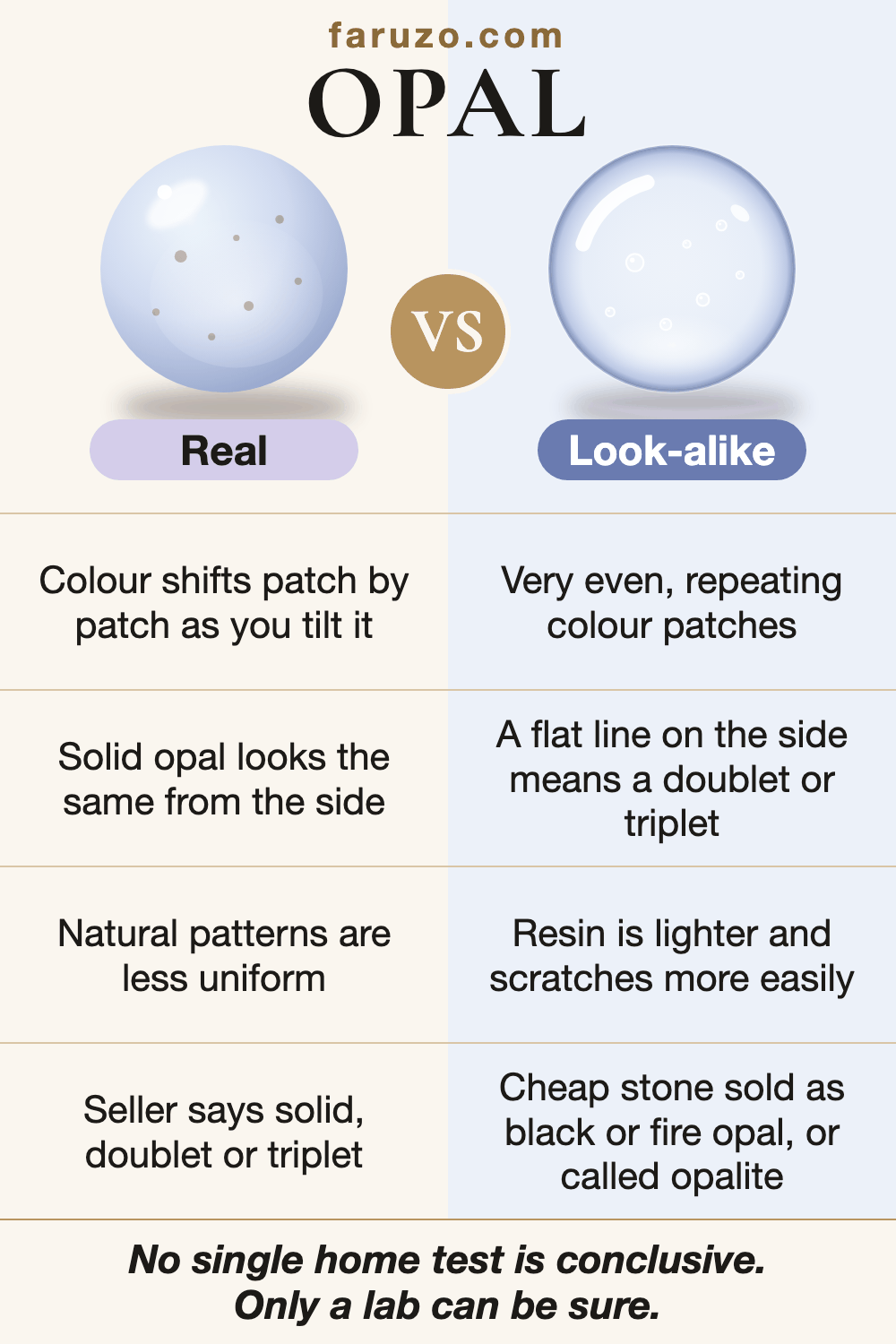
- Doublets and triplets. These are real opal, but only as a thin slice glued onto a dark backing, and a triplet adds a clear dome of quartz or plastic on top. They are sold as composite stones and usually cost less than solid opal. Look from the side: a straight line where the layers meet, or a flat back that is a different material, gives it away. Ask the seller to state in writing whether the stone is solid opal.
- Lab-made (synthetic) opal. Lab-made opal first appeared in the 1970s. Under magnification it often shows a very regular, tidy pattern of color patches, sometimes described as lizard skin or a chicken-wire look, and natural opal's patterns are usually less uniform. Lab-made material also tends to be lighter and more porous. A gemologist or lab testing is the reliable way to confirm.
- Resin or plastic imitations. Resin and plastic imitations can copy the rainbow flash. They are man-made and generally lighter and softer than stone, so they scratch more easily, and their color patches can look unnaturally even. A seller should say plainly if a piece is resin; if it is not stated, ask.
- Opalite (trade name). Opalite is a trade name that is used for glass and other man-made material, not for natural opal with play-of-color. It tends to be milky, uniformly bluish or whitish, and glassy, with no moving rainbow flash. If a stone is called opalite and costs very little, expect it to be made rather than mined.
Safe checks you can do
- Ask whether the stone is solid opal or a composite, and whether it is natural or lab-made. Honest sellers state it, and composites are legitimate when they are labelled as such.
- Look at the side of the stone under good light. A flat line where a thin opal layer sits on a dark base, or a clear dome sitting on top, means a doublet or triplet rather than solid opal.
- Watch how the color moves. Real play-of-color shifts and changes patch by patch as you tilt the stone. Very even, repeating color patches that look like a pattern can point to lab-made opal or plastic.
- Treat price and name as clues. A very cheap stone sold as black or fire opal, or anything labelled opalite, is often glass or resin. For a stone that matters, ask a gemologist or lab to test it, because most of these checks are hints rather than proof.
Wearing Opal
Ring
Avoid
Heat can ruin it, so a ring is best avoided.
Bracelet
Careful
Bracelets take more knocks, so wear it with care.
Pendant
Careful
Heat can harm it, so keep it away from steam.
Earrings
Careful
Heat can harm it, so keep earrings away from steam.
Guide for everyday wear, based on hardness and care notes. Safe, Careful or Avoid.
Opal is softer than many gems (Mohs 5.5 to 6.5) and can crack, so a ring is best avoided and pendants and earrings suit it better. If you still choose a ring, keep it to occasional wear in a setting with metal around the stone, and take it off for sports, cleaning and gardening. Store opal on its own in a soft pouch so harder stones do not scratch it, and avoid leaving it in a hot car or on a sunny windowsill.
Related stones
Questions about Opal
What does opal mean?
In crystal tradition opal is associated with creativity, inspiration and emotional expression, partly because its colors seem to shift as you move it. These are symbolic meanings from tradition, not facts about the stone or claims about your health or luck.
Is opal a real gemstone?
Yes. Opal is a natural form of hydrated silica and has been prized as a gem since antiquity. Strictly it is a mineraloid because it has no crystal structure. Lab-made opal, doublets and triplets also exist, as do plastic look-alikes, so ask what a particular stone is.
Is opal a birthstone?
Yes. Opal is a traditional birthstone for October, a month it shares with tourmaline in many modern lists.
How hard is opal?
Opal measures about 5.5 to 6.5 on the Mohs scale, depending on the stone and the reference list. That is softer than quartz (7), so dust and everyday knocks can scratch it, and a hard blow may chip it.
Can opal crack?
Yes. Opal contains water, up to about 20% in some stones, and can crack if it dries out too quickly or is heated. Some water-rich opal from Ethiopia and Nevada is known for it. Avoid heat, sudden changes and long dry storage in strong sun.
How do you clean opal?
Wipe it gently with a soft, slightly damp cloth and dry it straight away. Avoid harsh chemicals and machine cleaners. Keep oiled, waxed, doublet or triplet opal from long soaking.
How can you tell real opal from fake?
One quick test rarely settles it. Check the side of the stone for a layered line, which means a doublet or triplet, and watch whether the rainbow flash shifts naturally as you tilt it. Very regular patches can suggest lab-made opal or plastic. A lab can confirm a stone that matters.
What is the difference between precious opal and common opal?
Precious opal shows play-of-color, the moving rainbow flash. Common opal, such as milky or plain colored opal, does not show it. Both are opal, but precious opal is usually the one used in fine jewelry.
What is fire opal?
Fire opal is opal with a warm yellow, orange or red body color, and it is best known from Mexico. It may or may not show play-of-color.
Is opal safe in a ring?
A ring is best avoided. At 5.5 to 6.5 opal scratches and chips more easily than quartz. If you still choose one, a setting with metal around the stone, occasional wear, and taking it off for sports, cleaning and gardening all help. Pendants and earrings take fewer knocks.
Can opal go in water?
Solid natural opal can take a quick rinse in lukewarm water. Porous, treated or composite opal should be kept dry, and no opal should be soaked or put in hot water.
What are black opal and boulder opal?
Black opal has a dark body color that makes the play-of-color look vivid, and Lightning Ridge in Australia is its best-known source. Boulder opal is a thin layer of opal left attached to its ironstone host rock, mainly from Queensland.
What is pink opal?
Pink opal is a pastel pink variety of common opal, best known from Peru. Common opal has no play-of-color, so pink opal has a soft, even look rather than a rainbow flash. Dyed pink opal has been found on the market, so a very bright, even pink at a very low price may be dyed or a different pink stone. Ask the seller what it is.
Is fire opal the same as fire agate?
No. Fire opal is opal, a hydrated silica, at Mohs 5.5 to 6.5 with a warm yellow to red body colour. Fire agate is a brown chalcedony (quartz) at Mohs 6.5 to 7 whose thin iron-oxide layers give orange, gold and green flashes. The names are similar but they are different stones.