
Crystal guide
Fire Agate Meaning, Properties and Care
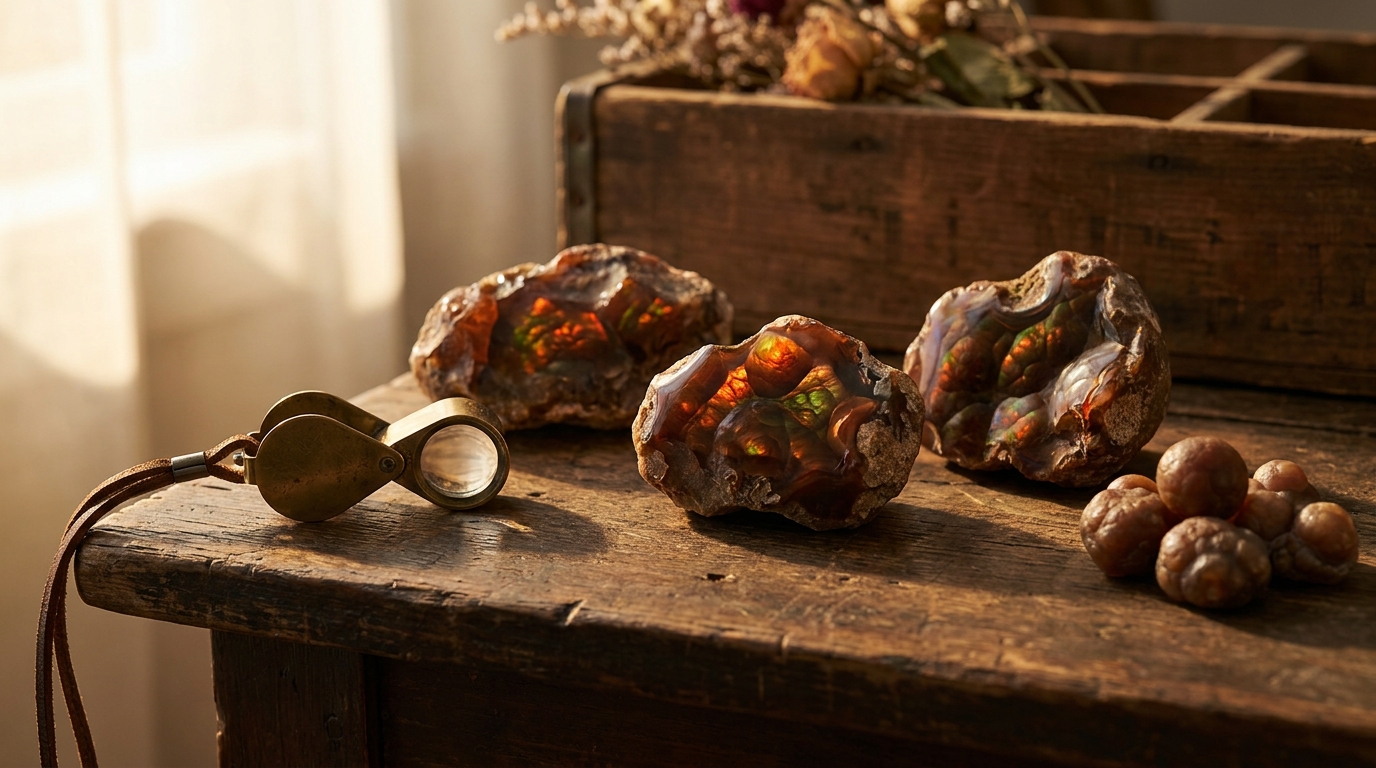
Fire agate is a brown variety of chalcedony (microcrystalline quartz, SiO2) with flashes of orange, gold, red and green that seem to glow from inside. The colour is thought to come from very thin iron-oxide layers that reflect light, not from heat or dye. At Mohs 6.5 to 7 with no cleavage it is fairly tough, though the colour layer sits close to the surface. In crystal tradition it is a stone of courage and grounding.
At a glance
- A brown chalcedony (microcrystalline quartz, SiO2) with iridescent flashes of orange, gold, red and green.
- Mohs 6.5 to 7 and no cleavage, but the thin colour layer lies near the surface, so deep scratches can dull it.
- The "fire" is optical: light bouncing between thin iron-oxide layers, not heat, paint or dye.
- Found mainly in Mexico and the US Southwest. Not on the standard birthstone lists. Not the same stone as fire opal.
Quick facts
| Family | Chalcedony (microcrystalline quartz) with thin layers of the iron oxides goethite or limonite; not a true banded agate |
|---|---|
| Chemical formula | SiO2 (silica), with iron-oxide layers |
| Crystal system | Trigonal (quartz), as microscopic crystals, often in rounded botryoidal masses |
| Mohs hardness | 6.5–7 |
| Luster | Waxy to vitreous, with no cleavage and an uneven, splintery or conchoidal break |
| Transparency | Translucent to opaque |
| Natural colors | brown body; iridescent orange, gold, red and green; occasionally blue-violet flashes |
| Main localities | Mexico (Chihuahua, San Luis Potosi, Aguascalientes); USA (Arizona, California, New Mexico) |
| Common treatments | the iridescence is natural layering inside the stone, not a treatment; metal-coated crystals and dyed agate can look similar but are different products, so ask the seller what a piece is |
Fire Agate at a glance, in pictures
Chakras (traditional)
Hardness range
Natural colors
- brown body
- iridescent orange, gold, red and green
- occasionally blue-violet flashes
Common forms of Fire Agate
- Rough raw chunk
- Cabochon smooth dome
- Tumbled polished pebble
How hard is Fire Agate?
- Talc 1
- Gypsum 2
- Copper coin ~ 3
- Calcite 3
- Fluorite 4
- Apatite 5
- Glass ~ 5.5
- Steel knife ~ 5.5
- Orthoclase 6
- Fire Agate 6.5–7
- Quartz 7
- Topaz 8
- Corundum 9
- Diamond 10
What it is and where it comes from
Fire agate is a variety of chalcedony, a microcrystalline form of quartz, so it is not a true agate. It typically has no banding, and the word "agate" in the name is a trade name rather than a description of its structure.
Its brown body and iridescent flashes are linked to inclusions of the iron oxides goethite or limonite, laid down in thin layers inside the chalcedony.
The effect is optical rather than a pigment. Light reflecting between very thin layers can produce shifting colours, the same general kind of effect as an oil film on water or the sheen of seashell nacre.
It is thought to form when hot water carrying silica and iron oxide fills cracks and cavities in rock and slowly sets into layers, often as rounded, botryoidal masses.
Gem material comes from central and northern Mexico and from Arizona, California and New Mexico in the US Southwest. Some Mexican material is described as showing mainly golden flashes, with full rainbow colour rare.
Cutting is slow, careful work. The cutter grinds away the chalcedony over the colour layers: cut too deep and the iridescence fades, cut too shallow and the stone looks dull. Few pieces can be cut to standard calibrated sizes.
In crystal tradition
What follows is belief and folklore, passed down in crystal tradition. It is not measured fact.
Traditionally associated with: courage, confidence, grounding, protection.
In crystal tradition, fire agate is linked with courage, confidence, grounding and protection. This is a modern spiritual tradition, not a fact about the stone.
Some traditions place it with the Sacral chakra, and its fiery look leads many people to connect it with passion and drive. Those links come from the stone's name and appearance, not from any property of the mineral.
How to care for Fire Agate
- Water Safe
- Sunlight Unknown
- Salt Unknown
- Heat Caution
- Ultrasonic Caution
- Chemicals Caution
Safe = fine as a rule · Caution = only briefly or gently · Avoid = can damage the stone · Unknown = no reliable guidance.
Wipe fire agate with a soft cloth and a little mild soap in lukewarm water, rinse briefly and dry. The colour sits in thin layers close to the polished surface, so avoid abrasive cleaners and rough scrubbing. As a precaution, skip ultrasonic cleaners, steam and harsh chemicals, which could stress or dull a thin colour layer. Store it in a soft pouch apart from harder stones, and take it off before heavy work.
Real or fake? Look-alikes and treatments
Often confused with
- Metal-coated crystals ("rainbow" or "aura" stones)
- Dyed agate
- Opal and opal doublets
- Iridescent glass
Common look-alikes
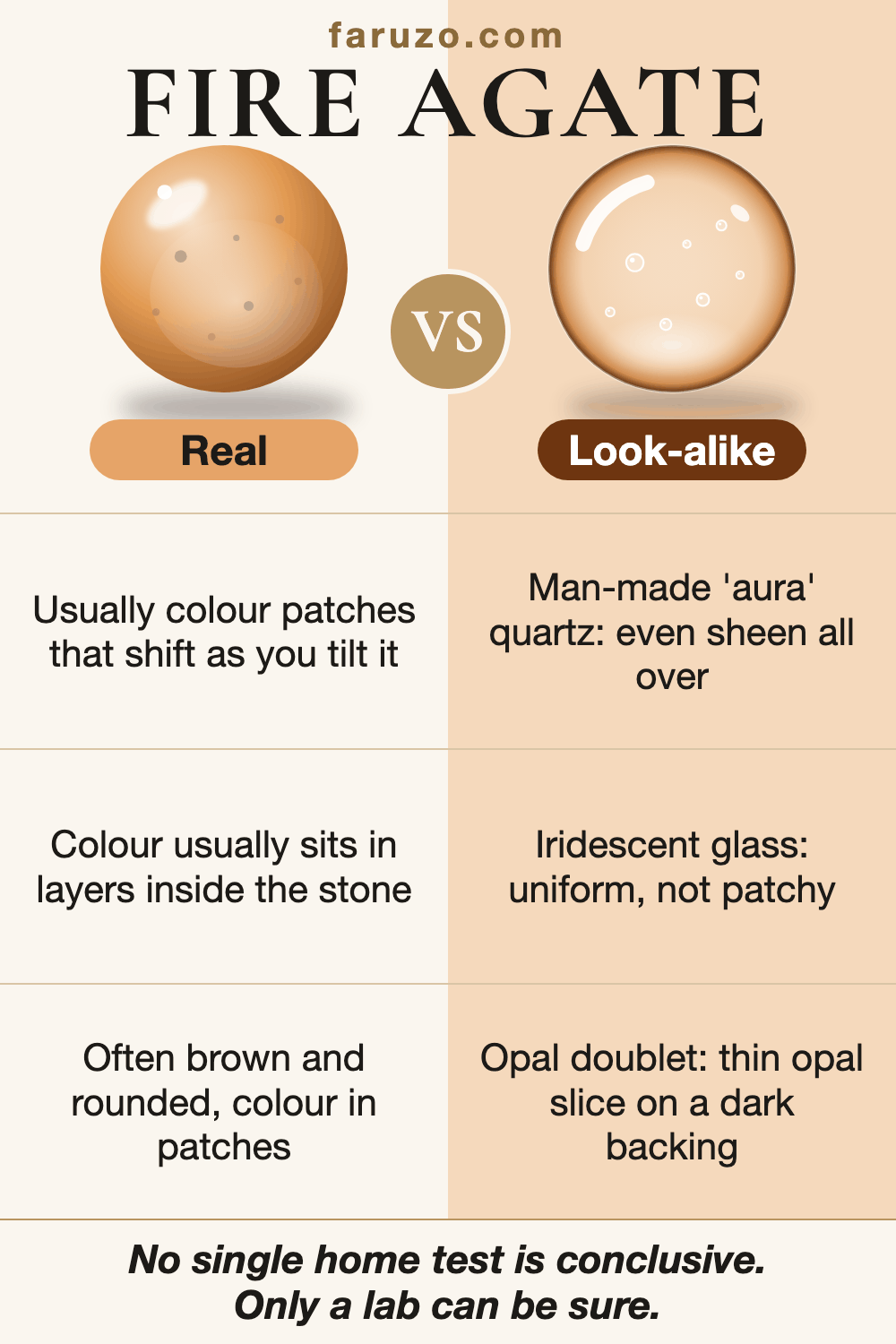
- Metal-coated crystals ("rainbow" or "aura" stones). These are crystals, usually quartz, with a thin metal film applied to the surface, which gives an iridescent sheen. This is a man-made finish on a different stone, not natural fire agate. Ask the seller to name the material and whether the colour is a coating.
- Dyed agate. Agate colour is often enhanced by dyeing, and dye gives a steady colour that does not flash. Fire agate shows brown stone with patches of colour that change as you tilt it.
- Opal and opal doublets. Opal can flash many colours too, but it is softer (about Mohs 5.5 to 6) and its colour comes from stacked silica spheres. Doublets are a thin slice of opal glued onto a dark backing, so ask whether a stone is solid.
- Iridescent glass. Glass is a long-standing imitation of many stones, and an iridescent finish can be added to it. Glass looks uniform and is not made of brown chalcedony with patchy colour. A gem lab can confirm what a piece is.
Safe checks you can do
- Ask the seller in writing whether the piece is natural fire agate, a coated crystal, dyed agate, an opal doublet or glass.
- Tilt the stone in light. Natural fire agate shows patches of colour that move and change within a brown, often rounded stone, while an even sheen over the whole surface deserves a question.
- Look at where the colour sits. In fire agate it is in layers within the chalcedony, while a coating lies on the outside and may wear at edges.
- Do not scratch-test or heat-test a stone you plan to keep. A gem lab can confirm what it is when it matters.
Wearing Fire Agate
Ring
Careful
Fine with care, but knocks can mark it.
Bracelet
Safe
Fairly hard, so fine for normal bracelet wear.
Pendant
Safe
Fairly hard, and a pendant sits clear of knocks.
Earrings
Safe
Fairly hard, and earrings rarely take knocks.
Guide for everyday wear, based on hardness and care notes. Safe, Careful or Avoid.
Fire agate sits at about 6.5 to 7 on the Mohs scale and has no flat cleavage planes, so pendants, earrings and bracelets are easy choices. A ring is fine with care: the colour layer lies close to the surface of a polished stone, so a hard knock or deep scratch can dull a spot. Take it off for heavy work, and store it in its own pouch away from harder stones.
Related stones
Questions about Fire Agate
What does fire agate mean?
In crystal tradition fire agate is linked with courage, confidence, grounding and protection. That is a belief, not a fact about the stone. Its practical appeal is flame-like colour that moves inside brown stone as you tilt it.
What is fire agate?
Fire agate is a brown variety of chalcedony, a microcrystalline quartz (SiO2), with thin iron-oxide layers that give shifting flashes of orange, gold, red and green. It is found mainly in Mexico and the US Southwest.
Is fire agate a true agate?
Not strictly. True agate is banded chalcedony, while fire agate typically has no banding. It belongs to the same chalcedony family, and "agate" in its name is a trade name.
What causes the fire in fire agate?
The colour is thought to come from thin layers of iron oxide (goethite or limonite) inside the stone. Light reflects between those layers and produces shifting colours, similar in kind to an oil film on water. It is not heat, paint or dye.
How hard is fire agate?
About 6.5 to 7 on the Mohs scale, close to quartz, and it has no cleavage. It is generally described as more durable than opal, though the thin colour layer can still be dulled by a deep scratch.
What is the difference between fire agate and fire opal?
They are different stones. Fire opal is a warm yellow to orange to red opal, usually without a play of colour, and opal is a softer, water-containing silica. Fire agate is harder chalcedony (about Mohs 6.5 to 7) whose flashes come from thin iron-oxide layers inside brown stone.
Is fire agate a birthstone?
Fire agate is not on the standard modern birthstone lists. Plain agate appears on some traditional lists, and lists vary, so check the one you are following.
Where does fire agate come from?
Gem material comes from central and northern Mexico, including Chihuahua, San Luis Potosi and Aguascalientes, and from Arizona, California and New Mexico in the US Southwest.
Why is fire agate cut as a cabochon?
The colour lies in thin layers near the surface, so it is usually cut as a smooth polished dome or rounded shape rather than faceted. The cutter grinds away the chalcedony over the colour layers, and cutting too deep or too shallow loses the effect.
Can you wear a fire agate ring every day?
It is possible with care. At Mohs 6.5 to 7 it resists most scratching and has no cleavage, but a hard knock can chip it or dull the thin colour layer. Pendants and earrings take fewer knocks, and a ring suits lighter wear.
How do you clean fire agate?
Use a soft cloth and mild soap in lukewarm water, rinse briefly and dry it. As a precaution, skip ultrasonic cleaners, steam and harsh chemicals, and store it away from harder stones.
Does fire agate fade in the sun?
Natural fire agate gets its colour from layers inside the stone, so it is not a surface dye that washes off. As a precaution, keep it out of long harsh heat. Coated or dyed look-alikes may behave differently.
How can you tell real fire agate from fake?
A home look can only hint. Natural fire agate shows patches of colour within brown stone that shift as you tilt it, while an even metallic sheen on a clear crystal may be a surface coating. Ask the seller to say in writing what the piece is, and use a gem lab for a stone that matters.
What should you ask before buying fire agate?
Ask whether the stone is natural fire agate or a coated crystal, dyed agate, an opal doublet or glass. Ask whether it is a solid piece, and check that the colour moves as you tilt it.