
Crystal guide
Amber Meaning, Properties and Care
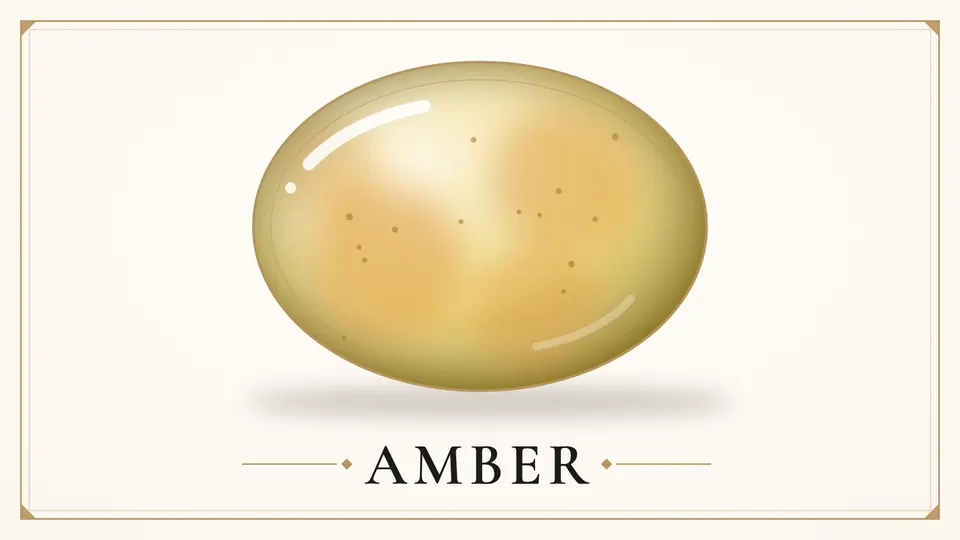
Amber is fossilized tree resin, so it is an organic gem rather than a mineral. It is light, warm to the touch and very soft, at about 2 to 2.5 on the Mohs scale, so heat, solvents and knocks can all harm it. Its colours run from pale yellow through honey and orange to brown. In crystal tradition it is a warm, sunny, protective stone.
At a glance
- Fossilized tree resin, an organic material with no crystal structure.
- Mohs only about 2 to 2.5, so it scratches easily. It is light and feels warm in the hand.
- Often yellow, orange or brown, sometimes with insects or plant matter trapped inside.
- Care: soft dry cloth, no heat, no perfume or solvents, no machine cleaners. Not a standard birthstone.
Quick facts
| Family | Organic gem: fossilized tree resin (a terpene-based resin polymer) |
|---|---|
| Chemical formula | No fixed formula; a resin polymer often given as about C10H16O |
| Crystal system | None: non-crystalline (amorphous), not a mineral |
| Mohs hardness | 2–2.5 |
| Luster | Resinous, taking a warm polish; no cleavage |
| Transparency | Transparent to translucent, sometimes cloudy or opaque |
| Natural colors | pale yellow, honey and orange, brown, cherry red (rare), green (rare), blue (rare) |
| Main localities | Baltic coast (the Kaliningrad area, Poland, Lithuania); Dominican Republic; Myanmar (Kachin State); Ukraine |
| Common treatments | gentle heating in oil to clear cloudiness, and sometimes dyeing to deepen colour; small fragments pressed into larger pieces (pressed or reconstituted amber, often sold as ambroid); epoxy resin is sometimes used to fill or stabilise a piece, so ask what has been done to it |
Amber at a glance, in pictures
Chakras (traditional)
Hardness range
Natural colors
- pale yellow
- honey and orange
- brown
- cherry red (rare)
- green (rare)
- blue (rare)
Traditionally linked to
- Zodiac
- Taurus
Common forms of Amber
- Rough raw chunk
- Bead drilled bead
- Cabochon smooth dome
How hard is Amber?
- Talc 1
- Gypsum 2
- Amber 2–2.5
- Copper coin ~ 3
- Calcite 3
- Fluorite 4
- Apatite 5
- Glass ~ 5.5
- Steel knife ~ 5.5
- Orthoclase 6
- Quartz 7
- Topaz 8
- Corundum 9
- Diamond 10
What it is and where it comes from
Amber starts as sticky resin from ancient trees. Buried and slowly hardened over a very long time, it first becomes copal and then, as heat and pressure drive off its lighter parts, amber.
It has been worn since Neolithic times, and amber jewelry goes back roughly 13,000 years. The Amber Road carried Baltic amber south to the Mediterranean.
The English word comes from the Arabic anbar, which first meant ambergris, a different substance.
The Greek word for amber, elektron, gave us the word electric, because rubbed amber picks up a static charge.
Pieces can hold insects, spiders or plant matter that were trapped in the resin millions of years ago.
Gem-quality amber is found in many places. The Baltic coast has long been the best-known source, with the Dominican Republic and Myanmar also important.
Dominican amber is known for glowing under ultraviolet light, and rare blue amber from there can show a blue shift in sunlight.
In crystal tradition
What follows is belief and folklore, passed down in crystal tradition. It is not measured fact.
Traditionally associated with: warmth, optimism, protection.
Amber is traditionally linked with warmth, optimism and protection. Its sunny colour and feel are why it is often tied to the Solar Plexus chakra in crystal practice.
Taurus is the zodiac sign most often paired with amber, though zodiac links vary. These are folklore and spiritual belief, not facts about the material.
How to care for Amber
- Water Caution
- Sunlight Caution
- Salt Unknown
- Heat Avoid
- Ultrasonic Avoid
- Chemicals Avoid
Safe = fine as a rule · Caution = only briefly or gently · Avoid = can damage the stone · Unknown = no reliable guidance.
Wipe amber with a soft dry cloth, or a barely damp one, and dry it at once. Do not soak it. Keep it away from heat, steam and ultrasonic cleaners, since heat can soften, cloud or crack it. Alcohol, perfume, hairspray and nail polish remover can dull or mark the surface, so put jewelry on last. Store it in its own soft pouch, out of long direct sun.
Real or fake? Look-alikes and treatments
Often confused with
- Copal
- Glass
- Plastic and resin
Common look-alikes
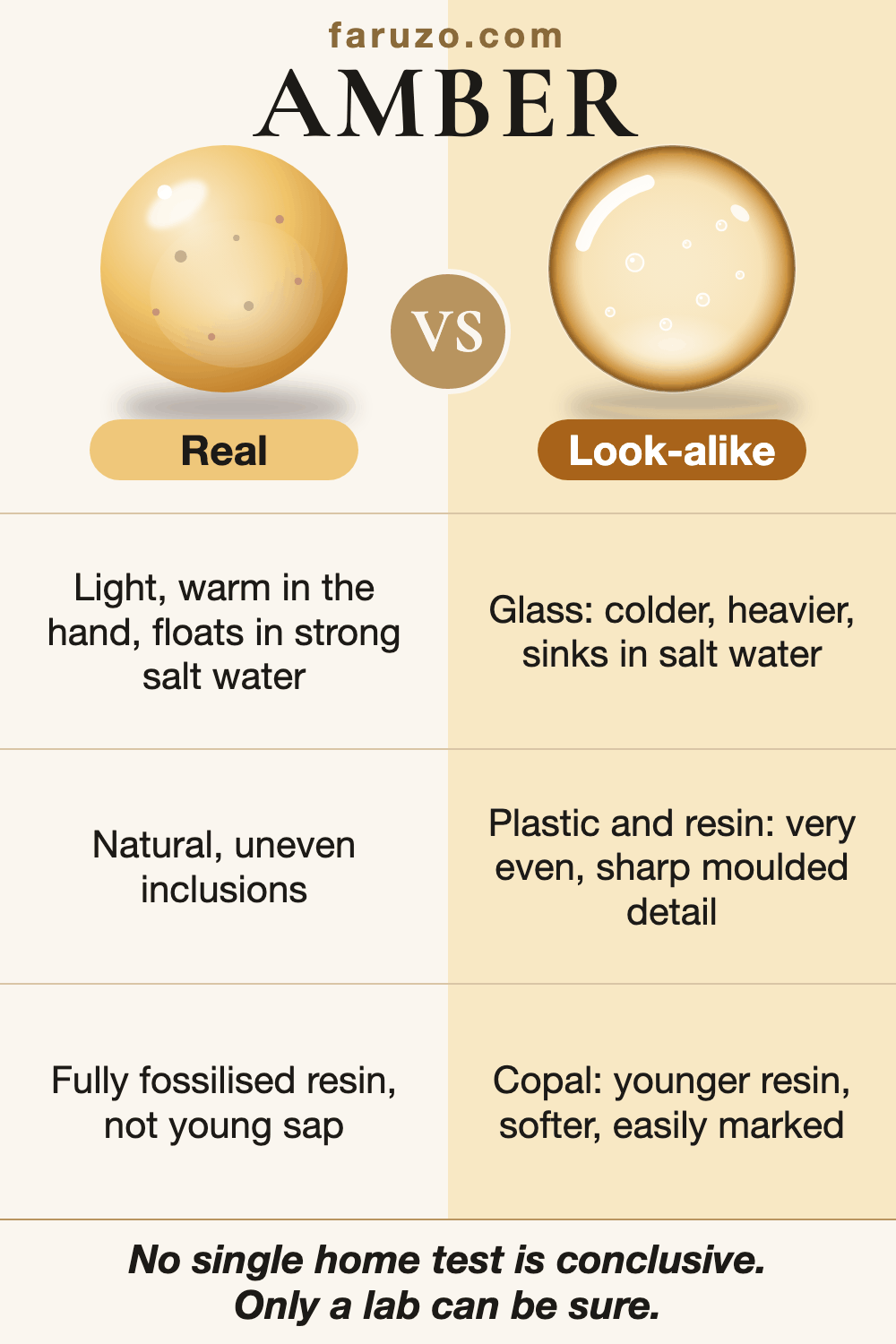
- Copal. Copal is young tree resin that has not fully fossilised. It looks very like amber but is usually softer and more easily marked. It is often sold as amber, so ask the seller, and let a lab settle a piece that matters.
- Glass. Amber-coloured glass is colder and heavier in the hand, and it will not float in the salt water that lifts real amber. Amber feels light and warms up quickly.
- Plastic and resin. Celluloid, Bakelite, polystyrene and moulded resin have all been sold as amber. They can feel light and warm too, so touch alone is not enough. Very even colour and sharp moulded detail point away from natural amber.
Safe checks you can do
- Ask the seller in writing whether the piece is natural amber, pressed amber, dyed, filled, copal or plastic. Pressed and dyed amber are still real amber, but they are not the same as a natural piece.
- Amber is light for its size and warms in your hand within seconds, while glass and stone stay cold and feel heavier.
- Real amber floats in a strong salt solution, though many plastics do too, so a float result is a hint, not proof. Use it on loose, undyed beads only.
- Rubbed on cloth, amber can pick up tiny scraps of paper, but plastics do this too. Treat it as a hint only.
- Insects and leaves inside are a real feature of amber, but they can be faked. Natural inclusions look uneven, while a perfectly posed insect in very clear material is worth a second look.
- Do not scratch, burn or solvent-test a piece you plan to keep. Those tests can damage amber, so a lab is the safe route for a valuable or antique piece.
Wearing Amber
Ring
Avoid
Softer than most everyday dust, so it scratches easily.
Bracelet
Avoid
Softer than most everyday dust, so a bracelet scratches easily.
Pendant
Avoid
Steam and hot rooms can ruin a pendant, so it is best avoided.
Earrings
Avoid
Heat near the face can ruin it, so earrings are best avoided.
Guide for everyday wear, based on hardness and care notes. Safe, Careful or Avoid.
Amber is very soft and heat-sensitive, so rings, bracelets, pendants and earrings are all best avoided for daily wear. If you do wear it, keep it to a special day, handled gently, and put it on after perfume and hairspray. Take it off for washing up, sport and cleaning, and never leave it in a hot car or on a sunny windowsill.
Related stones
Questions about Amber
What does amber mean?
In crystal tradition amber is a warm, sunny stone linked with optimism and protection, and with the Solar Plexus chakra. That is a belief, not a fact about the material. Its real story is fossilized tree resin that is millions of years old.
What is amber?
Amber is fossilized tree resin. Buried resin hardens over a very long time into a light, warm, resinous gem. It is often yellow to orange or brown, and sometimes holds insects or plant matter.
Is amber a mineral or a crystal?
No. It is an organic gem with no crystal structure, in the same group as pearl and jet. That is why it is so light, warm to the touch and soft.
How hard is amber?
About 2 to 2.5 on the Mohs scale, so it scratches easily. It is far softer than quartz or most gemstones.
Is amber a birthstone?
Amber is not on the standard modern or traditional birthstone lists, though lists vary. It is more often linked to the zodiac sign Taurus than to a birth month.
How can you tell real amber from fake?
A home look can only hint. Real amber is light, warms in the hand and floats in a strong salt solution, while glass feels cold and heavy. Copal and plastic can fool the eye, so a lab can settle a piece that matters.
What is the difference between amber and copal?
Copal is younger tree resin that has not fully fossilised, while amber has hardened over a very long time. Copal is usually softer and more easily marked, and it is sometimes sold as amber, so ask the seller what it is.
Is pressed or dyed amber real?
Yes, in the sense that it is made from real amber. Pressed amber joins small fragments under heat and pressure, and dyeing deepens colour. These are treated forms, so a seller should say so rather than call them natural.
Can you wear an amber ring?
A ring is best avoided. Amber is very soft, so everyday knocks scratch it, and a ring meets heat, water and soap too often.
Can amber get wet or go in the sun?
A quick wipe is fine if you dry it at once, but do not soak it. Heat, steam and long strong sun can soften, cloud or darken it, so keep it in a pouch away from sunny windows.
Do perfume and hairspray harm amber?
They can. Alcohol and other solvents can dull or mark the surface, so put amber jewelry on last and let sprays dry before you wear it.
Why does amber feel warm and pick up static?
Because it is organic resin rather than rock or glass, it does not pull heat from your hand the way cold stone does. It also holds a static charge when rubbed, which is where the word electric comes from.
Where does amber come from?
The Baltic coast is among the best-known sources. Dominican Republic, Myanmar and Ukraine also produce it. Pieces from different places can differ in colour and in how they look under ultraviolet light.
What are the insects inside amber?
They are small creatures and plant matter that were trapped in sticky resin long ago and preserved as it hardened. Real inclusions look uneven and natural, and they are a reason many people collect amber.