
Crystal guide
Jet Meaning, Properties and Care
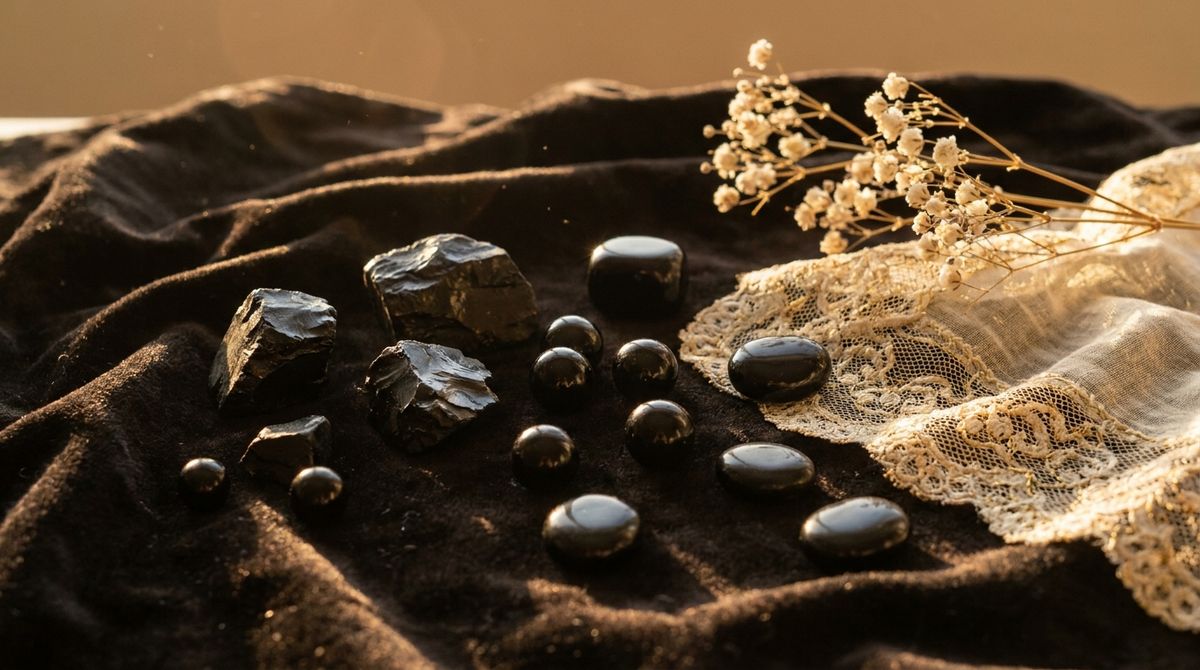
Jet is a compact black fossil wood, a coal-type organic material called lignite, so it is not a mineral at all. It is light, warm to the touch and takes a high polish, which is why it was carved into beads and brooches for centuries and became the signature stone of Victorian mourning jewelry from Whitby, England. It is also very soft, so it needs gentle handling. In crystal tradition it is a protective, comforting stone.
At a glance
- Fossil wood (lignite), an organic material rather than a crystal, with no fixed chemical formula.
- Hardness is only about 2.5 to 4 on the Mohs scale, so it scratches easily. It is light and feels warm in the hand.
- It became the stone of 19th-century mourning jewelry, with the best-known material from the Yorkshire coast of England.
- Care: dry soft cloth, no soaking, no heat, no machine cleaners. Heavily worn pieces are best kept for occasional wear.
Quick facts
| Family | Organic gem: fossil wood, a compact coal-type material (lignite) |
|---|---|
| Chemical formula | No fixed formula; mostly carbon, with oxygen, hydrogen and sulfur |
| Crystal system | None: non-crystalline (amorphous), not a mineral |
| Mohs hardness | 2.5–4 |
| Luster | Resinous to waxy, taking a bright polish; no cleavage |
| Transparency | Opaque |
| Natural colors | black, very dark brown |
| Main localities | England (Whitby, Yorkshire coast, and Dorset); Spain (Asturias, Teruel); France; Poland; Turkey; USA (New Mexico, Utah, Colorado) |
| Common treatments | usually sold natural and polished; cheap black beads sold as jet are sometimes a different material, so ask what the piece is made of |
Jet at a glance, in pictures
Chakras (traditional)
Hardness range
Natural colors
- black
- very dark brown
Common forms of Jet
- Rough raw chunk
- Bead drilled bead
- Carving carved pendant
How hard is Jet?
- Talc 1
- Gypsum 2
- Copper coin ~ 3
- Calcite 3
- Jet 2.5–4
- Fluorite 4
- Apatite 5
- Glass ~ 5.5
- Steel knife ~ 5.5
- Orthoclase 6
- Quartz 7
- Topaz 8
- Corundum 9
- Diamond 10
What it is and where it comes from
Jet forms when wood, often from trees related to the Chilean pine (the Araucariaceae family), is buried in mud and slowly compressed over millions of years instead of rotting away.
The best-known English jet comes from rock on the Yorkshire coast that is roughly 180 million years old.
Jet has been carved into beads and ornaments since ancient times. Roman jewelers worked it into amulets.
It became fashionable for mourning jewelry in the 1800s, especially after Queen Victoria wore it in mourning for Prince Albert, who died in the early 1860s.
The English jet trade peaked in the early 1870s, then shrank as cheaper imitations and changing fashion took over.
Jet is also found in other places, including Spain, France, Poland, Turkey and parts of the western USA, though the Yorkshire coast remains the best-known name.
In crystal tradition
What follows is belief and folklore, passed down in crystal tradition. It is not measured fact.
Traditionally associated with: protection, grounding, comfort in grief.
Jet is traditionally linked with protection, grounding and comfort during grief. The old custom of wearing it in mourning carried the same idea of quiet protection.
Crystal tradition also calls jet a stone said to absorb negative energy. This is a belief within crystal practice and has no physical basis.
How to care for Jet
- Water Caution
- Sunlight Caution
- Salt Unknown
- Heat Avoid
- Ultrasonic Avoid
- Chemicals Caution
Safe = fine as a rule · Caution = only briefly or gently · Avoid = can damage the stone · Unknown = no reliable guidance.
Wipe jet with a soft dry cloth, or a barely damp one, and dry it at once. Do not soak it. Keep it away from heat, steam and ultrasonic cleaners, since it is organic and can crack or burn. Perfume, hairspray and strong cleaners can dull the polish, so put jewelry on last. Store it in its own soft pouch, apart from harder stones, out of long direct sun.
Real or fake? Look-alikes and treatments
Often confused with
- Black glass (French jet)
- Vulcanite and ebonite
- Plastic and bakelite
- Black onyx
- Obsidian
- Cannel coal
Common look-alikes
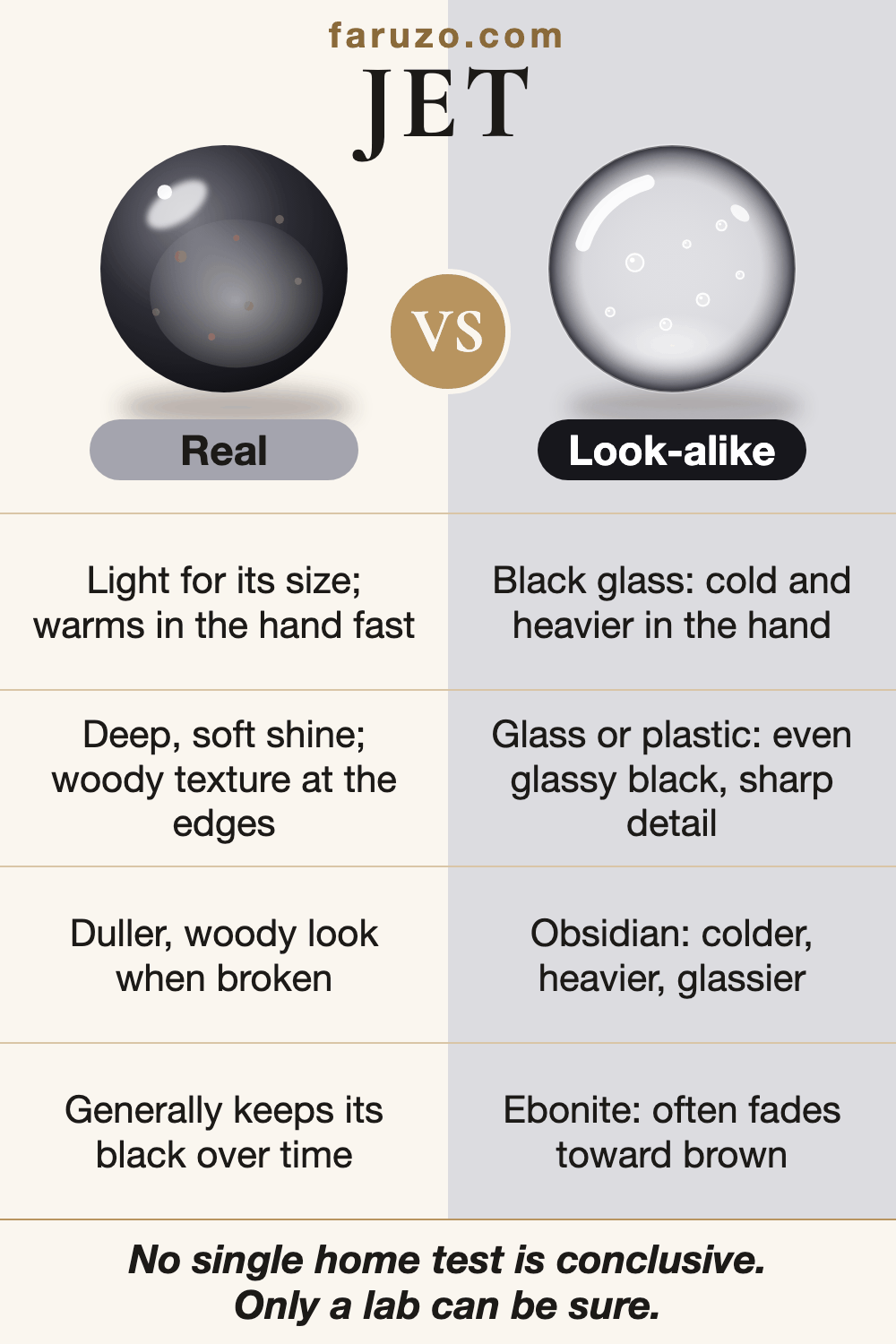
- Black glass (French jet). Black glass was made as a cheaper stand-in and has long been sold as 'French jet'. It usually feels cold and heavier, and stays cold in the hand, while real jet is light and warms up quickly.
- Vulcanite and ebonite. These hard rubber substitutes were common in 19th-century mourning jewelry. They often fade toward brown over time, which jet generally does not.
- Plastic and bakelite. Modern black plastic beads can look convincing. They often feel light and warm like jet, so the finish and a seller's honest answer matter more than touch.
- Black onyx. Onyx is a true mineral, much harder, colder to the touch and noticeably heavier for its size than jet.
- Obsidian. Obsidian is natural volcanic glass: colder, heavier and glassier, and it breaks with sharp curved edges rather than the duller, woody look of jet.
- Cannel coal. This dense coal can be carved much like jet and was used as a cheaper alternative. Telling the two apart is hard by eye, so a lab is the safe route for a valuable piece.
Safe checks you can do
- Hold it. Real jet feels light for its size and warms in your hand within seconds, while glass and stone stay cold and feel heavier.
- Look closely at the polish. Jet has a deep, soft shine, and a fine fibrous or woody texture can sometimes show at the edges. Perfectly even, glassy black with sharp moulded detail points to glass or plastic.
- Rubbed on cloth, jet tends to pick up a light static charge, but this is only a hint and plastics do it too.
- A hot-needle test gives a coal-like smell on real jet, but it damages the piece, so leave it to a lab, especially for an antique.
- For an inherited antique piece, ask a gemologist to examine it before cleaning it with anything stronger than a dry cloth.
Wearing Jet
Ring
Avoid
Softer than most everyday dust, so it scratches easily.
Bracelet
Avoid
Softer than most everyday dust, so a bracelet scratches easily.
Pendant
Avoid
Steam and hot rooms can ruin a pendant, so it is best avoided.
Earrings
Avoid
Heat near the face can ruin it, so earrings are best avoided.
Guide for everyday wear, based on hardness and care notes. Safe, Careful or Avoid.
Jet is soft and can burn or crack, so rings, bracelets, pendants and earrings are all best avoided for daily wear. If you do wear it, keep it to a brooch or a special day, handled gently. Take it off for washing up, sport and cleaning, and never soak it.
Related stones
Questions about Jet
What does jet mean?
In crystal tradition jet is a protective, grounding stone linked with comfort in grief, and the Root chakra. That is a belief, not a fact about the stone. Its real story is 19th-century mourning jewelry, when jet was the stone of mourning.
Is jet a mineral or a gemstone?
It is a gemstone but not a mineral. Jet is fossil wood, a coal-type material called lignite, with no crystal structure. The gem trade classes it as an organic gem, like amber and pearl.
Why was jet used for Victorian mourning jewelry?
Queen Victoria wore it in mourning after Prince Albert's death in the early 1860s, and the fashion spread. Its deep black polish suited mourning dress, and a local supply on the Yorkshire coast made brooches, beads and lockets widely available.
How hard is jet?
About 2.5 to 4 on the Mohs scale, so it scratches easily and is much softer than quartz or onyx.
Is jet a birthstone?
No. Jet is not generally counted among the standard modern or traditional birthstones.
How can you tell real jet from fake?
A home look can only hint. Real jet is light, warms in the hand and has a soft, deep polish, while black glass feels cold and heavy and plastic looks too perfect. A lab can settle a valuable piece.
Why does jet feel warm?
Because it is organic material rather than rock or glass, it does not pull heat from your hand the way a cold stone does, so it feels warm quickly.
Can jet get wet, and does it fade?
Do not soak it. Brief contact is fine if you dry it at once, but long moisture, heat and strong sun can dull the polish or crack an old piece. Fading toward brown usually points to vulcanite rather than jet.
Is jet dyed or treated?
Jet is normally sold natural and polished. Cheap black beads sold as jet are sometimes glass, plastic or dyed material, so ask what the piece is made of.
Can you wear a jet ring?
A ring is best avoided. Jet is soft, so knocks and everyday wear scratch it, and a ring meets water and heat too often.
Where does jet come from?
The best-known source is England's Yorkshire coast. It is also found in Dorset, Spain, France, Poland, Turkey and parts of the western USA.
Is jet the same as onyx or obsidian?
No. Onyx is a mineral and obsidian is volcanic glass. Both are colder, heavier and much harder than jet, which is fossil wood.