
Crystal guide
Obsidian Meaning, Properties and Care
Obsidian is natural volcanic glass, not a true crystal: it forms when silica-rich lava cools so fast that its atoms do not line up into a crystal structure. It is about 5 to 5.5 on the Mohs scale, breaks with smooth curved surfaces and can hold an extremely sharp edge. Black obsidian is the plain, even black kind and a common choice in jewelry. In crystal tradition it is a protective, truth-telling stone.
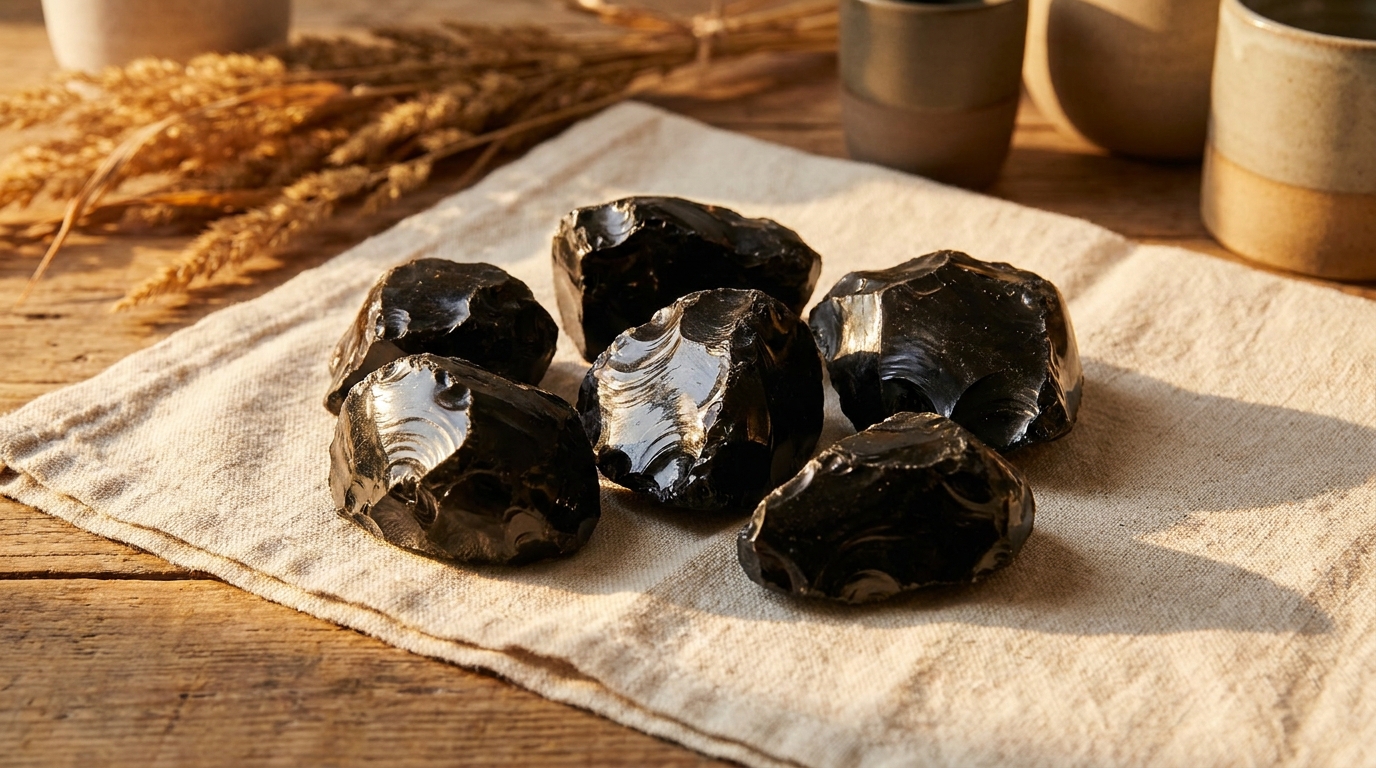
At a glance
- Volcanic glass, mostly silica, with no crystal structure (often called a mineraloid).
- Hardness is about 5 to 5.5 on the Mohs scale; it is brittle and breaks with a conchoidal (curved, shell-like) fracture.
- Black obsidian is the plain black kind. Varieties include snowflake, mahogany, rainbow, sheen and Apache tears.
- Care: soft cloth and gentle hand-washing; no machine cleaners or steam. Best as pendants, beads and earrings, not hard-knock rings.
Quick facts
| Family | Natural volcanic glass (a mineraloid), usually rhyolitic and rich in silica |
|---|---|
| Chemical formula | Mostly silicon dioxide (about 70 percent or more SiO2) with no fixed formula, since glass has no set composition |
| Crystal system | None. Obsidian is amorphous (a glass), so it has no crystal system and no cleavage. |
| Mohs hardness | 5–5.5 |
| Luster | Vitreous (glassy), sometimes with a sheen or iridescence in some varieties |
| Transparency | Opaque in thick pieces; thin edges are often translucent |
| Natural colors | black (the most familiar, from finely dispersed iron-rich minerals); brown or reddish-brown, including mahogany; dark green; black with white spots (snowflake); black with a gold, silver or rainbow sheen |
| Main localities | Mexico (including the Pachuca area); USA (Oregon, California, Idaho and Yellowstone); Italy (Lipari); Greece (Milos); Turkey (Cappadocia and Anatolia); Armenia and Georgia; Iceland |
| Common treatments | usually sold untreated, though glass-like stones are sometimes dyed, coated or imitated with man-made glass; check what you are buying |
Obsidian at a glance, in pictures
Chakras (traditional)
Hardness range
Natural colors
- black (the most familiar, from finely dispersed iron-rich minerals)
- brown or reddish-brown, including mahogany
- dark green
- black with white spots (snowflake)
- black with a gold, silver or rainbow sheen
Traditionally linked to
- Element
- Earth
Common forms of Obsidian
- Rough raw chunk
- Tumbled polished pebble
- Cabochon smooth dome
How hard is Obsidian?
- Talc 1
- Gypsum 2
- Copper coin ~ 3
- Calcite 3
- Fluorite 4
- Apatite 5
- Obsidian 5–5.5
- Glass ~ 5.5
- Steel knife ~ 5.5
- Orthoclase 6
- Quartz 7
- Topaz 8
- Corundum 9
- Diamond 10
What it is and where it comes from
Obsidian forms when felsic, silica-rich lava cools so quickly, often where lava meets air or water, that atoms have no time to arrange into crystals. The result is a natural glass.
Obsidian breaks with a conchoidal fracture and can be flaked to a very sharp edge, so people used it for blades, arrowheads and tools across many regions long before metalworking.
Mesoamerican cultures, including the Aztecs, worked obsidian into blades, weapons and polished mirrors. The god Tezcatlipoca, whose name is usually translated 'smoking mirror', is traditionally linked with obsidian.
An obsidian mirror of Mexican origin, once owned by the English astrologer John Dee, is reportedly kept in the British Museum.
Obsidian is a young and unstable material in geological terms: over long periods it takes up water and slowly alters, which is why very old obsidian is rare.
Colour and pattern come from tiny inclusions. White cristobalite clusters make snowflake obsidian, layers of aligned gas bubbles give a gold or silver sheen, iron oxides give reddish-brown mahogany, and thin mineral layers can give a rainbow effect.
In crystal tradition
What follows is belief and folklore, passed down in crystal tradition. It is not measured fact.
Traditionally associated with: protection, grounding, honest self-reflection.
Obsidian, and black obsidian above all, is traditionally called a 'stone of truth' and a protective stone, said to bring hidden feelings to the surface rather than smooth them over. This is a modern spiritual belief, not a fact about the stone.
Crystal tradition links obsidian with the Root chakra and grounding. The idea echoes obsidian's real history as a mirror and blade material, but the meanings are belief, not measurable properties.
How to care for Obsidian
- Water Caution
- Sunlight Unknown
- Salt Unknown
- Heat Avoid
- Ultrasonic Avoid
- Chemicals Caution
Safe = fine as a rule · Caution = only briefly or gently · Avoid = can damage the stone · Unknown = no reliable guidance.
Clean obsidian with a soft cloth and mild soapy water, then dry it. Skip ultrasonic and steam cleaners, because vibration and sudden heat can stress tiny cracks in glass. Avoid knocks and drops, and store it apart from harder stones that could scratch it. A brief rinse is fine; do not soak it. Keep it away from harsh cleaners, and avoid long sun and salt as a precaution.
Real or fake? Look-alikes and treatments
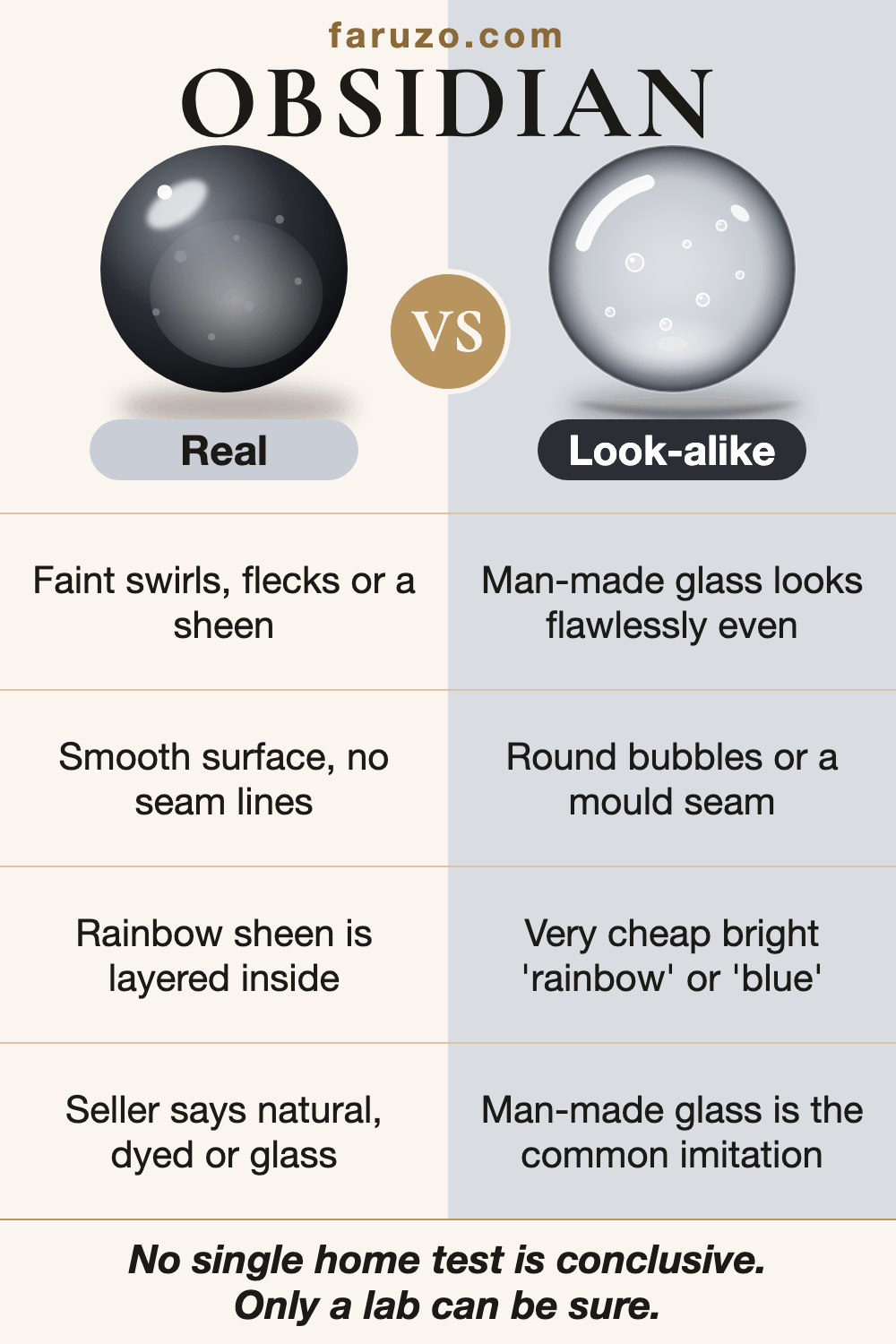
Often confused with
- Man-made black glass
- Black tourmaline
- Black onyx
- Jet
Common look-alikes
- Man-made black glass. This is a frequent imitation. Natural obsidian often shows slight swirls, tiny inclusions or a faint sheen, while man-made glass tends to look perfectly even and may show round gas bubbles or mould seams. Both break with curved surfaces.
- Black tourmaline. Black tourmaline is a true crystal mineral, harder (about 7 to 7.5) and denser, and uncut pieces show vertical striations. Obsidian is glass, lighter in the hand, and has curved shell-like breaks.
- Black onyx. Black onyx is a form of chalcedony (quartz family), about 6.5 to 7 on the Mohs scale. Most black onyx is dyed, and the colour can look slightly grey where it is thin. Obsidian is softer and glassier.
- Jet. Jet is an organic, lignite-like material that is much lighter and warmer to the touch than glass, and it has a softer, more velvety look. Obsidian feels cool and glassy.
Safe checks you can do
- Ask the seller in writing whether the stone is natural obsidian, dyed or man-made glass.
- Look for natural character: faint swirls, tiny flecks or a sheen when turned in light.
- Be wary of colourful 'rainbow', 'fire' or 'blue' obsidian sold very cheaply, since some bright effects are made by coating or treating glass. Natural rainbow obsidian shows a layered sheen within the stone.
- Do not scratch-test a stone you plan to keep, because glass can chip. A gemologist or lab can test it safely.
Wearing Obsidian
Ring
Avoid
Moderate hardness, so rings can scratch or chip.
Bracelet
Careful
Bracelets take more knocks, so wear it with care.
Pendant
Careful
Brittle glass, so a protective setting helps.
Earrings
Careful
Brittle glass, so earrings suit careful wear only.
Guide for everyday wear, based on hardness and care notes. Safe, Careful or Avoid.
Obsidian is glass: about 5 to 5.5 on the Mohs scale and brittle, so it chips and scratches more easily than quartz or sapphire, and a sharp knock can leave a curved chip. That makes it a poor choice for a ring worn daily. Pendants, beads, earrings and occasional-wear bracelets suit it better, ideally in a setting that protects the stone. Remove it for the gym, cleaning and anything rough, and store it away from harder stones.
Questions about Obsidian
What does obsidian mean?
In crystal tradition obsidian is a protective, grounding stone linked with the Root chakra. That is belief, not a fact about the stone.
What does black obsidian mean?
Black obsidian is the plain, even black kind of obsidian. In tradition it is a protection stone, an idea that echoes the Aztec use of polished obsidian mirrors; it is belief with no physical basis.
Is obsidian a crystal or a mineral?
Neither, strictly. Obsidian is volcanic glass that cooled too fast for atoms to form an ordered crystal structure, so it is often called a mineraloid. It is still sold alongside crystals.
How hard is obsidian?
About 5 to 5.5 on the Mohs scale, with some lists giving up to 6. It is softer than quartz and brittle, so it chips more easily than most gemstones.
Why is obsidian so sharp?
Glass has no crystal planes, so it breaks with smooth, curved surfaces called conchoidal fractures. A flaked piece can end in a very thin edge, which is why people used it for blades and tools for thousands of years.
What are snowflake, rainbow and mahogany obsidian?
They are natural varieties. Snowflake has white spots from clusters of cristobalite, mahogany has reddish-brown patches from iron oxides, and rainbow or sheen obsidian gets its colour play from tiny layers of mineral inclusions or aligned gas bubbles.
What are Apache tears?
Apache tears are small, rounded nodules of obsidian that are often translucent at the edges when held to light. They are usually sold uncut or lightly tumbled.
Can obsidian get wet?
A brief rinse is fine, but do not soak it, and dry it with a soft cloth. Obsidian is brittle, so knocks matter more than water; machine cleaners add vibration and sudden heat, which glass handles badly.
How can you tell real obsidian from fake?
A home check alone cannot settle it. Real obsidian often shows faint swirls, flecks or a sheen, while man-made black glass tends to look flawlessly even and may show round bubbles or mould seams. For a stone that matters, have a gemologist test it.
What is the difference between obsidian and black tourmaline?
They are unrelated. Obsidian is volcanic glass at about 5 to 5.5 with curved, shell-like breaks. Black tourmaline is a true crystal mineral at about 7 to 7.5, harder and denser, with vertical striations on uncut crystals.
Is obsidian a birthstone?
No. Obsidian is not on the standard modern or traditional birthstone lists, and it has no widely standardised zodiac assignment.
Is obsidian rare or expensive?
No. Obsidian is common wherever silica-rich volcanoes have erupted, so plain black obsidian is generally inexpensive. Sheen, rainbow and well-patterned pieces are less common, and polish and cutting matter a lot.
Is obsidian dyed or made from reconstituted glass?
Natural obsidian is usually sold untreated. Very bright, even colours such as vivid blue or 'fire' are often man-made glass or coated pieces, so ask the seller what the stone is.
Is obsidian safe in a ring?
It is a poor choice for a ring worn daily. At about 5 to 5.5 it is brittle glass, so a sharp knock can leave a curved chip. Pendants, beads and earrings in a protective setting are the safer choices.