
Crystal guide
Citrine Meaning, Properties and Care
Citrine is the yellow to orange variety of quartz (SiO2, Mohs 7). Natural citrine is rare: most citrine on the market is amethyst that has been heat treated. It is a November birthstone alongside topaz, and in crystal tradition it is the merchant's stone, linked to abundance and optimism.
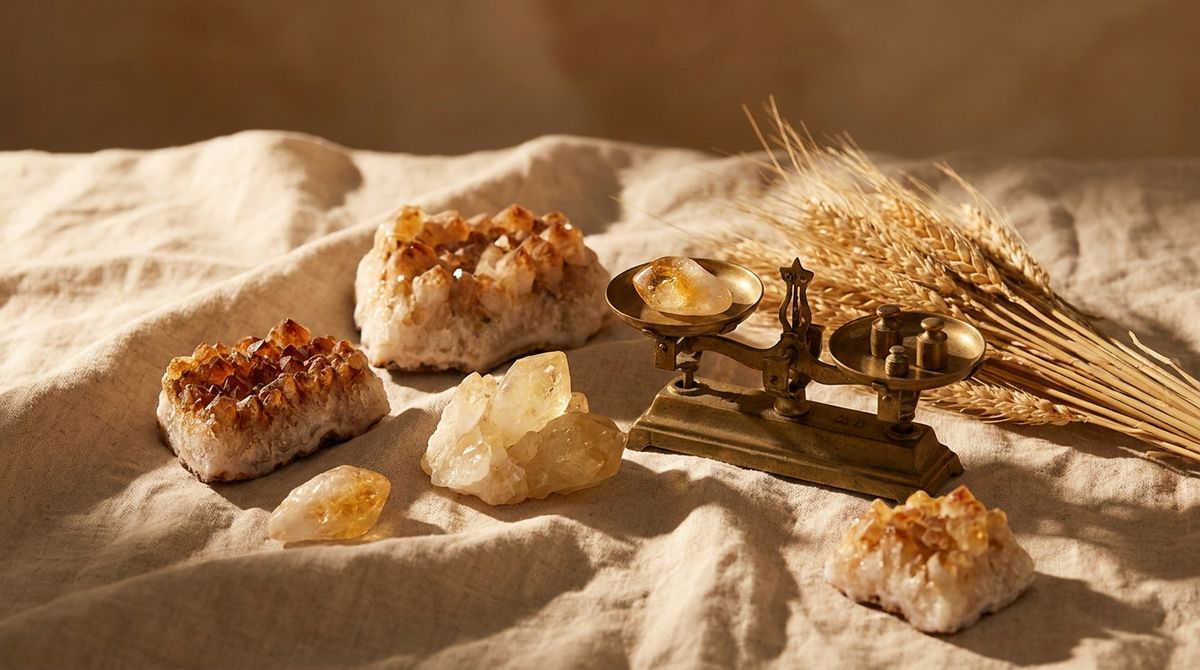
At a glance
- Hardness Mohs 7: citrine is considered fairly durable, but abrupt temperature changes can fracture it.
- Quartz (SiO2) in yellow to orange to orangy red; natural stones tend to be paler.
- A November birthstone with topaz, and the traditional gem for the 13th wedding anniversary.
- Care: gentle hand-washing is safe. Avoid sudden temperature swings.
Quick facts
| Family | Quartz (silica group) |
|---|---|
| Chemical formula | SiO2 |
| Crystal system | Trigonal (alpha-quartz) |
| Mohs hardness | 7 |
| Luster | Vitreous (glassy); no cleavage, conchoidal fracture |
| Transparency | Transparent for gem material. Much faceted citrine is eye-clean, meaning no inclusions visible to the eye. |
| Natural colors | yellow, orange, orangy red, brownish orange, pale yellow to smoky-tinged (more typical of natural stone) |
| Main localities | Brazil (mostly heat-treated amethyst), Bolivia, Spain, Madagascar, Mexico, Uruguay, Russia |
| Common treatments | heat treatment of amethyst, which accounts for most citrine; some citrine is heat-treated smoky quartz |
| Birth month | November (with topaz) |
Citrine at a glance, in pictures
Chakras (traditional)
Hardness range
Natural colors
- yellow
- orange
- orangy red
- brownish orange
- pale yellow to smoky-tinged (more typical of natural stone)
Traditionally linked to
- Planet
- Sun
- Zodiac
- GeminiLeo
- Element
- Fire
Common forms of Citrine
- Rough raw chunk
- Tumbled polished pebble
- Cabochon smooth dome
- Faceted cut gem
How hard is Citrine?
- Talc 1
- Gypsum 2
- Copper coin ~ 3
- Calcite 3
- Fluorite 4
- Apatite 5
- Glass ~ 5.5
- Steel knife ~ 5.5
- Orthoclase 6
- Citrine 7
- Topaz 8
- Corundum 9
- Diamond 10
What it is and where it comes from
The name comes from the Latin citrus (citron tree), via French citrin or citron, meaning lemon. It reportedly first appeared in English in the 14th century.
Citrine is the traditional gem for the thirteenth wedding anniversary.
Natural citrine is rare, and most citrine quartz today is the result of heat treatment of amethyst. The heated amethyst is mostly mined in Brazil.
Heating amethyst, usually quoted at roughly 400 to 500 degrees C, turns it yellow-orange to brown; iron is thought to be involved.
The exact cause of natural citrine's colour is not settled: aluminium colour centres and trace iron have both been suggested.
Details vary on ancient use. Citrine is often said to have been used by the ancient Egyptians, Greeks and Romans, while another version says the Egyptians used agates, not citrine. These ancient-use stories are tradition, not documented history.
Natural ametrine, a quartz with purple and yellow-orange zones, comes almost exclusively from the Anahi mine in Bolivia; most ametrine on the market is reportedly made by partly heating or irradiating amethyst.
In crystal tradition
What follows is belief and folklore, passed down in crystal tradition. It is not measured fact.
Traditionally associated with: abundance, optimism, confidence, motivation.
Citrine is traditionally associated with the Solar Plexus chakra (Manipura). This is a modern spiritual tradition, not a fact about the stone.
Citrine is traditionally associated with the zodiac signs Gemini and Leo (Aries and Libra are sometimes added), the Sun and the element Fire. This is a modern spiritual tradition, not a fact about the stone. These mappings differ between lists and have no scientific basis.
Citrine is called the merchant's stone or money stone because of a belief that it brings prosperity. It is traditionally associated with abundance, optimism and confidence. These are symbolic meanings, not effects on the body or mind.
How to care for Citrine
- Water Safe
- Sunlight Caution
- Salt Unknown
- Heat Caution
- Ultrasonic Unknown
- Chemicals Unknown
Safe = fine as a rule · Caution = only briefly or gently · Avoid = can damage the stone · Unknown = no reliable guidance.
Warm, soapy water is safe for cleaning citrine, but abrupt temperature changes can fracture it, so avoid hot-to-cold swings and torch work. Ultrasonic and steam cleaners are best avoided as a precaution; use a soft brush and a drop of mild soap instead. Long strong sun may fade some citrine, so keep pieces out of it. Salt and household chemicals are best avoided as a precaution.
Real or fake? Look-alikes and treatments
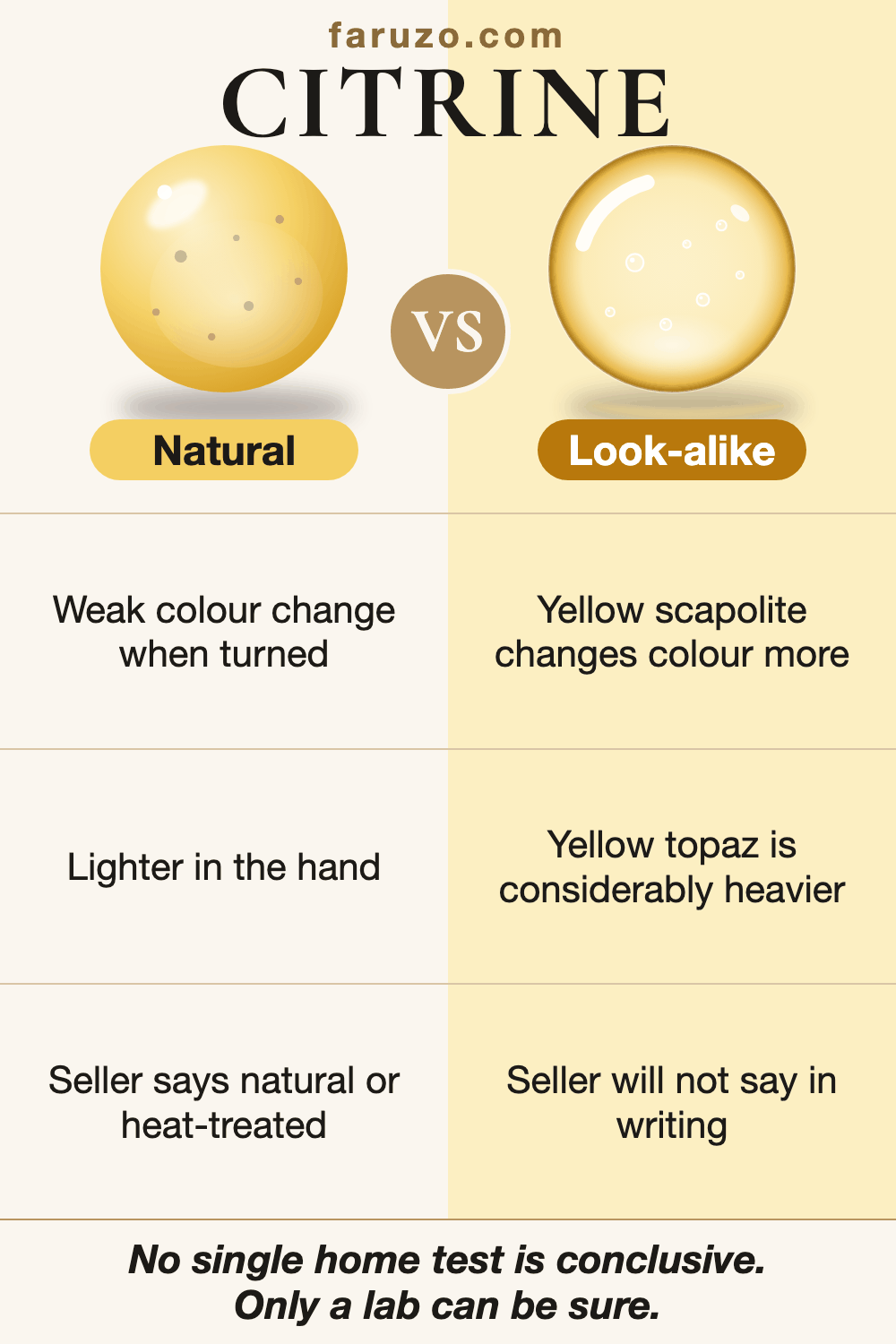
Often confused with
- Yellow topaz
- Heat-treated amethyst (sold as citrine)
- Heat-treated smoky quartz
- Yellow scapolite
Common look-alikes
- Yellow topaz. Topaz is Al2(F,OH)2SiO4, Mohs 8, refractive index 1.619 to 1.627, specific gravity 3.53, with perfect cleavage. Citrine is SiO2, Mohs 7, refractive index 1.544 to 1.553, specific gravity about 2.66, with no cleavage. Topaz is considerably heavier than citrine at equal size. A gemologist can separate them quickly with a refractometer; colour alone is not reliable.
- Heat-treated amethyst (sold as citrine). This is real quartz, so it is citrine in the trade sense, but it is a treated stone. Natural citrine is typically paler and weakly dichroic and may show smoky zones, while heated amethyst is usually deeper in colour, often shows zoning, and shows no dichroism. These are signs, not proof.
- Heat-treated smoky quartz. Some citrine on the market is reportedly heat-treated smoky quartz, which keeps dichroism. Smoky quartz itself is grey to brown to black. It is the same mineral, so refractive index and density do not separate it from citrine.
- Yellow scapolite. Yellow scapolite is a look-alike that is more pleochroic and has higher birefringence than citrine (citrine's birefringence is 0.009). A gemologist can separate them with standard gem tests.
Safe checks you can do
- Ask the seller in writing whether the stone is natural citrine or heat-treated amethyst or smoky quartz. A large, deeply orange stone sold as natural deserves a second opinion.
- Look at the colour and zoning. Natural citrine is usually pale and often smoky, with weak dichroism, while heated amethyst is deeper orange and may keep zoning from the parent crystal. Treat this as a hint, not proof, because colour varies from stone to stone.
- For a stone that matters, ask a gemologist or lab to measure refractive index and density. That separates citrine from topaz, but it cannot show whether quartz has been heated, because heated amethyst is still quartz.
- Do not rely on one home test. Weight against a known stone of the same size can hint at topaz, since topaz is considerably heavier, but it proves nothing alone. Heat treatment is a long-used process rather than an imitation; the real question is whether the label states it.
Wearing Citrine
Ring
Safe
Hard enough for daily wear; avoid hot water and sudden heat.
Bracelet
Safe
Beads and links hold up well; keep them away from heat.
Pendant
Safe
Few knocks as a pendant.
Earrings
Safe
Light, and rarely knocked.
Guide for everyday wear, based on hardness and care notes. Safe, Careful or Avoid.
At Mohs 7 with no cleavage, citrine suits pendants, earrings, bead bracelets and rings. The warning is about abrupt temperature changes, which can fracture the stone, so take rings off before very hot water or heat work. A ring takes the most knocks, so a protective setting helps, and storing citrine apart from harder stones such as topaz (Mohs 8) avoids scratches, since a harder gem can mark a softer one.
Related stones
Questions about Citrine
What does citrine mean?
In crystal tradition citrine is the merchant's stone, traditionally associated with abundance, optimism and confidence. The name merchant's stone reportedly comes from a belief that it brings prosperity. These are symbolic meanings from tradition, not facts about the stone or claims about your health or finances.
Is citrine a real gemstone?
Yes. Citrine is a variety of quartz (SiO2), not glass or a synthetic. Heat-treated material is still quartz and is sold as citrine, so check what yours is.
Is most citrine heat-treated amethyst?
Yes: the heated amethyst is mostly mined in Brazil, and some is heat-treated smoky quartz. Natural citrine exists but is rare and tends to be paler.
What is the difference between citrine and yellow topaz?
They are different minerals. Citrine is quartz, Mohs 7; topaz is Mohs 8, noticeably heavier, with perfect cleavage. Colour alone cannot separate them, but a gemologist can measure the difference easily.
Is citrine a birthstone?
Yes. Citrine is a November birthstone, shared with topaz.
How can you tell natural citrine from heat-treated?
Natural citrine is typically pale and weakly dichroic and may show smoky zones, while heated amethyst is deeper in colour, often shows zoning and shows no dichroism. Those are hints only, and a lab can say more if it matters.
How do you clean citrine?
Use lukewarm water, mild soap and a soft brush, then rinse and dry. Steam and machine cleaners are best avoided as a precaution.
Does citrine fade in the sun?
It might. Some citrine is reported to fade in long strong sun, so as a precaution keep it out of direct light.
Can citrine go in hot water?
Warm water is fine, but very hot water is best avoided. Abrupt temperature changes, such as hot water followed by cold, can fracture citrine.