
Crystal guide
Ametrine Meaning, Properties and Care
Ametrine is quartz (SiO2) that shows purple amethyst colour and yellow-orange citrine colour in one stone. At Mohs 7 with no cleavage it is hard enough for everyday jewellery. Natural ametrine is often associated with one mine in Bolivia, and much ametrine on the market is made by partly heating or irradiating amethyst, while low-priced stones may be lab-grown. In crystal tradition it is a stone that blends calm with cheer.
At a glance
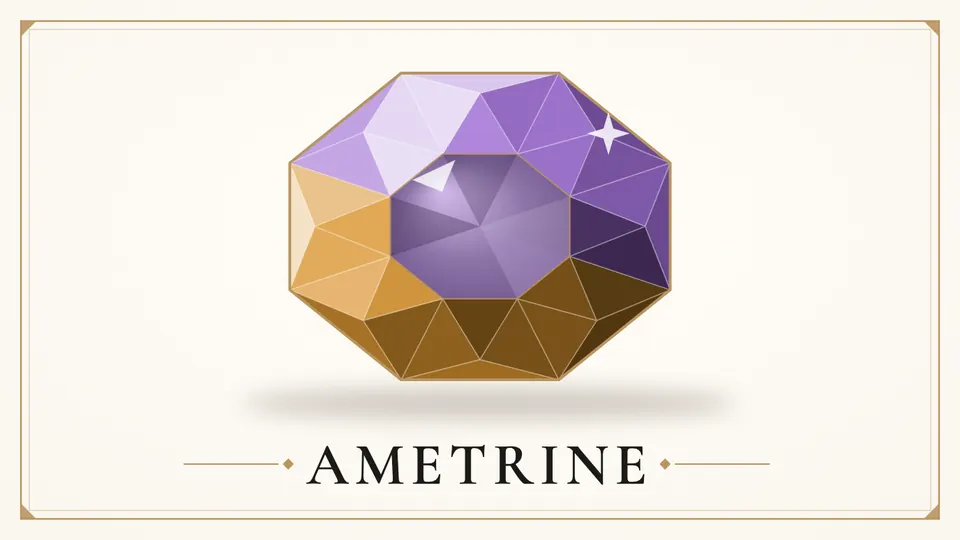
- Quartz, formula SiO2: amethyst and citrine colour in one stone, with a fairly sharp line between them.
- Mohs 7, with no cleavage, so it suits rings, pendants, earrings and bracelets.
- Much ametrine on the market is made by heating or irradiating amethyst, and low-priced stones may be lab-grown. Both are still real quartz, so ask the seller to say which.
- Not itself a birthstone, though amethyst (February) and citrine (November) are. Care: soft cloth, mild soap, no steam or ultrasonic.
Quick facts
| Family | Quartz (silica group), a bicolour variety showing amethyst and citrine colour in one crystal |
|---|---|
| Chemical formula | SiO2 |
| Crystal system | Trigonal |
| Mohs hardness | 7 |
| Luster | Vitreous, with no cleavage and a shell-like (conchoidal) fracture |
| Transparency | Transparent, and faceted stones generally show no inclusions to the eye |
| Natural colors | purple (amethyst); yellow to orange (citrine); both in one stone, often with a fairly sharp boundary |
| Main localities | Bolivia (the Anahi mine is often associated with natural ametrine), Brazil, India |
| Common treatments | natural bicolour stones are rarely treated, though fractures may be filled; heating or irradiation can change quartz colour, and much ametrine on the market is reportedly made by partly heating or irradiating amethyst; lab-grown ametrine is real quartz made by people instead of mined, and low-priced ametrine may be lab-grown |
Ametrine at a glance, in pictures
Chakras (traditional)
Hardness range
Natural colors
- purple (amethyst)
- yellow to orange (citrine)
- both in one stone, often with a fairly sharp boundary
Common forms of Ametrine
- Rough raw chunk
- Faceted cut gem
- Cabochon smooth dome
How hard is Ametrine?
- Talc 1
- Gypsum 2
- Copper coin ~ 3
- Calcite 3
- Fluorite 4
- Apatite 5
- Glass ~ 5.5
- Steel knife ~ 5.5
- Orthoclase 6
- Ametrine 7
- Topaz 8
- Corundum 9
- Diamond 10
What it is and where it comes from
Ametrine is quartz that carries amethyst and citrine colour in the same crystal, and the name blends the two. It also goes by trystine and golden amethyst, and bolivianite is a trade name.
Trace iron is the usual explanation for both colours. Natural zoning is explained by a temperature gradient as the crystal grew, with heat turning some zones yellow while the rest stayed purple.
More on its history
Natural ametrine is often associated with the Anahi mine in south-east Bolivia, described as the world's only commercial source. The mine also yields natural amethyst and citrine, and smaller deposits are reported in Brazil and India.
The mine is named for Anahi, a legendary princess. By one legend the mine came to a Spanish conquistador as her dowry.
Cutters tend to aim for a roughly even split of the two colours, with a sharp boundary near the middle of the finished stone. Rectangular step cuts are common because they show the two colours clearly.
Ametrine through time
-
1600s (legend)
A Spanish conquistador is said to find the Bolivian mine and show specimens to his queen, introducing ametrine to Europeans.
-
1960s
The mine, lost for over three centuries, is rediscovered. It lies in a remote part of Bolivia, reached by small plane or by road and boat.
-
1970s
Ametrine from the mine reaches the market again, and the bicolour gem becomes more widely known.
In crystal tradition
What follows is belief and folklore, passed down in crystal tradition. It is not measured fact.
Traditionally associated with: balance, calm, optimism.
Ametrine is traditionally seen as a blend of amethyst and citrine: amethyst's calm joined to citrine's cheer. This is a modern spiritual idea, not a fact about the stone.
It is traditionally linked with the Solar Plexus and Crown chakras, the places those two stones are each linked with. Mappings differ from one tradition to another, and they have no scientific basis.
How to care for Ametrine
- Water Safe
- Sunlight Caution
- Salt Unknown
- Heat Caution
- Ultrasonic Caution
- Chemicals Caution
Safe = fine as a rule · Caution = only briefly or gently · Avoid = can damage the stone · Unknown = no reliable guidance.
Warm water with mild soap and a soft cloth is a safe way to clean ametrine. Dry it afterwards. As a precaution, skip soaking, steam and ultrasonic cleaners, because some stones have filled fractures. Strong light can fade the purple part over time, and heat can change the colour of the stone, so keep it off hot windowsills and away from heaters and torch work. It may need repolishing now and then.
Real or fake? Look-alikes and treatments
Often confused with
- Glass
- Plastic
- Doublets and composites of amethyst and citrine
Common look-alikes
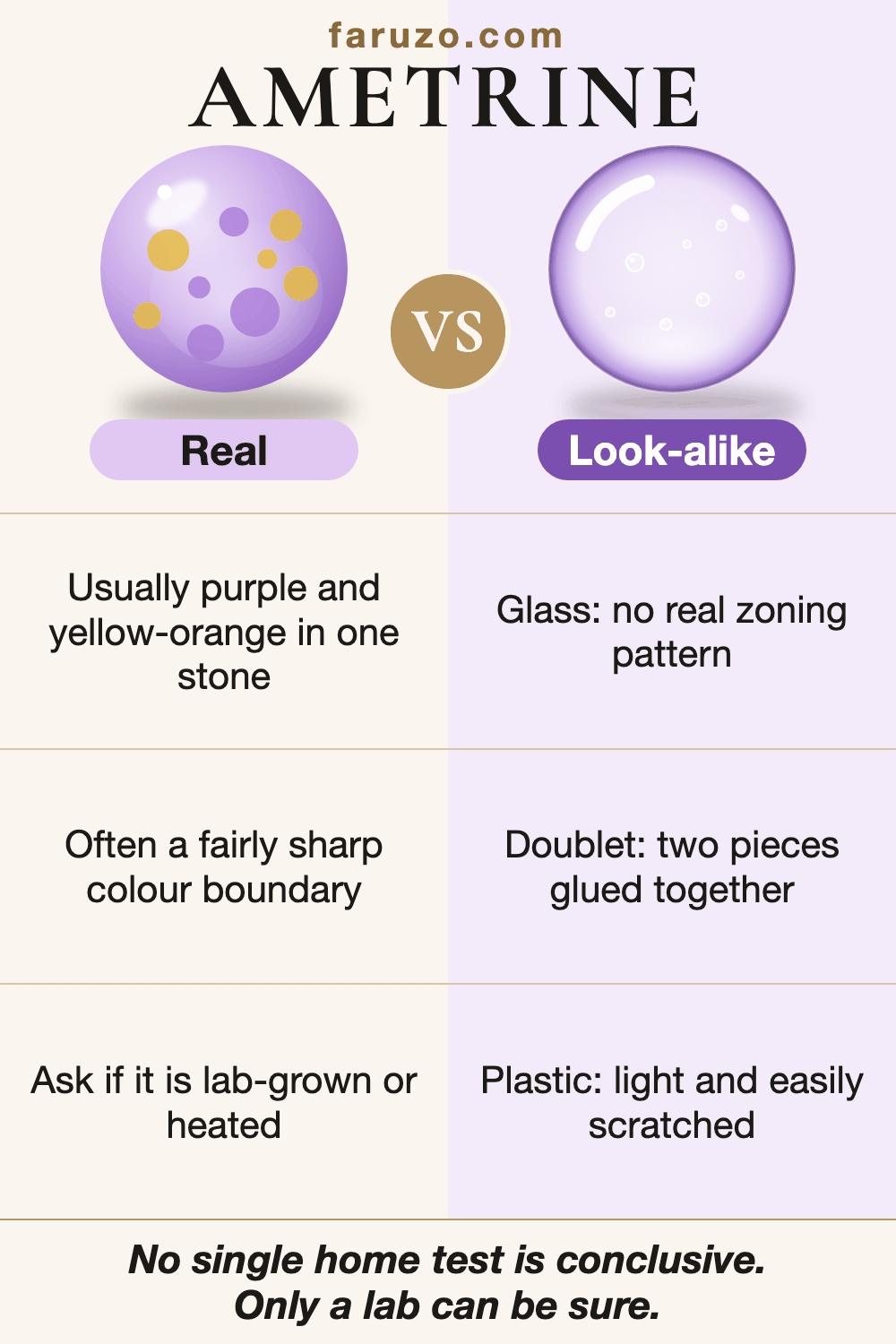
- Glass. Glass is a different material, not quartz, and can be made in any colour mix. A glass stone has no real zoning pattern, and a gem lab can confirm what a stone is.
- Plastic. Plastic is not a mineral at all. It is usually far softer than quartz, so it scratches easily and tends to feel lighter in the hand.
- Doublets and composites of amethyst and citrine. A doublet is one stone built from two pieces. A purple piece and a yellow piece can be joined to give a two-colour look, so ask whether the stone is a single piece and have a gem lab check if it matters.
Safe checks you can do
- Ask the seller in writing whether the stone is natural ametrine, lab-grown, treated, a doublet, or glass. A lab-grown or treated stone is still real quartz, so the point is that the label is honest.
- Ask whether the colour is natural to the quartz or comes from a stain or surface coating. Colour that sits in cracks or on the surface, or that wears off, points to this. A gem lab can confirm.
- Look at the colours. Natural ametrine is purple and yellow-orange. Green-yellow or blue-gold bicolour stones are not known to occur naturally.
- Be careful with a large, clean, bright stone at a very low price. Low-priced material may be lab-grown, and lab-grown ametrine looks the same as natural, so only a gem lab can tell.
- Do not scratch-test or heat-test a stone you plan to keep. Hot or sudden heat can change colour. A gem lab is the safer route when it matters.
Wearing Ametrine
Ring
Safe
Hard enough for daily wear.
Bracelet
Safe
Tough enough for everyday bracelets.
Pendant
Safe
A pendant sits clear of most knocks.
Earrings
Safe
Earrings rarely take hard knocks.
Guide for everyday wear, based on hardness and care notes. Safe, Careful or Avoid.
At Mohs 7 with no cleavage, ametrine is hard enough for pendants, earrings, bracelets and rings. It is durable for most jewellery, though it may need repolishing over time. A ring takes the most knocks, so a protective setting helps. Keep it away from heat and long strong light, which can change or fade its colour, and store it apart from harder stones such as topaz or sapphire so they do not scratch it.
Related stones
Questions about Ametrine
What does ametrine mean?
In crystal tradition ametrine is seen as a blend of amethyst and citrine, linked to calm, balance and optimism. That is a belief, not a fact about the stone. Its plain claim to fame is purple and golden-yellow colour in one piece of quartz.
What is ametrine?
Ametrine is a variety of quartz (SiO2) that shows amethyst and citrine colour in the same crystal. The name blends the two. Trace iron is the usual explanation for the purple and the yellow-orange.
How hard is ametrine?
7 on the Mohs scale, the same as quartz, with no cleavage. That makes it hard-wearing for most jewellery, though a hard knock can still chip any stone.
Is ametrine a birthstone?
Ametrine is not on the standard modern or traditional birthstone lists, though lists vary. Its two parts are on them: amethyst is the February birthstone, and citrine is a November birthstone along with topaz.
Where does ametrine come from?
Natural ametrine is often associated with the Anahi mine in south-east Bolivia, described as the only commercial source. Smaller deposits are reported in Brazil and India.
Why does ametrine have two colours?
Trace iron is the usual explanation for both colours. Natural zoning is generally explained by changes in temperature as the crystal grew, which left some zones yellow and others purple.
Is lab-grown ametrine real?
Lab-grown ametrine is real quartz made by people instead of mined. It looks and tests much like natural ametrine, and a gem lab can often tell the two apart. It should be sold as lab-grown, and it is priced differently from a natural stone.
Is the ametrine in a shop natural or lab-grown?
Much ametrine on the market is made by partly heating or irradiating amethyst, and low-priced stones may be lab-grown. Ask the seller in writing which it is. A gem lab can confirm a stone priced as natural.
I found an ametrine ring at a low price. Is it natural?
Possibly not. At a low price it may be lab-grown ametrine, a treated stone, a doublet, or glass. Lab-grown and treated ametrine are still real quartz and fair products when sold honestly. Ask the seller in writing what the stone is.
Is ametrine treated or dyed?
Natural bicolour stones are rarely treated, though fractures may be filled. Heat and irradiation can change quartz colour, and much ametrine on the market is reportedly made that way from amethyst. A treated stone is still real quartz, so ask whether the colour is natural.
Can you wear an ametrine ring every day?
Usually yes, since Mohs 7 with no cleavage suits rings. A protective setting helps, and it is best taken off for heavy work. Keep it away from heat and long strong sun, which can change or fade its colour.
Can ametrine get wet, and can you clean it in an ultrasonic cleaner?
Warm soapy water is safe. As a precaution, skip long soaks, steam and ultrasonic cleaners, because filled fractures and sudden heat can cause trouble.
Does ametrine fade in sunlight?
The purple part can fade with long strong light, as amethyst can. Heat can also change the colour. Keep it off sunny windowsills and store it in a closed box or pouch between wearings.
How can you tell real ametrine from fake?
A home look can only hint. Natural ametrine is purple and yellow-orange in one piece, while glass and plastic are different materials and a doublet joins two pieces. Lab-grown and treated ametrine are real quartz and look almost the same as natural, so a gem lab can confirm a stone that matters.