
Crystal guide
Amethyst Meaning, Properties and Care
Amethyst is the purple variety of quartz (SiO2, Mohs 7). Its colour is usually attributed to iron impurities combined with natural irradiation, and it can range from pale lavender to deep purple. It is the February birthstone, and in crystal tradition it is linked to calm, clarity and the crown chakra.
At a glance
- Hardness Mohs 7: a good level for rings and everyday jewelry, though it may need repolishing over the years.
- Quartz (SiO2) in pale lavender to deep purple; the most prized colour is usually a strong reddish purple with little visible zoning.
- Cheap purple stones can be glass or dyed quartz, and even real amethyst varies a lot in tone, so ask the seller what it is.
- Care: gentle hand-washing is safe. Keep it out of long strong light, since the colour can fade.
Quick facts
| Family | Quartz (silica group) |
|---|---|
| Chemical formula | SiO2 |
| Crystal system | Trigonal (alpha-quartz) |
| Mohs hardness | 7 |
| Luster | Vitreous (glassy) |
| Transparency | Transparent to translucent for gem material; it can contain fractures |
| Natural colors | pale lavender, violet, reddish purple, deep purple |
| Main localities | Brazil; Uruguay; Bolivia (ametrine); Zambia; Canada (Ontario, Newfoundland); Morocco; USA (Arizona); Russia |
| Common treatments | rarely treated, heating can turn amethyst yellow-orange or brown (sold as citrine), lab-grown amethyst exists |
| Birth month | February |
Looking for the month? February birthstone guide
Amethyst at a glance, in pictures
Chakras (traditional)
Hardness range
Natural colors
- pale lavender
- violet
- reddish purple
- deep purple
Traditionally linked to
- Planet
- Jupiter
- Zodiac
- PiscesAquarius
- Element
- Water
Common forms of Amethyst
- Rough raw chunk
- Tumbled polished pebble
- Cabochon smooth dome
- Faceted cut gem
How hard is Amethyst?
- Talc 1
- Gypsum 2
- Copper coin ~ 3
- Calcite 3
- Fluorite 4
- Apatite 5
- Glass ~ 5.5
- Steel knife ~ 5.5
- Orthoclase 6
- Amethyst 7
- Topaz 8
- Corundum 9
- Diamond 10
What it is and where it comes from
The name comes from the ancient Greek amethystos, often translated as not drunk. It reflects an old belief that the stone protected its wearer from intoxication.
Amethyst was used as a gem in ancient Egypt and was widely carved into engraved gems in antiquity.
It was once counted among the most prized coloured stones. Its standing is said to have fallen after very large deposits were found in Brazil.
Brazil is known for large deposits, including geodes big enough to stand inside. Other sources include Uruguay, Zambia, Ontario and Arizona.
Heating can turn amethyst yellow-orange or brown, which can look like citrine, and partial heating can give a two-toned quartz. Green quartz made this way is called prasiolite. Ametrine, a quartz with purple and yellow zones, also occurs naturally, and Bolivia is a known source.
A geode is a hollow, roughly rounded rock whose cavity is lined with crystals, and the word comes from the Greek for earthlike. Large amethyst-lined geodes are a feature of the basalts of Brazil and Uruguay.
In crystal tradition
What follows is belief and folklore, passed down in crystal tradition. It is not measured fact.
Traditionally associated with: calm, clarity, intuition, sobriety.
In crystal tradition amethyst is associated with the Crown and Third Eye chakras, and often with Pisces, Aquarius, Jupiter and Water. These mappings vary between lists, are a modern spiritual tradition, and have no scientific basis. The old belief behind the name, that amethyst protected against drunkenness, is the root of its traditional link with a clear head and self-control. It is also associated in tradition with calm, clarity and intuition. These are symbolic meanings, not effects on the body or mind.
How to care for Amethyst
- Water Safe
- Sunlight Caution
- Salt Unknown
- Heat Caution
- Ultrasonic Caution
- Chemicals Caution
Safe = fine as a rule · Caution = only briefly or gently · Avoid = can damage the stone · Unknown = no reliable guidance.
Warm, soapy water is usually safe for cleaning amethyst; rinse and dry with a soft cloth. If a stone has fractures, stick to that gentle wash only. Amethyst can fade in tone if overexposed to strong light, so avoid long strong sun and storing it on a bright windowsill. Because heating changes amethyst's colour, keep it away from heat sources and torch work. Ultrasonic cleaners and strong household chemicals are best avoided as a precaution, especially on fractured stones.
Real or fake? Look-alikes and treatments
Often confused with
- Heated amethyst (sold as citrine)
- Purple glass or dyed quartz
- Purple fluorite
- Ametrine
- Lab-grown amethyst
Common look-alikes
- Heated amethyst (sold as citrine). Same mineral and same hardness, so colour is the main clue: purple is amethyst, while yellow to orange may be citrine or heated amethyst.
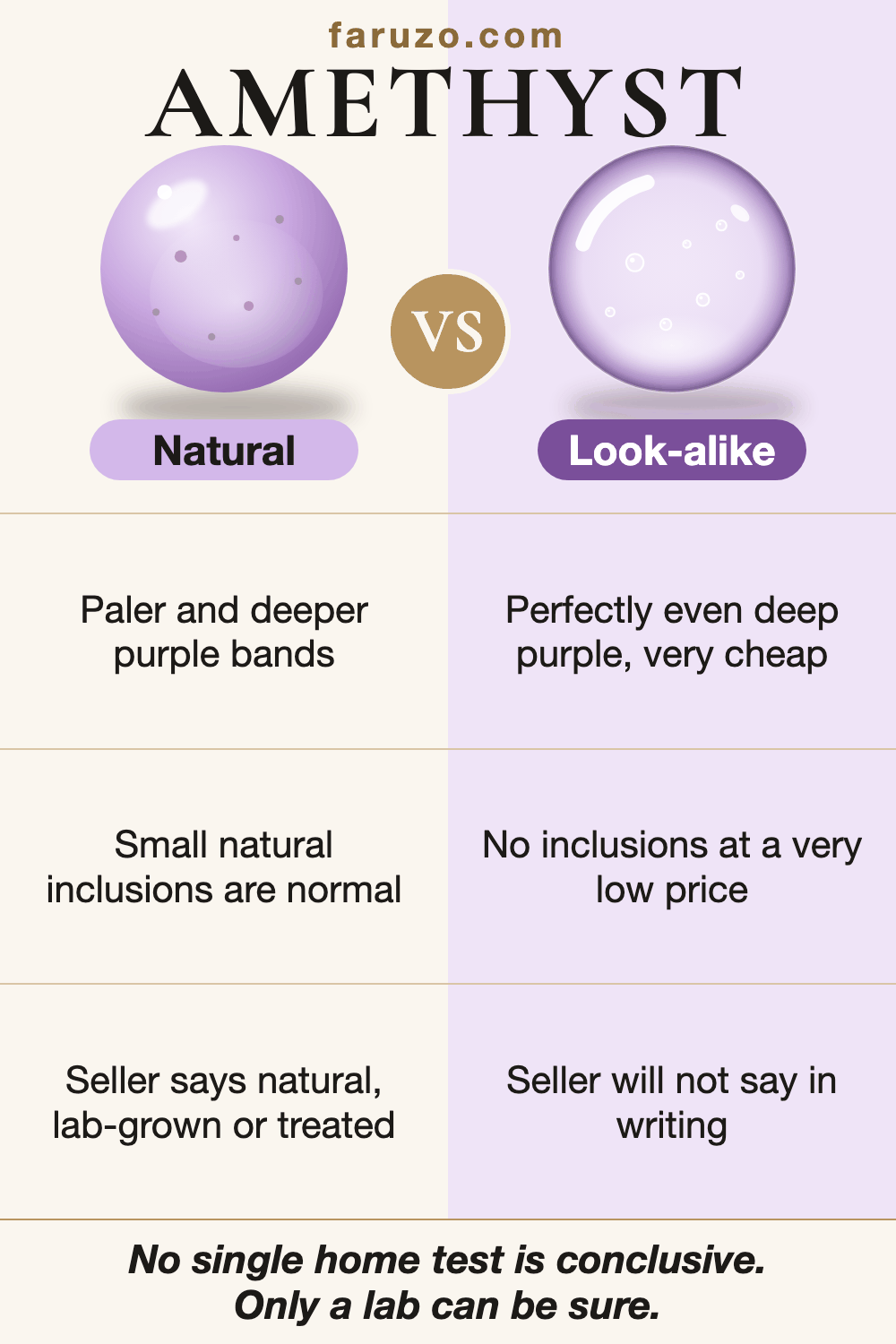
- Purple glass or dyed quartz. Cheap purple stones can be glass or dyed quartz. Glass is often very even and may show round bubbles, and dye can pool in cracks. Ask the seller what the stone is.
- Purple fluorite. Fluorite can be a similar purple but is much softer (Mohs 4), so it scratches and chips easily and often shows flat cleavage faces and colour bands. Amethyst is Mohs 7 with no cleavage.
- Ametrine. Ametrine is quartz showing purple and yellow zones in one stone, so it looks two-toned where amethyst is purple throughout. Bolivia is a known source, and some on the market is reportedly made by partial heating.
- Lab-grown amethyst. Synthetic amethyst is real quartz grown in a lab, so it looks and tests like the natural stone. A gemologist can often spot it by a pattern called Brazil law twinning, though that test is not foolproof.
Safe checks you can do
- Ask the seller in writing whether the stone is natural, lab-grown or treated. For a significant purchase, independent lab testing can confirm it is natural.
- Look for natural variation. Amethyst often shows colour zoning, with paler and deeper bands, while a flawless, even stone at a very low price deserves questions. Treat this as a hint, not proof.
- Do not rely on one home test. Lab-grown amethyst is real quartz, so only a gemologist can reliably tell it apart from natural.
Wearing Amethyst
Ring
Safe
Hard enough for daily wear; keep it out of strong heat and light.
Bracelet
Safe
Beads and links hold up well to everyday knocks.
Pendant
Safe
Few knocks as a pendant, but keep it out of long strong sun.
Earrings
Safe
Light, and rarely knocked.
Guide for everyday wear, based on hardness and care notes. Safe, Careful or Avoid.
At Mohs 7 amethyst is considered hard-wearing, so it suits pendants, earrings, bracelets and rings. A ring takes the most knocks, so a protective setting helps.
Related stones
Questions about Amethyst
What does amethyst mean?
In crystal tradition amethyst is associated with calm, clarity and intuition. The name comes from the Greek for not drunk, from an old belief that the stone protected against intoxication. These are symbolic meanings from tradition, not facts about the stone or claims about your health.
Is amethyst a real gemstone?
Yes. Amethyst is the purple variety of quartz (SiO2), not glass. Lab-grown amethyst also exists and is real quartz too, so check whether the listing says natural or lab-grown.
What is the hardness of amethyst?
Amethyst is Mohs 7. That is a good level for rings and everyday jewelry.
Is amethyst a birthstone?
Yes. It is the February birthstone, and the traditional gem for the 6th wedding anniversary.
Does amethyst fade in the sun?
It can. Amethyst can fade in tone if overexposed to strong light. As a precaution, keep it out of long strong sun and do not store it in a bright window.
How do you clean amethyst?
Hand-wash with lukewarm water, a drop of mild soap and a soft cloth, then rinse and dry. Stones with fractures should only get that gentle wash. Skip ultrasonic cleaners as a precaution.
How can you tell real amethyst from fake?
Natural amethyst often shows colour zoning, and a flawless, even stone at a very low price deserves questions. Lab-grown amethyst is still real quartz, so only a gemologist can reliably separate it from natural.
What is the difference between amethyst and citrine?
Both are quartz. Amethyst is purple and citrine is yellow to orange. Much of what is sold as citrine started as heated amethyst.
Can amethyst turn yellow?
Strong heat can change amethyst to yellow-orange or brown. Everyday wear does not do this, but keep amethyst away from heat sources.
Can amethyst go in water?
Yes. Plain water and mild soap are fine for amethyst. Skip very hot water and torch work.
What is an amethyst geode?
An amethyst geode is a hollow rock whose cavity is lined with purple amethyst crystals. The rock is the geode and the amethyst is the quartz growing inside it, so the two are not the same thing. The large ones come from old volcanic basalt in Brazil and Uruguay.
Can you wear an amethyst geode?
Not usually. A geode is a whole rock cavity and is normally kept intact as a display piece. Amethyst for jewelry is cut from the crystal itself. Some geodes on the market are artificially dyed, so ask whether the colour is natural.