
Crystal guide
Smoky quartz Meaning, Properties and Care
Smoky quartz is the grey to brown to near-black variety of quartz (SiO2, Mohs 7). Its colour comes from natural radiation acting on trace aluminium in the crystal, and much of what is sold today is clear quartz that was irradiated, sometimes with heat. In crystal tradition it is a grounding and protective stone linked to the root chakra.
At a glance
- Hardness Mohs 7: the same as clear quartz, amethyst and citrine, so fairly durable for rings.
- Quartz (SiO2) in grey, brown and near-black; the darkest, opaque kind is called morion.
- Smoky topaz is a misleading trade name: the stone is quartz, not topaz (Mohs 8).
- Colour comes from natural radiation, but much of the market stock is irradiated and sometimes heated.
- Care: soft cloth and mild soap. Keep it out of heat and long strong light, which can fade the colour.
Quick facts
| Family | Quartz (silica group) |
|---|---|
| Chemical formula | SiO2 |
| Crystal system | Trigonal (alpha-quartz) |
| Mohs hardness | 7 |
| Luster | Vitreous (glassy); no cleavage, conchoidal fracture |
| Transparency | Transparent to translucent; the darkest material is opaque. Some pieces show smoky clouds or fine needle-like inclusions. |
| Natural colors | pale grey, champagne to root-beer brown, dark brown, near-black (morion) |
| Main localities | Brazil, Madagascar, Switzerland (alpine fissures), Scotland (Cairngorm Mountains), Russia (Urals) |
| Common treatments | irradiation of clear quartz to produce a smoky colour (common); heating, which can fade the colour or turn it yellowish |
Smoky quartz at a glance, in pictures
Chakras (traditional)
Hardness range
Natural colors
- pale grey
- champagne to root-beer brown
- dark brown
- near-black (morion)
Traditionally linked to
- Planet
- Saturn
- Zodiac
- CapricornScorpio
- Element
- Earth
Common forms of Smoky quartz
- Rough raw chunk
- Tumbled polished pebble
- Cabochon smooth dome
- Faceted cut gem
How hard is Smoky quartz?
- Talc 1
- Gypsum 2
- Copper coin ~ 3
- Calcite 3
- Fluorite 4
- Apatite 5
- Glass ~ 5.5
- Steel knife ~ 5.5
- Orthoclase 6
- Smoky quartz 7
- Topaz 8
- Corundum 9
- Diamond 10
What it is and where it comes from
Smoky quartz is ordinary quartz whose colour comes from natural radiation. Over geological time, radiation from the surrounding rock activates colour centres around trace aluminium atoms in the crystal, and the colour deepens with exposure.
The colour can be undone. Heating can fade it, and heated stones may turn pale yellow and be sold as citrine. Long strong light is also said to fade it. Gamma treatment can bring colour back, which is why labs use it widely on clear quartz.
Morion is the very dark, nearly opaque end of the range. The name is reportedly a misreading of mormorion, a word in an ancient Roman natural-history text, and it is also the German word for smoky quartz.
Cairngorm is the traditional name for smoky quartz from the Cairngorm Mountains of Scotland. It is usually yellowish to greyish brown and is traditionally set in Scottish jewellery, kilt pins and the handles of the sgian dubh.
Smoky quartz is often said to have been cut into flat lenses worn as eye shades by judges in 12th-century China, so that witnesses could not read their expressions. This is a popular story rather than a well-documented fact.
In crystal tradition
What follows is belief and folklore, passed down in crystal tradition. It is not measured fact.
Traditionally associated with: grounding, protection, stability, letting go of stress.
Smoky quartz is traditionally associated with the Root chakra (Muladhara), the idea being that its dark, earthy colour links to stability and the base of the body. This is a modern spiritual tradition, not a fact about the stone.
Smoky quartz is traditionally linked with the zodiac signs Capricorn and Scorpio, the planet Saturn and the element Earth. These mappings differ from list to list and have no scientific basis.
In crystal tradition, smoky quartz is known as a grounding and protective stone, associated with staying present and steady under stress. These are symbolic meanings from folk and wellness tradition, not effects on the body or mind.
How to care for Smoky quartz
- Water Safe
- Sunlight Caution
- Salt Unknown
- Heat Caution
- Ultrasonic Unknown
- Chemicals Unknown
Safe = fine as a rule · Caution = only briefly or gently · Avoid = can damage the stone · Unknown = no reliable guidance.
Warm, soapy water and a soft cloth are the usual way to clean smoky quartz. Colour can fade with heat or long strong light, so keep pieces away from hot places such as a car dashboard or a sunny windowsill, and avoid torch work. Ultrasonic and steam cleaners are best avoided as a precaution, especially for stones with clouds or inclusions, because heat and vibration can stress them. Salt and household chemicals are best avoided as a precaution.
Real or fake? Look-alikes and treatments
Often confused with
- Brown or smoky topaz (the trade name)
- Citrine (including heated smoky quartz)
- Brown or smoky glass
- Dark brown tourmaline or other brown gems
- Irradiated clear quartz
Common look-alikes
- Brown or smoky topaz (the trade name). Smoky topaz is usually just smoky quartz under a misleading name. Real topaz is a different mineral, Mohs 8 with perfect cleavage and clearly heavier than quartz at the same size. Ask what the stone is in mineral terms; a gemologist can separate them quickly with a refractometer or by weighing.
- Citrine (including heated smoky quartz). Citrine is the yellow to orange variety of quartz. Heated smoky quartz can turn yellowish and is sometimes sold as citrine, so the two are the same mineral and can only be told apart by colour and history, not by hardness or density.
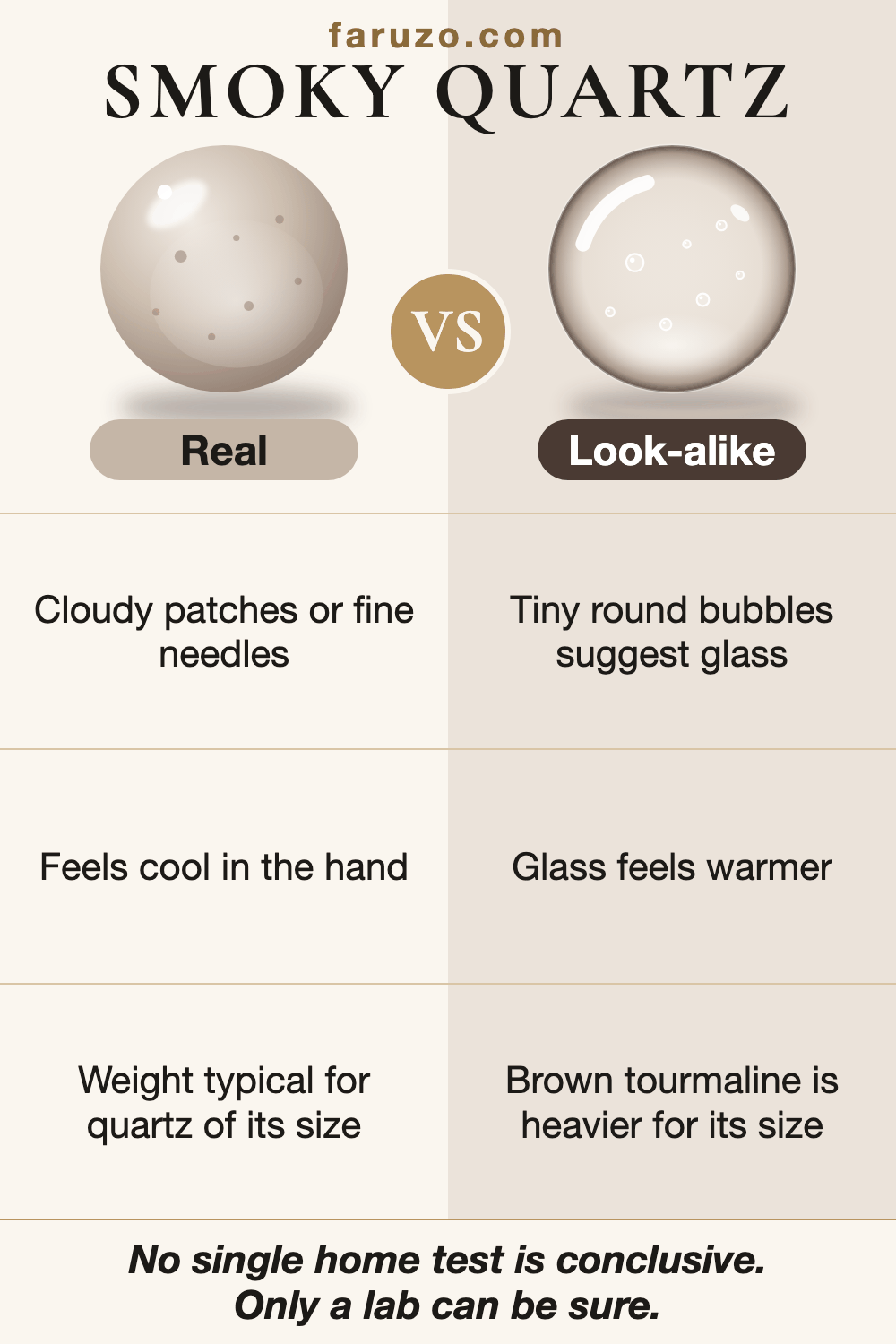
- Brown or smoky glass. Dark glass imitation is common in cheap pieces. Glass often shows tiny round bubbles under a loupe, feels warmer to the touch than quartz, and lacks the natural clouds or needle-like inclusions seen in quartz. A gemologist can confirm quickly.
- Dark brown tourmaline or other brown gems. Brown tourmaline and similar stones can look like smoky quartz at a glance. They are usually heavier than quartz for their size and often show a stronger colour change when turned, so a gemologist can separate them with standard tests.
- Irradiated clear quartz. This is real smoky-coloured quartz, but the colour was added rather than formed naturally. Very uniform, very dark colour is a hint, not proof. A lab can sometimes tell natural from irradiated colour, and a trustworthy seller should say which it is.
Safe checks you can do
- Ask the seller in writing what the stone is in mineral terms and whether the colour is natural or added.
- Look at the colour. Very even, deep, dark colour across a large stone often points to irradiated clear quartz, while natural material more often shows zoning, clouds or paler areas. This is a hint, not proof.
- Use a loupe. Tiny round bubbles suggest glass, while natural quartz may show cloudy patches or fine needles. Quartz also feels cooler in the hand than glass.
- For a stone that matters, ask a gemologist or lab to measure it. Quartz is Mohs 7 and specific gravity about 2.65, against Mohs 8 and about 3.5 for topaz. A lab can sometimes tell natural from added colour, but no home test is conclusive.
Wearing Smoky quartz
Ring
Safe
Hard enough for daily wear; keep it out of strong heat.
Bracelet
Safe
Beads and links hold up well to everyday knocks.
Pendant
Safe
Few knocks as a pendant; avoid long strong sun.
Earrings
Safe
Light, and rarely knocked.
Guide for everyday wear, based on hardness and care notes. Safe, Careful or Avoid.
Smoky quartz is fairly durable at Mohs 7 with no cleavage, so it suits pendants, earrings, bead bracelets and rings. A hard knock can still chip any gemstone, so a protective setting helps on a ring. Because heat and strong light can fade the colour, store it out of hot places and direct sun. Keeping it apart from harder stones such as topaz or sapphire avoids scratches.
Questions about Smoky quartz
What does smoky quartz mean?
In crystal tradition smoky quartz is a grounding and protective stone, traditionally linked to the root chakra and to staying steady under stress. These are symbolic meanings from folk and wellness tradition, not facts about the stone.
Is smoky quartz a real gemstone?
Yes. It is a variety of quartz (SiO2), real quartz, not glass. The colour can be natural or added in a lab.
Is smoky quartz always treated?
No. Natural smoky quartz forms through long exposure to radiation underground, and plenty of untreated material exists. Much of the deeply and evenly coloured stock on the market is irradiated clear quartz, sometimes with heat, so a seller should say which it is.
What is the difference between smoky quartz and smoky topaz?
Smoky topaz is a misleading trade name for smoky quartz. Real topaz is a separate mineral with Mohs 8 hardness and perfect cleavage.
Is smoky quartz hard enough for a daily ring?
It is fairly durable. At Mohs 7 it resists everyday scratching about as well as clear quartz, amethyst and citrine, and it has no cleavage. Like any gemstone it can still chip from a hard knock, so a protective setting helps.
What is cairngorm?
Cairngorm is the traditional Scottish name for smoky quartz from the Cairngorm Mountains. It is usually yellowish to greyish brown, and is traditionally set in kilt pins and sgian dubh handles.
What is morion?
Morion is the very dark, almost black and opaque end of the smoky quartz range. The name is reportedly a misreading of the ancient word mormorion.
Will smoky quartz fade in the sun?
It can. The colour comes from radiation-related defects that heat and strong light can reduce, so keep smoky quartz out of long strong sun and hot places such as a car dashboard.
How do you clean smoky quartz?
Use a soft cloth and mild soap and a little water, then dry it. Avoid hot-to-cold swings, and skip machine cleaners, especially for stones with inclusions.
What is smoky quartz traditionally linked with?
In crystal tradition it is linked to grounding and calm; this is belief, not a measured effect.
Is smoky quartz a birthstone?
Not on the standard modern or traditional lists. Citrine, another quartz variety, is a November stone, but smoky quartz has no widely agreed month.