
Crystal guide
Jasper Meaning, Properties and Care
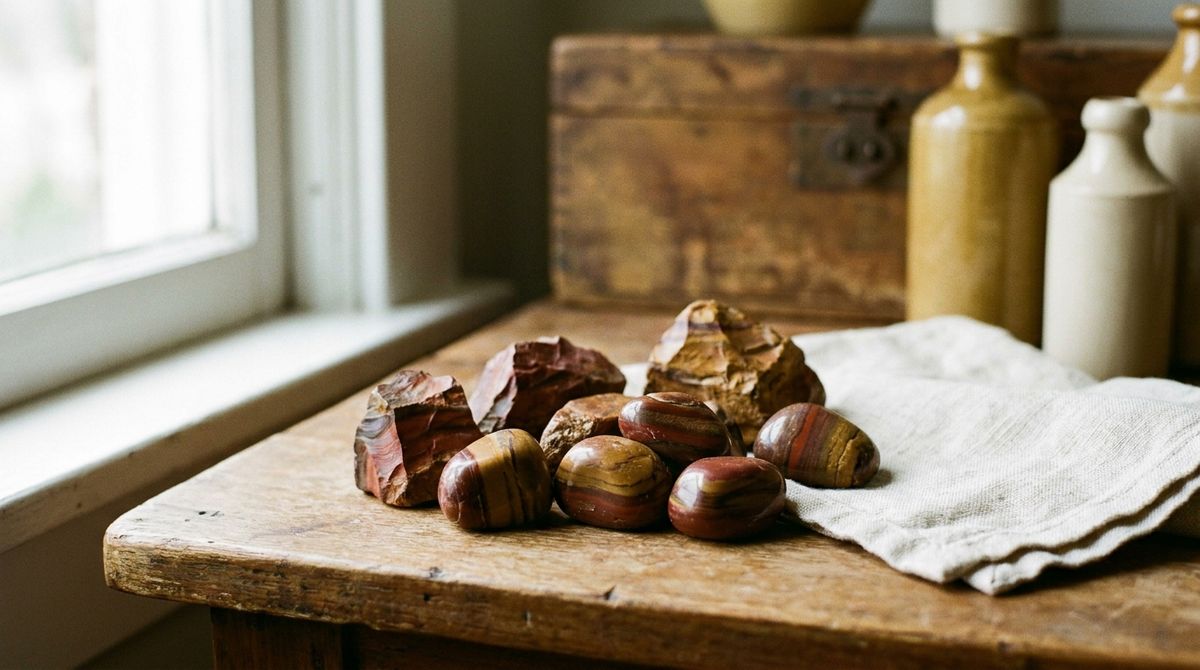
Jasper is an opaque, fine-grained form of quartz (chalcedony) coloured by impurities, usually iron, and it sits at about 6.5 to 7 on the Mohs scale. It is a family rather than one stone: red jasper is the most common, with yellow, brown, green, picture, ocean and many other patterned kinds. A bright piece is worth a question about dye. In tradition jasper is a grounding, steady stone.
At a glance
- Opaque microcrystalline quartz (SiO2) coloured by impurities, with a Mohs hardness of about 6.5 to 7.
- A family of stones: red is the most common, then yellow, brown and green. Stones sold as blue jasper are mostly dyed.
- No cleavage and a smooth, curved break, so it is tough and low-maintenance for jewellery.
- Dyed jasper is common: very bright pink, purple or blue pieces deserve a question to the seller.
Quick facts
| Family | Quartz (silicate): opaque, fine-grained microcrystalline quartz with impurities |
|---|---|
| Chemical formula | SiO2 (silicon dioxide), with iron and other mineral impurities |
| Crystal system | Microcrystalline quartz (trigonal); the crystals are far too small to see |
| Mohs hardness | 6.5–7 |
| Luster | Waxy to glassy when polished; no cleavage and a smooth, curved (conchoidal) fracture |
| Transparency | Opaque |
| Natural colors | red (the most common, from iron oxide); yellow and brown; green; banded, spotted or landscape-like patterns (picture jasper); circular, eye-like patterns (orbicular or ocean jasper); so-called blue jasper is mostly dyed, though some natural blue-grey stones carry the name |
| Main localities | United States (Oregon and Idaho, including Biggs and Bruneau jasper); Madagascar (ocean jasper); Australia (for example mookaite); deposits on most continents |
| Common treatments | often dyed to brighten or change colour, especially beads in pink, purple, blue or vivid yellow; sometimes oiled or waxed to deepen the colour and polish |
Jasper at a glance, in pictures
Chakras (traditional)
Hardness range
Natural colors
- red (the most common, from iron oxide)
- yellow and brown
- green
- banded, spotted or landscape-like patterns (picture jasper)
- circular, eye-like patterns (orbicular or ocean jasper)
- so-called blue jasper is mostly dyed, though some natural blue-grey stones carry the name
Traditionally linked to
- Zodiac
- AriesScorpio
- Element
- Earth
Common forms of Jasper
- Rough raw chunk
- Tumbled polished pebble
- Cabochon smooth dome
How hard is Jasper?
- Talc 1
- Gypsum 2
- Copper coin ~ 3
- Calcite 3
- Fluorite 4
- Apatite 5
- Glass ~ 5.5
- Steel knife ~ 5.5
- Orthoclase 6
- Jasper 6.5–7
- Quartz 7
- Topaz 8
- Corundum 9
- Diamond 10
What it is and where it comes from
The name comes from the Greek iaspis, which probably has a Semitic origin and reached Greek and Latin through earlier trade.
In ancient texts the word iaspis was often used for translucent green stones, so it may have included stones now called chalcedony. An old mention of jasper may not mean the stone sold today.
Jasper has been shaped for a very long time. Jasper seals were carved on Minoan Crete around 1800 BCE, and green jasper may have been used for drill bits at the early site of Mehrgarh.
Because it breaks with sharp, smooth curved edges and takes a good polish, jasper has long been used for tools, seals, vases and jewellery.
Jasper is a category rather than a single mineral. Varieties are named by place (Biggs, Bruneau), by look (picture, orbicular, ocean) or by trade name.
Bloodstone (heliotrope) is a dark green jasper flecked with red and a traditional March birthstone. Jasper itself is not on the usual modern lists.
In crystal tradition
What follows is belief and folklore, passed down in crystal tradition. It is not measured fact.
Traditionally associated with: grounding, protection, steadiness.
Traditionally jasper is associated with steady support, grounding and patience. This is a spiritual tradition, not a fact about the stone.
Red jasper is traditionally linked with the Root chakra, vitality and protection, partly because of its blood-red colour. Ocean jasper is traditionally linked with gentleness and emotional calm. These are beliefs, not facts about the stone.
In ancient Egyptian tradition, a knot-shaped amulet of red jasper was placed at the throat of the dead, and the red colour was linked with the protective blood of the goddess Isis. Jasper is also named among the stones in the high priest's breastplate in the Book of Exodus and in the wall of the holy city in the Book of Revelation, although the old word may not have meant the same stone as today.
How to care for Jasper
- Water Safe
- Sunlight Caution
- Salt Unknown
- Heat Caution
- Ultrasonic Caution
- Chemicals Caution
Safe = fine as a rule · Caution = only briefly or gently · Avoid = can damage the stone · Unknown = no reliable guidance.
Clean jasper with a soft cloth, lukewarm water and mild soap, then dry it. Natural jasper is tough and does not mind a quick rinse. Dyed or waxed pieces can lose colour or shine if soaked, scrubbed, left in strong light or hit with heat, solvents or ultrasonic cleaners. Keep it away from harsh chemicals and store it apart from harder stones. Little is known about salt, so a rinse after sea swimming is a sensible precaution.
Real or fake? Look-alikes and treatments
Often confused with
- Carnelian
- Red agate
- Glass or resin beads
- Bloodstone
- Rainforest jasper
- Dalmatian and leopard-skin jasper
Common look-alikes
- Carnelian. Carnelian is orange-red chalcedony that is translucent, while red jasper stays opaque all the way through.
- Red agate. Agate shows translucent, often wavy or concentric bands, while red jasper usually looks like one fairly even, solid colour. Patterned jaspers differ, so ask which variety it is.
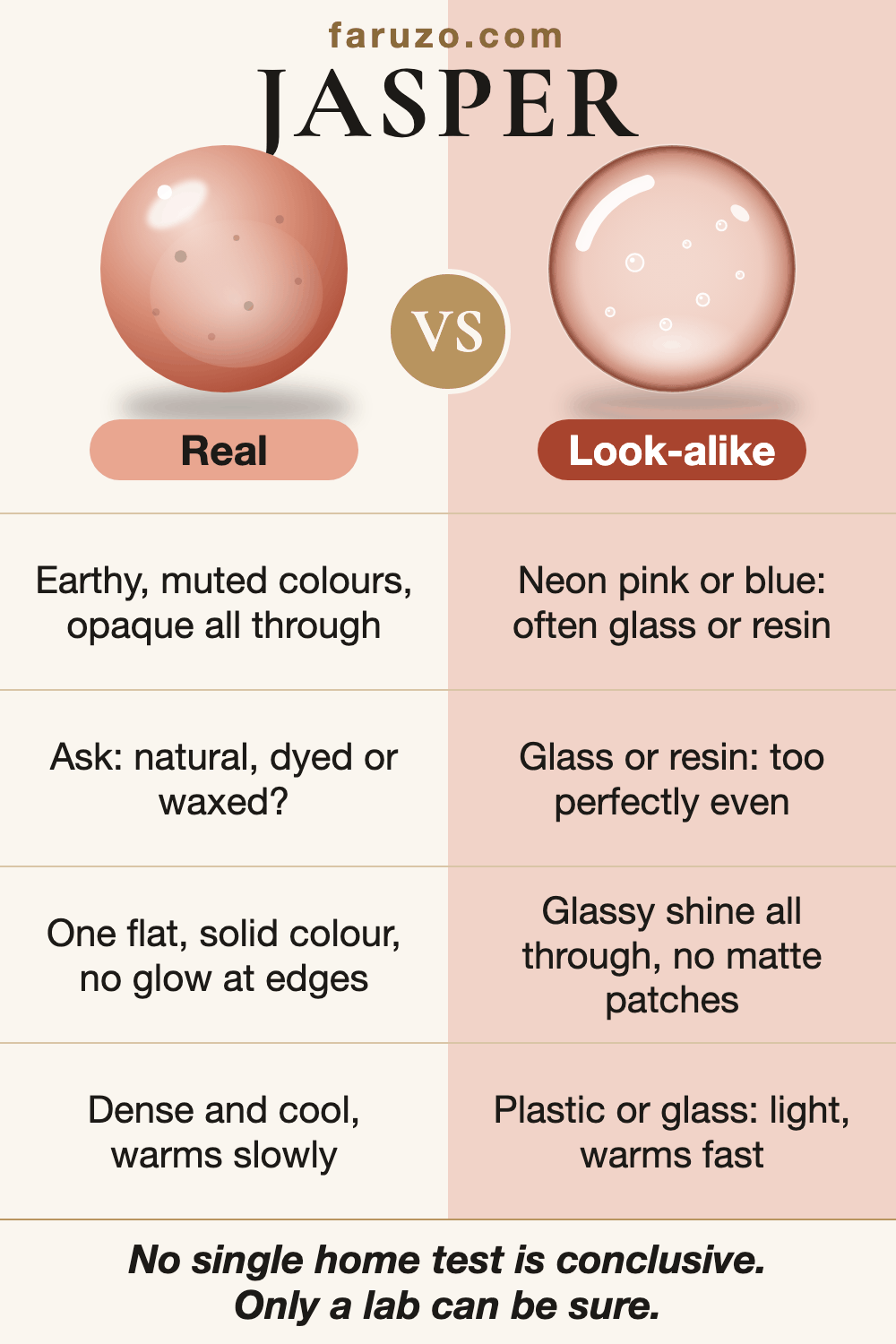
- Glass or resin beads. Imitation beads can be too perfectly even in colour and may feel lighter than stone. Tiny round bubbles suggest glass. Ask exactly what the material is.
- Bloodstone. A dark green kind of jasper with red flecks, not solid red. Ask which variety it is.
- Rainforest jasper. Sold as jasper, but it is usually a rhyolite, a volcanic rock with green and brown patches. It is a different rock sold under a trade name.
- Dalmatian and leopard-skin jasper. These spotted stones are trade names for patterned rocks that are not all true jasper. Ask what the stone is if it matters to you.
Safe checks you can do
- Be wary of very bright, saturated colours such as hot pink, vivid purple, electric blue or lemon yellow. Natural jasper is usually earthy and muted, so these are often dyed.
- Look at cracks, drill holes and edges for colour pooling in fine lines, which can suggest dye.
- Jasper is opaque. If light glows through thin edges or you see clear translucent bands, it may be agate or another chalcedony.
- Feel its weight. Stone usually feels dense and cool, while plastic feels light, but this is only a hint.
- Treated jasper cannot always be told by eye. For a piece that matters, ask a gemologist or lab.
Wearing Jasper
Ring
Careful
Fine with care, but knocks can mark it.
Bracelet
Safe
Fairly hard, so fine for normal bracelet wear.
Pendant
Safe
Fairly hard, and a pendant sits clear of knocks.
Earrings
Safe
Fairly hard, and earrings rarely take knocks.
Guide for everyday wear, based on hardness and care notes. Safe, Careful or Avoid.
Jasper is tough, with no cleavage, so natural pieces handle everyday wear well, especially pendants, earrings and bracelets. A ring works with some care: at about 6.5 to 7 on the Mohs scale the polish can slowly lose its shine from daily grit, and a hard knock can still chip it. Dyed or waxed jasper is more delicate, so avoid heat, harsh cleaners and long soaking.
Related stones
Questions about Jasper
What does jasper mean?
Jasper is a family of opaque, fine-grained quartz stones. In crystal tradition it stands for grounding, steadiness and protection, and red jasper is linked with the Root chakra. These are beliefs, not facts about the stone.
What is jasper made of?
Jasper is quartz (silicon dioxide) in the form of tiny crystals packed together with impurities such as iron oxide. The crystals are too small to see, which is why the stone is opaque and tough.
How hard is jasper?
About 6.5 to 7 on the Mohs scale. It has no cleavage and breaks with a smooth, curved edge, so it handles daily wear well.
What is the difference between jasper and agate?
Both are fine-grained quartz. Agate is translucent and often shows clear banding, while jasper is opaque all the way through because it holds more impurities.
What is red jasper?
Red jasper is the solid brick-to-rust-red variety, coloured by iron oxide, and it is the most common jasper.
Is jasper always dyed?
No. Many pieces are natural, but dyeing is common, especially on beads in pink, purple, blue or vivid yellow. Ask the seller what treatment a stone has had.
How can you tell real jasper from fake?
Real jasper is opaque, usually muted and earthy, and feels dense and cool, while very bright colour, glowing thin edges or colour pooling in cracks can point to dye or an imitation. A gemologist or lab can settle it for a stone that matters.
What are the main types of jasper?
Common kinds include red, yellow, picture (landscape-like patterns), ocean (circular patterns) and mookaite (cream to burgundy). Many more are named by place or sold under trade names.
Can jasper get wet?
Yes, natural jasper can be rinsed and washed in lukewarm water with mild soap. Dyed or waxed pieces should spend little time in water.
Is jasper a birthstone?
Not on the standard modern lists. Bloodstone, a dark green jasper with red flecks, is a traditional March birthstone.
Does red jasper fade?
Natural red jasper gets its colour from iron oxide locked in the stone and is not expected to fade in ordinary light. Dyed pieces can fade or bleed in long strong sunlight.
Is jasper rare or expensive?
Common jasper is widely found and usually inexpensive, while unusual patterns and well-marked picture or ocean jasper can be harder to find. Pattern, polish and whether it is dyed all matter.
Can you wear a jasper ring every day?
Natural jasper is tough with no cleavage, so a ring is fine with some care. The polish can slowly dull with daily wear.
What do the zodiac and element links for jasper mean?
In crystal tradition jasper is paired with Aries and Scorpio and with the Earth element, in line with its grounding reputation. These pairings are belief, not fact.