
Crystal guide
Black Septarian Meaning, Properties and Care
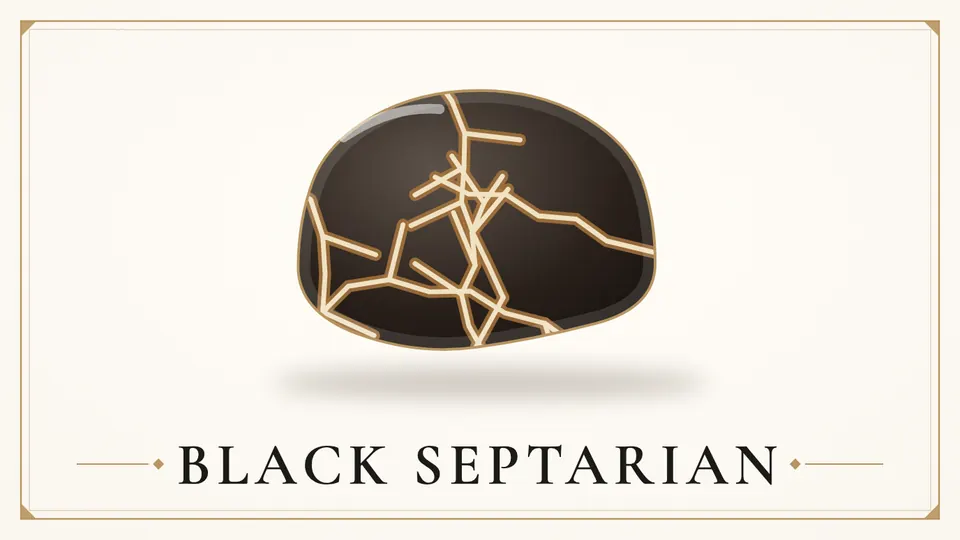
Black septarian is a polished septarian nodule: a rounded lump of hardened clay-rich carbonate rock cut by angular cracks that were later filled with calcite and aragonite. So it is a rock, not one mineral, and "dragon stone" is a trade name rather than a geological term. It is soft, at about 3 to 4 on the Mohs scale, and calcite reacts with acid. In crystal tradition it is a grounding, protective stone.
At a glance
- A rock, not one mineral: a clay-rich carbonate nodule with cracks filled by calcite and aragonite.
- Soft, about Mohs 3 to 4, so it scratches easily and suits display better than rings or bracelets.
- Calcite reacts with acid: no vinegar, no acid cleaners, no ultrasonic.
- "Dragon stone" and "dragon egg" are trade names. Polished pieces may have filled cracks, so ask the seller.
Quick facts
| Family | A concretion (a rock, not one mineral): a clay-rich carbonate matrix cut by angular cracks filled with calcite and aragonite |
|---|---|
| Chemical formula | No single formula; the calcite and aragonite fill are both calcium carbonate (CaCO3), set in a carbonate and clay matrix |
| Crystal system | Not a single crystal: a rock whose crack fill is crystalline calcite (trigonal) and aragonite |
| Mohs hardness | 3–4 |
| Luster | Calcite and aragonite fill glassy when polished; the clay-rich matrix is duller |
| Transparency | Mostly opaque as a whole; calcite crystals in cavities can be translucent |
| Natural colors | black or very dark (sold as black septarian), grey, brown, yellow, white |
| Main localities | Madagascar (Betsiboka Region), USA (Utah and the Gulf of Mexico coast), England (Kimmeridge Clay), Scotland (Isle of Skye), New Zealand (Moeraki Boulders) |
| Common treatments | polished pieces can have cracks repaired or gap-filled, so ask whether a piece has filler; a soft, cracked stone can be filled or impregnated to hold together, and dark colour can be enhanced, so ask whether the black is natural; a treated piece is still real septarian; it is a question for the seller, not a different stone |
Black Septarian at a glance, in pictures
Hardness range
Natural colors
- black or very dark (sold as black septarian)
- grey
- brown
- yellow
- white
Common forms of Black Septarian
- Rough raw chunk
- Sphere ball
- Tumbled polished pebble
- Cabochon smooth dome
How hard is Black Septarian?
- Talc 1
- Gypsum 2
- Copper coin ~ 3
- Calcite 3
- Black Septarian 3–4
- Fluorite 4
- Apatite 5
- Glass ~ 5.5
- Steel knife ~ 5.5
- Orthoclase 6
- Quartz 7
- Topaz 8
- Corundum 9
- Diamond 10
What it is and where it comes from
A septarian nodule is a carbonate-rich concretion with angular cracks inside, called septaria. The name comes from the Latin septum, meaning a partition.
The dense matrix is usually a clay-rich carbonate such as clay ironstone. The crack fill is usually calcite, often iron-bearing, sometimes with pyrite and clay. Polished Madagascar pieces show yellow calcite and brown aragonite.
Nodules form in mud at shallow burial depths, often under about 50 metres. How the cracks open is still debated: shrinking as the interior dries, water squeezed out of clay, or trapped fluid pressure are all proposed.
Mineral-rich groundwater later filled the cracks. That is why a cut nodule shows pale crystal veins running through a darker matrix.
Septarian nodules are a worldwide rock feature, most common in marine shales. Examples include the Kimmeridge Clay of England, the Staffin Shale of Skye and the Mancos Group of North America.
The Moeraki Boulders of New Zealand are septarian concretions up to about 3 metres across, eroding out of Paleocene mudstone on the South Island coast.
Most polished spheres and eggs come from Madagascar, with more from Utah and the Gulf of Mexico coast.
The "dragon stone" and "dragon egg" names are trade names. The crack pattern is said to resemble dragon skin, and an unopened nodule looks like an egg.
A geode is hollow, with crystals lining the cavity. A septarian nodule is solid, and its crystals fill cracks that were already there. Cut and polished, the two can look alike.
In crystal tradition
What follows is belief and folklore, passed down in crystal tradition. It is not measured fact.
Traditionally associated with: grounding, patience, protection, transformation.
In crystal tradition black septarian is linked with grounding, patience and steady decision-making, partly because it looks dense, dark and earthy. This is a modern spiritual belief, not a fact about the stone.
Protection and transformation are also traditionally associated with septarian, and the dragon-stone name adds dragon imagery to that lore. These are beliefs within crystal practice, not scientific claims.
How to care for Black Septarian
- Water Caution
- Sunlight Unknown
- Salt Unknown
- Heat Caution
- Ultrasonic Avoid
- Chemicals Avoid
Safe = fine as a rule · Caution = only briefly or gently · Avoid = can damage the stone · Unknown = no reliable guidance.
Wipe with a soft, dry or barely damp cloth. Keep vinegar, lemon and other acids away, because calcite reacts with acid and can dull or etch. Skip ultrasonic and steam cleaners and harsh chemicals. Do not soak it, and keep it from heat, especially if the cracks look filled. Store it apart from harder stones that could scratch it. Nothing firm is known about long sun or salt.
Real or fake? Look-alikes and treatments
Often confused with
- Glass
- Resin or plastic copies
- Other dark patterned stones, such as agate and jasper
Common look-alikes
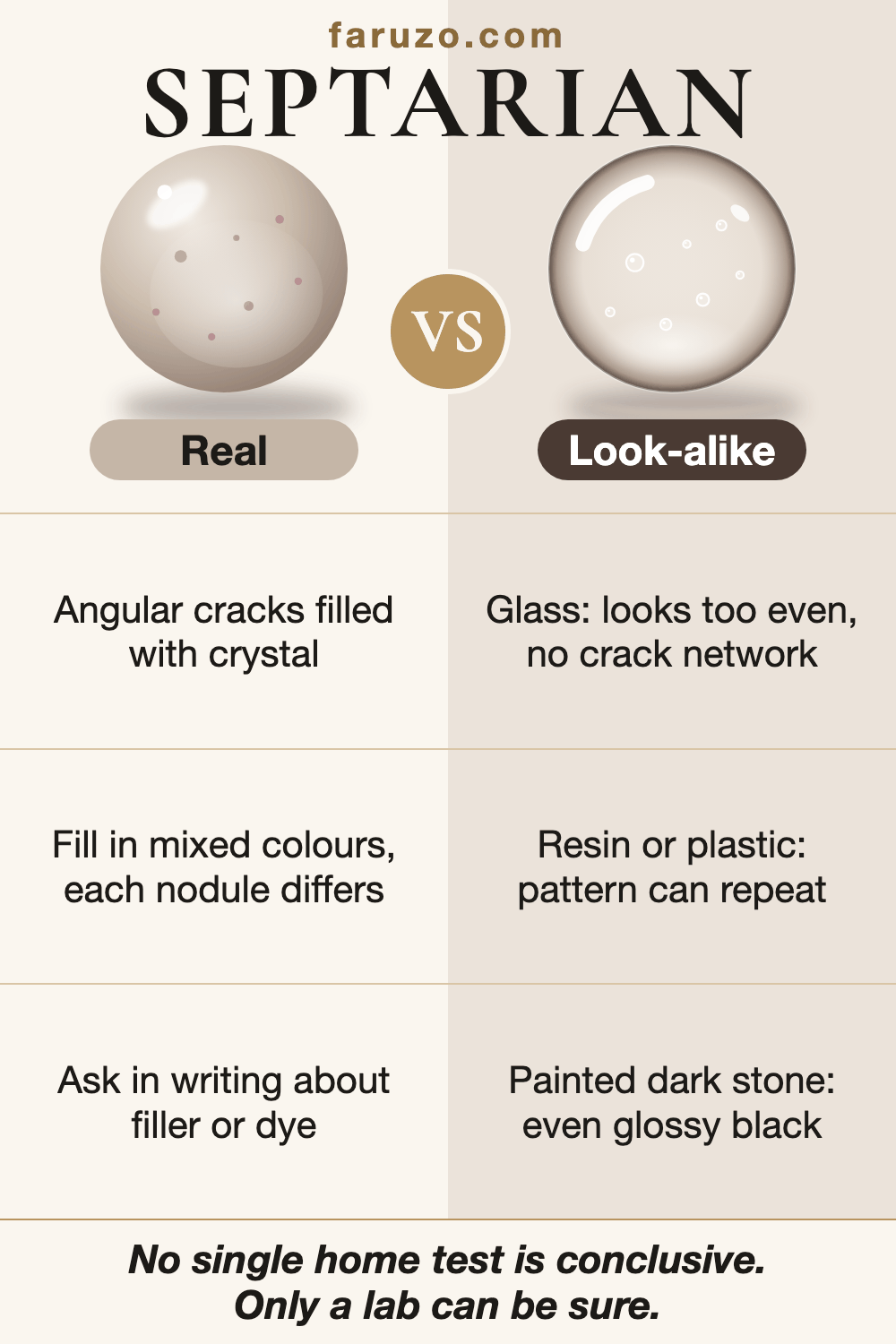
- Glass. Glass can be made in nearly any colour and imitates many patterned stones. Real septarian shows an irregular network of angular cracks filled with crystals in mixed colours, while a glass copy tends to look too even. Ask what it is made of.
- Resin or plastic copies. Plastic is used to imitate stones in inexpensive jewelry and is not durable. A cast copy can mimic a cracked, veined look, but its pattern can repeat from piece to piece. Each real nodule cracked and filled differently.
- Other dark patterned stones, such as agate and jasper. Agate and jasper are silica stones at about Mohs 6.5 to 7, much harder than septarian at 3 to 4. Their pattern is banding or speckle, not angular cracks filled with crystal. Much black agate on the market is artificially coloured.
Safe checks you can do
- Ask the seller in writing whether the piece is natural septarian, has filler or stabiliser in the cracks, has been dyed, or is something else.
- Look for angular cracks that taper, filled with crystal in contrasting colours such as yellow, brown, grey or white. Every nodule is different.
- Be wary of a batch where the pieces share an identical pattern. Each nodule cracked and filled in its own way.
- Ask whether the black is natural. A perfectly even, glossy black piece with no mineral colour is worth a question.
- Do not try vinegar or a scratch test at home. Calcite reacts with acid and the stone is soft, so both can mark a piece you want to keep.
Wearing Black Septarian
Ring
Avoid
Softer than most everyday dust, so it scratches easily.
Bracelet
Avoid
Softer than most everyday dust, so a bracelet scratches easily.
Pendant
Avoid
Very soft, so a pendant is best avoided.
Earrings
Avoid
Very soft, so earrings are best avoided.
Guide for everyday wear, based on hardness and care notes. Safe, Careful or Avoid.
Black septarian is soft, about Mohs 3 to 4, and its calcite veins mark and chip easily, so it is best avoided in rings and bracelets. Pendants and earrings are a poor fit too: they take fewer knocks but still scratch, and the stone dislikes water, acid and steam. Septarian suits spheres, eggs and display pieces far better than daily jewelry.
Related stones
Questions about Black Septarian
What does black septarian mean?
In crystal tradition black septarian is linked with grounding, patience, protection and transformation. That is a belief, not a fact about the stone. Its practical story is geological: a cracked mud nodule filled with calcite.
What is black septarian?
It is a septarian nodule, a rounded lump of clay-rich carbonate rock with angular cracks filled by calcite and aragonite. "Black" describes dark pieces. It is a rock, so it has no single mineral formula.
Is black septarian a crystal?
Not in the strict sense. The crack fill is crystalline calcite and aragonite, but the stone as a whole is a rock, not one crystal like quartz.
Why is it called dragon stone?
"Dragon stone" and "dragon egg" are trade names. The crack pattern is said to look like dragon skin, and an unopened nodule looks like an egg. They are not geological terms.
How hard is black septarian?
About 3 to 4 on the Mohs scale. The calcite fill is usually the softest part at about 3, and aragonite is a little harder. It scratches easily and is much softer than quartz.
Is black septarian a birthstone?
No. It is not on the standard birthstone lists, though lists vary. Check the list you are following.
What is the difference between septarian and a geode?
A geode is hollow, with crystals lining the cavity. A septarian nodule is solid, with cracks filled in by crystal. Cut and polished, the two can look alike.
Is black septarian natural, or is it dyed or filled?
The nodule is natural, but polished pieces can have cracks repaired or filled, and dark colour can be enhanced. Ask the seller in writing. A treated piece is still real septarian.
Can you wear black septarian every day?
It is not a good fit. At Mohs 3 to 4 it scratches and chips, so it is a poor fit for any piece of jewellery, rings, bracelets, pendants and earrings alike. It is better kept as a display piece, dry and away from knocks.
How do you clean black septarian?
Use a soft, dry or barely damp cloth. Keep acids such as vinegar and lemon away, and skip ultrasonic and steam cleaners. Store it apart from harder stones that could scratch it.
How can you tell real black septarian from fake?
A home look can only hint. Real pieces show angular cracks filled with crystal in mixed colours, and no two nodules match. Glass, resin and other dark stones can look similar, so ask the seller what it is.
What should I ask before buying septarian jewelry or a sphere?
Ask whether the cracks have filler, whether the stone has been stabilised or dyed, and whether the black is natural. For jewelry, remember its softness: it suits display and occasional wear better than daily rings.
Where does black septarian come from?
Most polished spheres and eggs come from Madagascar, with more from Utah and the Gulf of Mexico coast. Septarian nodules also occur in England, Scotland and New Zealand.