
Crystal guide
Pietersite Meaning, Properties and Care
Pietersite is a swirling, silky stone with blue-grey, gold and rust-red bands of moving light, called chatoyancy. At Mohs 6.5 to 7 it is fairly hard. It is usually described as a breccia: broken fibrous quartz fragments, rich in crocidolite fibres, cemented back together, so the pattern looks like a storm instead of neat stripes. Gem material comes mainly from Namibia and China. In crystal tradition it is linked to intuition, vision and willpower.

At a glance
- Swirled, broken chatoyant fibres in quartz, in blue-grey, gold, brown and rust-red.
- Hardness Mohs 6.5 to 7, quartz-based (SiO2), almost always cut as a cabochon.
- Mainly from Namibia (often blue-grey) and China (often reddish-brown).
- Not on the standard birthstone lists. Care: warm soapy water and a soft cloth; no ultrasonic, steam or strong cleaners.
Quick facts
| Family | Quartz group: a brecciated, fibrous quartz aggregate with crocidolite fibres, closely related to tiger's eye and hawk's eye and also described as a type of chalcedony |
|---|---|
| Chemical formula | SiO2 (quartz), with crocidolite fibres that cause the shimmer |
| Crystal system | Quartz is trigonal. Pietersite is a fibrous aggregate of broken fragments, so it shows no visible crystal faces. |
| Mohs hardness | 6.5–7 |
| Luster | Silky, with a moving band of light (chatoyancy) |
| Transparency | Chinese material tends to be more opaque than Namibian |
| Natural colors | blue-grey to dark blue, golden yellow to brown, orange to rusty red, reddish-brown with patches of blue and gold (typical Chinese material) |
| Main localities | Namibia, China |
| Common treatments | usually sold as natural stone, and not widely known to be heated or dyed; steam and heat can shift the colour, so keep it away from steam cleaners; ask the seller to say in writing whether any heat or dye was used |
Pietersite at a glance, in pictures
Chakras (traditional)
Hardness range
Natural colors
- blue-grey to dark blue
- golden yellow to brown
- orange to rusty red
- reddish-brown with patches of blue and gold (typical Chinese material)
Common forms of Pietersite
- Cabochon smooth dome
- Tumbled polished pebble
- Carving carved pendant
How hard is Pietersite?
- Talc 1
- Gypsum 2
- Copper coin ~ 3
- Calcite 3
- Fluorite 4
- Apatite 5
- Glass ~ 5.5
- Steel knife ~ 5.5
- Orthoclase 6
- Pietersite 6.5–7
- Quartz 7
- Topaz 8
- Corundum 9
- Diamond 10
What it is and where it comes from
Pietersite is usually described as a breccia. A breccia is a rock of angular fragments held together by finer cement, and here the fragments are fibrous and chatoyant. That broken, re-cemented structure is why the pattern swirls instead of running in neat parallel bands.
The shimmer comes from crocidolite fibres, the same fibre mineral behind tiger's eye and hawk's eye. The three are close relatives, though pietersite is thought to have formed differently from South African tiger's eye.
Its exact label is debated. It is often sold as a brecciated form of tiger's eye or hawk's eye, and it is also described as a type of chalcedony. Either way, it is a different look from a straight-banded tiger's eye.
Namibian pietersite was first described around 1962, and the name is reported to honour Sid Pieters, who found it there.
A similar material was later found in China. Namibian stones tend to be blue-grey or golden brown, while Chinese stones are mostly reddish-brown, often with patches of blue and yellow.
Pietersite is almost always cut as a cabochon, with the cut running parallel to the fibres. That is the direction in which the moving band of light shows best.
In crystal tradition
What follows is belief and folklore, passed down in crystal tradition. It is not measured fact.
Traditionally associated with: intuition, vision, willpower.
Pietersite is traditionally associated with the Third Eye chakra, and some lists add the Solar Plexus and Sacral chakras. This is belief, not a fact about the stone.
Its swirling colours earned it the trade name tempest stone, and it is also called eagle's eye. In tradition the storm look is read as change and fresh vision, and it is said to suit meditation. These are symbolic meanings, not effects on the body or mind.
Zodiac pairings for pietersite vary widely from one list to another.
How to care for Pietersite
- Water Safe
- Sunlight Unknown
- Salt Unknown
- Heat Caution
- Ultrasonic Avoid
- Chemicals Caution
Safe = fine as a rule · Caution = only briefly or gently · Avoid = can damage the stone · Unknown = no reliable guidance.
Wipe pietersite with warm soapy water and a soft cloth, then dry it. Skip ultrasonic cleaners and steamers, because heat can shift the colour. Keep it away from solvents and household cleaners that contain acids. Effects of long sun and salt exposure are not well documented, so avoid them as a precaution. The fibres inside are crocidolite, so leave any cutting or grinding to a workshop with wet cutting, since dust is the concern, not a polished piece.
Real or fake? Look-alikes and treatments
Often confused with
- Tiger's eye and hawk's eye
- Glass, including fibre optic glass
- Plastic or resin
- Dyed quartz or chalcedony
Common look-alikes
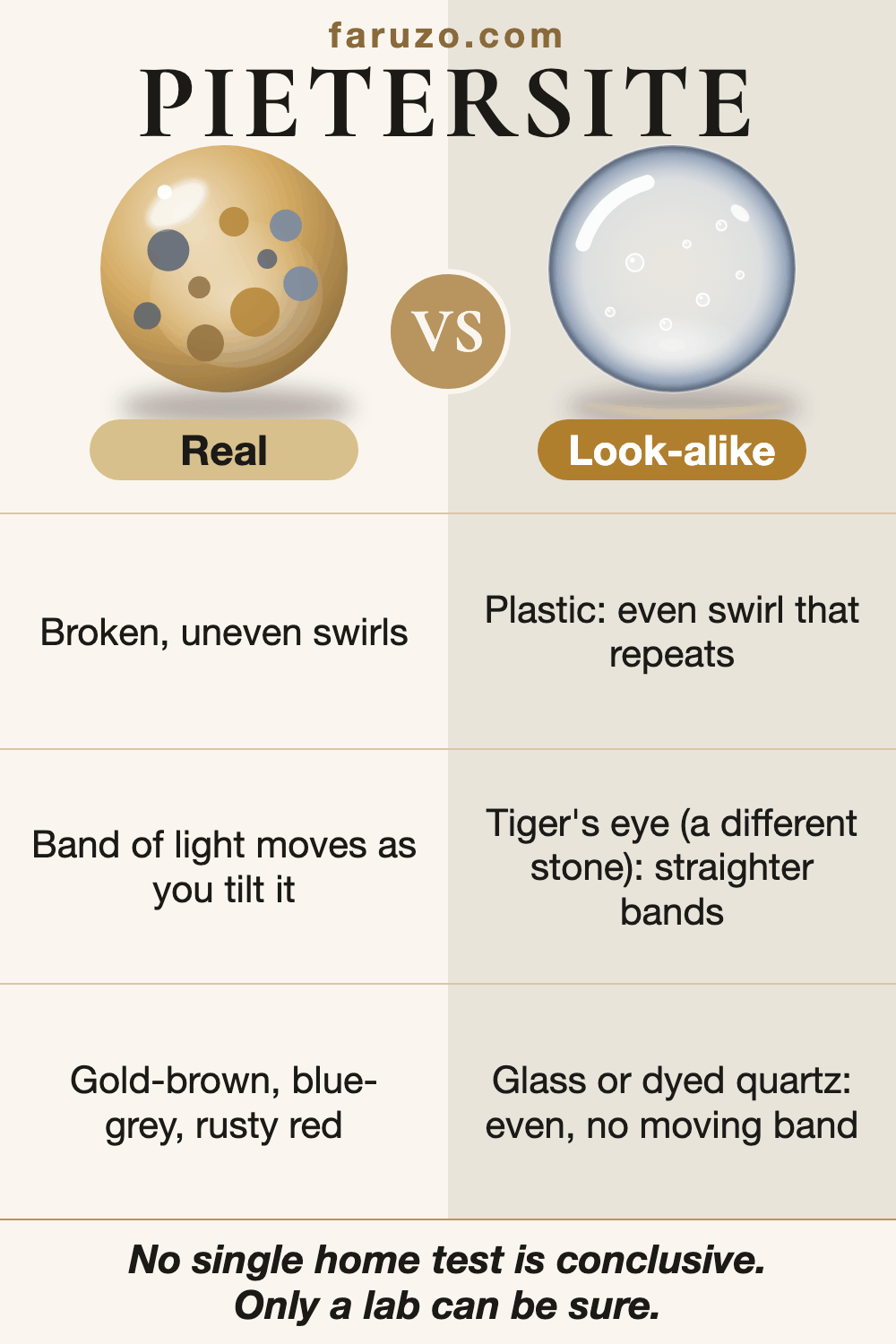
- Tiger's eye and hawk's eye. These are different stones, not copies, and red tiger's eye is usually heat-treated. Tiger's eye shows straighter parallel bands of light, while pietersite looks broken and swirled. Ask the seller what the stone is called and why.
- Glass, including fibre optic glass. Glass can be made to resemble chatoyant stones such as tiger's eye, so a blue and gold swirled piece may be glass. A gemmologist can separate glass from quartz by measuring refractive index and specific gravity. Pietersite should read in the quartz range.
- Plastic or resin. Plastic is a cheap imitation used in inexpensive fashion jewellery. A swirl that repeats evenly, like a printed pattern, is a reason to ask questions, but only a lab can be sure.
- Dyed quartz or chalcedony. Colour in quartz and chalcedony is often enhanced by dyeing, and dye can be pulled out by solvents such as alcohol or acetone. A bright, evenly coloured piece with no moving band of light is a question for the seller.
Safe checks you can do
- Ask the seller in writing whether the stone is natural pietersite, tiger's eye, glass, plastic or dyed quartz, and where it comes from (Namibia or China).
- Tilt it under a single light. Real chatoyancy is a band of light that moves as the stone or the light moves, and natural pietersite swirls unevenly. Even, repeating swirls deserve a closer look.
- Ask whether any heat or dye was used. A seller should say so, and a treated stone is still a real stone, not a fake.
- Do not rely on solvent swabs or scratch tests, because a swab can mark a finished piece and neither is conclusive. Ask for magnified inspection or lab testing instead.
- For a stone that matters, ask a gemmologist or lab to measure refractive index and specific gravity. These readings help separate quartz from glass, though not from every quartz look-alike.
Wearing Pietersite
Ring
Careful
Fine with care, but knocks can mark it.
Bracelet
Safe
Fairly hard, so fine for normal bracelet wear.
Pendant
Safe
Fairly hard, and a pendant sits clear of knocks.
Earrings
Safe
Fairly hard, and earrings rarely take knocks.
Guide for everyday wear, based on hardness and care notes. Safe, Careful or Avoid.
Pietersite is Mohs 6.5 to 7, tougher than many soft stones, and it is nearly always cut as a cabochon. A pendant, earrings or a bead bracelet suit everyday wear. A ring takes more knocks, so wear it with care and choose a protective setting. Harder gems such as sapphire or diamond can scratch it if pieces are stored loose. Take it off before using solvents, acid cleaners, steam or cleaning machines.
Related stones
Questions about Pietersite
What does pietersite mean?
In crystal tradition pietersite is linked to intuition, vision and willpower, and its swirling colours earned it the name tempest stone. These are symbolic meanings, not effects on the body or mind.
What is pietersite?
Pietersite is a breccia: broken, fibrous quartz fragments rich in crocidolite fibres, cemented back together. The fibres give a moving band of light and the breaks give a swirled, stormy pattern. It is closely related to tiger's eye and hawk's eye.
Is pietersite a birthstone?
Not on the standard birthstone lists, which name no month for pietersite. Crystal tradition has its own pairings with chakras, and those vary from one list to another.
Is pietersite the same as tiger's eye?
They are close relatives but not the same look. Both owe their shimmer to crocidolite fibres. Tiger's eye usually shows straighter bands, while pietersite is broken and swirled. Pietersite is often sold as brecciated tiger's eye or hawk's eye, and sometimes described as a type of chalcedony.
Where does pietersite come from?
Gem material comes mainly from Namibia and China. Namibian stones tend to be blue-grey or golden brown, while Chinese stones are mostly reddish-brown with patches of blue and gold.
Who is pietersite named after?
The name is reported to honour Sid Pieters, who found the stone in Namibia, where it was first described around 1962.
How hard is pietersite?
6.5 to 7 on the Mohs scale, about the same as tiger's eye and close to quartz. It is tougher than many soft stones, but hard gems like sapphire can still scratch it.
Is pietersite treated or dyed, and what should I ask the seller?
Pietersite is usually sold as a natural stone and is not widely known to be heated or dyed. Ask the seller to state in writing whether the stone is natural pietersite, whether any heat or dye was used, and where it comes from. A treated stone is still real, but it needs more careful cleaning.
How can you tell real pietersite from fake?
A home look can only hint. Real pietersite shows broken, uneven swirls and a band of light that moves as you tilt it. Glass, plastic and dyed quartz can look similar, so a gemmologist can measure refractive index and specific gravity for a stone that matters.
Can you wear a pietersite ring every day?
It is better as a pendant, earrings or a bead bracelet. A ring takes more knocks, so wear it with care in a protective setting, and take it off for heavy work and cleaning.
Can pietersite get wet, and can it go in an ultrasonic cleaner?
A rinse in warm soapy water is fine, then dry it fully. Skip ultrasonic cleaners and steamers, because heat can shift the colour, and keep it away from solvents and acid cleaners.
Does pietersite contain asbestos?
The shimmering fibres are crocidolite, a blue asbestos-type fibre mineral that quartz has grown around. The concern for this family of stones is dust from cutting or grinding, so leave shaping to a workshop with wet cutting and do not grind it at home.
Why is pietersite called tempest stone?
Its swirling blue, gold and rust colours look like a storm, so it is also known as tempest stone and eagle's eye.