
Crystal guide
Tiger's Eye Meaning, Properties and Care
Tiger's eye is a silky, golden-brown quartz that shows a moving band of light, called chatoyancy (Mohs 6.5 to 7). The glow comes from parallel fibres of an iron-stained mineral grown through the quartz. Gold is the usual colour, red stones are mostly heat-treated, and the blue-grey version is called hawk's eye. In crystal tradition it is the stone linked to courage, confidence and protection.
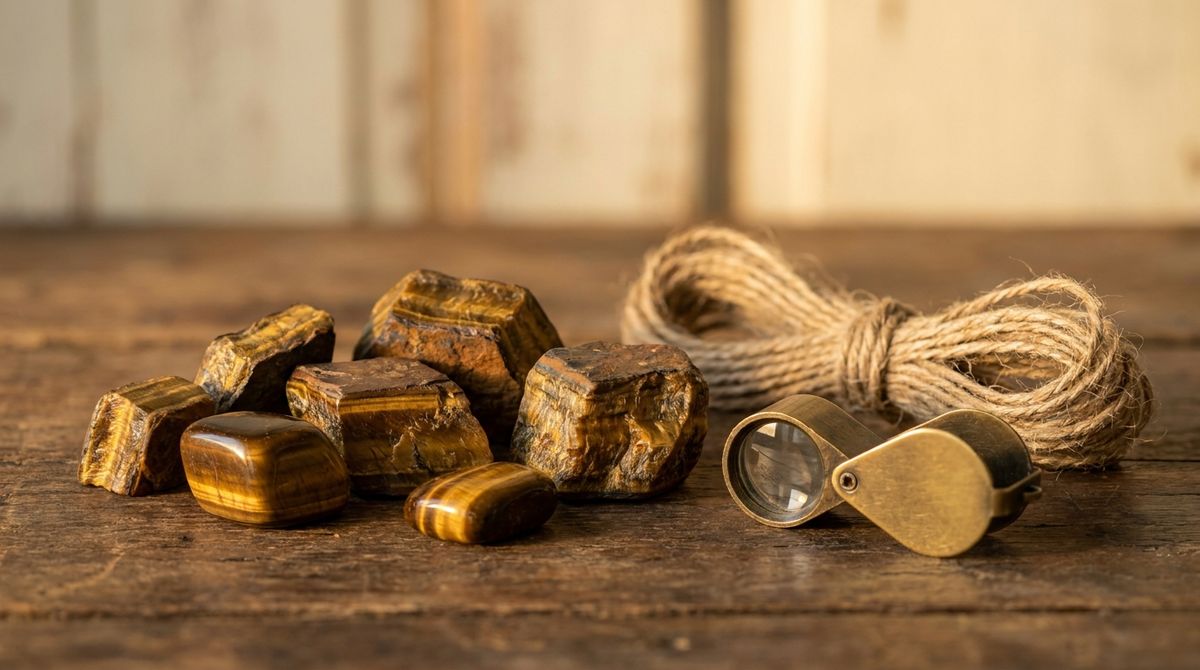
At a glance
- Hardness Mohs 6.5 to 7, quartz-based (SiO2).
- The moving band of light comes from fibres inside the stone. Gold comes from iron oxides.
- Three colours: gold-brown (usual), red (mostly heat-treated, some dyed), blue-grey hawk's eye.
- Care: warm soapy water and a soft brush; skip machine cleaners and solvents.
Quick facts
| Family | Quartz group (quartz with fibrous amphibole inclusions) |
|---|---|
| Chemical formula | SiO2 (quartz), coloured mainly by iron oxide |
| Crystal system | Quartz is trigonal. Tiger's eye is a compact, fibrous mass of tiny quartz crystals with fibrous inclusions, so it shows no visible crystal faces. |
| Mohs hardness | 6.5–7 |
| Luster | Silky |
| Natural colors | golden to red-brown, red or maroon (mostly heat-treated), blue-grey to dark blue (hawk's eye), bluish-grey with brown or yellow overtones |
| Main localities | South Africa (Northern Cape Province, near Prieska), the chief source; Western Australia (Pilbara); India, Myanmar, Namibia, the United States, Brazil, Canada, China, Korea and Spain |
| Common treatments | red stones are developed by gentle heat treatment, some red or maroon stones are dyed, dark stones are reportedly lightened with acid, most tiger's eye is natural and untreated |
Tiger's Eye at a glance, in pictures
Chakras (traditional)
Hardness range
Natural colors
- golden to red-brown
- red or maroon (mostly heat-treated)
- blue-grey to dark blue (hawk's eye)
- bluish-grey with brown or yellow overtones
Traditionally linked to
- Planet
- Sun
- Zodiac
- LeoCapricorn
- Element
- Fire
Common forms of Tiger's Eye
- Rough raw chunk
- Tumbled polished pebble
- Cabochon smooth dome
- Sphere ball
How hard is Tiger's Eye?
- Talc 1
- Gypsum 2
- Copper coin ~ 3
- Calcite 3
- Fluorite 4
- Apatite 5
- Glass ~ 5.5
- Steel knife ~ 5.5
- Orthoclase 6
- Tiger's Eye 6.5–7
- Quartz 7
- Topaz 8
- Corundum 9
- Diamond 10
What it is and where it comes from
A tiger's-eye slab from the Pilbara region of Western Australia formed about 2.5 billion years ago in iron-rich sediments. Fractures in the rock filled with fibrous crocidolite, and quartz then encased the fibres.
Tiger's eye was long thought to form by quartz replacing crocidolite fibre by fibre. An alternative idea is that repeated cracking and filling left each band, with new fibres growing in the gap. The older replacement story is still widely repeated.
Chalcedony is not usually found in the South African material, so the shimmer comes from the crocidolite fibres rather than from chalcedony.
The gold and brown tones come from iron: the iron-rich needles in common golden-brown material have weathered to iron oxides. In the rarer dark blue hawk's eye the needles are less altered and keep their original colour.
Large South African finds in the 1800s reportedly made the stone far more available. Today the Prieska deposits are mined intermittently and on a small scale by local communities.
Some cultures believe tiger's eye wards off the evil eye, and Roman soldiers reportedly wore engraved tiger's eye for protection in battle. This is lore.
In crystal tradition
What follows is belief and folklore, passed down in crystal tradition. It is not measured fact.
Traditionally associated with: courage, confidence, protection.
Tiger's eye is traditionally associated with the Solar Plexus chakra, and some lists add the Sacral chakra. This is belief, not a fact about the stone.
It is traditionally paired with Leo and Capricorn, the Sun and the element Fire. These mappings differ between lists and have no scientific basis.
In crystal tradition the colours are read differently: gold for confidence, red for motivation, and blue hawk's eye for calm and intuition. This is belief, not a fact about the stone.
The protective reputation draws on the older lore of the evil eye and Roman soldiers. These are symbolic meanings, not effects on the body or mind.
How to care for Tiger's Eye
- Water Safe
- Sunlight Unknown
- Salt Unknown
- Heat Unknown
- Ultrasonic Avoid
- Chemicals Caution
Safe = fine as a rule · Caution = only briefly or gently · Avoid = can damage the stone · Unknown = no reliable guidance.
Warm water with a few drops of mild dish soap and a soft brush reserved for jewelry is safe for most gemstones. Skip ultrasonic and other machine cleaning, especially for red stones that have been heat-treated or may be dyed. Dyes can be removed by solvents such as alcohol or acetone and some fade in prolonged sun, so keep any dyed piece away from both. Effects of sunlight, heat or salt on tiger's eye are not well documented, so avoid long exposure as a precaution, and keep torch or open flame away from the stone. Cutting or grinding can release fine fibre dust, so leave shaping to a workshop with wet cutting.
Real or fake? Look-alikes and treatments
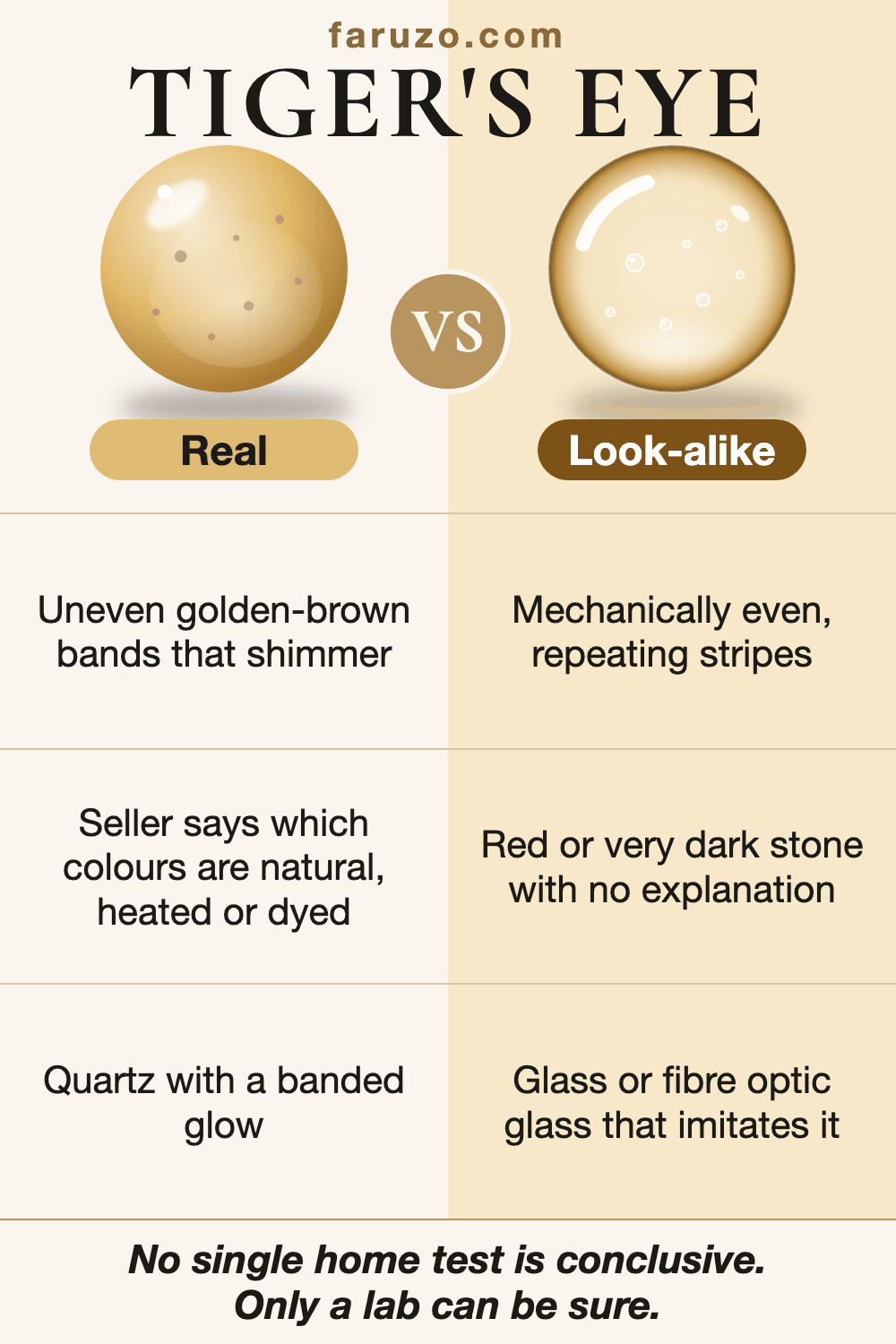
Often confused with
- Petrified tree fern
- Glass and fibre optic glass
- Dyed or heat-treated red stones
- Tiger iron
Common look-alikes
- Petrified tree fern. Petrified tree fern can look much like tiger's eye, and ordinary tests may not separate them. A lab can sometimes tell them apart.
- Glass and fibre optic glass. Glass can be made to resemble tiger's eye, and fibre optic glass is a frequent imitation. Glass is not quartz, so a gemmologist can separate it by measuring refractive index and specific gravity.
- Dyed or heat-treated red stones. These are tiger's eye, not fakes, but the colour is not natural. Red stones are usually developed by gentle heating, and some are dyed. Ask which treatment was used.
- Tiger iron. Tiger iron is a banded rock with tiger's eye in it, with reddish-brown and steel-grey patterns from hematite. It is natural, but it is not a pure chatoyant stone.
Safe checks you can do
- Ask the seller in writing whether the stone is natural, heat-treated or dyed, and which colour is which.
- Tilt it under a single light. Natural tiger's eye shows uneven golden-brown bands, while mechanically even, repeating stripes deserve a closer look. This is a sign, not proof, because glass can be made to resemble it.
- Do not rely on acetone-swab or penny-scratch tests: a swab can mark a finished piece, and neither is conclusive. Ask for magnified inspection or lab testing instead.
- For a stone that matters, ask a gemmologist or lab to measure specific gravity and refractive index. These readings help separate tiger's eye from glass, though not reliably from petrified tree fern.
- Ask about red and very dark stones in particular. Red is mostly heat-treated and may be dyed, and dark stones are reportedly lightened with acid, so an unusual colour is a question for the seller, not proof of a fake.
Wearing Tiger's Eye
Ring
Careful
Fine with care, but knocks can mark it.
Bracelet
Safe
Fairly hard, so fine for normal bracelet wear.
Pendant
Safe
Fairly hard, and a pendant sits clear of knocks.
Earrings
Safe
Fairly hard, and earrings rarely take knocks.
Guide for everyday wear, based on hardness and care notes. Safe, Careful or Avoid.
Tiger's eye is Mohs 6.5 to 7, softer than sapphire, ruby or diamond, which can scratch it if loose pieces knock together in a jewelry box. It is usually cut as a cabochon or bead to show the moving band of light. A pendant, bead bracelet or earring is a lower-risk choice, and a ring takes more knocks, so a protective setting helps. Take it off before using solvents, strong cleaners or cleaning machines.
Related stones
Questions about Tiger's Eye
What does tiger's eye mean?
In crystal tradition tiger's eye is linked to courage, confidence and protection. These are symbolic meanings, not effects on the body or mind.
Why does tiger's eye shimmer?
The moving band of light, called chatoyancy, comes from parallel fibres inside the quartz, not from the quartz itself. The fibres are crocidolite that has weathered with iron, grown through the stone as it formed by repeated cracking and filling of the rock.
Is tiger's eye a birthstone?
Not on the standard birthstone list, which names no month for tiger's eye. Crystal tradition pairs it with zodiac signs such as Leo and Capricorn, but that is a separate tradition from birthstones and varies between lists.
What is the difference between tiger's eye and hawk's eye?
They are close relatives. In common golden-brown tiger's eye the iron-rich needles have weathered to iron oxides. In hawk's eye, dark blue to bluish-grey, the needles are less altered and keep their original colour. Hawk's eye is generally the less common variety.
Is red tiger's eye natural?
Red tiger's eye is real tiger's eye with a changed colour. Red stones are usually developed by gentle heat treatment, and some are dyed. Ask which treatment applies.
How can you tell if tiger's eye is real or fake?
Home checks are unreliable on their own. Look for uneven golden-brown bands with a moving band of light, but remember glass and fibre optic glass can imitate the look. For a stone that matters, a gemmologist can measure specific gravity and refractive index.
How do you clean tiger's eye?
Use warm water, a few drops of mild dish soap and a soft brush, then dry it fully. Red and other treated pieces need extra care: keep solvents and cleaning machines away from them.
Does tiger's eye contain asbestos?
The golden fibres are usually described as crocidolite (a blue asbestos-type fibre mineral) that quartz has replaced or grown around, so the stone is now mostly quartz. Do not grind or cut it at home, because cutting dust should be left to workshops with wet cutting and a mask.
Can tiger's eye get wet?
Yes, briefly. A rinse is fine; dry it fully afterwards. For red or other treated pieces, avoid long soaking.