
Crystal guide
Labradorite Meaning, Properties and Care
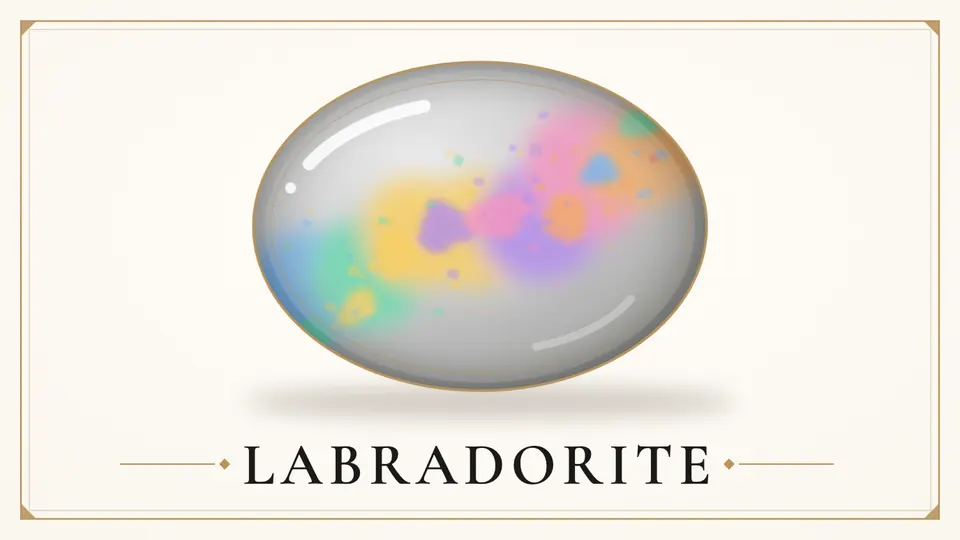
Labradorite is a plagioclase feldspar (Mohs 6 to 6.5) best known for labradorescence, a flash of blue, green, gold or purple that switches on and off as the stone is turned. The base is usually grey to dark, and the flash comes from thin layers inside the crystal. In crystal tradition it is a stone of intuition and change.
At a glance
- A feldspar (plagioclase), not a quartz, with a color flash called labradorescence.
- Hardness Mohs 6 to 6.5, but it has perfect cleavage, so a hard knock can split it.
- Spectrolite is the name for the Finnish material with the widest color range: the same mineral, not a different stone.
- Care: soft cloth, mild soap and water; no machine cleaners or steam. Moonstone is the usual look-alike.
Quick facts
| Family | Plagioclase feldspar (a silicate in the calcium-rich part of the plagioclase series) |
|---|---|
| Chemical formula | (Ca,Na)(Al,Si)4O8, with roughly 50 to 70 percent of the calcium end of the series |
| Crystal system | Triclinic |
| Mohs hardness | 6–6.5 |
| Luster | Vitreous (glassy), sometimes pearly on cleavage surfaces |
| Transparency | Translucent to transparent, often nearly opaque in dark jewelry material |
| Natural colors | grey, grey-green or near black body color; flash of blue, green, gold or yellow, and sometimes purple, pink, orange or red; spectrolite shows a wider range of flash colors in one stone |
| Main localities | Canada (Paul's Island near Nain, Labrador, the type area); Finland (Ylamaa, home of spectrolite); Madagascar; China; Australia; Slovakia; Norway; Poland; USA |
| Common treatments | usually sold as cut and polished natural stone; dyed or coated pieces, sometimes sold as 'mystic' or 'aura' material, exist, so ask what was done |
Labradorite at a glance, in pictures
Chakras (traditional)
Hardness range
Natural colors
- grey, grey-green or near black body color
- flash of blue, green, gold or yellow, and sometimes purple, pink, orange or red
- spectrolite shows a wider range of flash colors in one stone
Traditionally linked to
- Zodiac
- ScorpioSagittariusLeo
Common forms of Labradorite
- Rough raw chunk
- Tumbled polished pebble
- Cabochon smooth dome
How hard is Labradorite?
- Talc 1
- Gypsum 2
- Copper coin ~ 3
- Calcite 3
- Fluorite 4
- Apatite 5
- Glass ~ 5.5
- Steel knife ~ 5.5
- Orthoclase 6
- Labradorite 6–6.5
- Quartz 7
- Topaz 8
- Corundum 9
- Diamond 10
What it is and where it comes from
The stone is named after Labrador in Canada. Its type area is Paul's Island near Nain, and it is traditionally said to have been first described by a missionary there around 1770.
The flash is caused by very thin, repeating layers that form inside the crystal as it cools slowly. Light reflects between them, and the spacing of the layers decides the color you see, which is why the effect only shows at certain angles.
More on its history
Spectrolite is a trade name for labradorite from Ylamaa in south-eastern Finland. The deposit is reported to have been found around 1940 during construction of defensive works, quarrying began after the Second World War, and local cutting and polishing began in the 1970s.
Oregon sunstone, from Harney County and Lake County, Oregon, is a related copper-bearing feldspar that is often classed as a variety of labradorite. Its sparkle (schiller) and color are linked to tiny copper inclusions, and it became Oregon's state gemstone in the late 1980s.
Labradorite through time
-
Around 1770
Traditional date for the first description of the stone near Nain, on the Labrador coast of Canada.
-
Around 1940
The deposit at Ylamaa in Finland, later sold as spectrolite, was reportedly found during construction of defensive works.
-
After the Second World War
Quarrying of the Finnish material began.
-
The 1970s
The first local workshop in Ylamaa started cutting and polishing spectrolite.
-
Late 1980s
Oregon named its copper-bearing sunstone, a related feldspar often classed as labradorite, its state gemstone.
In crystal tradition
What follows is belief and folklore, passed down in crystal tradition. It is not measured fact.
Traditionally associated with: change, intuition, inner clarity.
Labradorite is traditionally called the stone of transformation. Traditionally, its dull grey surface that only shows color at the right angle is read as a picture of change, linked to intuition and getting through life transitions. This is a modern spiritual tradition, not a fact about the stone.
It is traditionally associated with the Third Eye and Crown chakras. Zodiac pairings vary between lists: Scorpio, Sagittarius and Leo are named most often. These pairings differ from list to list and have no scientific basis.
Pink-flashing labradorite is sometimes said in the crystal trade to relate to the heart. That is a marketing tradition and not a property of the stone.
A popular story says the Northern Lights were once trapped in the rocks of Labrador until a warrior freed them with his spear. It is a folk tale told by the crystal trade, not a documented history, and it came long after the stone was described.
How to care for Labradorite
- Water Safe
- Sunlight Unknown
- Salt Unknown
- Heat Caution
- Ultrasonic Avoid
- Chemicals Caution
Safe = fine as a rule · Caution = only briefly or gently · Avoid = can damage the stone · Unknown = no reliable guidance.
Clean labradorite by hand with a soft cloth and mild soap and water, then dry it. Skip ultrasonic and steam cleaners: perfect cleavage means vibration or sudden heat can stress the stone along a weak plane. Avoid harsh cleaners as a precaution. Effects of long sun or salt water are not well documented, so avoid them as a precaution. Store it apart from harder stones that could scratch it.
Real or fake? Look-alikes and treatments
Often confused with
- Moonstone
- Oregon sunstone
- Rainbow moonstone
Common look-alikes
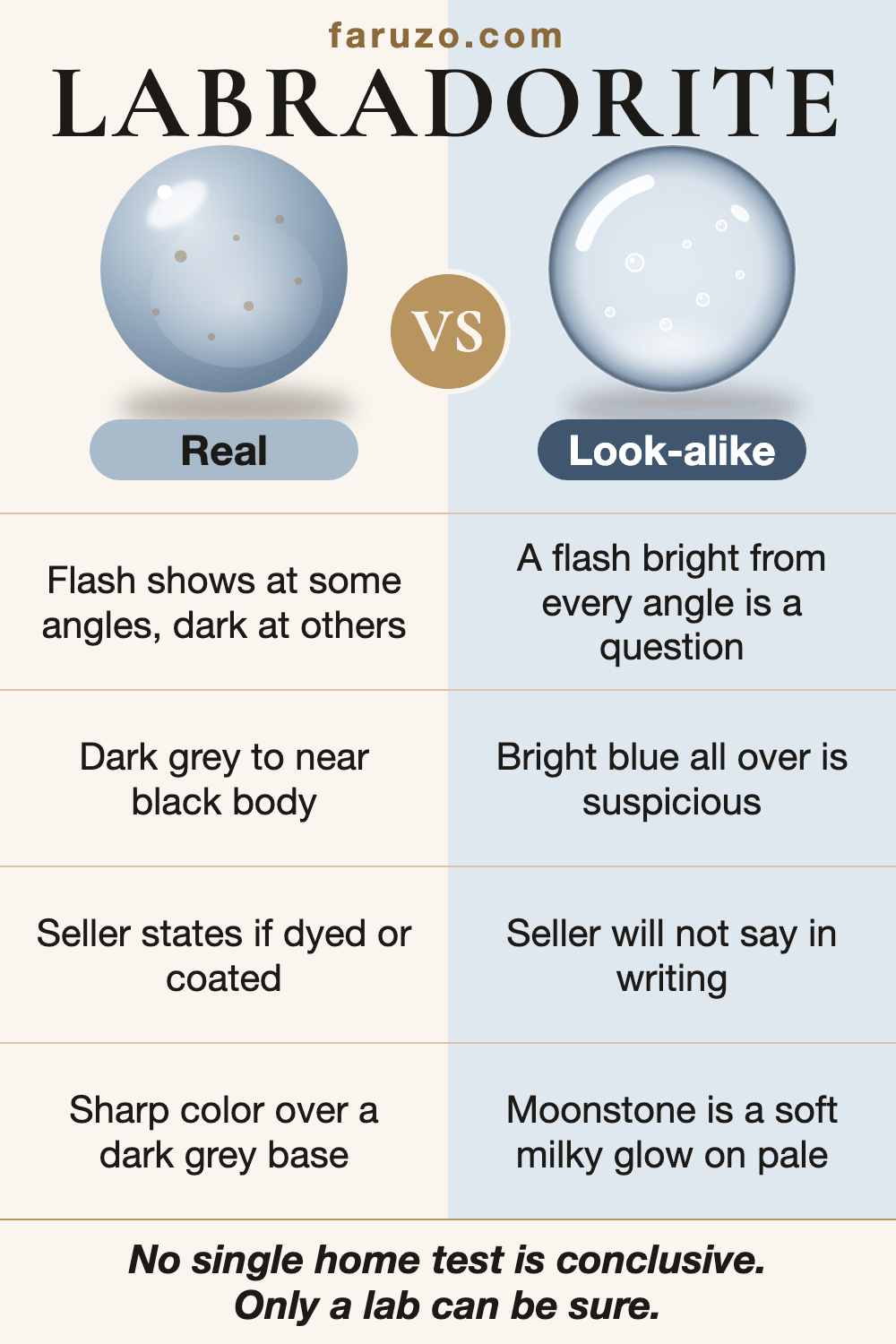
- Moonstone. Moonstone is also a feldspar, but its glow (adularescence) is a soft, milky sheen over a pale, near-clear base. Labradorite flashes sharper color over a darker grey base, and only at certain angles. Base color is often the fastest side-by-side clue.
- Oregon sunstone. A copper-flecked, often transparent feldspar from Oregon, often classed as a labradorite variety. Its golden to orange or reddish glow looks different from the grey base and blue or green flash of typical labradorite.
- Rainbow moonstone. Despite the name, rainbow moonstone is generally labradorite, usually with a pale, clear to white base and a blue or rainbow flash, rather than true moonstone. If a 'rainbow moonstone' flashes sharp color from certain angles, it is very likely labradorite. Ask what the stone is.
Safe checks you can do
- Turn the stone under one light. Real labradorescence appears at certain angles and goes dark at others. A flash that stays bright from every angle is a prompt to ask questions.
- Look at the body color. Real labradorite is dark grey, grey-green or near black away from the flash, not bright blue all over.
- Ask the seller in writing whether the stone is natural labradorite, spectrolite or a mix, and whether anything was coated or dyed. Spectrolite is a trade name for Finnish material, so a clear answer on origin is fair to expect.
Wearing Labradorite
Ring
Careful
Cleaves if knocked hard; a protective setting helps a ring.
Bracelet
Careful
Cleaves if knocked hard, so wear it with care.
Pendant
Careful
Takes few knocks; the flash shows best on a cabochon.
Earrings
Careful
Takes few knocks; light, but cleavage means no hard blows.
Guide for everyday wear, based on hardness and care notes. Safe, Careful or Avoid.
Labradorite is hard enough for everyday wear (Mohs 6 to 6.5, softer than quartz), but perfect cleavage means a sharp direct knock can split it. Pendants and earrings take the fewest knocks, while a ring worn daily is better in a protective setting. A cabochon cut is the usual way to show the flash, because the stone has to be oriented so the layers face the viewer.
Questions about Labradorite
What does labradorite mean?
In crystal tradition labradorite is the stone of transformation, linked to change, intuition and hidden potential. The idea comes from how the stone looks plain until it catches light at the right angle. These are symbolic meanings, not facts about the stone or claims about your health.
Is labradorite a real gemstone?
Yes. It is a natural plagioclase feldspar that is cut into cabochons, beads and carvings. It is usually called semi-precious, which is a market tradition and says nothing about whether it is genuine.
What causes the color flash in labradorite?
The flash is called labradorescence. It comes from thin, repeating layers inside the crystal that formed as it cooled slowly. Light reflects between those layers, and their spacing sets the color, so the effect shows only at certain angles.
What is the difference between labradorite and spectrolite?
Spectrolite is labradorite, not a different mineral. The name is used for the material from Ylamaa in Finland, which is prized for showing a wider range of flash colors in one stone. The term is sometimes used loosely for very colorful stones from elsewhere.
Is labradorite the same as moonstone?
Classic moonstone is a different feldspar, though both are feldspars. Moonstone gives a soft, milky glow over a pale base, while labradorite gives sharper color flashes over a darker grey base. Looking at the base color side by side is often the quickest way to separate them. Note that 'rainbow moonstone' is usually labradorite sold under a moonstone name.
How hard is labradorite?
Mohs 6 to 6.5. That resists everyday scratching about as well as moonstone, but it has perfect cleavage in one direction and a second good one at nearly a right angle, so a hard knock can split it. Pendants and earrings are safer than a daily ring.
How do you clean labradorite?
Hand-wash it with mild soap and water, dry it, and keep it clear of harsh chemicals. Its perfect cleavage is the reason to be gentle: a hard knock or a jolt of heat can stress it.
How can you tell real labradorite from a fake?
A home look can only hint. Real labradorescence appears and disappears as you tilt the stone, and the body color is dark grey or near black. A flash that is the same from every angle, a glue line or a coating that is wearing off are warning signs. A gemologist can look at a stone that matters.
What is pink labradorite?
It is labradorite whose layers flash pink or purple instead of the more common blue, green or gold, which is less usual. It is not a separate mineral, and pink-flashing pieces can also be coated, so check what was done.
Is labradorite a birthstone?
Not on the standard birthstone lists. Crystal tradition pairs it with zodiac signs, which is a separate idea from birthstones.
Is rainbow moonstone the same as labradorite?
Usually, yes. Stones sold as rainbow moonstone, with a blue or rainbow flash, are generally labradorite with a pale base rather than true moonstone.
What other names does labradorite go by?
Spectrolite is the best-known one, for the Finnish material. You will also see flash-color names such as rainbow, pink or purple labradorite. Black moonstone and rainbow moonstone are trade names that usually mean labradorite rather than true moonstone, and Oregon sunstone is a related copper-bearing feldspar often classed as labradorite.
Can labradorite get wet?
Brief contact is fine: a rinse or hand-wash in lukewarm water is okay. Dry it afterwards and do not soak it, especially if a coating may have been added.