
Crystal guide
Fuchsite Meaning, Properties and Care
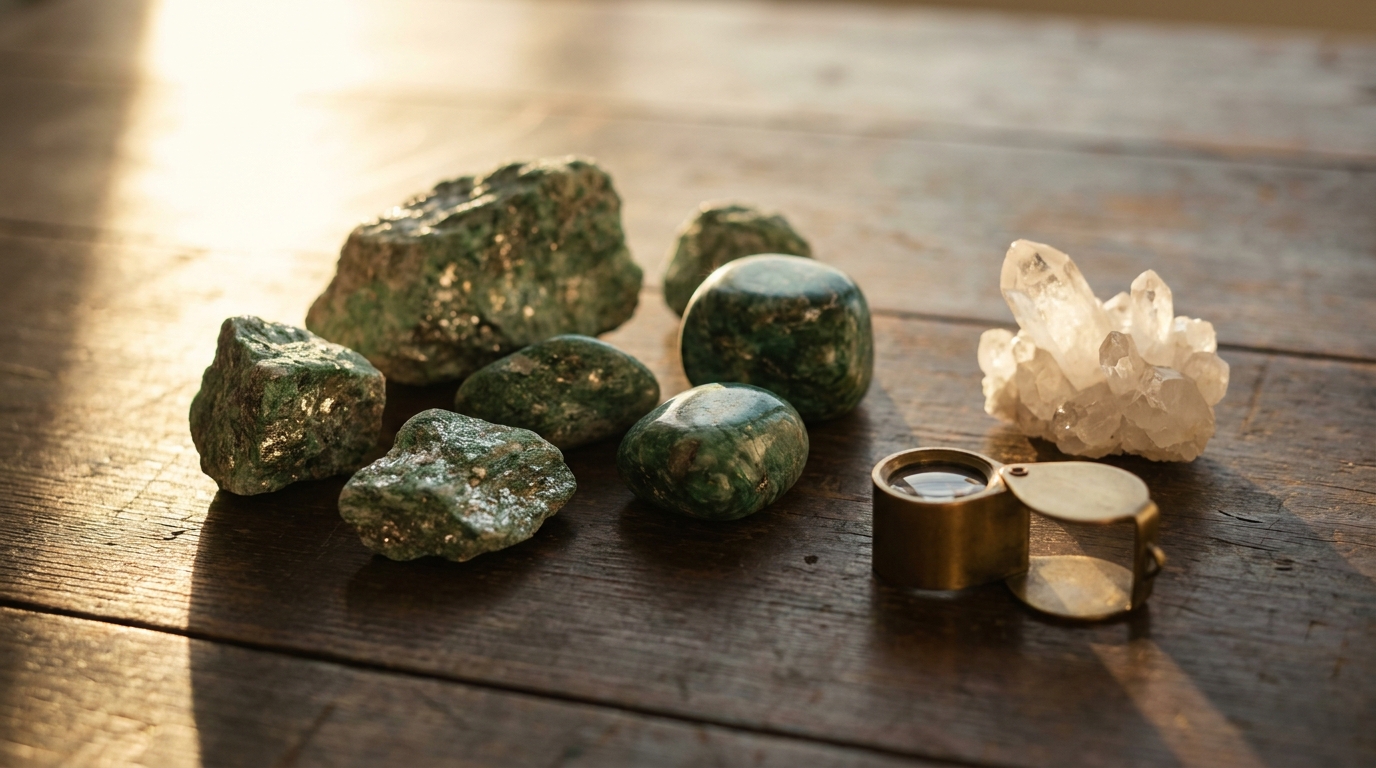
Fuchsite is the green, chromium-bearing variety of muscovite mica (K(Al,Cr)3Si3O10(OH)2). It is very soft, about 2 to 2.5 on the Mohs scale, and it peels into thin flakes along one flat plane. Many green stones sold under the name are fuchsite quartzite, a much harder rock with fuchsite flakes in it. In crystal tradition it is a gentle, heart-centred stone.
At a glance
- Formula K(Al,Cr)3Si3O10(OH)2, monoclinic, a chromium-green mica.
- Hardness only about 2 to 2.5 on the Mohs scale, with perfect cleavage that lets it flake and peel.
- Many green beads and tumbled stones are fuchsite quartzite, quartz with green flakes, which is much harder (about 7).
- Care: dry soft cloth, no soaking, no machine cleaners. Solid fuchsite is best avoided for rings and bracelets.
Quick facts
| Family | Mica (sheet silicate), the chromium-bearing green variety of muscovite |
|---|---|
| Chemical formula | K(Al,Cr)3Si3O10(OH)2 |
| Crystal system | Monoclinic, as thin flexible sheets and small flakes |
| Mohs hardness | 2–2.5 |
| Luster | Vitreous to pearly, with perfect cleavage in one direction (it splits into thin sheets) |
| Transparency | Translucent to opaque, usually with a glittery shimmer |
| Natural colors | pale green to emerald green, depending on how much chromium is present |
| Main localities | South Africa (the rock verdite, near Barberton); Brazil; India; Austria; Russia |
| Common treatments | solid fuchsite is usually sold untreated, but soft or crumbly pieces are sometimes stabilised with resin or dyed to deepen the green; fuchsite quartzite beads are sometimes dyed as well |
Fuchsite at a glance, in pictures
Chakras (traditional)
Hardness range
Natural colors
- pale green to emerald green, depending on how much chromium is present
Common forms of Fuchsite
- Rough raw chunk
- Tumbled polished pebble
- Carving carved pendant
How hard is Fuchsite?
- Talc 1
- Gypsum 2
- Fuchsite 2–2.5
- Copper coin ~ 3
- Calcite 3
- Fluorite 4
- Apatite 5
- Glass ~ 5.5
- Steel knife ~ 5.5
- Orthoclase 6
- Quartz 7
- Topaz 8
- Corundum 9
- Diamond 10
What it is and where it comes from
The name honours Johann Nepomuk von Fuchs, a 19th-century German chemist.
Fuchsite is simply muscovite coloured green by chromium. Plain muscovite is colourless to pale, and the more chromium it holds, the deeper the green.
It forms in metamorphic rock such as schist, usually as scattered flakes rather than large crystals, so it is rarely cut as a gem on its own.
Verdite is the name for a green rock made mostly of fuchsite. It is associated with South Africa and is carved into ornaments and beads.
Fuchsite quartzite is quartz holding many green fuchsite flakes. The flakes give it a sparkle, and because quartz is the main mineral the rock is much harder than fuchsite itself. Green aventurine is a close relative.
A popular decorative material pairs pink-to-red ruby crystals with a green fuchsite background, often sold as ruby in fuchsite.
In crystal tradition
What follows is belief and folklore, passed down in crystal tradition. It is not measured fact.
Traditionally associated with: compassion, forgiveness, emotional release.
Fuchsite is traditionally associated with the Heart chakra and with love, compassion and forgiveness. This is a modern spiritual tradition, not a fact about the stone.
Some crystal lore also links it to letting go of old emotional patterns and to abundance. These are beliefs within crystal practice and carry no physical evidence.
How to care for Fuchsite
- Water Caution
- Sunlight Unknown
- Salt Unknown
- Heat Caution
- Ultrasonic Avoid
- Chemicals Caution
Safe = fine as a rule · Caution = only briefly or gently · Avoid = can damage the stone · Unknown = no reliable guidance.
Wipe fuchsite with a soft dry or barely damp cloth and never soak it, because the layered mica can lift and flake. Avoid ultrasonic and steam cleaners, which can split the layers. Keep it away from perfume, cleaners and hot water, and store it apart from harder stones so it is not scratched. Fuchsite quartzite is tougher, but dyed or stabilised pieces still need gentle handling.
Real or fake? Look-alikes and treatments
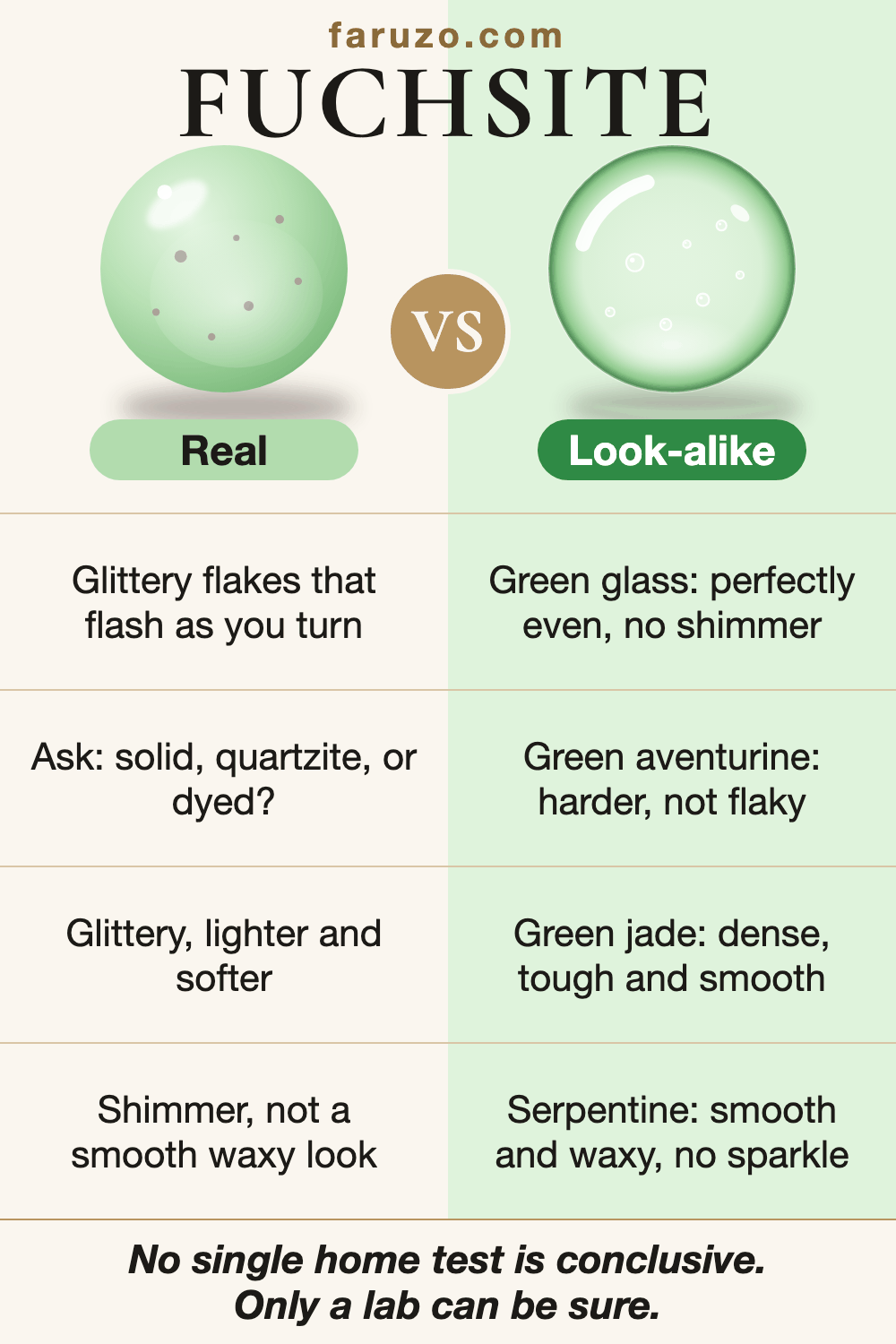
Often confused with
- Green aventurine
- Serpentine
- Green-dyed quartz or glass
- Green jade or other green rock
Common look-alikes
- Green aventurine. A green quartz with a sparkle that comes from fuchsite flakes. It is much harder (about 7) and not flaky, so it does not peel or scratch with a fingernail.
- Serpentine. Serpentine is a different green mineral with a smooth, waxy look rather than a glittery shimmer, and it lacks the flaky mica sparkle.
- Green-dyed quartz or glass. Vivid, perfectly even green with no flaky shimmer points to dyed quartz or glass. Genuine fuchsite shows tiny reflective flakes that flash as the stone turns.
- Green jade or other green rock. Jade is dense and tough with a smooth, even texture, while fuchsite looks glittery and feels lighter and softer.
Safe checks you can do
- Look for glittery flakes that flash as you turn the stone. That shimmer is typical of fuchsite and fuchsite quartzite, but it is only a hint.
- Ask whether the piece is solid fuchsite, fuchsite quartzite, or dyed or stabilised. The answer changes how it wears and how it should be cared for.
- A very hard, glassy piece is probably fuchsite quartzite or another stone rather than solid fuchsite, which should feel soft and flaky.
- Do not scratch-test a stone you plan to keep, because fuchsite marks very easily.
Wearing Fuchsite
Ring
Avoid
Splits easily along a flat plane, so a ring is best avoided.
Bracelet
Avoid
One knock on the wrist can split it along a flat plane.
Pendant
Avoid
A pendant can still split along a flat plane, so it is best avoided.
Earrings
Avoid
Small and exposed, and it splits easily: earrings are best avoided.
Guide for everyday wear, based on hardness and care notes. Safe, Careful or Avoid.
Solid fuchsite is as soft as a fingernail and peels along flat layers, so a ring, bracelet, pendant or pair of earrings in it is best avoided. It suits display, a protected carving or occasional gentle wear far better than daily jewelry. If you like the look, fuchsite quartzite is far harder and holds up much better, though dyed or stabilised pieces still need care. Take it off for the gym, cleaning and anything rough.
Related stones
Questions about Fuchsite
What does fuchsite mean?
In crystal tradition fuchsite is a gentle stone linked to the Heart chakra, love, compassion and forgiveness. That is a belief, not a fact about the stone.
What is fuchsite?
Fuchsite is the green, chromium-bearing variety of muscovite mica, K(Al,Cr)3Si3O10(OH)2. Chromium gives it its colour, from pale green to emerald.
Is fuchsite a real gemstone or just coloured mica?
It is a genuine mineral, a chromium mica, and its green is natural. It is rarely cut as a gem on its own, though, because it is so soft and flaky.
How hard is fuchsite?
About 2 to 2.5 on the Mohs scale, roughly as soft as a fingernail, with perfect cleavage so it peels into thin sheets.
Is fuchsite a birthstone?
No. Fuchsite is not on the standard modern or traditional birthstone lists.
Is fuchsite the same as green aventurine?
No, but they are related. Green aventurine is quartz that owes its sparkle to fuchsite flakes. It is much harder, about 7.
What is fuchsite quartzite?
It is quartz rock full of green fuchsite flakes. It is often sold simply as fuchsite, and it is much harder than solid fuchsite, around 7, so it suits jewelry better.
Can fuchsite get wet or fade?
Do not soak it, since the layers can lift and flake. A damp wipe is fine if dried right away. Fading is not a known problem, but dyed pieces may lose colour, so ask the seller what a piece is.
Can you wear a fuchsite ring?
A ring of solid fuchsite is best avoided, because it scratches and flakes easily. A fuchsite quartzite ring takes knocks better, though dyed or stabilised pieces still need care.
Are fuchsite stones dyed or stabilised?
Some are. Soft or crumbly material can be stabilised with resin, and some green beads are dyed. A lab can sometimes tell, so ask what the piece is before you buy.
What is verdite?
Verdite is a green rock made mostly of fuchsite, associated with South Africa and carved into ornaments.
Where does fuchsite come from?
It forms in metamorphic rock such as schist and is found in places including South Africa, Brazil, India, Austria and Russia.