
Crystal guide
Serpentine Meaning, Properties and Care
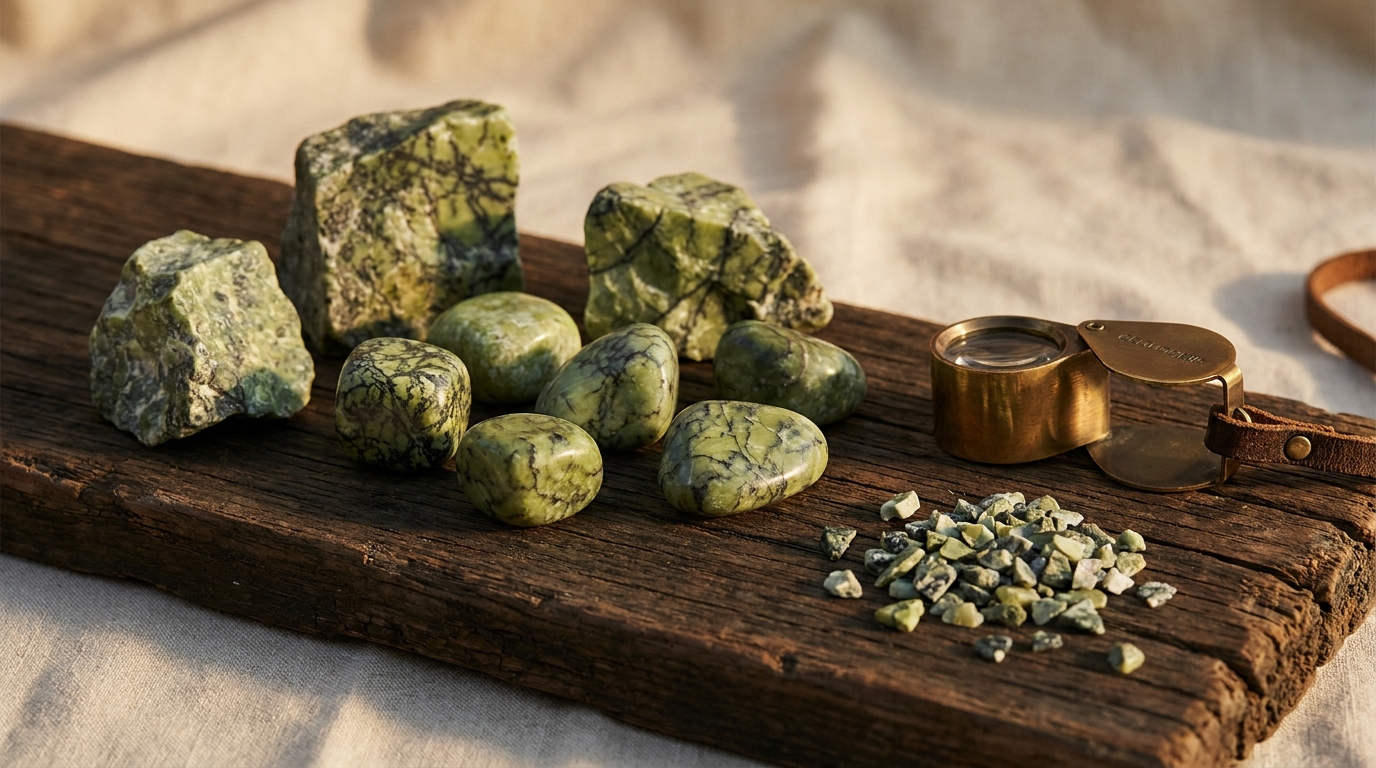
Serpentine is not one mineral but a group of about twenty related green-to-yellow silicates that share a formula and look similar enough to sell under one name. Hardness is 2.5 to 5.5 on the Mohs scale, varying by type, and the name itself comes from the mottled, snake-skin look of a polished piece. In crystal tradition it is a stone of change and renewal.
At a glance
- A group of about 20 minerals, with roughly the formula Mg3Si2O5(OH)4, mostly green and often mottled.
- Hardness is 2.5 to 5.5 on the Mohs scale, varying by type, so most pieces scratch easily.
- Named varieties include bowenite (one of the harder ones), williamsite and the soft, common lizardite.
- Often sold as "new jade", but it is a separate stone from jade, and some pieces are dyed or stabilised.
Quick facts
| Family | Hydrous magnesium silicate group (phyllosilicate); main members are antigorite, lizardite and chrysotile |
|---|---|
| Chemical formula | Roughly Mg3Si2O5(OH)4, with some iron, nickel, manganese or zinc replacing magnesium |
| Crystal system | Monoclinic, usually sold as massive (compact, non-crystalline-looking) material |
| Mohs hardness | 2.5–5.5 |
| Luster | Waxy, greasy or silky, rarely glassy |
| Transparency | Translucent to opaque |
| Natural colors | green to yellow-green (the best-known look), often mottled or veined; olive or oily green (williamsite); apple green, translucent (bowenite); white, grey, brown or near-black |
| Main localities | USA (California, Rhode Island, Maryland and Pennsylvania); Canada (Quebec); New Caledonia; India; Britain (the Lizard peninsula, Cornwall); Greece; Russia (the Urals); China |
| Common treatments | lower grades are sometimes dyed, often to imitate jade; some pieces are stabilised (soaked in resin or wax to firm and polish them); colour and finish of a treated piece can change over time |
Serpentine at a glance, in pictures
Chakras (traditional)
Hardness range
Natural colors
- green to yellow-green (the best-known look), often mottled or veined
- olive or oily green (williamsite)
- apple green, translucent (bowenite)
- white, grey, brown or near-black
Traditionally linked to
- Zodiac
- Gemini
- Element
- Earth
Common forms of Serpentine
- Rough raw chunk
- Tumbled polished pebble
- Cabochon smooth dome
- Bead drilled bead
- Carving carved pendant
How hard is Serpentine?
- Talc 1
- Gypsum 2
- Copper coin ~ 3
- Calcite 3
- Fluorite 4
- Serpentine 2.5–5.5
- Apatite 5
- Glass ~ 5.5
- Steel knife ~ 5.5
- Orthoclase 6
- Quartz 7
- Topaz 8
- Corundum 9
- Diamond 10
What it is and where it comes from
The name comes from the Latin serpentinus, meaning snake-like, for the green, mottled and sometimes scaly look of the stone.
It forms when water reacts with magnesium-rich rock deep in the crust, often along ocean ridges, fault lines and plate collision zones. That is why it turns up on almost every continent rather than in one famous deposit.
Three main types make up most material: antigorite, lizardite and chrysotile. They share a chemistry but differ in structure, and they are hard to tell apart without lab tools.
Antigorite is the type most often cut for gems and carvings. Bowenite is a hard, translucent, apple-green form of it, and williamsite is an oily olive-green form first known from the eastern USA.
Verd antique is a decorative serpentine-rich rock used for architectural and ornamental work rather than jewelry.
Serpentine is a group of minerals, and one member, chrysotile, is a fibrous asbestos mineral. Cutting or grinding dust should be left to workshops that use wet cutting and a mask.
In crystal tradition
What follows is belief and folklore, passed down in crystal tradition. It is not measured fact.
Traditionally associated with: change, renewal, grounding.
Serpentine is traditionally linked with transformation and renewal, an idea drawn from its snake name and green colour. This is a modern spiritual tradition, not a fact about the stone.
Crystal tradition also ties it to the Heart chakra, to the earth and to Gemini, and says it guards against negative energy. These are beliefs within crystal practice with no physical basis.
How to care for Serpentine
- Water Caution
- Sunlight Unknown
- Salt Unknown
- Heat Caution
- Ultrasonic Avoid
- Chemicals Caution
Safe = fine as a rule · Caution = only briefly or gently · Avoid = can damage the stone · Unknown = no reliable guidance.
Wipe serpentine with a soft damp cloth and dry it straight away. Do not soak it, since soaking can dull a polish and dyed or stabilised pieces may suffer. Keep it away from steam, hot water and acidic or strong cleaners, and skip ultrasonic cleaners, because vibration can crack a soft stone. Store it apart from harder jewelry so it is not scratched.
Real or fake? Look-alikes and treatments
Often confused with
- Jade (jadeite and nephrite)
- Green aventurine
- Green calcite and other soft green stones
Common look-alikes
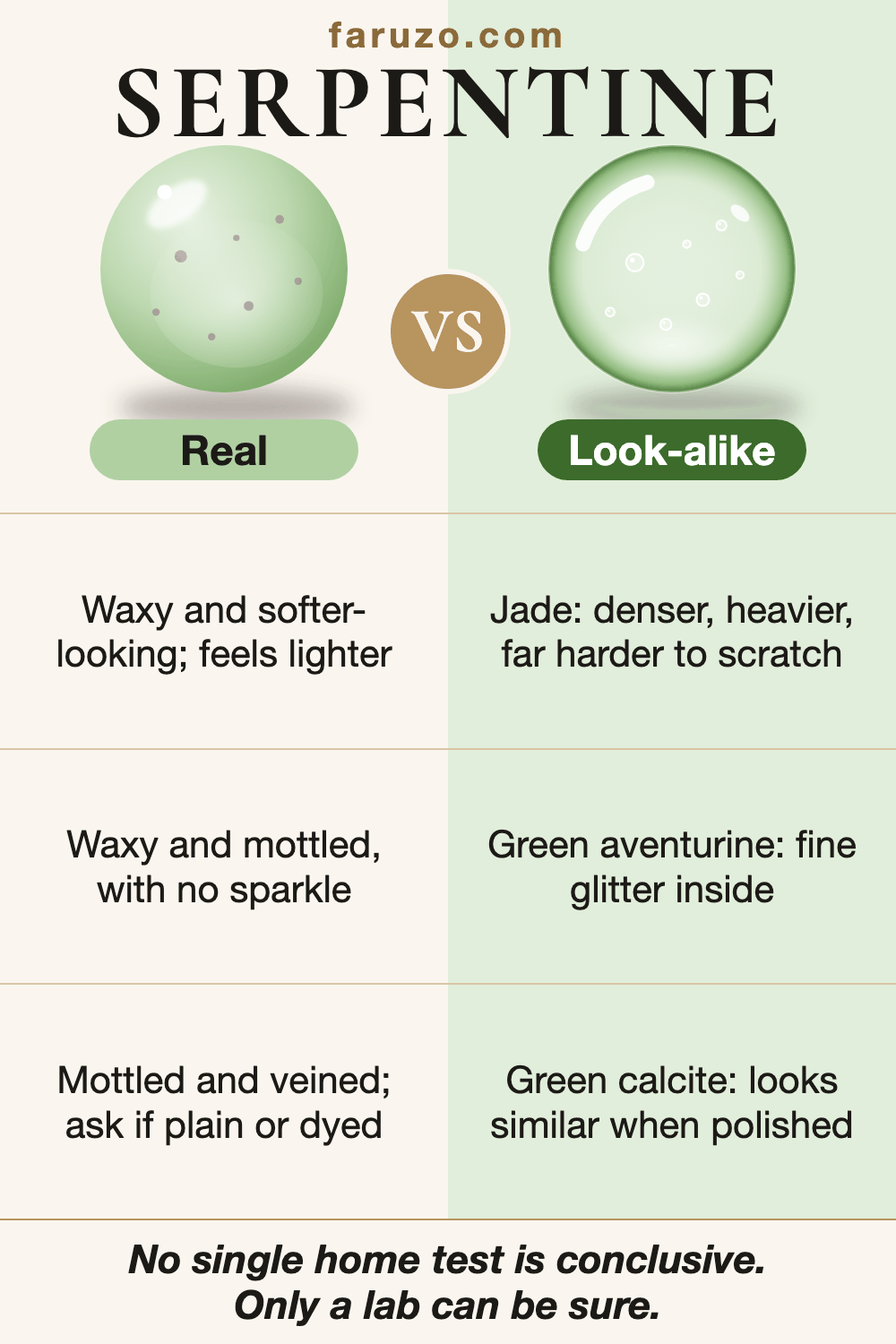
- Jade (jadeite and nephrite). Serpentine sold as "new jade" or "Korean jade" is a separate, much softer stone. Jade feels denser and heavier for its size and is far harder to scratch, while serpentine looks waxier and softer. A lab can sometimes tell them apart.
- Green aventurine. Aventurine is a quartz, much harder, and often shows a fine glitter inside. Serpentine looks waxy and mottled without sparkle.
- Green calcite and other soft green stones. Some soft green stones look similar when polished. Serpentine tends to look waxy and veined, but touch and eye alone will not settle it.
Safe checks you can do
- Ask the seller in writing whether the stone is plain serpentine, dyed, stabilised or sold under a trade name such as "new jade".
- Look for natural mottling and veining. Serpentine is rarely perfectly even, and an unusually uniform, vivid green may be dyed.
- Check cracks and drill holes for dye that has pooled in them, a common sign of colouring.
- Do not scratch-test a stone you plan to keep, since serpentine marks easily.
Wearing Serpentine
Ring
Avoid
Mostly soft, and even bowenite scratches, so a ring is best avoided.
Bracelet
Avoid
Wrists take knocks that would soon scratch serpentine.
Pendant
Avoid
Hardness 2.5 to 5.5 is too low, so a pendant is best avoided.
Earrings
Avoid
Small and exposed, and too soft: earrings are best avoided.
Guide for everyday wear, based on hardness and care notes. Safe, Careful or Avoid.
Hardness varies by type from 2.5 to 5.5, and even at the top of that range a ring, bracelet, pendant or earrings are all best avoided for everyday wear. Bowenite, the hardest type, can still pick up scratches, and the softest types mark very easily. If you wear it, keep it dry and away from knocks, and take it off for the gym and cleaning.
Related stones
Questions about Serpentine
What does serpentine mean?
In crystal tradition serpentine is a stone of change, renewal and grounding, linked to the Heart chakra. That is a belief, not a fact about the stone. The name simply comes from the Latin for snake-like.
What is serpentine?
Serpentine is a group of about twenty hydrous magnesium silicate minerals, roughly Mg3Si2O5(OH)4, that form when water reacts with magnesium-rich rock. Antigorite, lizardite and chrysotile are the three main types.
How hard is serpentine?
It depends on the type: lizardite is about 2.5, antigorite about 3.5 to 4, and bowenite up to about 5.5 on the Mohs scale. Most of that range is soft, so serpentine scratches far more easily than quartz.
Is serpentine a birthstone?
No. Serpentine is not on the standard modern or traditional birthstone lists. Its link to Gemini is a crystal-tradition pairing only.
Is serpentine the same as jade?
No. Jade is jadeite or nephrite, different and much harder minerals. Serpentine is sometimes sold as "new jade" or "Korean jade" because the green can look similar, so the trade name is worth questioning.
What is bowenite?
Bowenite is a hard, translucent, apple-green form of antigorite, up to about 5.5 on the Mohs scale. It is the hardest common serpentine and the one most often sold under the "new jade" name.
What is williamsite?
Williamsite is an oily, olive-green form of antigorite, first known from the eastern USA. It is valued for its clear colour and is usually cut as cabochons.
Can serpentine get wet, and can I wear it in a ring?
A quick wipe is fine, but do not soak it, and dry it straight away. Serpentine is soft, so a ring is best avoided, and a bracelet, pendant or earrings are best avoided too. If you do wear it, keep it dry and clear of knocks.
Is serpentine dyed or treated?
Sometimes. Lower grades are dyed, often to imitate jade, and some pieces are stabilised with resin or wax. An unusually even, vivid green is a reason to ask the seller what has been done to the stone.
Will serpentine fade or change over time?
Plain serpentine is fairly stable, but dyed pieces can lose or shift colour, and a polish can dull with soaking or harsh cleaners. Gentle wiping and dry storage keep a piece looking its best.
Does serpentine contain asbestos?
Some serpentine-group minerals are fibrous, and chrysotile is an asbestos mineral. Jewelry stones are usually massive varieties rather than fibrous ones. Any dust from cutting or grinding is a workshop matter, with wet cutting and a mask. If you are unsure what a piece is, ask the seller.
Where does serpentine come from?
Almost everywhere. It forms wherever water meets magnesium-rich rock, so it is found in the USA, Canada, New Caledonia, India, Britain, Greece, Russia and China, among other places.