
Crystal guide
Seraphinite Meaning, Properties and Care
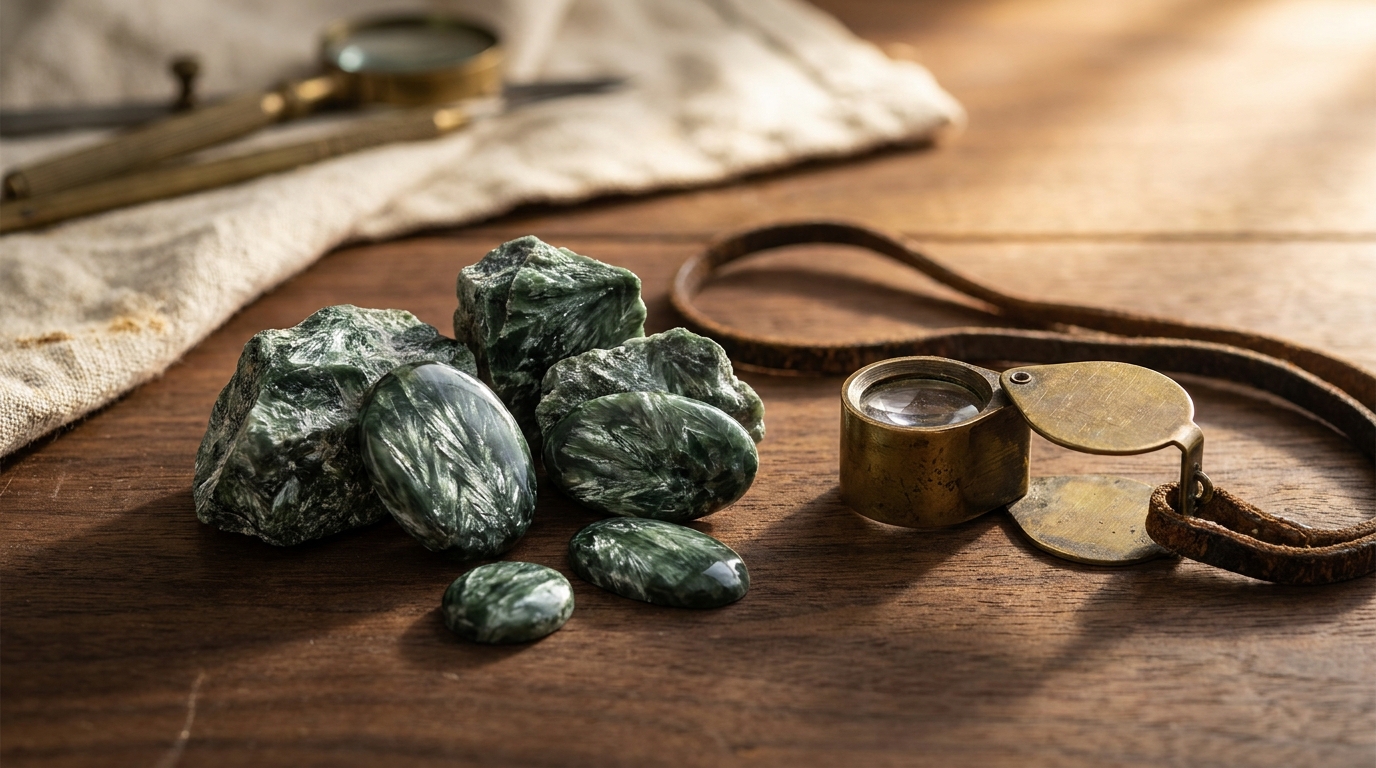
Seraphinite is the trade name for a dark green, feathery form of clinochlore, a soft layered mineral of the chlorite group. It is known mainly from one limited area of eastern Siberia, Russia, and its silvery streaks look like feathers. At about 2 to 2.5 on the Mohs scale it is very soft, and in crystal tradition it is a stone of renewal.
At a glance
- A trade name for a feathery form of clinochlore, not a separate mineral species.
- Hardness is about 2 to 2.5 on the Mohs scale, so it scratches very easily.
- Known mainly from one limited area of eastern Siberia, Russia.
- Dark green with silvery, feather-like streaks, usually cut as cabochons or carvings.
Quick facts
| Family | Clinochlore (chlorite group, a layered silicate); seraphinite is a trade name for a dark green, feathery form |
|---|---|
| Chemical formula | Roughly (Mg,Fe)3(Si,Al)4O10(OH)2·(Mg,Fe)3(OH)6 for clinochlore, with the balance of magnesium, iron and aluminium varying from piece to piece |
| Crystal system | Monoclinic, and usually cut from compact, fine-grained massive material |
| Mohs hardness | 2–2.5 |
| Luster | Pearly, dull or greasy; the mineral has perfect cleavage in one direction, and its plates are flexible rather than springy |
| Transparency | Translucent to opaque in cut stones |
| Natural colors | dark green to grey with silvery, feather-like streaks; the wider clinochlore family also runs from other greens to rarely yellow, red or white |
| Main localities | Russia: a limited area of eastern Siberia, in the Korshunovskoye iron deposit in Irkutsk Oblast |
| Common treatments | no standard treatment is described for seraphinite; ask whether a piece has been dyed or coated, since soft green stones are sometimes dyed |
Seraphinite at a glance, in pictures
Chakras (traditional)
Hardness range
Natural colors
- dark green to grey with silvery, feather-like streaks
- the wider clinochlore family also runs from other greens to rarely yellow, red or white
Traditionally linked to
- Zodiac
- Sagittarius
Common forms of Seraphinite
- Rough raw chunk
- Cabochon smooth dome
- Carving carved pendant
How hard is Seraphinite?
- Talc 1
- Gypsum 2
- Seraphinite 2–2.5
- Copper coin ~ 3
- Calcite 3
- Fluorite 4
- Apatite 5
- Glass ~ 5.5
- Steel knife ~ 5.5
- Orthoclase 6
- Quartz 7
- Topaz 8
- Corundum 9
- Diamond 10
What it is and where it comes from
Seraphinite is a trade name rather than a separate mineral species. It is a feathery form of clinochlore, a member of the chlorite group of layered silicates.
The name appears to come from the feather-like look of its silvery streaks, an effect called chatoyancy, and from the seraphim, the winged angels of the Bible. Marketing names such as "silver plume seraphinite" describe the pattern.
The Russian Nikolay Koksharov, who lived from 1818 to the early 1890s, is often credited with its discovery.
Seraphinite is mined in a limited area of eastern Siberia, Russia, at the Korshunovskoye iron deposit in Irkutsk Oblast.
Clinochlore as a mineral turns up in many places, including Brazil, Michigan and Minnesota. The feathery gem material sold as seraphinite is tied to Siberia.
Seraphinite is described as a compact, massive form of clinochlore, used as a decorative carving stone.
In crystal tradition
What follows is belief and folklore, passed down in crystal tradition. It is not measured fact.
Traditionally associated with: renewal, nature.
Seraphinite is traditionally linked with nature, renewal and the Heart chakra, partly because of its green colour and its angel-derived name. This is a modern spiritual tradition, not a fact about the stone.
Looser pairings are said to tie it to Sagittarius or to the feng shui idea of wood energy. These are beliefs within crystal practice with no physical basis.
How to care for Seraphinite
- Water Caution
- Sunlight Unknown
- Salt Unknown
- Heat Caution
- Ultrasonic Avoid
- Chemicals Caution
Safe = fine as a rule · Caution = only briefly or gently · Avoid = can damage the stone · Unknown = no reliable guidance.
Wipe seraphinite with a soft, dry or barely damp cloth and dry it straight away. Do not soak it. Skip ultrasonic and steam cleaners and strong cleaners: a very soft stone with perfect cleavage can mark or split under vibration and sudden changes. Store it on its own or in a soft pouch, away from harder stones and metal that can scratch it, and take it off before sport and rough work.
Real or fake? Look-alikes and treatments
Often confused with
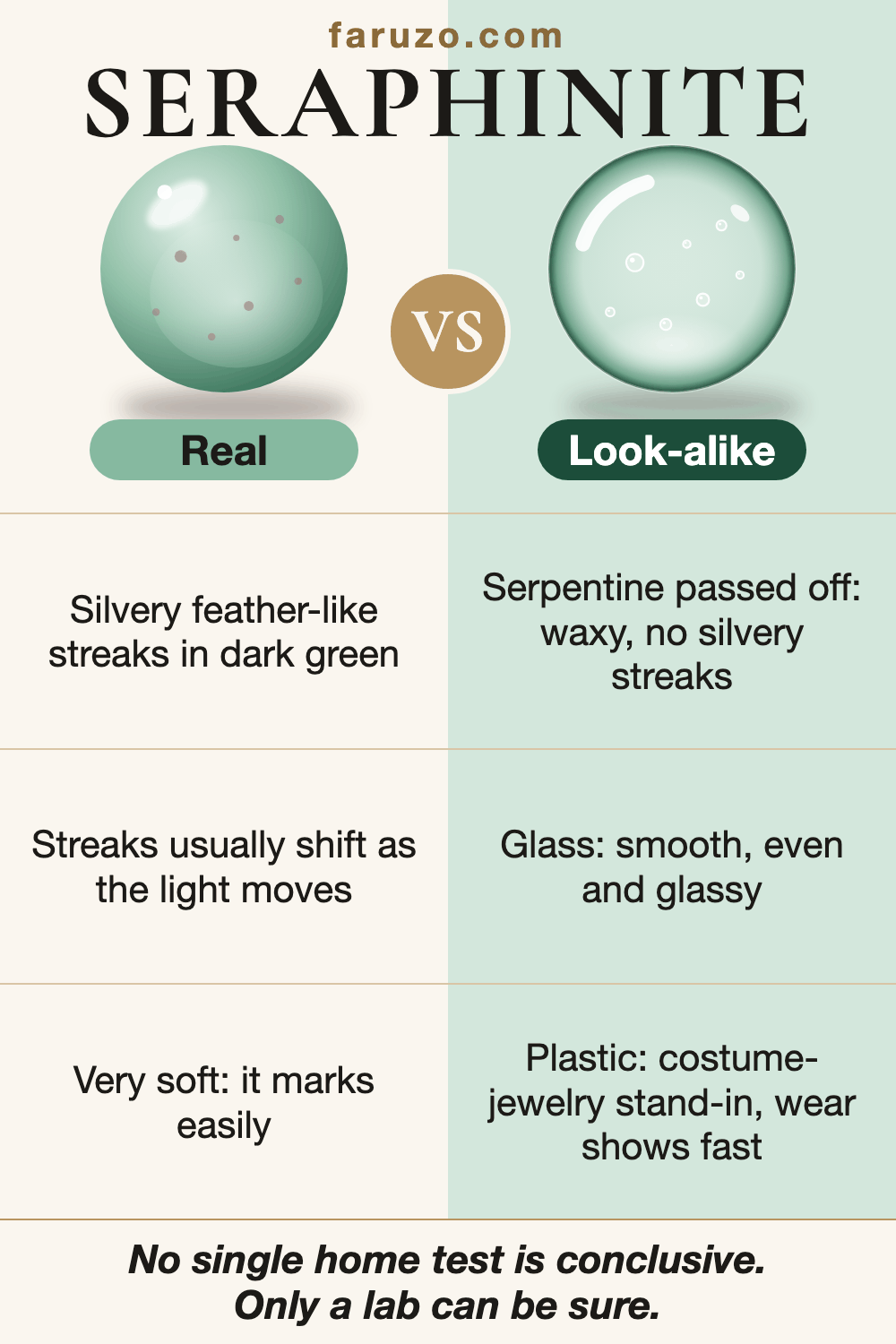
- Dark green serpentine, including dyed pieces
- Glass
- Plastic
Common look-alikes
- Dark green serpentine, including dyed pieces. Serpentine is a different mineral, waxy and mottled or veined. It lacks the silvery, plume-like streaks that move with the light, and lower grades are sometimes dyed. Ask the seller what the stone is.
- Glass. Glass can be made in nearly any colour and is a long-standing stand-in for many stones. A smooth, even, glassy dark green with no feathering is not what natural seraphinite looks like.
- Plastic. Plastic is used in costume jewelry to imitate stones and is not durable, so wear and scratches show quickly. A lab can say what a piece really is.
Safe checks you can do
- Ask the seller in writing what the material is and whether it has been dyed, coated or stabilised.
- Look at the streaks. Natural feathering usually sits inside the stone and tends to shift as the light moves, so a flat, printed-looking or identical pattern on every piece deserves questions.
- Check cracks, drill holes and edges for dye or colour that has pooled in them.
- Be wary of a hard, glassy, very even dark green stone sold cheaply as seraphinite. Glass and plastic stand in for many stones, and only a lab can be sure.
- Do not scratch-test a stone you plan to keep, since seraphinite marks very easily.
Wearing Seraphinite
Ring
Avoid
Very soft at 2 to 2.5, so everyday knocks would soon mark a ring.
Bracelet
Avoid
A bracelet meets desks, doors and grit that would scratch it.
Pendant
Avoid
Too soft for daily pendant wear, so it is best avoided.
Earrings
Avoid
Small, exposed and very soft, so earrings are best avoided.
Guide for everyday wear, based on hardness and care notes. Safe, Careful or Avoid.
At about 2 to 2.5 on the Mohs scale, seraphinite is too soft for a ring, a bracelet, a pendant or earrings to stay unmarked in everyday wear, and its perfect cleavage adds a risk of splitting. A ring and a bracelet take the most knocks, while a pendant or earrings still meet keys, zips and other jewelry. If you wear it, keep it for occasional, careful use, keep it dry and take it off for the gym, showers and cleaning.
Related stones
Questions about Seraphinite
What does seraphinite mean?
In crystal tradition seraphinite is a stone of nature and renewal, linked to the Heart chakra. That is a belief, not a fact about the stone. The name itself refers to the feather-like look of its streaks and to the seraphim, the winged angels.
What is seraphinite?
Seraphinite is a trade name for a dark green, feathery form of clinochlore, a chlorite-group mineral made of magnesium, iron and aluminium silicate layers. It is not a separate mineral species.
Is seraphinite a real mineral?
The material is real, but the name is a trade name. Clinochlore is the mineral, and seraphinite is the name given to its dark green form with silvery, feather-like streaks.
How hard is seraphinite?
About 2 to 2.5 on the Mohs scale, which is very soft. It scratches far more easily than quartz, which is 7, and it can be marked by harder stones and metal.
Is seraphinite a birthstone?
No. Seraphinite is not on the standard modern US, UK or traditional birthstone lists. Its link to Sagittarius is a crystal-tradition pairing only.
Where does seraphinite come from?
It is known mainly from one limited area of eastern Siberia, Russia, at the Korshunovskoye iron deposit in Irkutsk Oblast. Clinochlore itself is found in many other places, but the feathery gem material is tied to Siberia.
Why is it called seraphinite?
The name appears to come from the feather-like look of its silvery streaks, called chatoyancy, and from the seraphim, the winged angels of the Bible. The Russian Nikolay Koksharov is often credited with discovering it.
Can you wear a seraphinite ring every day?
A ring is best avoided. Seraphinite is very soft and has perfect cleavage, so it scratches and can split under knocks. A bracelet, pendant or earrings are best avoided for daily wear too.
Can seraphinite get wet or go in an ultrasonic cleaner?
A quick wipe is fine, but do not soak it, and dry it straight away. Skip ultrasonic and steam cleaners, because vibration and sudden changes can mark or split a soft stone.
How can you tell real seraphinite from fake?
A home look can only hint. Natural feathering sits inside the stone and shifts with the light, while a flat, printed-looking or identical pattern deserves questions. Dyed green stones, glass and plastic can all pass at a glance, so ask the seller for the material in writing.
Is seraphinite dyed or treated?
No standard treatment is described for seraphinite, but any soft green stone can be dyed or coated. A dyed seraphinite is still real stone underneath, just treated, so it is worth asking the seller what has been done.
I found seraphinite jewelry at a very low price. Is it real?
Price alone does not settle it. Glass, plastic and dyed green stones are sold as many stones, so ask the seller for the material and any treatment in writing, and look for natural feathering that shifts with the light.