
Crystal guide
Sapphire Meaning, Properties and Care
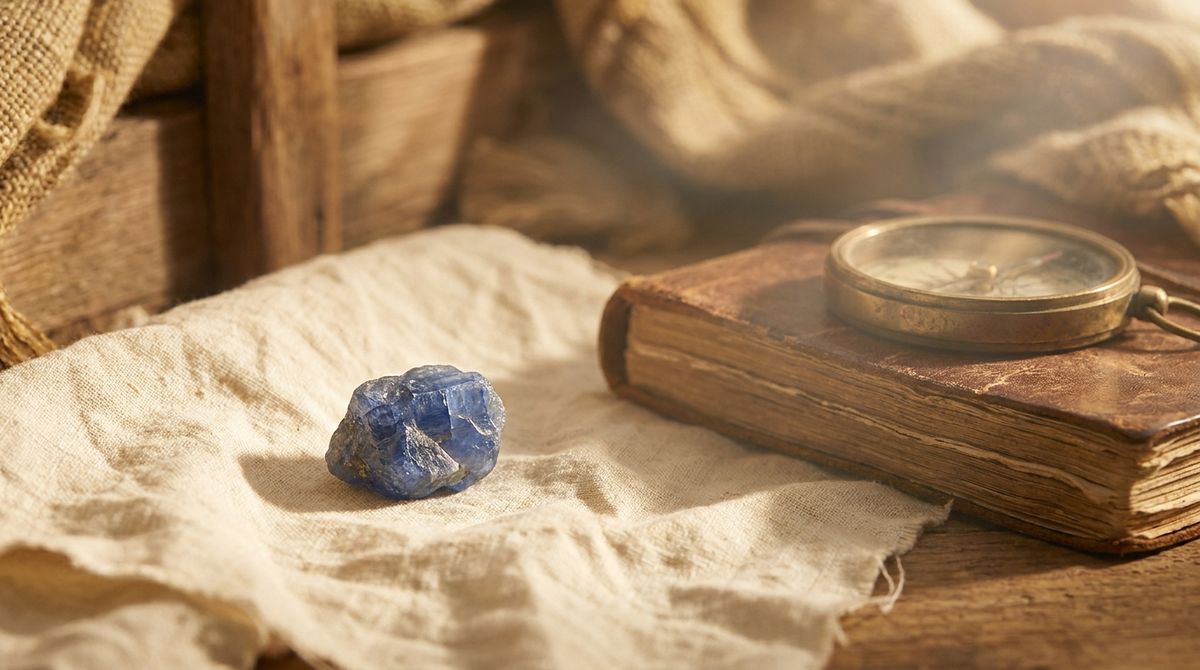
Sapphire is corundum, aluminium oxide (Al2O3), in any colour except red. Blue is the famous one, but pink, yellow, green, orange, purple and colourless stones are sapphires too. At Mohs 9 it is one of the hardest natural gems. In crystal tradition it stands for wisdom, truth and loyalty.
At a glance
- Formula Al2O3: the mineral corundum. Red corundum is ruby; every other colour is sapphire.
- Mohs 9 with no cleavage, so it is tough enough for everyday jewellery.
- Heat treatment is very common and lab-created sapphire is the same material, made by people.
- Care: warm soapy water is usually safe; stones that are filled or dyed need extra care.
Quick facts
| Family | Corundum (aluminium oxide); sapphire is gem corundum in any colour except red |
|---|---|
| Chemical formula | Al2O3, coloured by trace elements such as iron, titanium and chromium |
| Crystal system | Trigonal |
| Mohs hardness | 9 |
| Luster | Vitreous to adamantine, with no cleavage; it can part along some planes |
| Transparency | Transparent to translucent; star stones are cut as translucent domes |
| Natural colors | blue; pink; yellow; green; orange; purple to violet; colourless; grey, brown or black; padparadscha (pinkish orange) |
| Main localities | Sri Lanka, Myanmar, Madagascar, Kashmir (India), Australia, USA (Montana) |
| Common treatments | heat treatment is very common, permanent and widely accepted in the trade; less common: lattice diffusion, fracture filling and dyeing, which need extra care; lab-created (synthetic) sapphire is the same material as natural sapphire, made by people |
| Birth month | September |
Looking for the month? September birthstone guide
Sapphire at a glance, in pictures
Chakras (traditional)
Hardness range
Natural colors
- blue
- pink
- yellow
- green
- orange
- purple to violet
- colourless
- grey, brown or black
- padparadscha (pinkish orange)
Traditionally linked to
- Zodiac
- VirgoTaurus
Common forms of Sapphire
- Rough raw chunk
- Faceted cut gem
- Cabochon smooth dome
How hard is Sapphire?
- Talc 1
- Gypsum 2
- Copper coin ~ 3
- Calcite 3
- Fluorite 4
- Apatite 5
- Glass ~ 5.5
- Steel knife ~ 5.5
- Orthoclase 6
- Quartz 7
- Topaz 8
- Sapphire 9
- Diamond 10
What it is and where it comes from
Sapphire is a variety of the mineral corundum. Trace iron and titanium together give the classic blue, while trace chromium gives red, which is why red corundum has its own name, ruby.
The word comes from Latin sapphirus and Greek sappheiros, probably from a Hebrew word that may once have meant lapis lazuli. In the Middle Ages the name settled on blue corundum.
Sri Lanka has supplied sapphire for a very long time, and Myanmar and Madagascar are also major sources. Kashmir stones are prized for a rare, intensely saturated, velvety blue, and Montana is a notable source in the USA.
Padparadscha is a rare, valuable pinkish-orange sapphire whose name is usually traced to the Sinhalese word for lotus blossom.
Star sapphires show a six-rayed star, called asterism, from fine needle-like inclusions of rutile. They are cut as smooth domes (cabochons) so the star can show.
Sapphire can also change colour, usually blue in daylight and purple under incandescent light. Many stones carry fine rutile needles known as silk.
Lab-created sapphire was first made in the early 1900s with the flame-fusion method, and it has essentially the same chemical, physical and optical properties as natural sapphire. It is real corundum, made by people rather than dug from the ground, and it is also used for watch crystals, scanner windows and electronics.
In crystal tradition
What follows is belief and folklore, passed down in crystal tradition. It is not measured fact.
Traditionally associated with: wisdom, truth, loyalty, clear thinking.
Sapphire is traditionally associated with sincerity, truth, faithfulness and nobility, and it has long been tied to royalty and clergy.
Old belief held that the sky took its blue from a giant sapphire the earth rested on, and that a blue sapphire guarded its wearer from harm and envy. These are historical beliefs, not facts about the stone.
In crystal tradition sapphire is linked to the Third Eye and Throat chakras and to wisdom and clear thinking. This is a modern spiritual tradition, not a fact about the stone.
Zodiac links vary from one tradition to another, with Virgo and Taurus both mentioned. Treat them as folklore.
How to care for Sapphire
- Water Safe
- Sunlight Unknown
- Salt Unknown
- Heat Caution
- Ultrasonic Caution
- Chemicals Caution
Safe = fine as a rule · Caution = only briefly or gently · Avoid = can damage the stone · Unknown = no reliable guidance.
Warm water, mild soap and a soft brush clean sapphire safely. Ultrasonic and steam cleaners are usually fine for untreated, heat-treated and diffusion-treated stones, but a fracture-filled or dyed sapphire should only be wiped with a damp cloth, and even mild acids such as lemon juice can damage it. When the treatment history is unknown, hand-cleaning is the safer default. Keep it away from sudden, extreme heat, and store it so harder stones do not rub against its edges.
Real or fake? Look-alikes and treatments
Often confused with
- Tanzanite
- Iolite
- Blue spinel
- Synthetic spinel sold as sapphire
- Blue topaz
- Blue glass
Common look-alikes
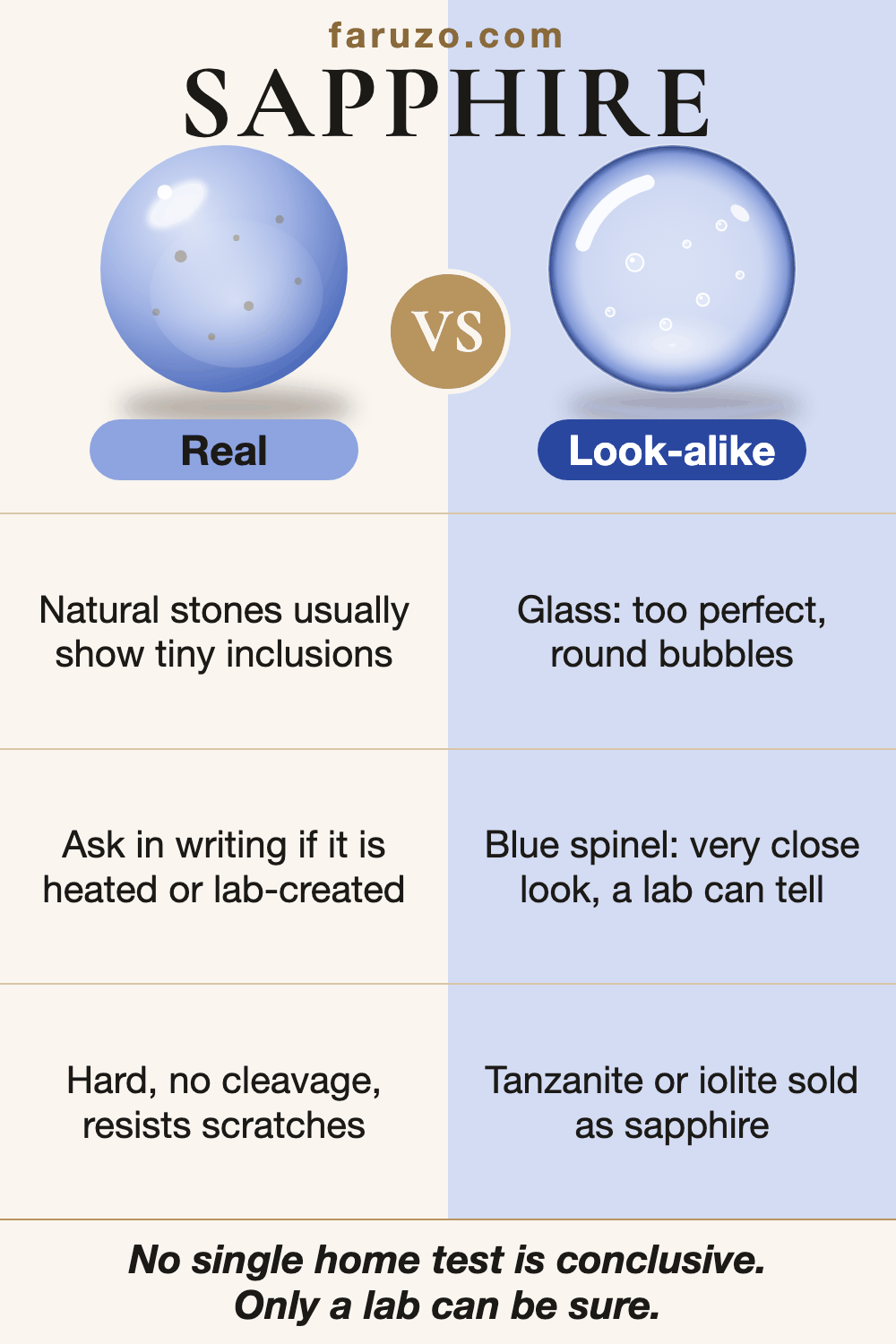
- Tanzanite. Tanzanite is a violet-blue stone that shows strong blue, violet and burgundy colour from different directions. It is much softer (Mohs 6.5) and has cleavage, so it chips and splits where sapphire would not.
- Iolite. Iolite is strongly pleochroic, flashing violet-blue, pale blue and pale yellow or grey as it is turned. At Mohs 7 to 7.5 it is notably softer than corundum, and it is sometimes sold as an inexpensive sapphire substitute, even nicknamed water sapphire.
- Blue spinel. Blue spinel is a different mineral, Mohs 8, coloured by cobalt and singly refractive, so it lacks the double refraction of sapphire. The two can look very close, so a lab can confirm which is which.
- Synthetic spinel sold as sapphire. Lab-grown spinel is a different material from sapphire and is a long-standing, inexpensive blue gem substitute. If a stone is described as lab-grown, ask whether it is lab-grown spinel or lab-created sapphire, because the two are not the same.
- Blue topaz. Most blue topaz is heat-treated and irradiated pale stone. It is Mohs 8 with perfect cleavage, so it is softer and more fragile than sapphire, and its blue is usually lighter and cooler.
- Blue glass. Glass is the most common imitation. It can show round gas bubbles or swirl marks and is much softer than corundum, so it scratches and chips with ordinary wear.
Safe checks you can do
- Ask the seller in writing whether the stone is natural sapphire, heat-treated, lab-created sapphire, spinel, glass or another blue gem.
- Ask whether the stone has been fracture-filled, diffusion-treated or dyed, because these treatments change how it should be cleaned.
- Look at the colour while turning the stone. Strong, clearly different colours from different angles point to tanzanite or iolite rather than sapphire.
- Remember that lab-created sapphire is the same material as natural sapphire, so a hardness test cannot separate them. Telling natural from lab-created takes a trained eye or a gem lab.
- When origin or treatment matters, ask for a written identification from a recognised gem lab. Do not scratch-test a stone you plan to keep.
Wearing Sapphire
Ring
Safe
Hard enough for daily wear.
Bracelet
Safe
Tough enough for everyday bracelets.
Pendant
Safe
A pendant sits clear of most knocks.
Earrings
Safe
Earrings rarely take hard knocks.
Guide for everyday wear, based on hardness and care notes. Safe, Careful or Avoid.
Sapphire is Mohs 9 with no cleavage, so it is among the best stones for everyday jewellery, including a daily ring. Even a very hard stone can chip a facet edge on a hard direct knock, so a setting that protects the edge is wise for a ring worn all day. Pendants, earrings and bracelets take fewer knocks still. Check the treatment first: a fracture-filled or dyed stone needs gentler handling and cleaning.
Related stones
Questions about Sapphire
What does sapphire mean?
In crystal tradition sapphire stands for wisdom, truth, loyalty and nobility, and it has long been linked with royalty and clergy. That is belief and symbolism, not a fact about the stone. Its practical claim to fame is being corundum at Mohs 9.
What is sapphire?
Sapphire is the gem variety of corundum, aluminium oxide (Al2O3), in any colour except red. Trace elements give the colour: iron and titanium together give blue. Red corundum is called ruby.
Is sapphire always blue?
No. Blue is the best known, but sapphire also comes in pink, yellow, green, orange, purple, colourless and even grey, brown or black. Every colour of gem corundum except red is called sapphire.
Is sapphire a birthstone?
Yes. Sapphire is the birthstone for September. It is also the traditional gem for the 5th and 45th wedding anniversaries.
What is the difference between sapphire and ruby?
Nothing in the mineral itself: both are corundum. Red corundum, coloured by chromium, is called ruby, and every other colour is called sapphire.
What is a padparadscha sapphire?
A rare pinkish-orange sapphire, usually said to take its name from the Sinhalese word for lotus blossom. Natural stones are rare and valuable, and the exact colour range that earns the name is judged by a lab.
What is a star sapphire?
A sapphire cut as a smooth dome that shows a six-rayed star, called asterism, caused by fine needle-like rutile inclusions. The star only shows when the stone is cut to preserve it, so star sapphires are not faceted.
How hard is sapphire?
9 on the Mohs scale, with no cleavage, which puts it among the hardest natural gems. It scratches almost everything else but can still chip at a sharp edge on a hard knock.
Is lab-created sapphire real?
Yes. Lab-created sapphire is real corundum with essentially the same chemistry, hardness and optical properties as natural sapphire. It is made by people rather than mined. It is different from imitations such as glass or spinel, and a seller should say which one a stone is.
Are sapphires heat treated?
Most are. Heat treatment is very common, permanent and widely accepted in the trade, and it is used to improve colour. Less common treatments such as fracture filling or dyeing need more careful cleaning, so ask what has been done.
How do you clean sapphire?
Warm water, mild soap and a soft brush are usually safe. Ultrasonic and steam cleaners are usually fine for untreated, heat-treated and diffusion-treated stones, but wipe a fracture-filled or dyed sapphire with a damp cloth only.
Can you wear a sapphire ring every day?
Usually yes. With Mohs 9 and no cleavage, sapphire is one of the better choices for a daily ring. A setting that protects the edges still helps against hard knocks, and a treated stone may need gentler care.
How can you tell real sapphire from fake?
A home look can only hint. Glass can show bubbles or swirl marks and is much softer, while tanzanite and iolite flash strong colour changes as they turn. Blue spinel can look almost identical, and lab-created sapphire is the same material, so a gem lab can confirm a stone that matters.
Is the blue stone in birthstone jewellery a real sapphire?
Not always. Affordable birthstone-style jewellery may use lab-created sapphire, lab-grown spinel, coloured glass or another material, and each is a different thing. Check the product description for exactly what the stone is, and treat a very low price for a large natural sapphire with caution.
Where does sapphire come from?
Notable sources include Sri Lanka, Myanmar, Madagascar, Kashmir in India, Australia and Montana in the USA. Kashmir stones are prized for a velvety blue, while Sri Lanka has supplied sapphire for a very long time.