
Crystal guide
Kyanite Meaning, Properties and Care
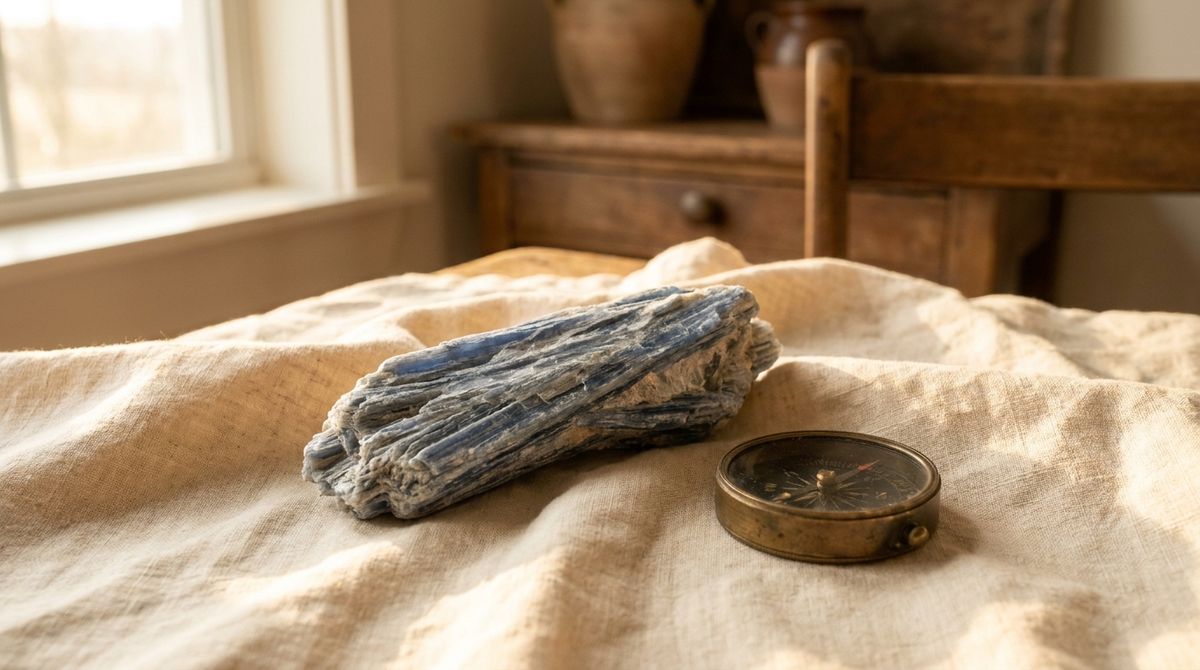
Kyanite is a blue aluminium silicate mineral (Al2SiO5) with an unusual trait: it is much softer along the length of its blade-like crystals (about 4.5 on the Mohs scale) than across them (about 6.5 to 7). It also splits easily along a flat plane, so how you wear and clean it matters more than with most blue stones. In crystal tradition it is a calm, communication-minded stone.
At a glance
- Formula Al2SiO5, triclinic, usually in flat blade-shaped crystals.
- Hardness is direction-dependent: about 4.5 along the blade and 6.5 to 7 across it, with perfect cleavage.
- Blue is the best-known colour, but it also occurs white, grey and green, and rarely other shades.
- Care: warm water, mild soap, soft cloth; no steam or machine cleaners. Best as pendants or earrings in protective settings.
Quick facts
| Family | Aluminium silicate (nesosilicate), sharing its formula with andalusite and sillimanite |
|---|---|
| Chemical formula | Al2SiO5 |
| Crystal system | Triclinic, usually as bladed or columnar crystals |
| Mohs hardness | 4.5–7 |
| Luster | Vitreous to pearly (pearly on cleavage surfaces) |
| Transparency | Transparent to translucent |
| Natural colors | blue (the most familiar colour, often uneven or streaky); white, grey or colourless; green; orange and black, less often; rarely yellow or pink |
| Main localities | Nepal (reportedly a source of fine blue material), Brazil (Minas Gerais), Switzerland (Pizzo Forno), Kenya, Russia, USA (Appalachian region and New York schist), India |
| Common treatments | usually sold untreated, though cheap blue beads and tumbled stones are sometimes dyed; because it is soft in one direction and cleaves, rough handling in cutting and wear is the bigger concern |
Kyanite at a glance, in pictures
Chakras (traditional)
Hardness range
Natural colors
- blue (the most familiar colour, often uneven or streaky)
- white, grey or colourless
- green
- orange and black, less often
- rarely yellow or pink
Common forms of Kyanite
- Rough raw chunk
- Tumbled polished pebble
- Cabochon smooth dome
How hard is Kyanite?
- Talc 1
- Gypsum 2
- Copper coin ~ 3
- Calcite 3
- Fluorite 4
- Apatite 5
- Glass ~ 5.5
- Steel knife ~ 5.5
- Kyanite 4.5–7
- Orthoclase 6
- Quartz 7
- Topaz 8
- Corundum 9
- Diamond 10
What it is and where it comes from
The name comes from the Greek kyanos, meaning dark blue, the same root that gives English 'cyan'.
It is also spelled cyanite in older and trade usage.
An older name for kyanite is disthene, often explained as meaning 'two strengths' in Greek, which fits its direction-dependent hardness.
Kyanite forms in aluminium-rich metamorphic rock such as schist and gneiss when rock is squeezed under high pressure, and geologists use it as a marker of metamorphic zones. It is the most stable of its three same-formula minerals at high pressure.
Most kyanite is not gem quality. The bulk of it is used in ceramics, refractory bricks and kiln furniture for high-temperature work, and in some electrical insulators.
Gem-quality blue material is reportedly mined in Nepal, Brazil, Kenya and elsewhere, and clean pieces are usually cut as cabochons or beads, since the blade-like crystals and cleavage make faceting difficult.
In crystal tradition
What follows is belief and folklore, passed down in crystal tradition. It is not measured fact.
Traditionally associated with: calm, clear communication, honest speech.
Kyanite is traditionally associated with the Throat and Third Eye chakras and with calm, clear and honest communication. This is a modern spiritual tradition, not a fact about the stone.
A popular crystal tradition says kyanite never needs cleansing and can 'clear' other stones. This is a belief within crystal practice and has no physical basis. Its real, measurable talking point is the two hardnesses.
How to care for Kyanite
- Water Caution
- Sunlight Caution
- Salt Caution
- Heat Avoid
- Ultrasonic Avoid
- Chemicals Caution
Safe = fine as a rule · Caution = only briefly or gently · Avoid = can damage the stone · Unknown = no reliable guidance.
Clean kyanite with a soft cloth, mild soap and lukewarm water, and dry it straight away. Avoid ultrasonic and steam cleaners, because vibration and sudden heat can open a crack along the cleavage plane. A brief rinse is fine; do not soak it. Keep it away from harsh cleaners and store it apart from harder stones so it is not scratched. Long sun and salt water are best avoided as a precaution.
Real or fake? Look-alikes and treatments
Often confused with
- Blue sapphire
- Blue glass
- Dyed quartz or dyed stones
- Sodalite
Common look-alikes
- Blue sapphire. Both can be a rich blue. Sapphire is much harder (Mohs 9 in every direction) and has no cleavage, while kyanite is softer in one direction. A gemologist can separate them quickly with a refractometer.
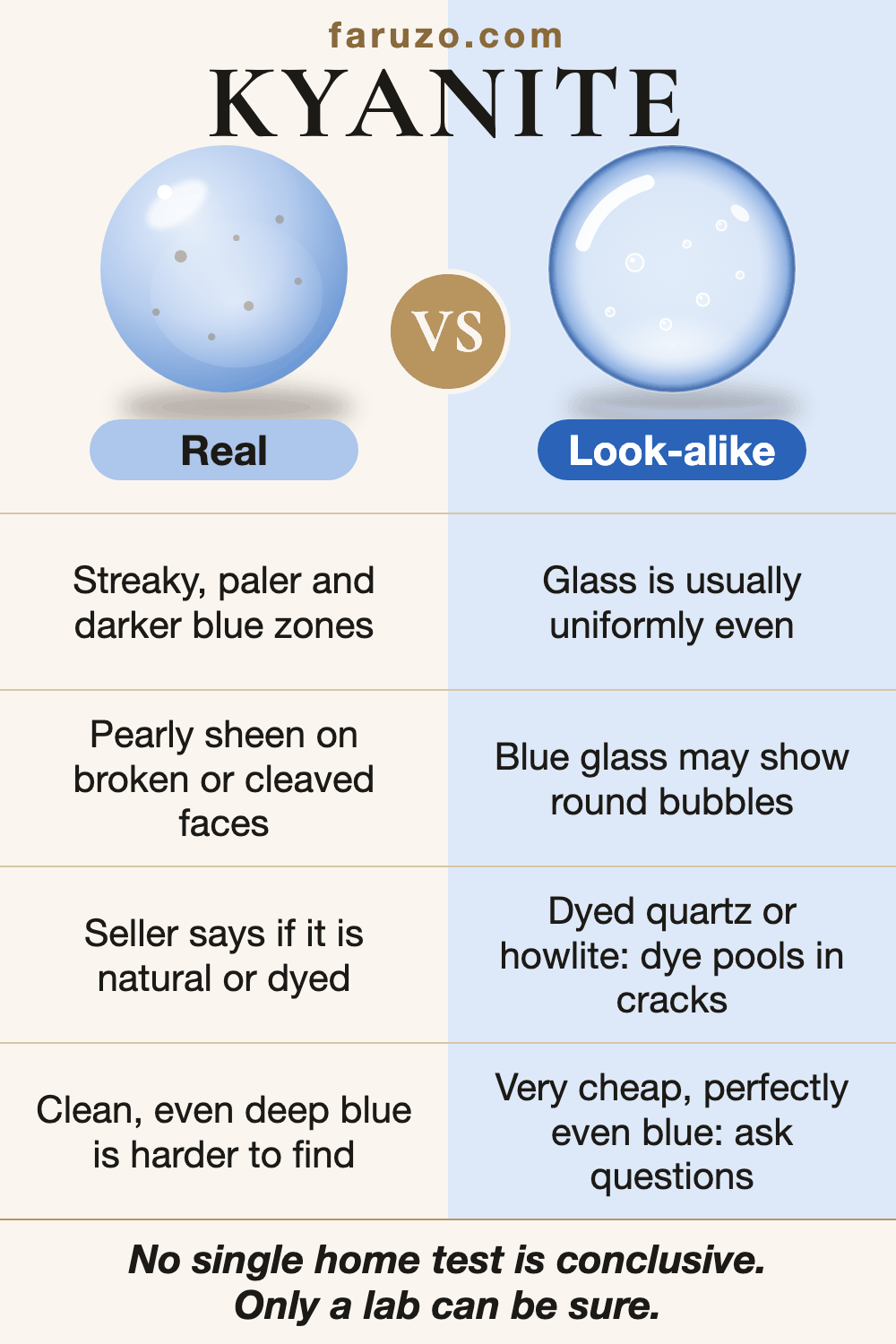
- Blue glass. Blue glass is a common imitation. It tends to look too even and may show round gas bubbles. Real kyanite is often streaky or paler in places, with a pearly sheen on broken surfaces. A gemologist can confirm.
- Dyed quartz or dyed stones. Dyed stones can imitate a deep blue, and dye often pools in cracks. Ask whether the stone is natural or dyed.
- Sodalite. Sodalite is a different blue stone, usually darker and often with white veining, and it lacks kyanite's blade-like look and pearly sheen.
Safe checks you can do
- Ask the seller in writing whether the stone is natural kyanite, dyed, glass or something else.
- Look for natural unevenness. Kyanite is often streaky, with paler and darker blue zones and a blade-like grain, whereas glass is usually uniformly even.
- Check the surface for a pearly sheen on any broken faces. That sheen is typical of kyanite but is only a sign, not proof.
- Be wary of a very cheap, perfectly even, deep blue stone sold as gem kyanite. Clean, even blue material is the harder kind to find, so ask questions.
- Do not scratch-test a stone you plan to keep. Kyanite is easy to damage, so a gemologist or lab can test it more safely.
Wearing Kyanite
Ring
Avoid
Splits easily along a flat plane, so a ring is best avoided.
Bracelet
Avoid
One knock on the wrist can split it along a flat plane.
Pendant
Careful
It can split along a flat plane, so keep it protected.
Earrings
Careful
A flat-plane split is possible, so keep earrings for dressy wear.
Guide for everyday wear, based on hardness and care notes. Safe, Careful or Avoid.
Kyanite is softer along its blades than across them and breaks along flat planes, so a hard knock at the wrong angle can chip it. That makes rings and bracelets best avoided, while pendants and earrings suit it better, ideally in a setting that protects the stone. Remove it for the gym, cleaning and anything rough.
Questions about Kyanite
What does kyanite mean?
In crystal tradition kyanite is a calm stone linked to clear, honest communication and the Throat and Third Eye chakras. That is a belief, not a fact about the stone. Its measurable claim to fame is that it has two different hardnesses depending on direction.
What is kyanite?
Kyanite is an aluminium silicate mineral, Al2SiO5, that usually forms flat, blade-like crystals in metamorphic rock. Its name comes from the Greek kyanos, meaning dark blue, though it also occurs in white, grey and green.
Why does kyanite have two hardnesses?
Its atomic structure is not the same in every direction, so a scratch test gives a different result depending on where you test. It is about 4.5 on the Mohs scale along the blade and about 6.5 to 7 across it.
How hard is kyanite?
About 4.5 along the length of a blade and 6.5 to 7 across it. Perfect cleavage adds to the fragility.
Is kyanite a birthstone?
No. Kyanite is not on the standard modern or traditional birthstone lists.
Can kyanite get wet?
A brief rinse is fine, but do not soak it, and dry it straight away.
Is kyanite the same as sapphire?
No. Sapphire is corundum, Mohs 9 in every direction with no cleavage. Kyanite is aluminium silicate with directional hardness of roughly 4.5 to 7 and a perfect cleavage plane, so it is noticeably softer and more fragile.
How can you tell real kyanite from fake?
A home look can only hint. Real kyanite is often streaky, with blade-like grain and a pearly sheen on broken surfaces, while glass and dyed stones look more even. A gemologist can test a stone that matters.
Does kyanite need cleansing?
Crystal tradition says kyanite never needs cleansing and can clear other stones. That is a belief with no physical basis. For physical care, clean it gently with mild soap, lukewarm water and a soft cloth.
Is kyanite rare or expensive?
As a mineral kyanite is common in metamorphic rock, and most of it goes to industry. Clean, evenly coloured gem-quality blue is harder to find, and cutting is difficult, so quality varies a lot.
What is kyanite used for besides jewelry?
Most kyanite is used in industry, in ceramics, refractory bricks and kiln furniture for high-temperature work, because it holds up under heat.
Can you wear a kyanite ring?
It is a fragile choice for a ring. A hard knock at the wrong angle can chip it, while pendants and earrings take fewer knocks.
Are there orange, black or green kyanites, and can it be faceted?
Yes. Orange, green and black kyanite exist, black usually as fans of blades. Faceting is difficult because of the cleavage, so most gems are cabochons or beads.
Why is blue kyanite from Nepal priced higher?
Clean, evenly deep blue material is scarcer than streaky or pale stone, and good colour is what buyers pay for. Origin alone does not guarantee quality.