
Crystal guide
Lapis Lazuli Meaning, Properties and Care
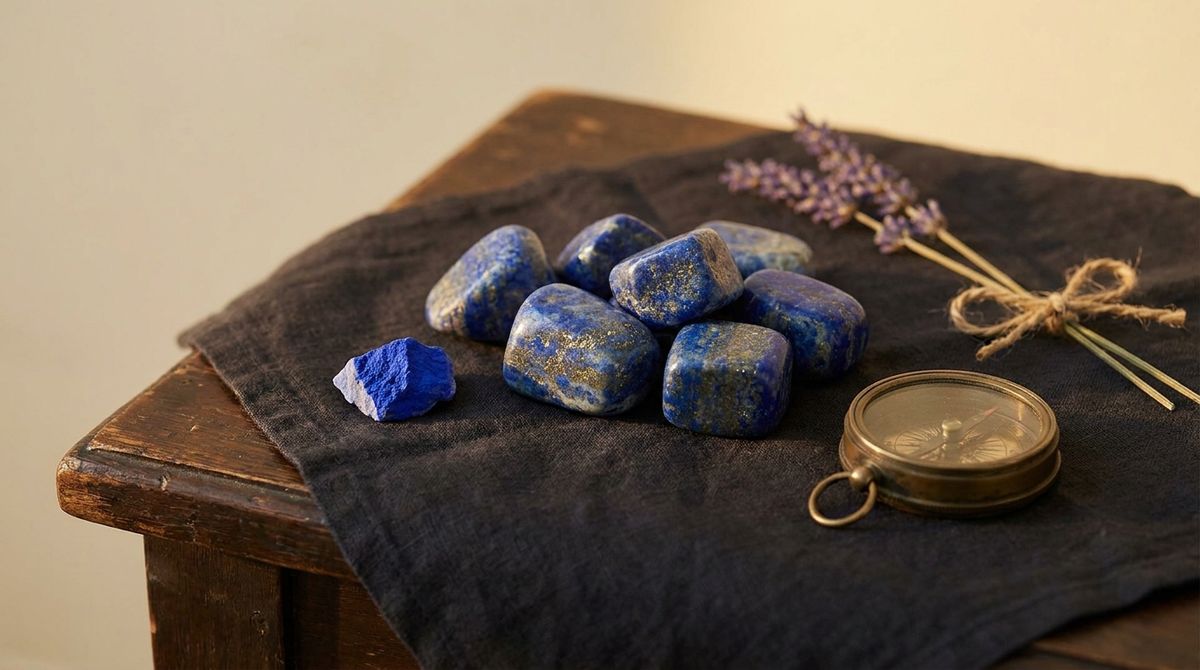
Lapis lazuli is a deep blue rock, not a single mineral: an aggregate of lazurite, calcite and pyrite (Mohs 5 to 6). Lazurite supplies the blue, calcite shows as white streaks and pyrite as gold flecks. It has no month on the standard birthstone list, and in crystal tradition it is the stone of truth and insight.
At a glance
- A rock, not a mineral: mostly lazurite (blue), with white calcite and gold pyrite.
- Hardness Mohs 5 to 6, varying with the mix of minerals. It is only fairly tough, so a ring is best avoided.
- Mined at Sar-e-Sang, Badakhshan, Afghanistan for thousands of years, and a traditional source of fine colour.
- Care: warm water and mild soap; avoid steam, machine cleaners, acids and perfume. Dyed or waxed stone is a main thing to watch for.
Quick facts
| Family | A rock (aggregate) whose main mineral is lazurite, a feldspathoid of the sodalite group, with calcite and pyrite |
|---|---|
| Chemical formula | No single formula, because it is a rock. The blue mineral lazurite is a sodium-calcium aluminium silicate with sulfur. |
| Crystal system | Lapis itself is a massive rock with no crystal system. Its blue mineral, lazurite, is isometric (cubic) but rarely forms visible crystals. |
| Mohs hardness | 5–6 |
| Luster | Waxy to vitreous (glassy) as a polished rock; lazurite itself is vitreous to dull |
| Transparency | Semitranslucent to opaque |
| Natural colors | greenish blue to violetish blue, deep royal blue (most valued: uniform dark blue to violetish blue with no visible calcite), dull greenish blue when there is a lot of pyrite |
| Main localities | Afghanistan (Sar-e-Sang, Badakhshan; a traditional source of very fine material); Chile (Coquimbo, Ovalle area); Russia (Lake Baikal area); Myanmar (Mogok area); Tajikistan; Pakistan; Angola; Canada; USA (Colorado) |
| Common treatments | dyeing to improve or even out the blue and hide calcite; waxing or oiling to boost colour and luster, which has only fair stability; heating to deepen pale material, which may turn it greenish |
Lapis Lazuli at a glance, in pictures
Chakras (traditional)
Hardness range
Natural colors
- greenish blue to violetish blue
- deep royal blue (most valued: uniform dark blue to violetish blue with no visible calcite)
- dull greenish blue when there is a lot of pyrite
Traditionally linked to
- Planet
- Jupiter
- Zodiac
- Sagittarius
Common forms of Lapis Lazuli
- Rough raw chunk
- Tumbled polished pebble
- Cabochon smooth dome
How hard is Lapis Lazuli?
- Talc 1
- Gypsum 2
- Copper coin ~ 3
- Calcite 3
- Fluorite 4
- Apatite 5
- Glass ~ 5.5
- Steel knife ~ 5.5
- Lapis Lazuli 5–6
- Orthoclase 6
- Quartz 7
- Topaz 8
- Corundum 9
- Diamond 10
What it is and where it comes from
The name comes from Persian lazhward, the name of the Badakhshan mining area, which also gave English 'azure'. Medieval Latin lazulum is often glossed as 'sky' or 'heaven', and lapis lazuli means 'stone of lazulum'.
Human use of lapis is thought to go back more than 6,000 years, and it was treasured in ancient Mesopotamia, Egypt, China, Greece and Rome. The Sar-e-Sang mines in Afghanistan are among the oldest known.
Lapis reportedly appeared in Mesopotamia by the late Ubaid period (about 4900 to 4000 BCE) for seals and jewelry, and was used in Egypt for amulets and scarabs. It is also found in the funeral mask of Tutankhamun, who reigned roughly 1332 to 1323 BC.
Marco Polo reportedly saw the Badakhshan mines in the late 1200s. The Sar-e-Sang deposits in the Hindu Kush are hard to reach and, because of climate, work only a few months each summer.
Ground lapis became the pigment ultramarine, whose name comes from the Latin for 'beyond the sea' because it was imported from distant mines. Simply grinding the stone gave a greyish blue, so makers used a complex washing process to isolate the blue mineral.
Ultramarine was among the most expensive Renaissance blues, at times valued as highly as gold in Europe. Painters reserved it for the Virgin Mary's robes, and Vermeer used it in the turban of Girl with a Pearl Earring.
Synthetic ultramarine was developed in the 1820s: Jean Baptiste Guimet reportedly developed a process in about 1826 but kept it secret, and Christian Gmelin published his process in about 1828. This ended the cost barrier for the pigment.
Lazurite, the blue mineral of lapis, was first described in the late 1800s from the Sar-e-Sang district of Badakhshan. It forms by contact metamorphism of limestone, often with calcite, pyrite and diopside, and makes up roughly a quarter to two-fifths of the rock.
In crystal tradition
What follows is belief and folklore, passed down in crystal tradition. It is not measured fact.
Traditionally associated with: truth, insight, honest self-expression.
Lapis lazuli is traditionally associated with the Third Eye and Throat chakras, and with truth, insight and honest self-expression. This is a modern spiritual tradition, not a fact about the stone.
Lapis lazuli is traditionally paired with Sagittarius and the planet Jupiter. Some lists also name Virgo, Pisces or Capricorn instead. These pairings differ between lists and are belief, not fact.
Ancient Mesopotamian and Egyptian cultures used lapis for seals, amulets and royal objects, and its deep blue has long been read as the colour of the sky. These are cultural meanings, not effects on the body or mind.
How to care for Lapis Lazuli
- Water Caution
- Sunlight Caution
- Salt Unknown
- Heat Caution
- Ultrasonic Avoid
- Chemicals Avoid
Safe = fine as a rule · Caution = only briefly or gently · Avoid = can damage the stone · Unknown = no reliable guidance.
Clean lapis with a soft cloth, warm water and mild soap, and avoid steam or ultrasonic cleaners. Lapis contains calcite, so acids, vinegar, perfume, sweat and strong cleaners can etch or dull it, and solvents can strip dye or wax. Dyed colour can fade, so keep dyed pieces out of long strong sun. Avoid salt water. A brief rinse is fine, but do not soak the piece.
Real or fake? Look-alikes and treatments
Often confused with
- Dyed howlite or dyed magnesite
- Dyed jasper
- Sodalite
- Glass, plastic and ceramic
- Lab-made lapis (Gilson process)
Common look-alikes
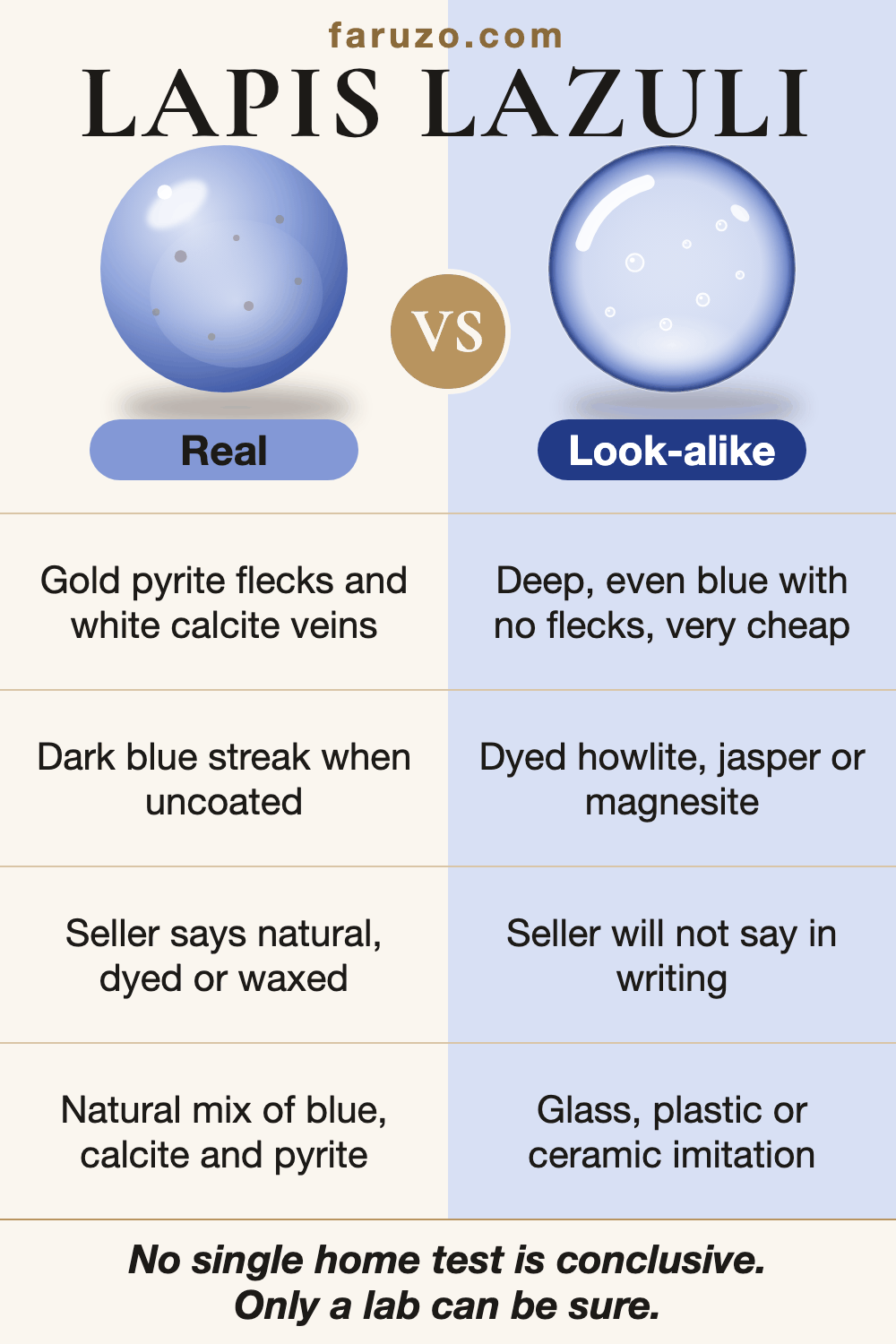
- Dyed howlite or dyed magnesite. Dyed magnesite and dyed howlite are common lapis imitations. They lack lapis's mix of lazurite, calcite and pyrite. Ask what the stone is.
- Dyed jasper. A common lapis imitation. Dye is the reason it looks blue, so ask whether the stone is natural lapis or dyed.
- Sodalite. Sodalite is a common substitute and a related blue mineral. Look for lapis's gold pyrite flecks and calcite veins, but treat that as a sign only: a gemologist can separate them with testing.
- Glass, plastic and ceramic. Glass, plastic and ceramic have all been used to imitate lapis. A gemologist can separate them using refractive index and density.
- Lab-made lapis (Gilson process). A lab-made lapis look-alike made by the Gilson process, from synthetic ultramarine and zinc phosphates, is sold as a trade material. Ask whether the stone is natural, and a gemologist can confirm.
Safe checks you can do
- Ask the seller in writing whether the stone is natural lapis, dyed, waxed or a look-alike material. Gems may be treated to alter colour, apparent clarity or durability, and lapis may be dyed to improve its colour and conceal calcite.
- Look for pyrite and calcite. Pyrite flecks and calcite spots and veins are typical of lapis, though the most valued colour has no visible calcite, so a very clean stone is a reason to ask questions, not a verdict.
- Gemologists use an acetone swab to look for dye, but solvents can damage a treated gem's surface, so do not test a piece you plan to keep. Leave it to a lab.
- Wax or oil on otherwise natural lapis can be detected by a gemologist.
- Density and streak help a trained tester, but they are not simple home pass-or-fail checks. Leave them to a lab.
- If a deep, even, pyrite-free blue stone is very cheap, ask what it is. Dyed lookalikes exist for exactly that appearance, but no single visible clue is conclusive.
Wearing Lapis Lazuli
Ring
Avoid
Moderate hardness, so rings can scratch or chip.
Bracelet
Careful
Bracelets take more knocks, so wear it with care.
Pendant
Careful
Keep a pendant away from hard knocks.
Earrings
Careful
Take earrings off for sport and sleep.
Guide for everyday wear, based on hardness and care notes. Safe, Careful or Avoid.
Lapis lazuli is a rock with fair toughness and a hardness of 5 to 6, softer than quartz. It is typically cut as cabochons, beads, inlays or tablets. Pendants and earrings suit it with care, since they see the fewest knocks, and a bracelet takes more. A ring is best avoided. Keep it away from perfume, acids, solvents and cleaning products, and keep steam and machine cleaners away too.
Related stones
Questions about Lapis Lazuli
What does lapis lazuli mean?
In crystal tradition lapis lazuli is the stone of truth, insight and honest self-expression, and it is traditionally linked to the Third Eye and Throat chakras. Culturally, ancient Mesopotamia and Egypt used it for seals, amulets and royal objects. These are symbolic meanings, not measured effects.
Is lapis lazuli a rock or a gemstone?
Both words are used, but strictly it is a rock. It is described as an aggregate of several minerals, mainly lazurite, calcite and pyrite. Lazurite gives the blue, calcite appears as white streaks and pyrite as gold flecks, which is why no two pieces look the same.
Is lapis lazuli a birthstone?
Not on the standard birthstone list. Some lists attach it to December or September as an alternative, and lists differ, so treat it as an alternative rather than an official stone.
How hard is lapis lazuli?
Mohs 5 to 6. The figure varies because lapis is a rock. It has fair toughness, so avoid knocks and abrasion.
Can lapis lazuli get wet?
Brief contact with water is fine, but do not soak it. Acids, perfume and solvents are the bigger worry, as are steam and machine cleaners, and dyed or waxed pieces are the most sensitive.
How can you tell if lapis lazuli is real or dyed?
A home look can only hint. Real lapis usually shows gold pyrite flecks and white calcite veins, but top-grade stone can have little calcite, and dyed jasper, howlite or magnesite are common imitations. A gemologist can detect dye and wax.
Why was lapis lazuli so valuable in painting?
Ground lapis was the raw material for ultramarine, a famously bright and stable pigment. It was among the most expensive Renaissance blues, at times valued as highly as gold in Europe, because the stone had to be imported from distant mines and purified by hand.
What is the difference between lapis lazuli and sodalite?
Both are blue and are often confused. Lapis is a mix of lazurite, calcite and pyrite, while sodalite is a single, different mineral that is used as a lapis substitute. A gemologist can tell them apart if it matters.
What zodiac sign is lapis lazuli for?
Crystal tradition most often pairs lapis with Sagittarius and the planet Jupiter, and some lists add Virgo, Pisces or Capricorn. This differs between lists and has no scientific basis.
Does lapis lazuli fade?
Natural lapis colour is generally steady in ordinary wear. Dyed colour is the weak point, since it can fade or be stripped by solvents and long strong sun.