
Crystal guide
Sodalite Meaning, Properties and Care
Sodalite is a deep blue sodium aluminium silicate mineral (Na8Al6Si6O24Cl2), usually crossed by white veins. It is often mistaken for lapis lazuli, but it typically lacks lapis's gold pyrite flecks. At Mohs 5.5 to 6 it suits careful wear. In crystal tradition it is the stone of logic and honest speech.

At a glance
- Formula Na8Al6Si6O24Cl2, a cubic mineral named for its sodium content.
- Hardness is 5.5 to 6 on the Mohs scale.
- Usually blue with white veins, with no gold flecks in most pieces.
- A rare variety, hackmanite, can change colour in light (tenebrescence).
- Care: soft cloth, mild soap, quick rinse; no steam or machine cleaners.
Quick facts
| Family | Feldspathoid (a tectosilicate related to the feldspars), rich in sodium and chlorine |
|---|---|
| Chemical formula | Na8Al6Si6O24Cl2 |
| Crystal system | Cubic, usually found as compact masses rather than well-formed crystals |
| Mohs hardness | 5.5–6 |
| Luster | Dull vitreous to greasy |
| Transparency | Translucent to opaque in most jewelry material; clear crystals are rare |
| Natural colors | deep blue to grey-blue (the best-known look), often with white veins; grey, green, yellow, violet or pink in other material; hackmanite can shift between pale and violet or pink in light |
| Main localities | Greenland (Ilimaussaq complex, where it was first described); Canada (Bancroft, Ontario, and Mont-Saint-Hilaire, Quebec); USA (Litchfield, Maine, and Magnet Cove, Arkansas); Brazil; Namibia; Russia; Myanmar and Afghanistan (hackmanite) |
| Common treatments | usually sold untreated; paler material is sometimes dyed or waxed to even out the colour |
Sodalite at a glance, in pictures
Chakras (traditional)
Hardness range
Natural colors
- deep blue to grey-blue (the best-known look), often with white veins
- grey, green, yellow, violet or pink in other material
- hackmanite can shift between pale and violet or pink in light
Common forms of Sodalite
- Rough raw chunk
- Tumbled polished pebble
- Cabochon smooth dome
How hard is Sodalite?
- Talc 1
- Gypsum 2
- Copper coin ~ 3
- Calcite 3
- Fluorite 4
- Apatite 5
- Glass ~ 5.5
- Steel knife ~ 5.5
- Sodalite 5.5–6
- Orthoclase 6
- Quartz 7
- Topaz 8
- Corundum 9
- Diamond 10
What it is and where it comes from
The name comes from its sodium content: 'soda' plus the standard mineral ending '-lite'.
Sodalite was first described around 1811 from the Ilimaussaq complex in Greenland.
Large deposits near Bancroft, Ontario, were reportedly identified in the 1890s, and a quarry there still carries the name Princess Sodalite. The stone became popular for decoration in the early 1900s.
Its main use is ornamental. Good blue material is cut into cabochons and beads, and lesser material is used for facing and inlay.
Hackmanite is a variety of sodalite that shows tenebrescence, a reversible colour change in light. Freshly quarried Greenland or Quebec material is violet and fades to grey or greenish white, while Myanmar and Afghan material starts pale and turns violet to pink in sunlight.
In crystal tradition
What follows is belief and folklore, passed down in crystal tradition. It is not measured fact.
Traditionally associated with: logic, honest communication, clear thinking.
Sodalite is traditionally called the stone of logic and is associated with clear thinking, honest communication and the Throat and Third Eye chakras. This is a modern spiritual tradition, not a fact about the stone.
How to care for Sodalite
- Water Caution
- Sunlight Unknown
- Salt Unknown
- Heat Avoid
- Ultrasonic Avoid
- Chemicals Caution
Safe = fine as a rule · Caution = only briefly or gently · Avoid = can damage the stone · Unknown = no reliable guidance.
Clean sodalite with a soft cloth, mild soap and lukewarm water, rinse briefly and dry straight away rather than soaking. Avoid ultrasonic and steam cleaners, since vibration and heat may stress fractures in the stone. Acids can attack sodalite, so keep it from strong cleaners. Keep it away from chlorine, perfume, hairspray and harsh cleaners, which can dull the surface. Store it apart from harder stones so it is not scratched. Long sun and salt exposure are not well documented, so avoid them as a precaution.
Real or fake? Look-alikes and treatments
Often confused with
- Lapis lazuli
- Dyed quartz or dyed stones
- Blue glass
- Azurite
Common look-alikes
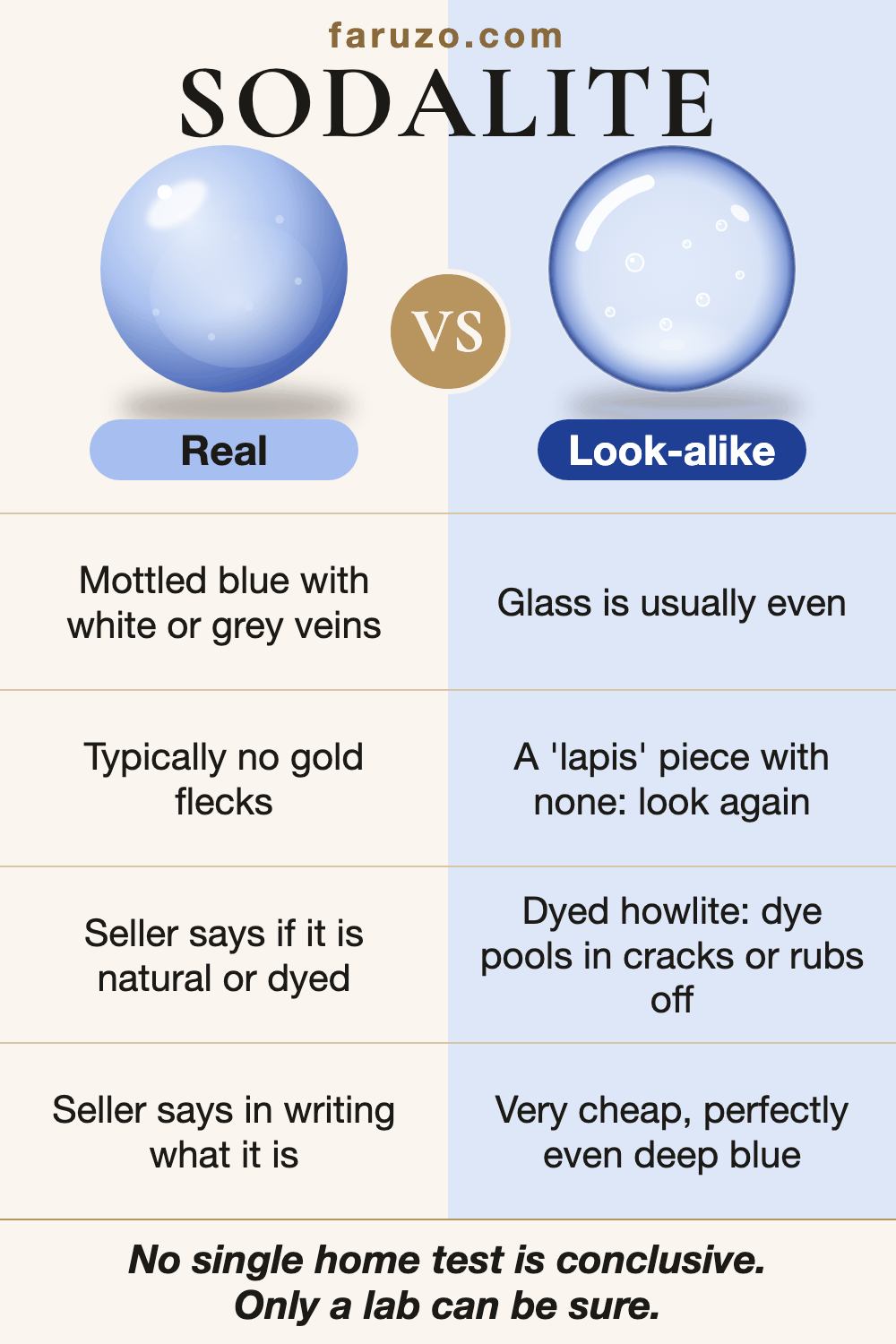
- Lapis lazuli. Lapis is a rock that usually carries gold pyrite flecks, while sodalite is usually lighter in the hand and a little harder. Lapis tends to be a richer ultramarine, though patterns overlap, so a lab can sometimes tell them apart.
- Dyed quartz or dyed stones. Dyed stones can imitate a deep blue. Dye often pools in cracks, and the colour can look too even or too bright. Ask whether the stone is natural or dyed.
- Blue glass. Glass is a common imitation. It tends to look too uniform and may show round gas bubbles, while sodalite is usually mottled with white veins. A gemologist or lab can confirm.
- Azurite. Azurite is a deeper, more intense blue and is much softer (about 3.5 to 4). Sodalite is typically a slightly greyer blue with white veining.
Safe checks you can do
- Ask the seller in writing whether the stone is natural sodalite, dyed, glass or something else.
- Look for natural variation. Sodalite is usually mottled, with white or grey veins running through the blue, whereas glass is usually even.
- Check cracks and drill holes for pooled dye. Colour that collects in cracks, or rubs off on a cloth, suggests dyeing.
- If it is sold as lapis, look for gold flecks; a 'lapis' piece with none is worth a second look.
- Be wary of a very cheap, perfectly even, deep blue stone sold as a rare variety. Ask questions, and have a gemologist or lab test a stone that matters.
Wearing Sodalite
Ring
Avoid
Moderate hardness, so rings can scratch or chip.
Bracelet
Careful
Bracelets take more knocks, so wear it with care.
Pendant
Careful
Heat can harm it, so keep it away from steam.
Earrings
Careful
Heat can harm it, so keep earrings away from steam.
Guide for everyday wear, based on hardness and care notes. Safe, Careful or Avoid.
At Mohs 5.5 to 6 sodalite is fine for pendants, earrings and bracelets with a little care. A ring is best avoided; if you wear one, keep it occasional and in a protective setting, because it can scratch or chip. Remove it for swimming, cleaning, the gym and rough work, store it apart from harder stones, and keep it away from perfume and hairspray.
Related stones
Questions about Sodalite
What does sodalite mean?
In crystal tradition sodalite is the stone of logic, linked to clear thinking, honest communication and the Throat and Third Eye chakras. That is belief, not a fact about the stone.
What is sodalite?
Sodalite is a cubic sodium aluminium silicate with chlorine, Na8Al6Si6O24Cl2. It is usually blue with white veins and is named for its sodium content.
How hard is sodalite?
5.5 to 6 on the Mohs scale: softer than quartz (7), so it can scratch if stored loose with harder stones.
What is the difference between sodalite and lapis lazuli?
Lapis lazuli is a rock that usually contains gold pyrite flecks and often white calcite, while sodalite is a single mineral, usually mottled with white veins. Lapis is often a richer ultramarine, but the two overlap.
Does sodalite change colour?
Ordinary sodalite does not. A rare variety called hackmanite can change colour in light, shifting between pale and violet or pink, in a reversible effect called tenebrescence.
Is sodalite a birthstone?
No. Sodalite is not on the standard modern or traditional birthstone lists, so it is worn by preference rather than by month.
Can sodalite get wet?
A brief rinse is fine, but do not soak it or wear it in chlorinated water. Dry it straight away and leave machine cleaners alone.
Where does sodalite come from?
It was first described from Greenland in 1811. Well-known deposits are in Canada (Bancroft, Ontario, and Quebec), the USA (Maine and Arkansas), Brazil and Russia, among others.
How can you tell real sodalite from fake?
A home check cannot settle it. Real sodalite is usually mottled, while glass and dyed stones look more even or show dye pooled in cracks. A gemologist can test a stone that matters.
Is sodalite rare or expensive?
Sodalite is fairly widely available and is generally an affordable stone compared with many gems. Evenly coloured, well-polished material is the better grade, and quality varies, so check what you are buying.
Does sodalite need cleansing?
Crystal practice has many cleansing rituals, but they are beliefs with no physical basis. For physical care, use mild soap, lukewarm water and a soft cloth, and avoid soaking.
Is sodalite good for a ring?
Best avoided; if worn, occasional wear in a protective setting only: at 5.5 to 6 it can scratch or chip, and it should come off for swimming, cleaning and rough work.
Does sodalite fade?
Ordinary sodalite is stable in normal wear. Hackmanite, a rare variety, changes colour reversibly in light. Dyed pieces can fade or rub off, so keep them away from water and harsh cleaners.