
Crystal guide
Morganite Meaning, Properties and Care
Morganite is the pink to orange-pink form of beryl, a beryllium aluminium silicate (Be3Al2(SiO3)6). At 7.5 to 8 on the Mohs scale it is hard, and its soft blush colour has made it a popular choice for engagement-style rings. Much of it is heat-treated, and a treated stone is still real morganite. In crystal tradition it is a gentle stone of love and compassion.
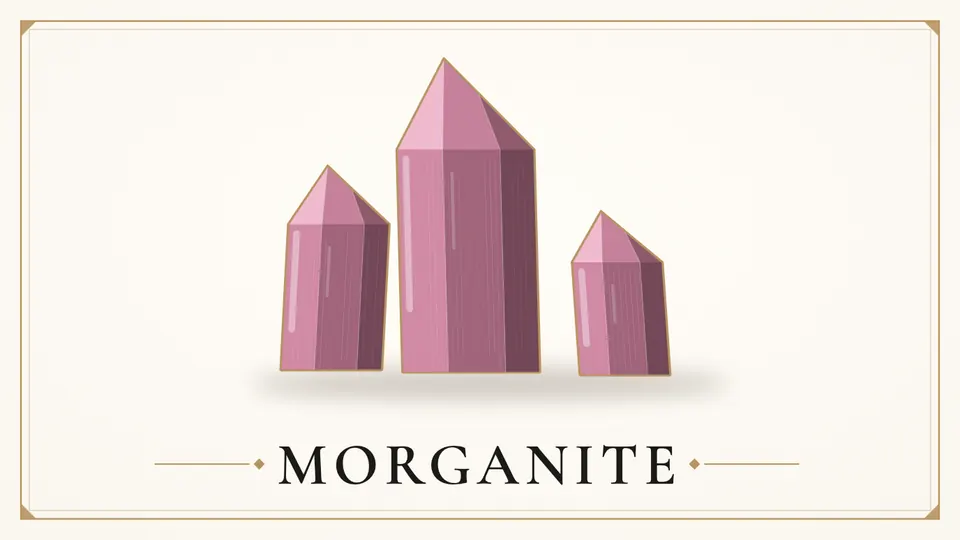
At a glance
- Formula Be3Al2(SiO3)6, the pink to orange-pink form of beryl.
- Mohs 7.5 to 8, hard for daily wear, but with imperfect cleavage so a hard knock can still chip it.
- Heat treatment to shift orange tones towards pink is routine; irradiation is occasional.
- Not on the standard birthstone lists. Care: soft cloth, mild soap, no sudden heat.
Quick facts
| Family | Beryllium aluminium silicate (beryl), the pink to orange-pink variety of beryl |
|---|---|
| Chemical formula | Be3Al2(SiO3)6 |
| Crystal system | Hexagonal, often as six-sided prismatic crystals |
| Mohs hardness | 7.5–8 |
| Luster | Vitreous, with imperfect cleavage in one direction |
| Transparency | Transparent to translucent, usually transparent when cut |
| Natural colors | pink, orange-pink to salmon, peachy pink, magenta-pink |
| Main localities | Brazil (Minas Gerais), Madagascar, Afghanistan, Mozambique, Namibia, USA |
| Common treatments | heat treatment is routine, used to remove yellow or orange tones and push the colour towards pink; occasionally irradiated to improve colour; lab-grown pink beryl also exists |
Morganite at a glance, in pictures
Chakras (traditional)
Hardness range
Natural colors
- pink
- orange-pink to salmon
- peachy pink
- magenta-pink
Common forms of Morganite
- Rough raw chunk
- Faceted cut gem
How hard is Morganite?
- Talc 1
- Gypsum 2
- Copper coin ~ 3
- Calcite 3
- Fluorite 4
- Apatite 5
- Glass ~ 5.5
- Steel knife ~ 5.5
- Orthoclase 6
- Quartz 7
- Morganite 7.5–8
- Topaz 8
- Corundum 9
- Diamond 10
What it is and where it comes from
Morganite is the pink to orange-pink gem variety of beryl. The same mineral is the blue-green gem aquamarine and the green gem emerald, and morganite's pink colour is attributed to traces of manganese.
The name honours the financier J. P. Morgan. Like kunzite, it is a gem named for a person rather than a place or a colour.
Madagascar was the original deposit, and its magenta-toned rough still sets the standard for the best colour, though it is only a minor producer today.
Most morganite on the market today comes from pegmatite mines in Minas Gerais, Brazil, with Afghanistan, Mozambique, Namibia and the USA as minor and inconsistent sources.
Morganite is rarer than aquamarine, yet large cut stones are readily available. Crystals can grow big: Brazilian finds of around 10 kilograms are on record.
Untreated morganite often has a strong orange component, a salmon colour. Heat treatment is routine for removing patches of yellow and shifting the colour towards pink, and some stones are irradiated to improve colour.
In crystal tradition
What follows is belief and folklore, passed down in crystal tradition. It is not measured fact.
Traditionally associated with: love, compassion, gentle commitment.
Morganite is traditionally associated with the Heart chakra and with love, compassion and tenderness. This is a modern spiritual tradition, not a fact about the stone.
Its soft pink is why it is traditionally linked to romance and promises, which fits its modern use in engagement-style rings. Zodiac links vary, so treat them as folklore.
How to care for Morganite
- Water Safe
- Sunlight Unknown
- Salt Unknown
- Heat Caution
- Ultrasonic Caution
- Chemicals Caution
Safe = fine as a rule · Caution = only briefly or gently · Avoid = can damage the stone · Unknown = no reliable guidance.
Wipe morganite with a soft cloth, mild soap and lukewarm water, then dry it. Avoid sudden temperature swings and harsh chemicals. Be careful with ultrasonic cleaners, because a stone with inclusions or a cleavage plane can be harmed. Store it apart from harder stones such as diamond and sapphire, which can scratch it, and take it off before sport and rough work.
Real or fake? Look-alikes and treatments
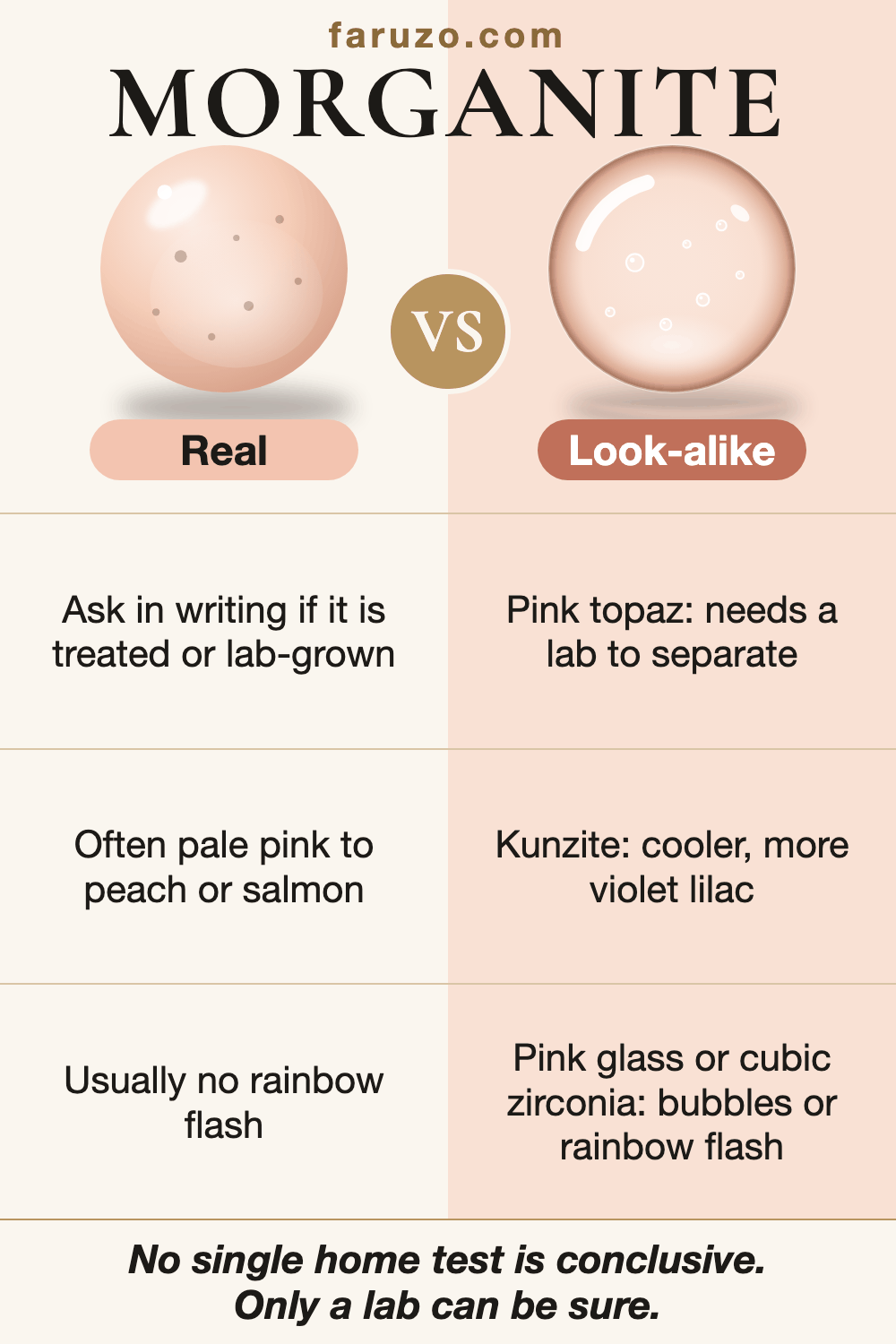
Often confused with
- Pink topaz
- Kunzite
- Pink sapphire
- Pink glass
- Morganite-coloured cubic zirconia
Common look-alikes
- Pink topaz. Pink topaz can be a similar soft pink and is a little harder (Mohs 8). It has perfect cleavage and is denser than beryl. Its pink is commonly produced by treatment. Colour alone is not a safe guide, so a lab can confirm.
- Kunzite. Kunzite is pink to lilac spodumene. It leans cooler and more violet than morganite, is softer (Mohs 6.5 to 7), and has perfect cleavage. Morganite is usually warmer and peachier.
- Pink sapphire. A pink sapphire is sometimes sold as morganite. It is much harder (Mohs 9), and its colour is usually more saturated and more even. A lab can separate the two quickly.
- Pink glass. Glass is a common imitation. It tends to look too even and may show round gas bubbles. It is softer than morganite, so it picks up scratches and chips sooner.
- Morganite-coloured cubic zirconia. Cubic zirconia can be made in pink and peach shades. It usually throws more rainbow flash than beryl and feels noticeably heavier for its size, since it is far denser.
Safe checks you can do
- Ask the seller in writing whether the stone is natural morganite, heat-treated, irradiated, lab-grown, or another pink gem.
- Look at the colour. Pale pink to peachy or salmon is typical. A very bright, even, fiery pink that looks too perfect is a reason to ask more questions.
- Check the sparkle and the weight in the hand. Cubic zirconia flashes with rainbow colours and feels heavy for its size, and glass can show tiny round bubbles.
- Remember that a heat-treated or lab-grown stone is still real beryl, made or treated by people, so the question to ask is whether the seller says so.
- Do not scratch-test or heat-test a stone you plan to keep. A lab can measure it to separate beryl from pink topaz, kunzite and sapphire.
Wearing Morganite
Ring
Careful
It can split along a flat plane if knocked.
Bracelet
Careful
A knock on a bracelet can split it along a flat plane.
Pendant
Careful
It can split along a flat plane, so keep it protected.
Earrings
Careful
A flat-plane split is possible, so keep earrings for dressy wear.
Guide for everyday wear, based on hardness and care notes. Safe, Careful or Avoid.
Morganite is hard at 7.5 to 8, but it has an imperfect cleavage plane, so a hard knock can still chip or split it. A ring works with care, ideally in a setting that shields the stone, and it is best taken off for the gym and rough work. Bracelets take more knocks, while pendants and earrings take fewer.
Related stones
Questions about Morganite
What does morganite mean?
In crystal tradition morganite is a gentle stone linked to love, compassion and the Heart chakra. That is a belief, not a fact about the stone. Its practical claim to fame is a soft pink to peachy colour in a hard gem that suits rings.
What is morganite?
Morganite is the pink to orange-pink gem variety of beryl, a beryllium aluminium silicate with the formula Be3Al2(SiO3)6. Its pink colour is attributed to traces of manganese.
How hard is morganite?
7.5 to 8 on the Mohs scale, harder than quartz. Hardness only measures scratching, though. Morganite has an imperfect cleavage plane, so a sharp knock can still chip it.
Is morganite a birthstone?
Morganite is not on the standard modern or traditional birthstone lists, though lists vary. It is in the same beryl family as aquamarine and emerald, which are on the standard lists.
Is morganite related to aquamarine and emerald?
Yes. All three are beryl, the same mineral in different colours. Aquamarine is the blue-green form, emerald is the green form, and morganite is the pink to orange-pink form.
Is morganite a good choice for an engagement ring?
It is a popular one. At 7.5 to 8 it resists everyday scratches better than many soft pink stones. Because it can still chip on a hard knock, a protective setting helps. Ask whether the stone is natural, treated or lab-grown before you buy.
Can you wear a morganite ring every day?
Many people do, with care. A setting that shields the stone helps, and it is best taken off for the gym, gardening and rough work, since a hard knock can chip or split it.
Is morganite heat-treated?
Heat treatment is routine. It is used to remove yellow or orange tones and shift the colour towards pink, and some stones are also irradiated to improve colour. A treated stone is still real morganite, so the useful step is to ask the seller to say so in writing.
Is lab-grown morganite real?
Lab-grown pink beryl exists. It is real beryl that people grew rather than dug up, so it is not an imitation. It is a different thing from a natural stone, though, so ask the seller to state in writing which one you are buying.
How can you tell real morganite from fake?
A home look can only hint. Cubic zirconia tends to flash with rainbow colours and feel heavy, and glass can show round bubbles. Pink topaz, kunzite and pink sapphire can look similar, so a lab can confirm a stone that matters.
What is the difference between morganite and kunzite?
Morganite is pink to peachy beryl, usually warmer in tone and harder (Mohs 7.5 to 8). Kunzite is pink to lilac spodumene, cooler and more violet, softer (Mohs 6.5 to 7), and splits easily along cleavage planes.
Where does morganite come from?
Most morganite on the market comes from pegmatite mines in Minas Gerais, Brazil. Madagascar was the original deposit and is a minor producer today, and Afghanistan, Mozambique, Namibia and the USA are minor and inconsistent sources.
Can morganite get wet, and how do you clean it?
Plain water and mild soap are fine. Wipe it with a soft cloth, rinse in lukewarm water and dry it. Avoid sudden temperature changes and harsh chemicals, and be careful with ultrasonic cleaners.