
Crystal guide
Kunzite Meaning, Properties and Care
Kunzite is the pink to lilac form of spodumene, a lithium aluminium silicate (LiAlSi2O6). It looks hard on paper, at 6.5 to 7 on the Mohs scale, but it splits cleanly along two flat planes, so a sharp knock can crack it. Its colour can also pale in strong light. In crystal tradition it is a gentle, open-hearted stone.
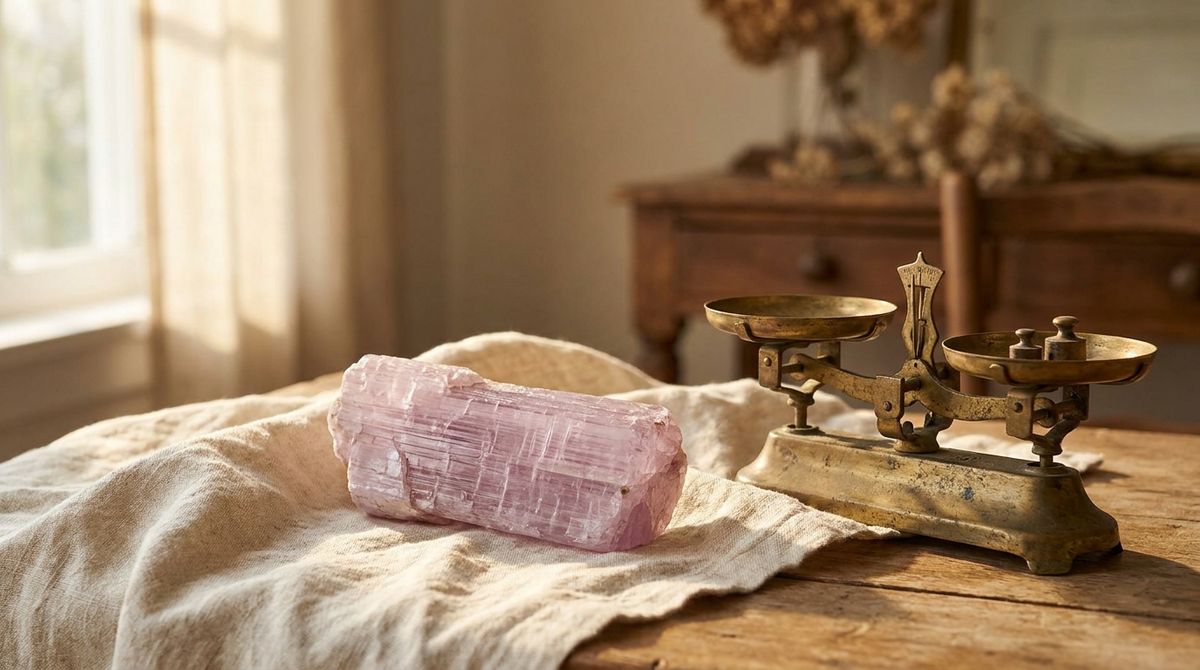
At a glance
- Formula LiAlSi2O6, a pink to lilac form of spodumene.
- Mohs 6.5 to 7, with perfect cleavage in two directions, so it can split if knocked.
- Colour can fade in strong light, so store it away from sunny windows.
- Not on the standard birthstone lists. Care: soft cloth, mild soap, no steam or machine cleaners.
Quick facts
| Family | Lithium aluminium silicate (pyroxene group), the pink to lilac variety of spodumene |
|---|---|
| Chemical formula | LiAlSi2O6 |
| Crystal system | Monoclinic, often as long, striated prismatic crystals |
| Mohs hardness | 6.5–7 |
| Luster | Vitreous, with perfect cleavage in two directions |
| Transparency | Transparent to translucent, usually transparent when cut |
| Natural colors | pink, lilac to violet, pale purple-pink |
| Main localities | Afghanistan, Brazil, Madagascar, Pakistan, USA (California) |
| Common treatments | colour is sometimes deepened by treatment, so ask whether a stone is natural colour; strong light can pale the colour over time |
Kunzite at a glance, in pictures
Chakras (traditional)
Hardness range
Natural colors
- pink
- lilac to violet
- pale purple-pink
Common forms of Kunzite
- Rough raw chunk
- Faceted cut gem
- Tumbled polished pebble
How hard is Kunzite?
- Talc 1
- Gypsum 2
- Copper coin ~ 3
- Calcite 3
- Fluorite 4
- Apatite 5
- Glass ~ 5.5
- Steel knife ~ 5.5
- Orthoclase 6
- Kunzite 6.5–7
- Quartz 7
- Topaz 8
- Corundum 9
- Diamond 10
What it is and where it comes from
Kunzite is a gem variety of spodumene. The same mineral coloured by chromium is the green variety hiddenite, and the pink to lilac colour of kunzite comes from traces of manganese.
The name honours George Kunz. The pink variety was first described in California in the early 1900s, which makes it a young gem name compared with most stones.
Spodumene forms in lithium-rich granite pegmatites, where crystals can grow large with few flaws.
Today gem material is reportedly mined mainly in Afghanistan, Brazil, Madagascar and Pakistan, with California as the original but now minor source.
Kunzite is strongly pleochroic, meaning the colour looks deeper from one direction. Cutters usually orient the rough so the richest colour shows through the top of the stone.
In crystal tradition
What follows is belief and folklore, passed down in crystal tradition. It is not measured fact.
Traditionally associated with: calm, openness, gentle self-love.
Kunzite is traditionally associated with the Heart chakra and with calm, openness and softening a guarded heart. This is a modern spiritual tradition, not a fact about the stone.
Zodiac links vary from one tradition to another, with Taurus and Scorpio both mentioned. Treat them as folklore.
How to care for Kunzite
- Water Caution
- Sunlight Avoid
- Salt Caution
- Heat Caution
- Ultrasonic Avoid
- Chemicals Caution
Safe = fine as a rule · Caution = only briefly or gently · Avoid = can damage the stone · Unknown = no reliable guidance.
Wipe kunzite with a soft cloth, mild soap and lukewarm water, then dry it. A short rinse is fine; do not soak it. Keep it away from ultrasonic and steam cleaners, because vibration and sudden temperature swings can open a crack along the cleavage planes. Store it in a closed box or soft pouch, out of strong light, and take it off before sport and rough work.
Real or fake? Look-alikes and treatments
Often confused with
- Morganite
- Pink topaz
- Pink sapphire
- Pink glass
Common look-alikes
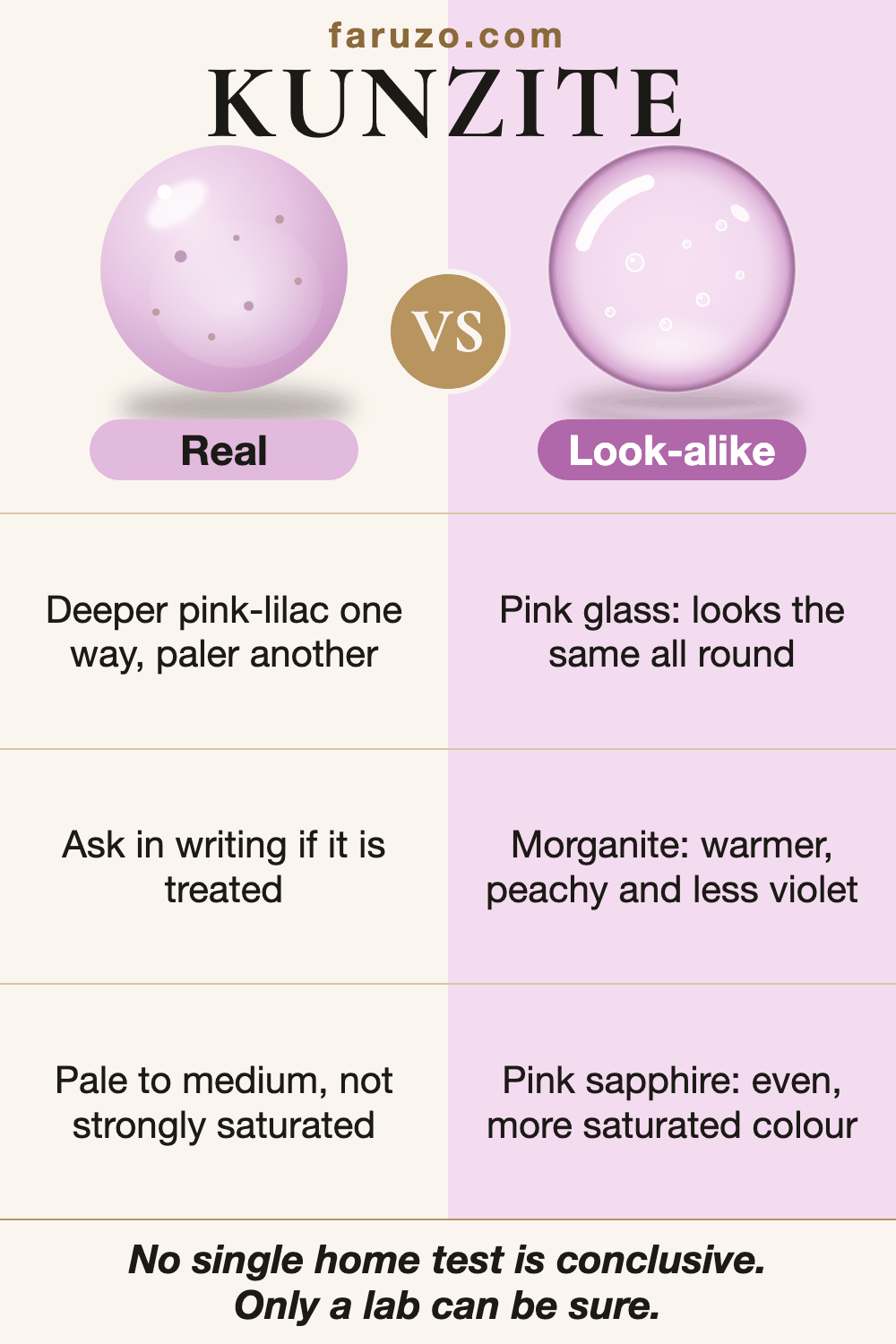
- Morganite. Morganite is a pink to peachy beryl, usually warmer and less violet than kunzite. Kunzite leans lilac and shows deeper colour from one direction. A lab can sometimes tell them apart quickly.
- Pink topaz. Pink topaz can be a similar soft pink but tends to be harder and has a different cleavage. Colour alone is not a safe guide, so a lab can confirm.
- Pink sapphire. Pink sapphire is much harder (Mohs 9) and has no cleavage, and its colour is usually more saturated and even.
- Pink glass. Glass is a common imitation. It tends to look too even and may show round gas bubbles, and it will not show kunzite's change in colour depth with viewing angle.
Safe checks you can do
- Ask the seller in writing whether the stone is natural kunzite, treated, glass or another pink gem.
- Turn the stone. Kunzite often looks deeper pink-lilac from one direction and paler from another, while glass looks the same all round.
- Check the colour is not suspiciously even and bright. Pale to medium pink-lilac is typical.
- Do not scratch-test or heat-test a stone you plan to keep. A lab is the safer route when it matters.
Wearing Kunzite
Ring
Careful
Fine with care, but knocks can mark it.
Bracelet
Careful
A knock on a bracelet can split it along a flat plane.
Pendant
Careful
It can split along a flat plane, so keep it protected.
Earrings
Careful
A flat-plane split is possible, so keep earrings for dressy wear.
Guide for everyday wear, based on hardness and care notes. Safe, Careful or Avoid.
Kunzite looks sturdy at 6.5 to 7 but splits along flat planes if knocked, so wear it with care. A ring is possible only occasionally, in a protective setting, while pendants and earrings take fewer knocks. Take it off for the gym, cleaning and rough work, and keep it out of strong light between wearings.
Questions about Kunzite
What does kunzite mean?
In crystal tradition kunzite is a gentle stone linked to calm, an open heart and the Heart chakra. That is a belief, not a fact about the stone. Its practical claim to fame is a soft pink-lilac colour that can pale in strong light.
What is kunzite?
Kunzite is the pink to lilac gem variety of spodumene, a lithium aluminium silicate with the formula LiAlSi2O6. Its colour comes from traces of manganese, and it forms in lithium-rich granite pegmatites.
How hard is kunzite?
6.5 to 7 on the Mohs scale, close to quartz. Hardness only measures scratching, though. Perfect cleavage in two directions means a sharp knock can still split it.
Is kunzite a birthstone?
Kunzite is not on the standard modern or traditional birthstone lists, though lists vary and some modern or alternative lists may include it. Check the list you are following.
Does kunzite fade in sunlight?
It can. Strong light and heat over a long time may pale the colour, so avoid leaving kunzite on a sunny windowsill. Between wearings, keep it in a closed box or pouch.
Is kunzite the same as hiddenite?
Both are spodumene. Kunzite is the pink to lilac variety, coloured by manganese, while hiddenite is the green variety, coloured by chromium.
Who is kunzite named after?
The name honours George Kunz. It is a rare case of a gem named for a person rather than a place or a colour.
Can you wear a kunzite ring every day?
It is not the best choice. Because kunzite splits along two flat planes, a knock on a ring hand can crack it. Pendants and earrings take fewer knocks, and a ring suits occasional wear in a protective setting.
Can kunzite get wet, and can you clean it in an ultrasonic cleaner?
A short rinse in lukewarm water is fine, but do not soak it. Skip ultrasonic and steam cleaners, since vibration and sudden temperature changes can open a crack along the cleavage planes.
How can you tell real kunzite from fake?
A home look can only hint. Real kunzite often looks deeper pink-lilac from one direction, while glass looks even all round. Morganite and pink topaz can look similar, so a lab can confirm a stone that matters.
Is kunzite treated or dyed?
Kunzite is usually sold as a natural stone, though its colour is sometimes enhanced by treatment. Ask the seller to say in writing whether the colour is natural, and remember that a treated stone is still real kunzite.
Where does kunzite come from?
Gem material is reportedly mined mainly in Afghanistan, Brazil, Madagascar and Pakistan. California is where the pink variety was first described, and it is a minor source today.